

It might not win the prize for the most succinct moniker, but the Hasselblad 907X & CFV 100C certainly wins the prize for the most compact, medium-format, interchangeable-lens camera out there. It’s quite the looker, exuding oodles of retro-charm in a chrome-trimmed body reminiscent of a vintage Bentley. There is nothing vintage about its innards, though, as I discovered when I got my hands on one.
Earlier in 2025, I spent a very enjoyable few weeks taking photographs with two of Hasselblad’s contemporary medium-format cameras. Both were outstanding. The first of these, the Hasselblad X2D, came with a 25mm XCD wide-angle prime. Its successor, the X2D II, was accompanied by the new XCD 35-100E zoom.

Inevitably, while reading about these cameras, I learned of their stable mate: the Hasselblad 907X & CFV 100C. Whereas the X2D-series sport a modern style, with handgrip and EVF, the 907X & CFV 100C certainly does not.
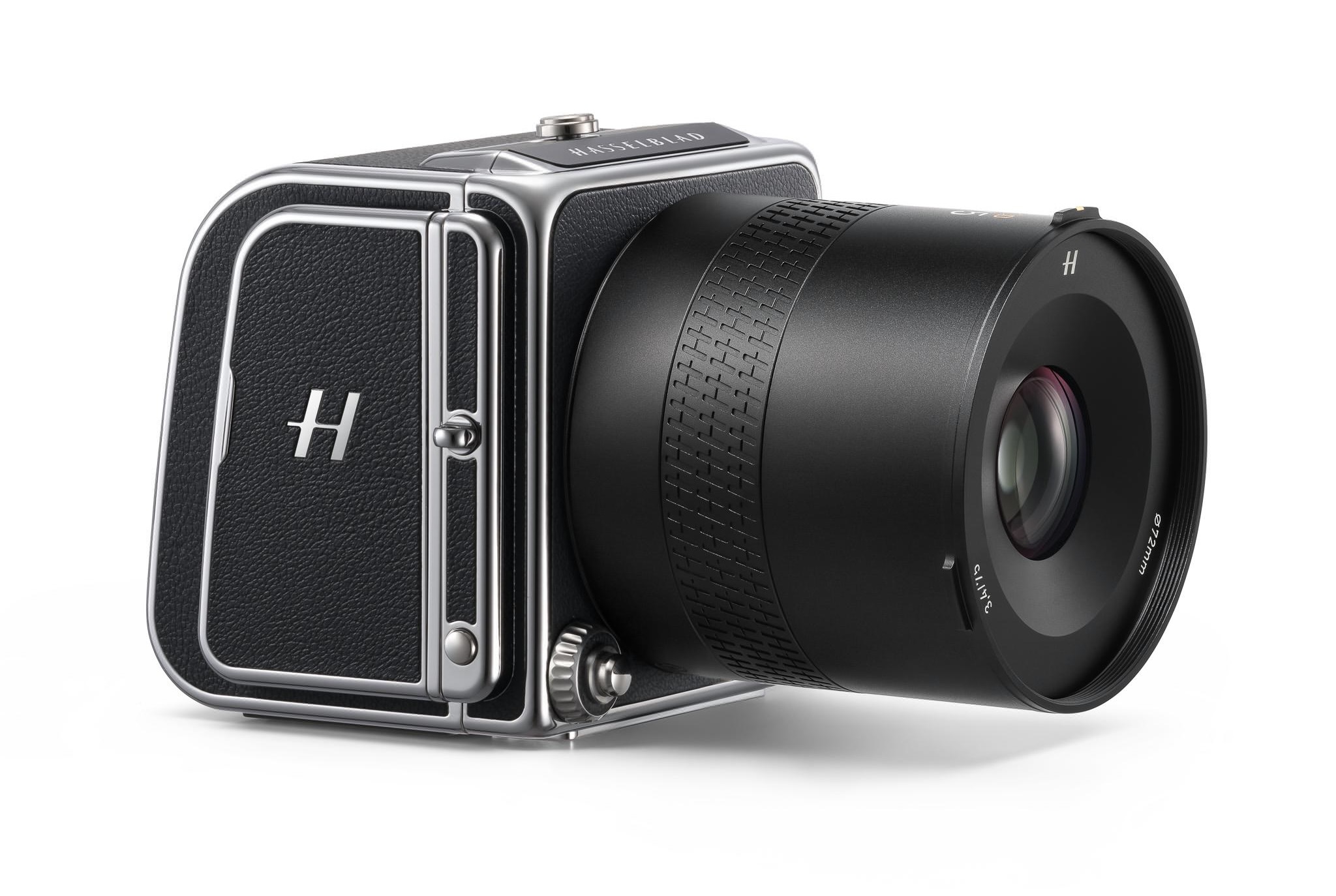
In fact, it looks as if it can trace its lineage directly to the landmark Hasselblad 500 C film camera, the basis of the company’s product line for some fifty years. That’s because it can.
Mix and match
Modularity is the mouthful of a name of the game here. The device you are looking at in the image below has three components.
The first, and relatively conventional component, is the lens; my loaner came with an XCD 75P f/3.4 lens. This is comparable to a 60mm focal length, and f/2.8 depth-of-field in full-frame equivalence. I say ‘relatively conventional’ because it contains a leaf shutter. Most interchangeable lens systems incorporate the shutter within the body.
The second, narrow component, the 907X, acts as a bridge between the lens and the CFV 100C module housing the sensor. The 907X contains the lens mount and a chrome shutter release/control dial.
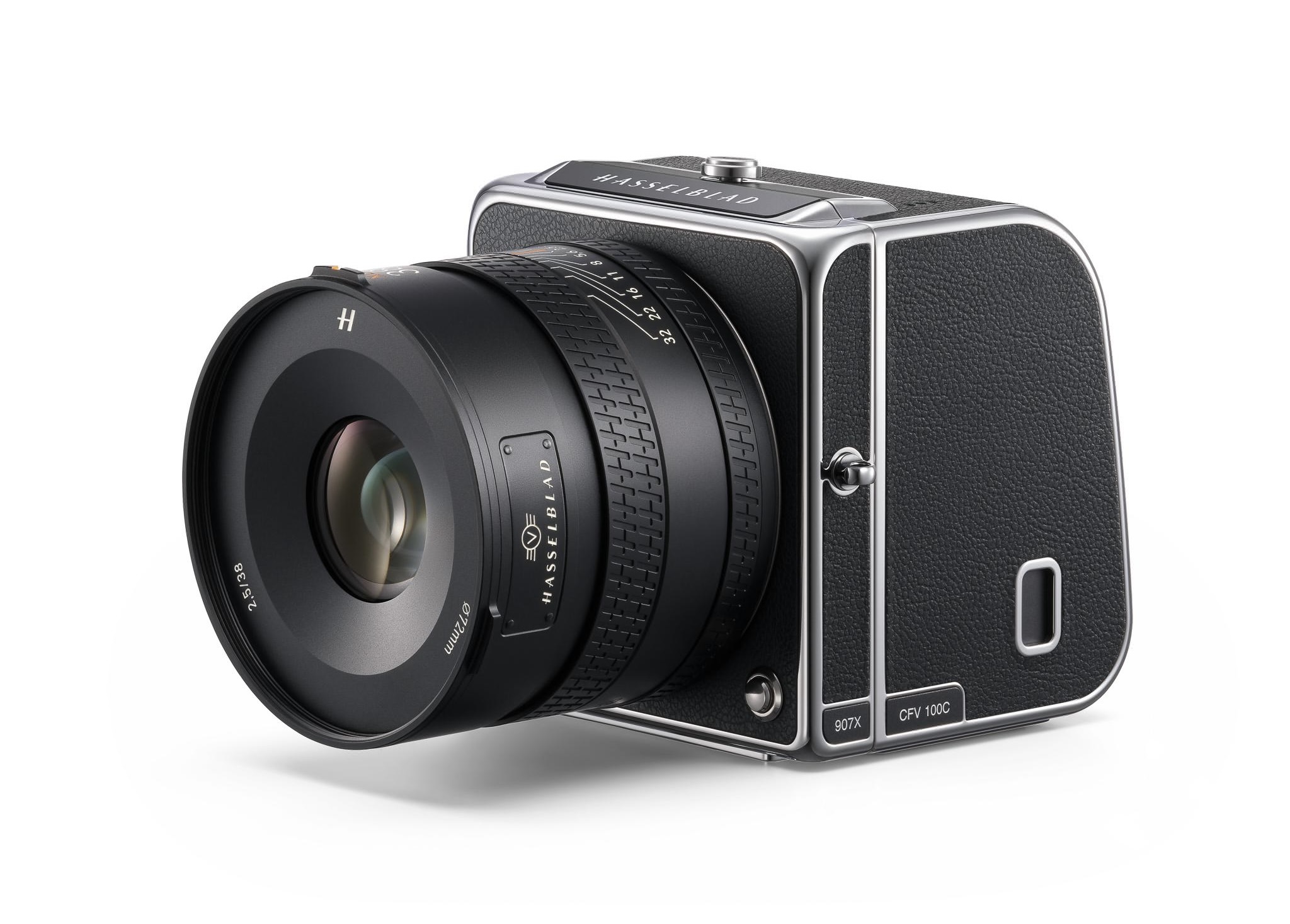
It connects electronically to both lens and CFV 100C sensor module, hereafter referred to as the CFV. Hence, when the user selects aperture priority via the touchscreen of the CFV, they make the selection via the 907X. In turn, the 907X instructs the XCD lens to adjust its aperture.
Business end
As mentioned above, the final component, the CFV module, or ‘back’, houses the sensor and several additional functions. As the nomenclature suggests, it is a 100 megapixel, back-illuminated, 44×33 mm sensor, as in the X2D. The CFV features a large, tilting, rear touchscreen through which users control the camera’s functions. It employs a menu system identical to that in the X2D, which I discussed in my earlier article.
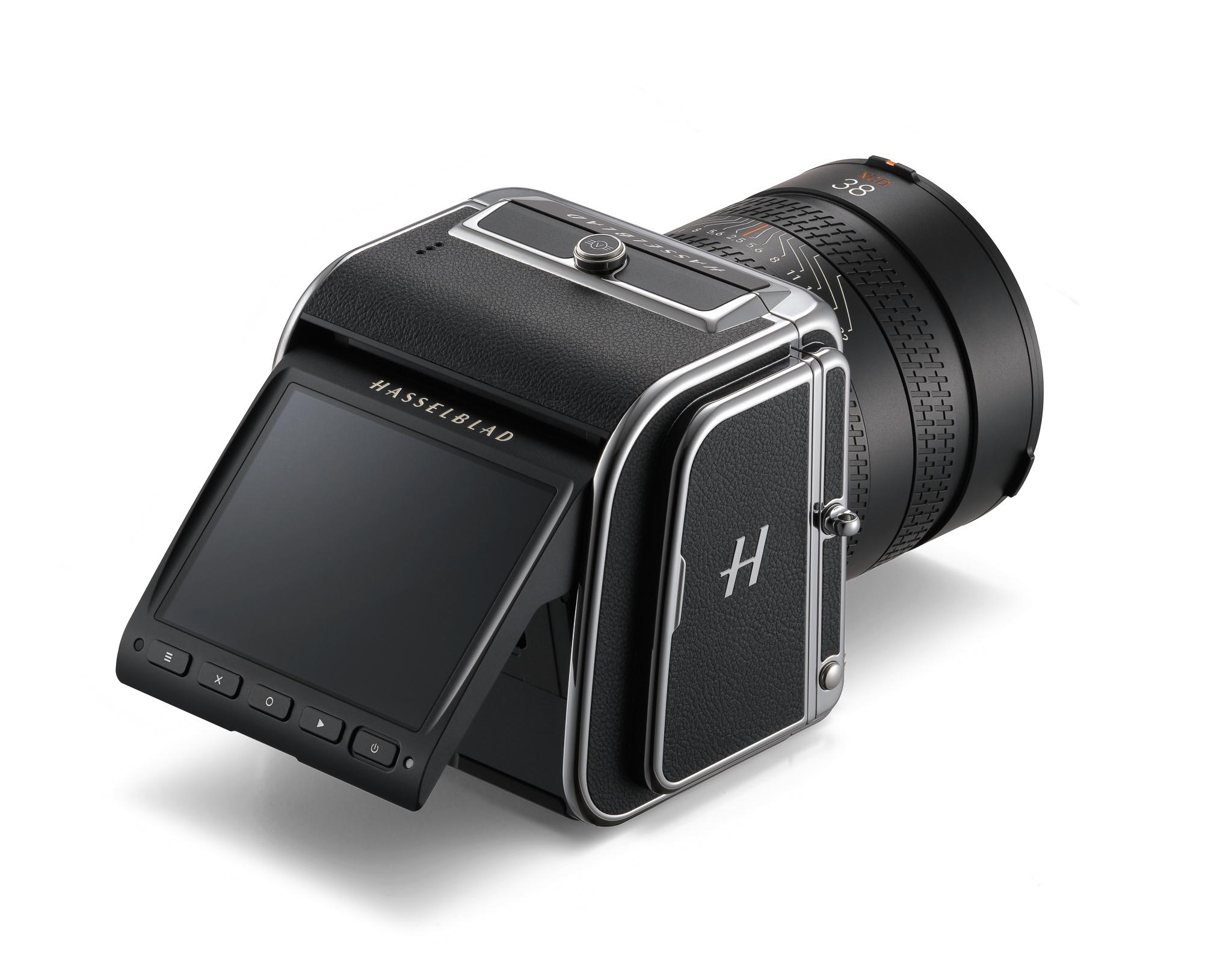
The CFV is equipped with a built-in one terabyte solid-state hard drive, a CF-Express slot, and various ports. These include a USB-C 3.1 Gen2 port, concealed behind a small door on the left of the body, enabling charging and up to 10Gb/s data transmission rates.
A sliding door at the other side of the CFV opens to reveal the battery and CF-Express port. Hot-shoe connections and flash-sync ports are accessible by sliding off or opening various covers. It is a superbly designed and compact piece of kit.

With modularity come options
The combination of 907X and CFV creates an extremely manageable, medium format camera, weighing 735g including battery (1,140g with the XCD 75P mounted). You can mount all available XCD lenses, as well as, via adaptors, all earlier generations of lenses.
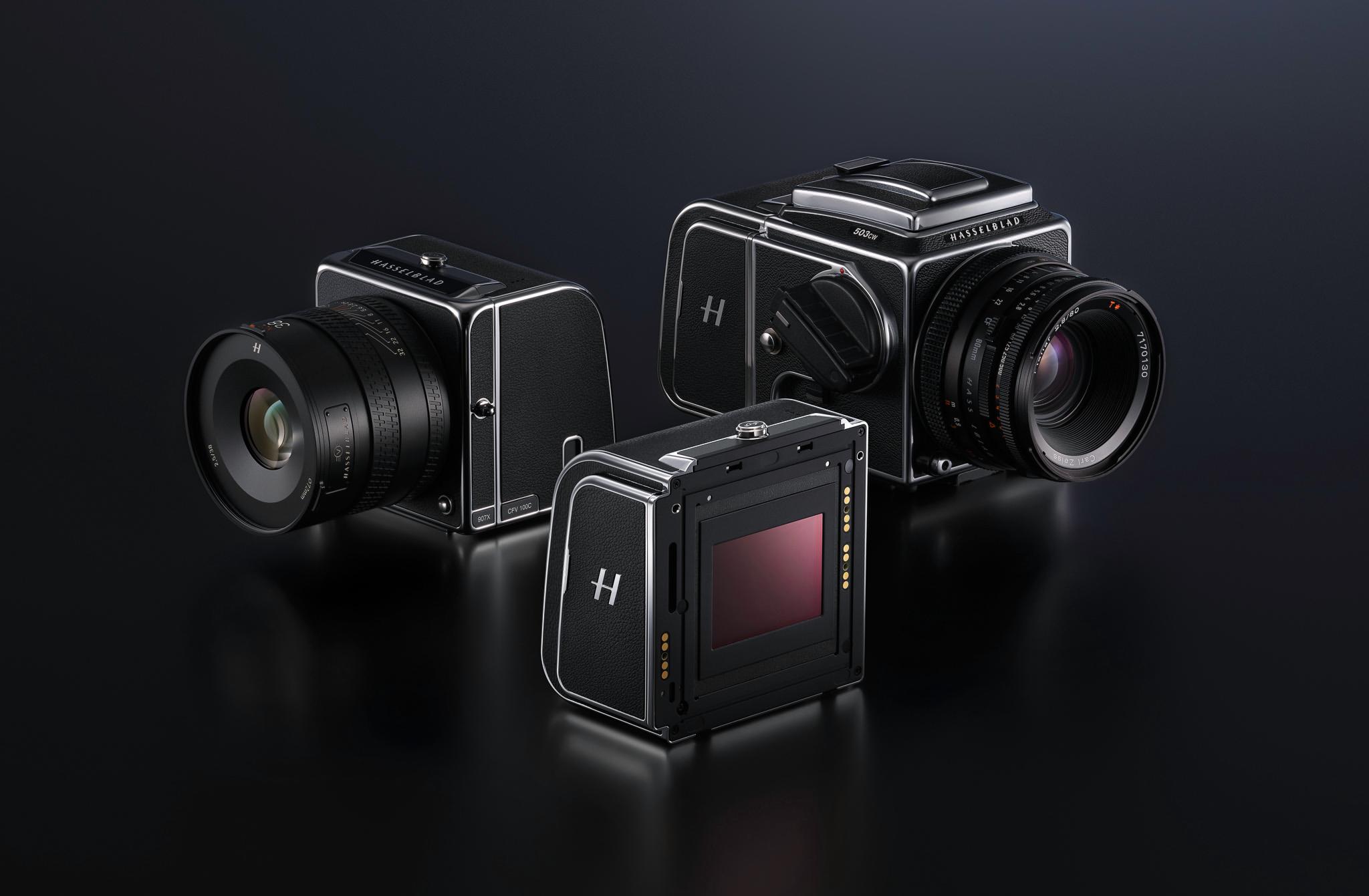
Alternatively, you can attach the CFV to one of Hasselblad’s V-series film camera bodies, such as the 500- or 2000-series. This transforms these classic bodies into digital cameras.
Finally, you can attach the CFV to technical cameras designed for rigorous shooting needs. These might be used by institutions, museums, or architectural photographers.
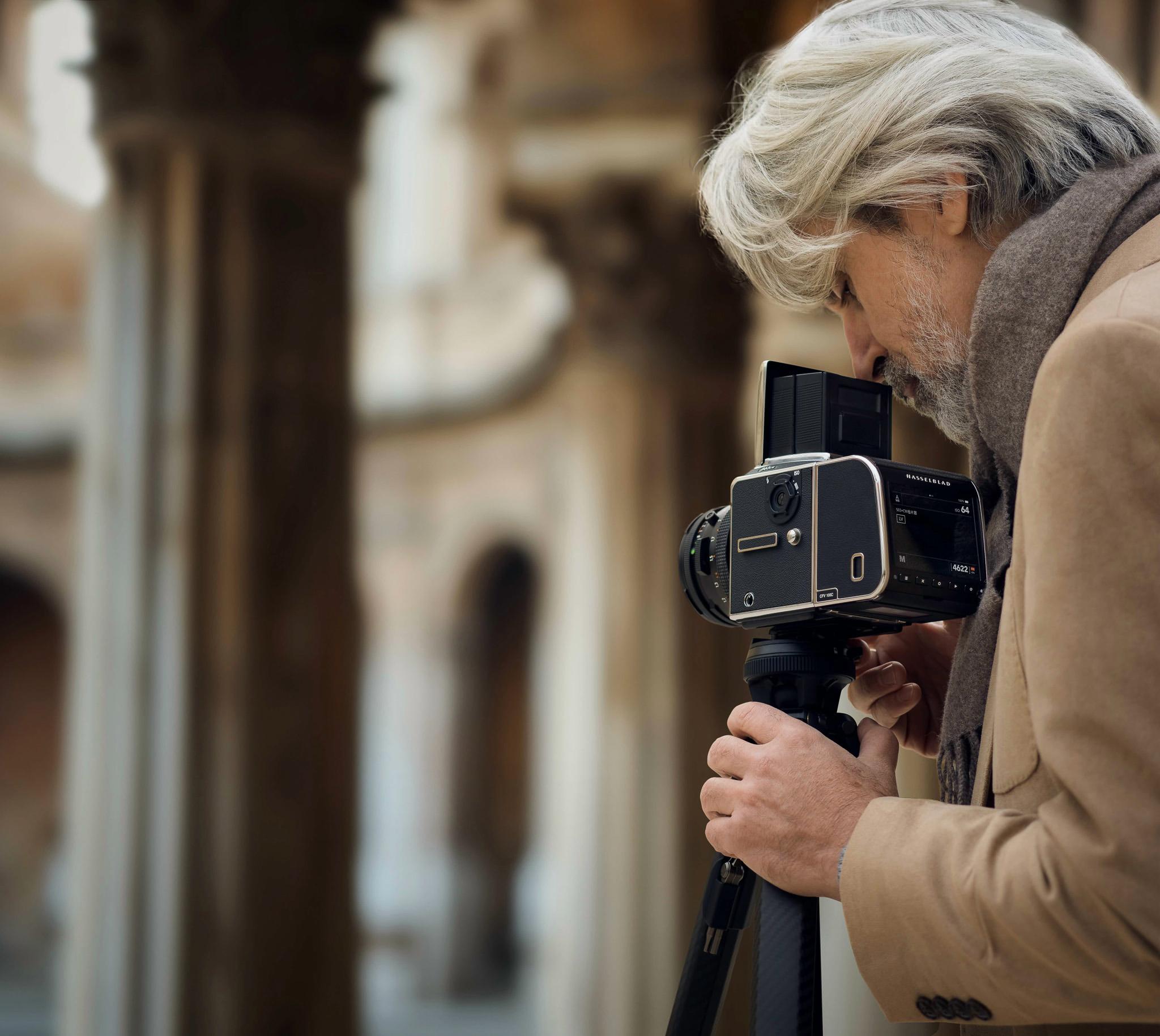
I was primarily interested in the 907X & CFV 100C because of its radically different form factor from the two X2D-series cameras I had used previously. What would it be like in every-day use, and for which types of photography was it best suited?
Shoot anything that isn’t moving
Hasselblad suggests that the target audience for this device would be mostly portrait and landscape photographers. I concur. The 907X & CFV 100C supports single autofocus, with facial recognition. It does not support continuous autofocus, and so is not geared to tracking and capturing moving objects.

It also lacks image stabilisation. However, using high shutter speeds, or when mounted on a tripod, it is capable of capturing incredible detail — perfect for landscape and portraiture.
In another massive departure from the X2D-series, it does not possess an electronic viewfinder (EVF). Fortunately, its rear screen is superb, producing a bright, crisp image. Nevertheless, many photographers would find the lack of an EVF an insurmountable impediment to buying this camera.
Since the X2D II would be just as good as the 907X & CFV 100C for portrait and landscape photography, while also possessing an EVF, continuous autofocus, and IBIS, why would someone plump for the latter?

Reasons to be cheerful
First, it is a thing of beauty. Just like a vintage Corvette, it possesses delicious curves and shiny chrome trim.

It is also unique. There is nothing comparable on the market. In the few weeks that I used it, countless passersby stopped me and asked about it.
Its vintage design is a nod to Hasselblad’s storied history, and its place in photographic history, as the maker of the first camera used on the moon.

The boxy shape turns out to be a very space-efficient form factor, packing a great deal of tech into a small package.
And, if you already own a Hasselblad film camera and lenses, it’s a clever way of repurposing that kit for the digital age.
How I used the 907X & CFV 100C
I soon got used to holding the camera, placing my left hand below the lens and wrapping my right hand around the body. It took a while to get used to looking down at the tilted rear screen to frame shots, but it was a novel and fun experience that I mastered with a little practice.
I definitely found myself taking things more slowly than when using EVF-equipped cameras.

Given the absence of continuous autofocus with tracking, and the lack of IBIS, I confined myself mostly to photographing stationary objects. I have sprinkled examples throughout the article. It produced superbly detailed portraits. I was unable to convince anyone to let me photograph them in a controlled studio environment, but even out in the wild, it delivered the goods.
I was also able to capture beautifully rendered landscape and nature photographs. Occasionally, I succeeded in capturing candid shots of people, when I could sneak up behind them as they looked the other way. Since, as mentioned above, the XCD 75P lens is approximately equivalent to a 60mm focal length on a full frame camera, I could frame the shot without having to get too close.
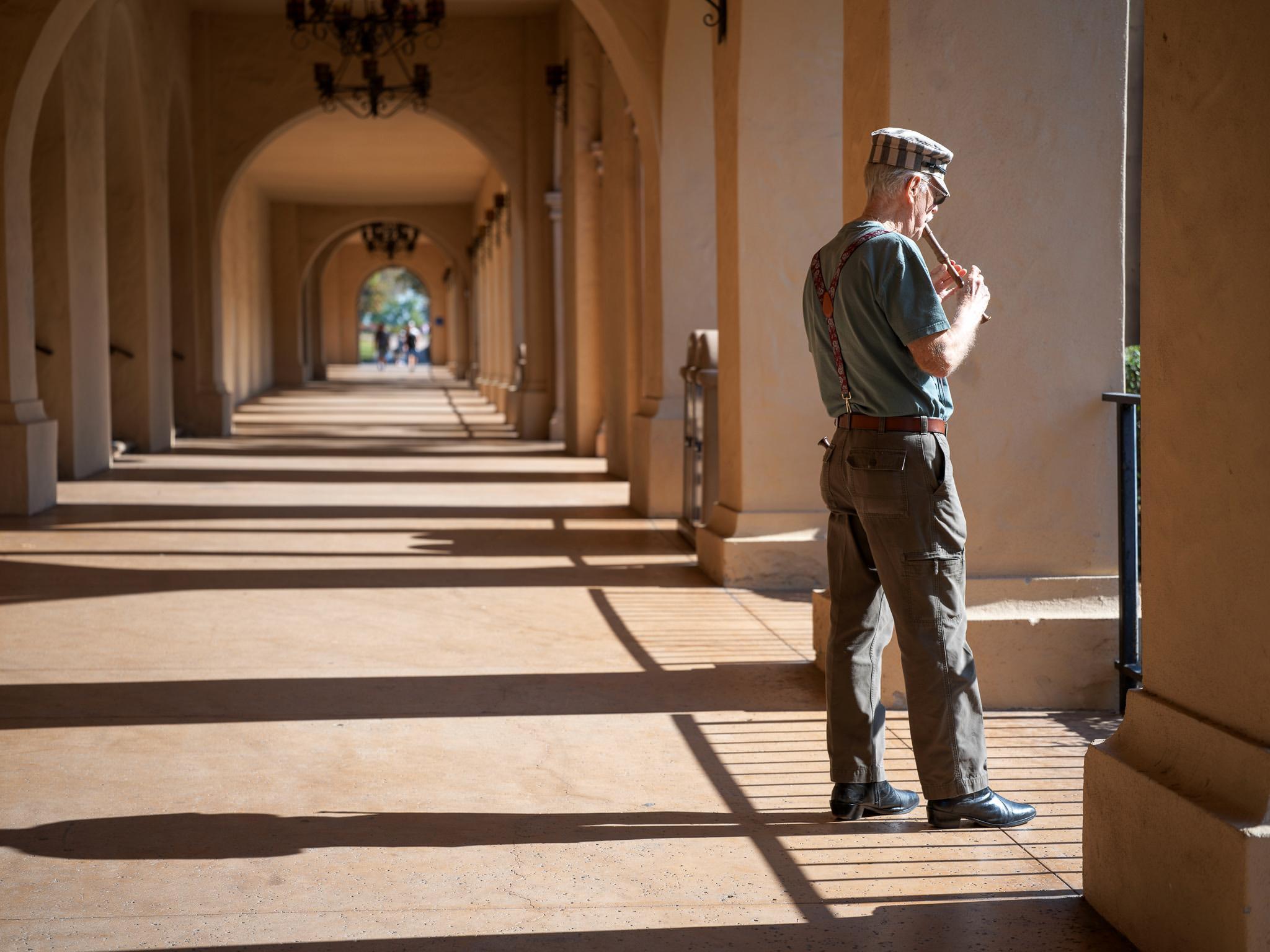
Sneaking in some moving subjects
On several occasions, I dialled up the shutter speed and even snapped a couple of people in motion. I captured the jogger on the beach at sunset by framing the scene and spot-focusing on him as he entered the frame. Shooting at f/11, 1/250s, once the focus was locked, I panned across the scene and pressed the shutter button when he was well inside the frame.

The concert flautist bounced around to a surprising degree. I used the facial recognition feature to focus, and because of poor light, shot wide-open at f/3.4 1/400s, taking a hit on Auto ISO, which climbed to 3200. The image is largely free of noise, even though I did not use the AI-denoise feature in Lightroom.

JPEG vs RAW
This is perhaps just as well because, since all these images were shot as JPEGs, they are not compatible with the Lightroom denoise protocol.

I shot JPEG rather than RAW to minimize the file-size issues I ran into with the X2D II, where 200 megabyte RAW files stressed my computer processor. Nevertheless, the image quality and colour rendition delivered by this boxy little fellow are superb.
For photographers who cannot live without a hand-grip, and more physical buttons and dials, Hasselblad offers an accessory grip for the 907X & CFV. The 907X Control Grip has a shutter release button, joystick, and dials for controlling aperture and shutter speed. Its styling complements the vintage vibe of the camera itself. They also supply an accessory optical viewfinder, if you just can’t live with the rear screen alone.
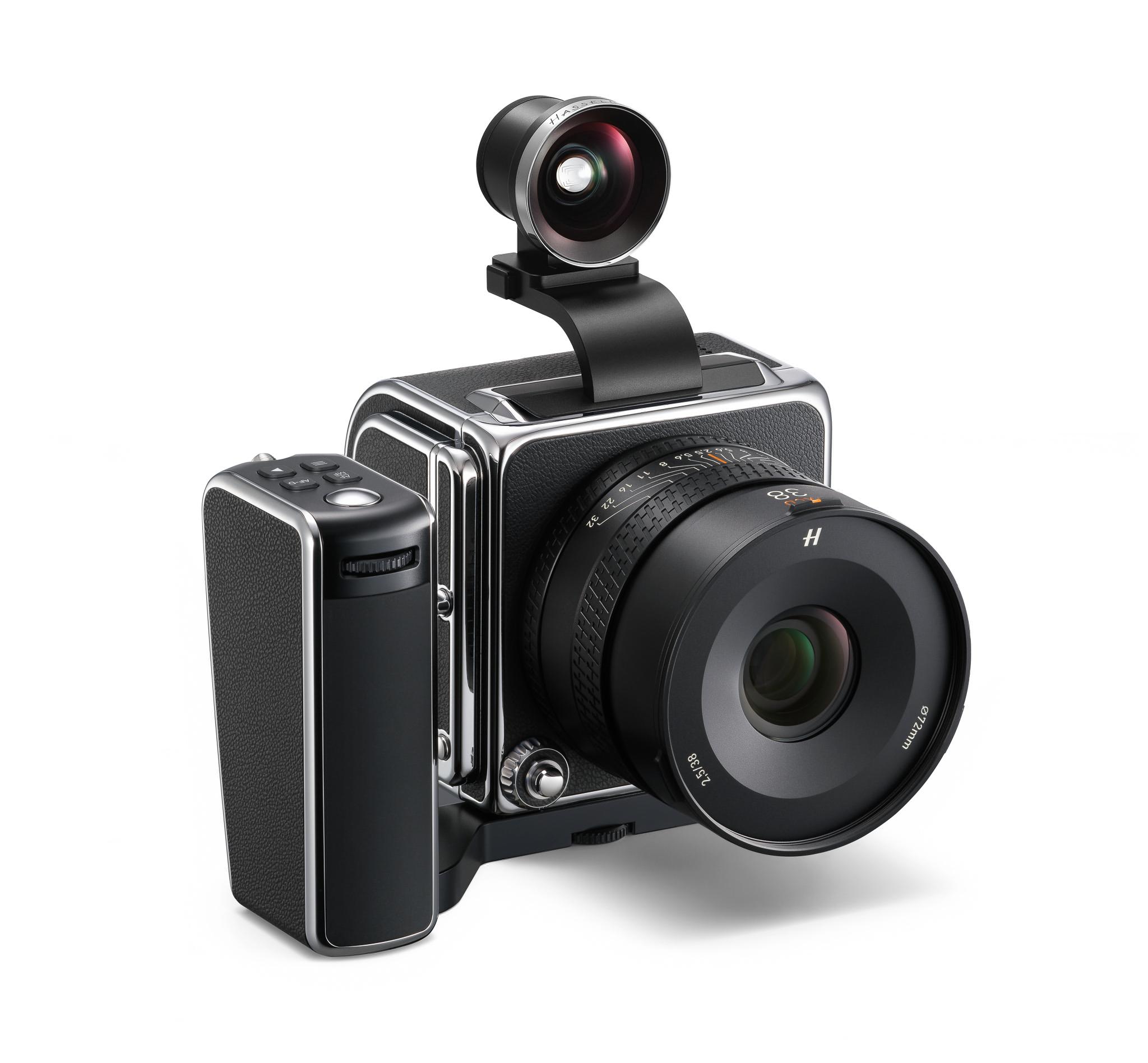
However, if you really want those features, you might ask yourself: “Why not just buy an X2D instead?”
Final thoughts
The Hasselblad 907X & CFV 100C is a fascinating camera. It’s a remarkable blend of vintage looks and modern photographic performance.

If you are a photographer who appreciates devices that are beautiful as well as functional, and who wants to shoot medium format, this could be the one for you. The case is even stronger if you do not want a camera that looks like everyone else’s, do not care about EVFs, but do care about the ultimate in image quality.
Sometimes, photographers choose a different path, seeking to connect with an earlier era in camera design. Thus, many Leica shooters enjoy the simplicity and classic looks of cameras such as the screenless M11-D. Or, they are drawn to the history and charm of rangefinder cameras in general.
I can see this quirky Hasselblad camera appealing to just those types, who eschew the mainstream for more interesting and fun tributaries running alongside.


As with the earlier X2D-series cameras I borrowed, I thoroughly enjoyed my time with the 907X & CFV 100C. I felt I was tapping into the history of a storied brand, while taking shots with a superbly designed and compellingly competent photographic tool. It is not for everyone, and I shall not be buying one, but I am extremely grateful to the team at Hasselblad for entrusting me with it for a few weeks.
How much does it cost?
Retail price for the 907X & CFV 100C: $7,399 ⎸ £6,400 | €7,200
Retail price for the XCD 75P: $2,299 ⎸ £2,149 | €2,529
And for the 907X Control Grip: $729 ⎸ £679 | €749
In comparison, I found a bundle offer for the Hasselblad X2D plus XCD 75P for $7,369. There is currently no comparable UK bundle.
Make a donation to help with our running costs
Did you know that Macfilos is run by five photography enthusiasts based in the UK, USA and Europe? We cover all the substantial costs of running the site, and we do not carry advertising because it spoils readers’ enjoyment. Any amount, however small, will be appreciated, and we will write to acknowledge your generosity.
Hmm, get thee behind me Satan! 😉
My 503CX & 80mm Planar has been gathering dust since the demise of my darkroom (as have my M7 et al) and the possibility of swapping the film back for either of the CFV digital backs has been a temptation for a quite a while – so far resisted. Ah well, too late to add one to the 2025 Christmas wish-list…
Very informative article plus excellent images. Thanks.
I have been using this system since it was released; first the CFV 50 anniversary edition, and now the CFV100. I use it both with XCD lenses and with Cambo WRS. With the technical cameras this is a “bargain” priced back as the only other BSI back is by Phase One, several times more expensive! I love this system but like anything it has its limitations. Horses for courses!
Oooh that looks just luscious. I have seen pictures of it here and there, but hadn’t worked out exactly what it was. Your explanation helps immensely, thanks.
Hi Andrew, it is indeed a gorgeous camera. Having developed the digital ‘back’ I assume Hasselblad realized they could make a self-contained camera by producing the 907X module to which it could be attached. Very creative.
All the best,
Keith
Thanks for covering these cameras — I suspect it’s an experience very few of us readers would be able to duplicate 🙂
In a way, it’s like the Ricoh (although not quite as pocketable): if your eyes can’t take a touchscreen, then you just can’t use the camera. But even for those who can . . . I noticed you talked about AF. Do you think you can get the benefits of those 100 megamixels, by trying to focus with the touchscreen?
Well, I’m fairly certain I’ll never get to experience that!
One more thing … I really liked your ‘recorder’ portrait. Very bold — off centering him from the colonnade!
Thanks, Kathy!
I found it quite easy to achieve focus using the rear screen. The camera’s autofocus system works well. You can use point focus, where a small square turns green when the subject is in focus, or facial recognition, where again, a square indicator turns green when the subject is in focus. It is trickier in bright sunlight, when you are dealing with glare on the screen.
I like the photo of the recorder player too. I took a few shots with him more centered in the frame, but I felt this one, with him offset and the view along the colonnade centered, was much better.
All the best,
Keith