
Leica’s M EV1, the rangefinder-style camera without a rangefinder, has now been on the market for six months. I have fondled it several times since the launch and have read countless reviews and opinions. It’s fair to say that the reception has been mixed. But there is a general feeling that the M EV1 is a niche, albeit a promising evolution of the M formula. I thought I knew everything there was to know, and I’d decided I didn’t need the camera. However, when I got the chance to use the M EV1 for a few days, I discovered something I had not expected; something unique which has changed my mind entirely.
In common with most Macfilos readers, I am no stranger to using manual M lenses on mirrorless cameras. Fifteen years ago, I was experimenting with these lenses on Fujifilm X cameras. And from the arrival of the M240 in 2012, I have always had a Visoflex viewfinder to attach to my current rangefinder.
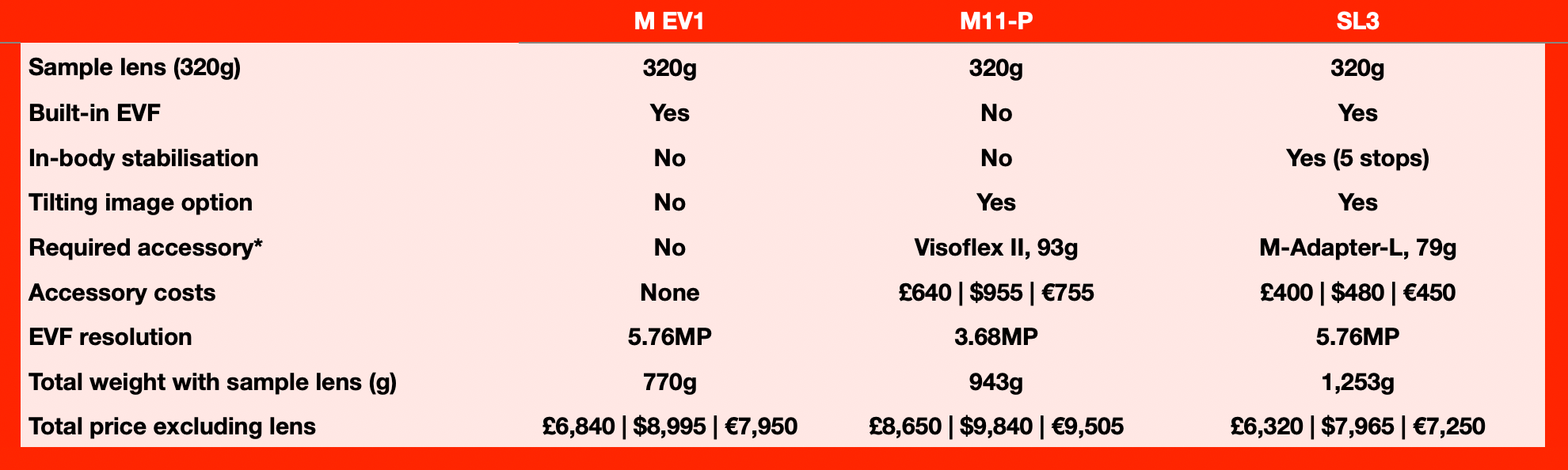
More recently, I have used the M11-D with the Visoflex 2. I’ve also fitted M lenses to the SL3, which offers a much brighter and larger EVF, image stabilisation and a firm grip. In fact, the SL3 is a pretty good companion for M lenses, with the need for an adapter and the weight being the only real disadvantages.

First impressions
I soon discovered that I very much like the appearance and overall handling of the M EV1. It is 35g lighter than the standard M11, which doesn’t sound much, but it feels much lighter. And if you are coming from the now-discontinued silver-chrome version of the M11, the new camera is a whopping 145g lighter.
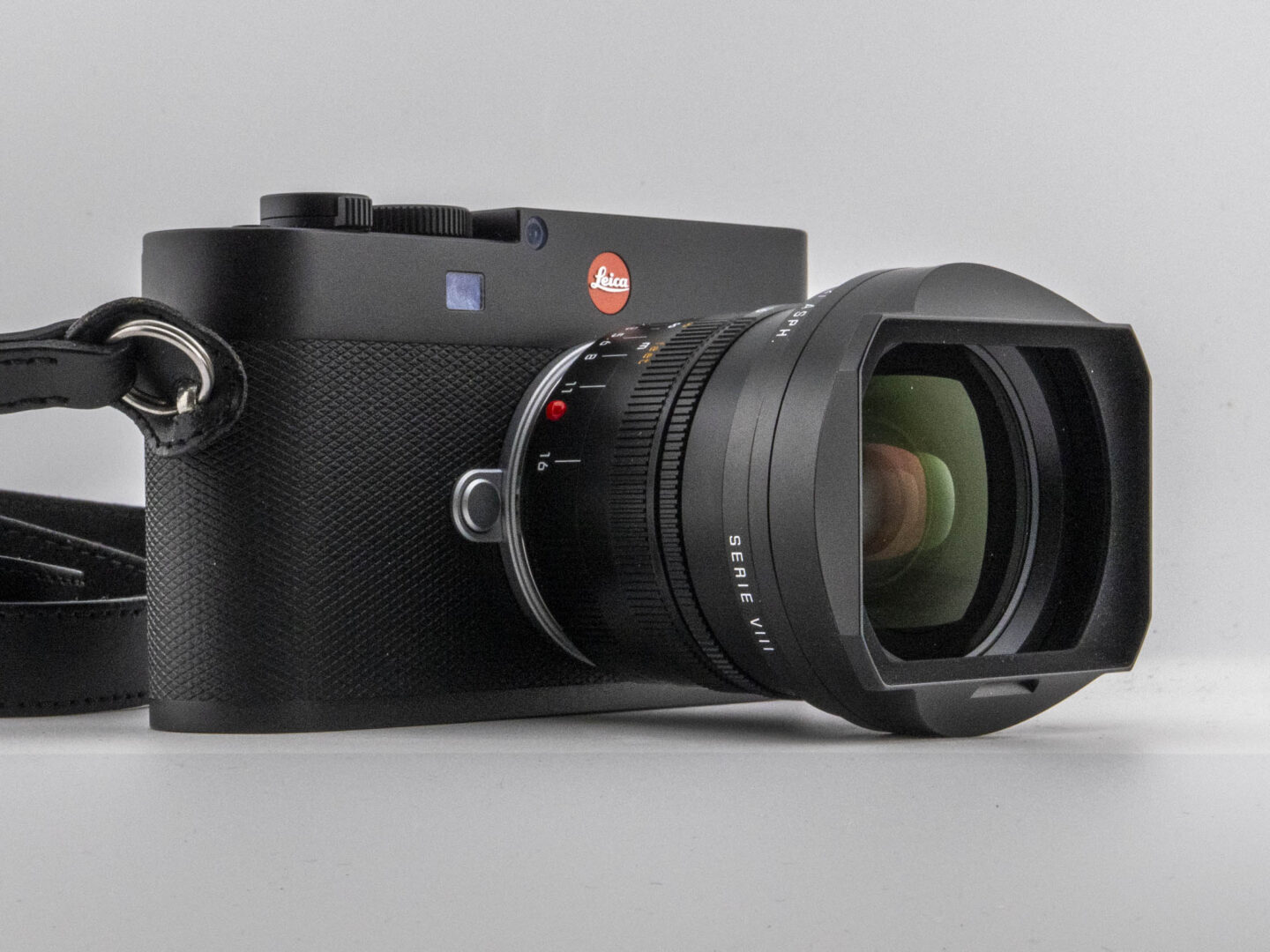
While the dimensions of the M EV1 are identical to those of the M11, the camera somehow feels smaller. It gives the impression of a compact device that you would want to carry around all day. Add a 250g lens, such as the popular 35mm f/2 Summicron-M ASPH, and you have an outfit which weighs about the same as a Q3, but with the added versatility of the vast M-lens collection.

My initial thoughts, then, were very positive. The controls are familiar, the Leica menu system is outstandingly simple and usable, especially for anyone familiar with a Q, M rangefinder or SL3 (see our recent interview with Stefan Daniel and Nico Köhler on this subject). The new EVF is bright and offers an almost identical view to the finder on the Q3 or Q3 43. In fact, on first impression, there is nothing to dislike and everything to reinforce the impression that this is a true Leica, if a little unconventional.
Lightweight
The Leica M EV1 provides a lightweight full-frame experience which, surprisingly, compares well with a typical small APS-C outfit such as the Fujifilm X-E5. Together with the 35mm XF f/2 WR, the Fuji rig weighs only 620g, 125g lighter than the M EV1, but then it does have a crop sensor.1
At 484g, including battery, the M1 EV1 is the lightest full-frame mirrorless body with an electronic viewfinder. The runner-up is the Sony a7C which weighs 509g. When you also consider the size and relatively low weight of M lenses, the system advantages are clear.
This minimisation of size and weight (with the added advantage of not requiring a mount adapter) is the whole story of the EV1. It is the essential experience of electronic-viewfinder M-lens focusing, in the smallest possible package.
Design
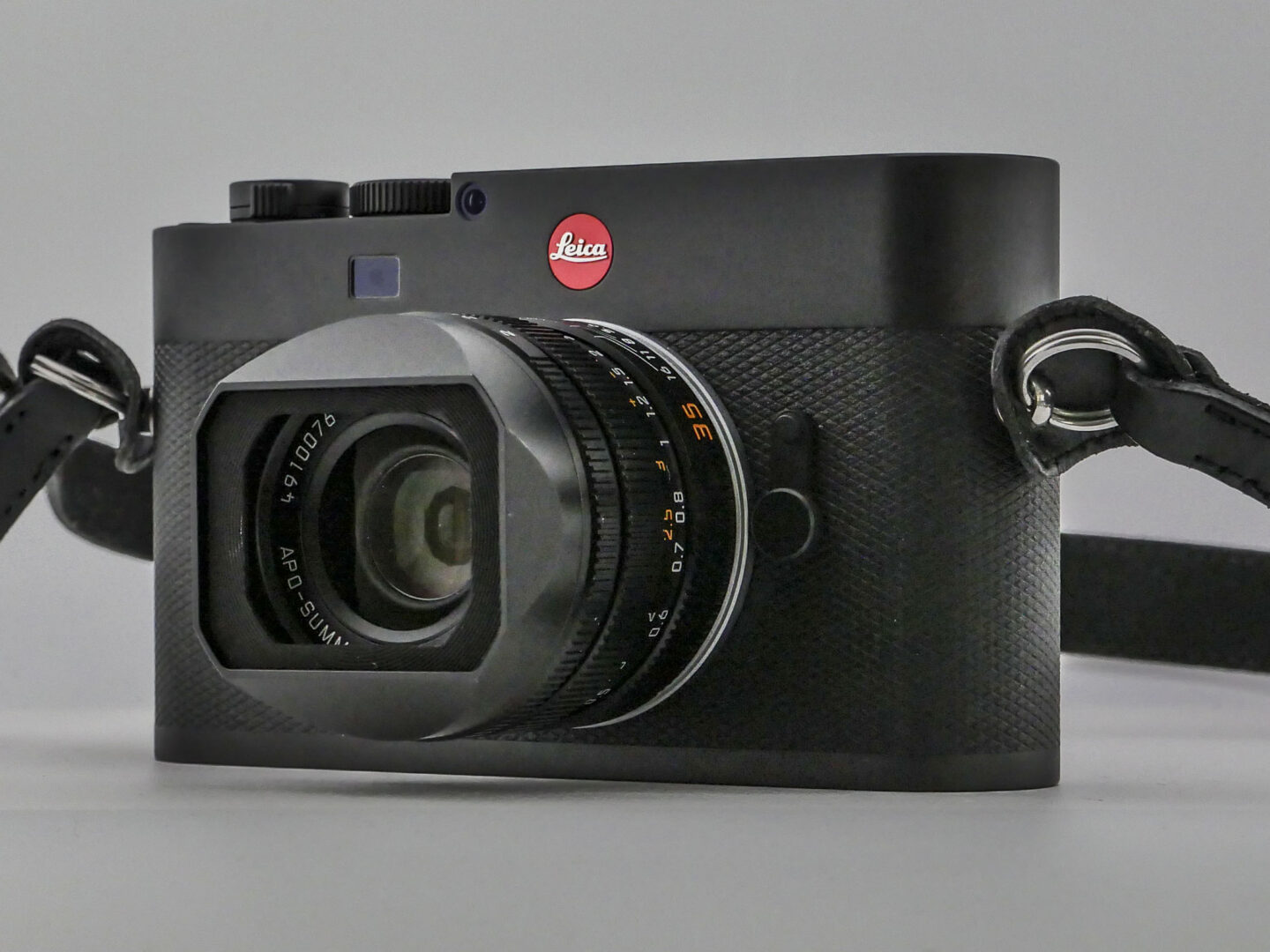
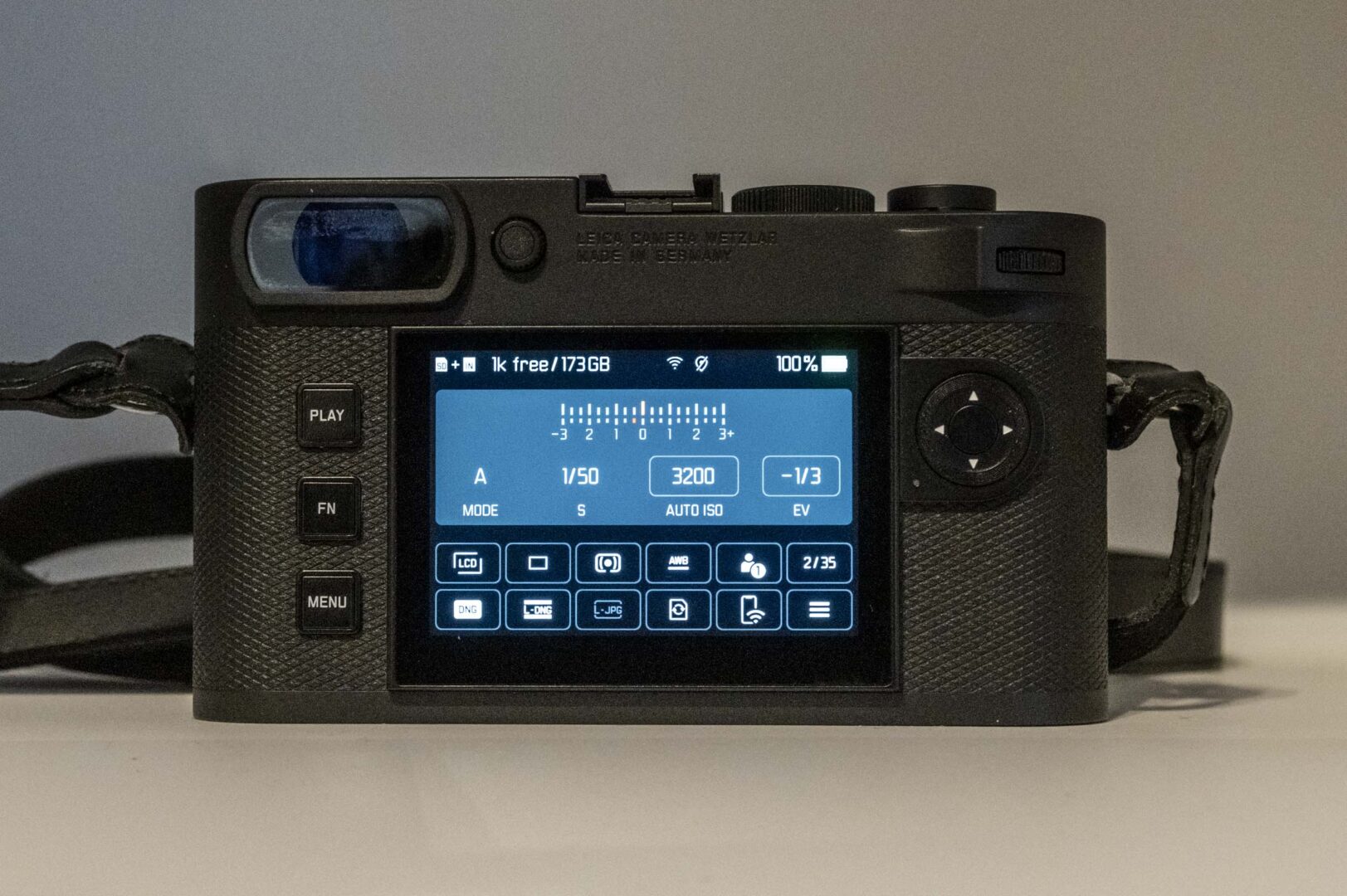
The exterior of the M EV1 is almost identical to that of the M11. The button layout and functions are the same, with the single exception of the lever to the right of the lens mount. However, the familiar ISO dial has been sacrificed (there wasn’t enough room for it alongside the EVF) and, of course, the rangefinder window is missing.
On rangefinder cameras, this lever is used to preview framelines. On the M-EV1 it acts as two discrete additional function buttons (left and right) which can be programmed to various menu options — such as focus assist, focus magnification, digital zoom.
Apart from that, the only significant difference is the electronic viewfinder, which replaces the traditional rangefinder. The 60MP CMOS sensor is again identical to that of the M11, and the camera offers the well-tried Triple Resolution option which allows users to choose between 60, 36 and 18MP.
The absence of a tilting screen, similar to those on the Q3 and SL3, is a disappointment, but not surprising since this is essentially an M11. We will have to wait for the M12 to discover if a tilting screen, which doesn’t ruin the simplicity of the M body, is a possibility. And the other expected omission, which is no surprise to M users, is the lack of IBIS. Again, maybe this is on the cards for the M12.

The lens story
It is difficult to fully appreciate the story of the M EV1 without understanding the legacy of the M system. In a world of snappy autofocus photography, why would anyone want to mess around with manual focus? The fact is that there is tremendous interest in using manually focused M-Mount lenses, which extends way beyond the limited world of the rangefinder. And since there is so much demand, the M EV1 is Leica’s ploy to offer the most congenial platform on which to experience lenses ancient and modern.

The massive inventory, including still-functioning optics from 70 years ago (and up to 95 years if you use a simple, slim adapter) is unrivalled by any modern camera system with its built-in obsolescence. Check our M-Files Navigator, which goes into detail on many of the principal lenses from third-party manufacturers. Not only that, but manual lenses without fussy and weighty AF motors, are generally smaller than equivalent autofocus lenses, and they are likely to be more reliable.
It’s this simplicity and manual operation which promotes value retention to a degree that cannot reasonably be expected with modern electronic lenses. Eventually, these electronic lenses will die, or lack a suitable body on which to mount them. But the M lens lives on, and that’s why there is so much interest in using them on modern systems with electronic viewfinders.
Viewfinder
According to the spec sheet, the electronic viewfinder shoehorned into the M11 body, has the same 5.76-million-dot OLED panel as the Q3(43) and SL3, but there are subtle differences in implementation and viewing experience. My conclusion, using the new camera alongside the Q3 43, is that the view is more or less identical. If you are happy with the Q3, you will enjoy the M EV1’s viewfinder. However, bear in mind that the refresh rate of the EV1 is only 60 fps, compared with 120 fps on the Q3 duo.
Both the EV1 and Q3 produce a crisp image. However, surprisingly, neither feels as immersive as the implementation of the same panel on the SL3.
The SL3 viewfinder offers up to 120 fps and a more generous eye point — there is more space in the body and, as is obvious at a glance, the eye cup of the SL3 is larger and more accommodating.
The SL3 image contrives to appear larger and more immersive. In many respects, I have to say, I prefer the experience of focusing M lenses on the SL3. The viewfinder is more comfortable and cinematic. But the size and weight penalty, plus the inconvenience of the adapter, are the killers.
Superb canvas
Nonetheless, the viewfinder of the M EV1 provides a superb canvas on which to compose your pictures. It is much better than the experience you get when using the 3.7-million-dot Leica Visoflex 2 mounted on the M11 range (although you then get the advantage of a tilting view).
I compared the two options: Visoflex 2 on the M11-D with the M EV1. The EV1’s EVF is both sharper and snappier, while the Visoflex 2 is usable but feels a generation behind current viewfinders in both resolution and responsiveness. Here we compared a large range of viewfinder alternatives for the rangefinder.
Unlike the optical rangefinder, the EVF has no parallax distortion and offers more accurate overview of the subject, and greater control over exposure. It is necessary for lenses wider than 28mm and a great aid in ensuring accurate focusing with fast lenses and their narrow depth of field. And, of course, with the EVF there is no viewfinder blockage which frequently occurs in rangefinder photography, especially when using wider or larger lenses.
Setting the scene
As with all mirrorless cameras, there is a diopter adjustment, which makes it easy for you to dial in a crisp image whether you wear glasses or not. This has a range of -4 to +2 diopters and enables you to adjust the view to correspond with your prescription glasses, provided the correction is within the range.
The image in the viewfinder is governed by the chosen JPEG recipe, so you can adopt a more vivid picture or, even, monochrome which many people prefer, even when taking colour shots. This JPEG setting is retained even when shooting RAW only.
Focus area
Although I am a great fan of the rangefinder, I appreciate the experience of using the EV1 as an alternative platform. I will never give up the rangefinder, but I also enjoy using M lenses on a mirrorless camera.
One thing I don’t appreciate, however, is the floating focus point, although I know it comes with the mirrorless territory, and the EV1 offers a full range of options.

I prefer the rangefinder method of focus and recompose, even when using mirrorless cameras and AF lenses. I therefore prefer the electronic focus point to stay in the middle of the frame. Unfortunately, it doesn’t stay put on other Leicas, and the M EV1 is no exception. The focus area can often be found lurking in one of the corners.
Leica seems incapable of added a “lock focus point” menu option to any of its cameras, despite much demand over the years from focus-and-recompose fans. At least, on the EV1, they have added a “Center” menu option which, if assigned to a function button, can move the focus point back to the centre of the frame.
A lock function would be a welcome feature on the M EV1, since it would allow experienced rangefinder users to adopt the same method that they are accustomed to. Of all the Leica cameras, this is the one that would most benefit.
Focus aids
The EV1 offers two focus aids — magnification and focus peaking. I am not a fan of focus peaking and tend to prefer magnification and rely on my eyesight for accuracy (in this respect, make sure you have finely adjusted the diopter dial to sharpen your impression of detail). There are two levels of magnification, 5× and 10x, which you can toggle as required.
For general photography, especially with the ultra-wide 21mm Summilux, 5x is adequate. But for greater precision with longer lenses at faster apertures, I preferred to switch to 10x magnification. In general, I was able to manage very well with magnification alone, without focus peaking.
Enhanced aids
Other manufacturers, such as Nikon, are now offering enhanced manual focus aids. However, the M11 lacks phase detect and, more significantly, a mapping system — this is something that autofocus cameras do have.
A useful trick of the M EV1 is that you can optionally choose to have magnification initiated when you turn the focus ring. I am a fan of this, although I have read that many people find it irritating. It is something of a conjuring trick because M lenses are purely mechanical and have no means of communicating with the camera.

However, all lenses do have a mechanical rangefinder cam (or coupling cam) which pushes on the small roller/arm inside the body. So, instead of activating the rangefinder focus patch, as it does with and M, the M EV1 uses this coupling mechanism to turn on magnification.
While automatic magnification is common on mirrorless cameras with electronic lenses, the M EV1 (and other recent M cameras fitted with a Visoflex) can do this automatically with M lenses. It isn’t possible, for instance, with the SL3 where magnification has to be initiated using a function control.

Focus peaking
Focus peaking is another story. I find it helpful with longer lenses and faster apertures, but I usually keep the setting to minimum. Heavy peaking can be confusing with wider lenses, where the depth of field is so large that coloured area almost obliterates the entire scene. Even when dealing with such a wide depth of field, it’s nice to be able to select a focus point — unless using zone focus, in which case none of this applies.
After the first few days, I began to use focus peaking less and less, and found myself satisfied with magnification as the primary focus aid. I left auto magnification switched on for most purposes, but you might prefer to disable it.
EVF v RF focus
In general, I do not think the EVF makes adjusting focus easier than on the rangefinder. This is not a criticism of the M EV1, just a general observation covering all electronic viewfinders. The rangefinder is still an accurate and quick (arguably quicker than EVF) method of focus confirmation.
With lenses in the standard range of 28-50, I feel more confident in aligning the focus patch to achieve spot-on focus on the subject (subject to the rangefinder mechanism being in proper adjustment). These are also the focal lengths where the framelines provide a very usable guide, from full-frame at 28mm to a usable “see round” frame at 50mm.
On the other hand, the EV1 is almost necessary for lenses wider than 28mm. There are no rangefinder framelines for wider lenses, such as 18, 21 or 24mm; you have to guess the full extent of the frame (as many experienced photographers can do) or fit an external viewfinder, either optical or electronic.
With the M EV1, you can compose more accurately without the need to add an accessory viewfinder.
At the other end of the scale, composing images through the M EV1 on longer lenses (from 75mm to 135mm) is a definitive advantage. The rangefinder frames become increasingly restricted as the focal length increases. However, with the EVF, you enjoy a full view of the entire frame, irrespective of the focal length of the lens.
Long lenses
The 75mm APO-Summicron-M is the longest M lens I had available, but I definitely appreciated using the M EV1 because of the larger image. However, with longer lenses, combined with magnification, the lack of in-body stabilisation can sometimes be a problem, hence the need to watch minimum shutter speeds. What most people overlook when talking about stabilisation, is that lens stabilisation (OIS) is more effective than IBIS in general use. But this will never be a possibility for mechanical M lenses.

Electronic focusing does, however, come into its own with faster lenses. I was unable to try the camera with a Noctilux or modern Summilux because I didn’t have any handy.
These days, I’ve standardised on Summicrons such as the 35m and 50mm APOs. But I was able to test the camera with a retro 35mm Summilux f/1.4 “steel rim” with good results, and found it easier to focus accurately using the M EV1 than with the M11.
Having used the camera for a few days, I detected no real advantages in terms of composition and focus over any mirrorless camera equipped with an M-Mount adapter. All do a good job, especially the SL3, but all bring penalties in terms of weight, size, and over-complication.
Digital zoom
Fixed-lens cameras such as the Q3 offer digital zoom framelines based on focal length — 35mm, 50mm and 75mm, for instance. The M-EV1, on the other hand, expresses the zoom in terms of magnification, with two levels at 1.3x and 1.8x so that it can be interpreted in relation to lenses of varying focal lengths.
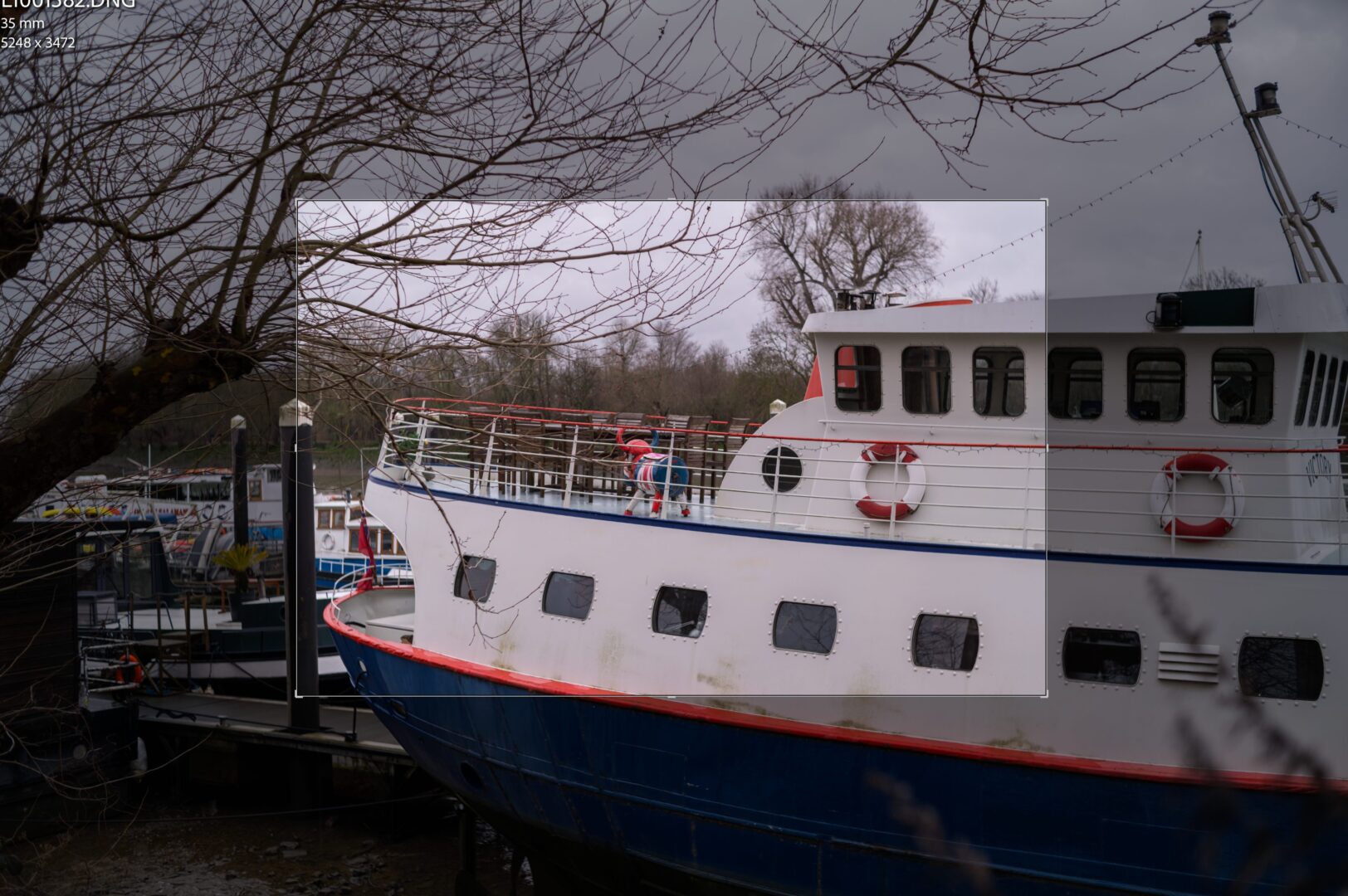
As an example, if you are using a 28mm lens, the zoom function adds 36mm and 50mm focal-length options. If used with the full resolution of 60MP, these crops are capable of offering fine detail and resolution. Similarly, if you attach a 75mm lens, you get the zoom options of 98mm and 135mm.
Frame lines
The degree of zoom is indicated using a frame line, rather than filling the screen with the cropped image. This follows the practice on other Leica cameras, such as the Q and SL. I prefer it since it provides “see around” capabilities, much loved by rangefinder fans.
You can see what is just outside the frame and adjust the composition accordingly. With the full-frame zoom image (as adopted by Ricoh with the GR), it can be confusing since it isn’t immediately apparent that you are looking at a zoomed image, and you can forget to turn it back to full size.
Digital zoom had a bad rap for many years in the late Naughties and early Teens, but with the recent leaps in sensor technology and resolution, modest cropping is a viable and acceptable alternative to optical zooming. And, of course, the M system doesn’t offer real zoom lenses.
The MATE (medium-angle) provide three discrete focal lengths (28, 35 and 50mm), but does not operate as a true zoom. On the other hand, the wide-angle WATE is actually a proper zoom, but is mechanically restricted to three specific focal lengths, 16, 18 and 21mm.

Here you can find an article on the MATE, which was discontinued as long ago as 2007. And here is a farewell to the WATE from last year. Both these lenses will have a new lease of life with the arrival of the M EV1, and who is to say that Leica will not produce a true zoom M lens in the future?
Digital zoom
The digital zoom function is mainly of interest in creating out-of-camera JPEGs for sharing. I seldom need this, and typically shoot RAW only. So I can crop in post-processing. However, I discovered that the digital zoom is an aid in composing shots when I knew I was aiming for a cropped image. Keep in mind, if you use digital zoom on a Leica camera, you will always get the full sensor RAW file, albeit with non-destructive cropping in your post-processing software.

Steady as she goes…
Like other M cameras, the EV1 is not equipped with in-body-image-stabilization (IBIS). You might think this is a significant omission in a modern, digital camera. Presumably, its absence follows from Leica’s determination to retain the camera’s compact form factor at all costs. Addition of IBIS in a body that is already jam-packed would probably be a considerable, perhaps even insurmountable, challenge.

In practice, the absence of IBIS is less of a concern than you might think. Setting a minimum shutter speed via the AUTO-ISO settings menu represents a simple means of avoiding camera shake.
Users can either select a multiple (such as 4x) of the lens focal length, or a specific shutter speed, such as 1/250s. Thus, when shooting in aperture priority, to achieve correct exposure the camera will increase ISO rather than reduce shutter speed below the selected threshold.
Either approach works well, although I was caught out when using the multiple-of-focus-length approach while taking the image below. With a 21mm lens, and a 4x multiple, that is potentially too slow.
On a freezing-cold January day, shivering to keep warm, it can be difficult to hold the camera perfectly steady. This could well be the cause of the softness in the image. With such a lens, selecting a minimum shutter speed of 1/250s would be more prudent.
Furthermore, I am told that image stabilisation via the lens is more effective than IBIS, and so even IBIS-equipped cameras would not offer significantly more stops of exposure when equipped with a non-stabilised lens.
Exposure correction
When using a rangefinder camera, there is no way of seeing the effect of exposure compensation on the image, other than by using live view on the rear screen. The EV1 viewfinder addresses this problem and allowed me to get a much better impression of exposure, helping to avoid blown highlights.
This is the same as with any electronic viewfinder, but it’s worth mentioning if you normally use a rangefinder. I did a photo walk in the City of London on a sunny winter day when the contrast was exceptionally acute. Using the EV1’s viewfinder, with exposure composition, was a lifesaver and I doubt that I would have achieved the same exposure balance had I been using a rangefinder.

Image quality
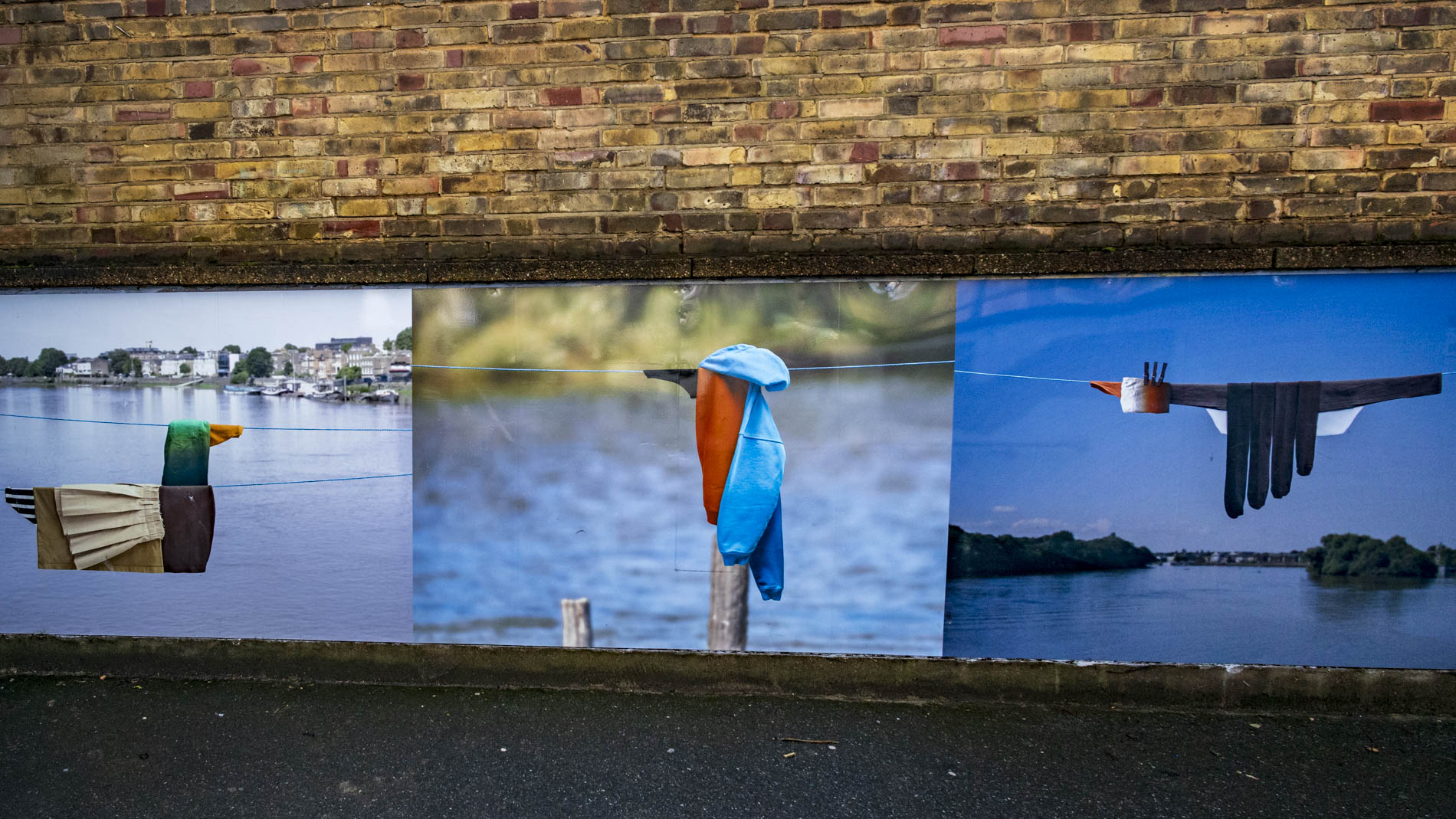
Since the EV1 is identical to the M11, I won’t go into image quality, which is well documented in hundreds of written tests and videos. It is superb, as you will see in Jono Slack’s long-term test, which we published at the time of the camera’s launch. My snaps in this article are here to brighten up the reading experience….
As with other full-frame Leicas, the M EV1 has Triple Resolution Technology, which allows you to adjust output to 18MP and 36MP in addition to the full resolution of 60MP. I am sure some users find this useful, but I invariably use the full resolution of the sensor since it’s available.
Why the M EV1?
What I did find surprising about the M EV1, which I didn’t expect, and which changed my entire impression of the camera? It was just how right it feels and how well it does the specific job it is created for. It is the lightest and smallest Leica M and, for the purist, provides the best platform for using a full range of Leica M glass, from ancient to modern, from wide to long, from fast to slow.
Sure, you can have a similar experience with the SL3 or a lesser experience with an M11 and Visoflex 2, but nothing compares with the M EV1 in real life. The camera does have its disadvantages, mainly the lack of stabilisation and lack of a tilting screen. Buyers will overlook these shortcomings in the face of the overall utility of the camera and the minimal weight.
Everything comes down to how keen you are to use M lenses on an electronic platform and how often you would use the M EV1 instead of an M11, or any other recent rangefinder. It’s a similar dilemma to when deciding if you need a Monochrom camera or can manage with post-processing to feed your black-and-white passion.

Best you can get
If shooting M lenses through an EVF attracts you, then the M EV1 is the most focused option you can get. Leica has found the sweet spot in launching a camera that will not cannibalise rangefinder sales. On the contrary, it complements the rangefinder and encourages dedicated enthusiasts to consider the EV1 as a second body. It might attract a few photographers who have always fancied the look of the M system but couldn’t embrace the rangefinder, but I suspect they will be in a minority.

But, for purists, the M EV1 is the real McCoy. I love my rangefinder, but I would willingly buy the M EV1 as an additional body. I thoroughly enjoyed my time with the camera and can recommend it without serious reservation if you want the best experience of focusing M lenses through an electronic viewfinder.
The M EV1 is a precisely honed, dedicated tool rather than the Swiss Army knife that is the average mirrorless camera with its adapter, or a standard M with its accessory viewfinder.
Make a donation to help with our running costs
Did you know that Macfilos is run by five photography enthusiasts based in the UK, USA and Europe? We cover all the substantial costs of running the site, and we do not carry advertising because it spoils readers’ enjoyment. Any amount, however small, will be appreciated, and we will write to acknowledge your generosity.
- I have used 35mm lens comparisons here, but bear in mind that, on APS-C a 35mm lens would have the same angle of view as a full-frame 50mm lens. Shorter focal length is, by the way, one reason why APS-C lenses can be smaller (in addition to the need of covering a smaller image circle and thus getting by with narrower bayonet mount). ↩︎