
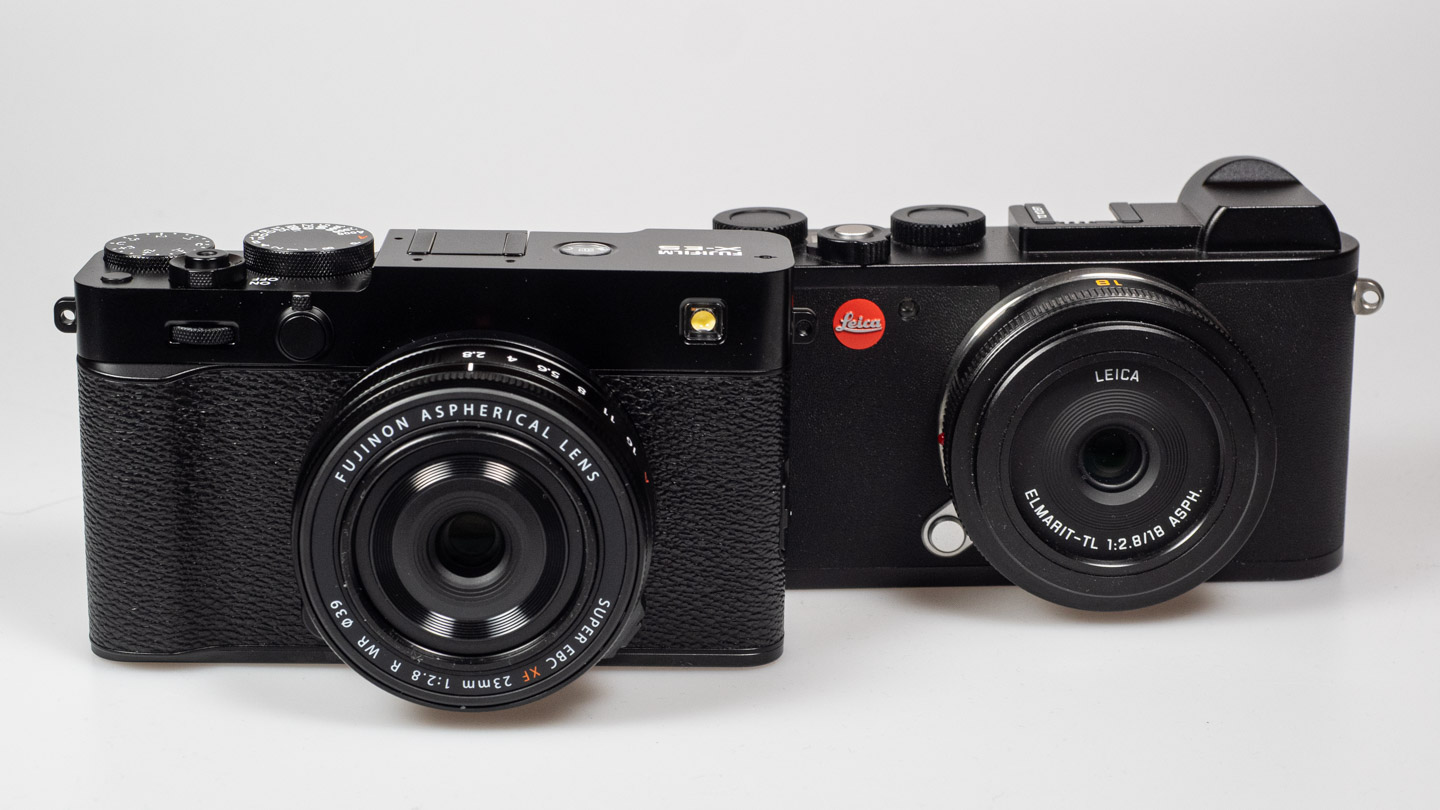
Leica vs. Fujifilm? Many Leica customers will quietly sigh. A 64-page Fujifilm system brochure and an entire display case at your retailer, with different camera models, lenses, and accessories. The Leica fan has either never bought a Leica T, TL2 or CL, or has long since sold it again. Or, worst of all, he has his Leica APS-C gear lying unused in a drawer. The question is open: What did Fujifilm do so well with its APS system — and why did Leica fail so miserably?

When it comes to Leica vs. Fujifilm, it’s worth looking back to 2009. Leica launched the X1, a camera with a fixed 24mm Elmarit lens (36mm equivalent in full frame). Initial aperture 2.8, APS-C size CMOS sensor, 12.2 megapixels, external optical viewfinder to attach. This was a remarkable achievement, and initial reactions to the €1,550 camera are positive.
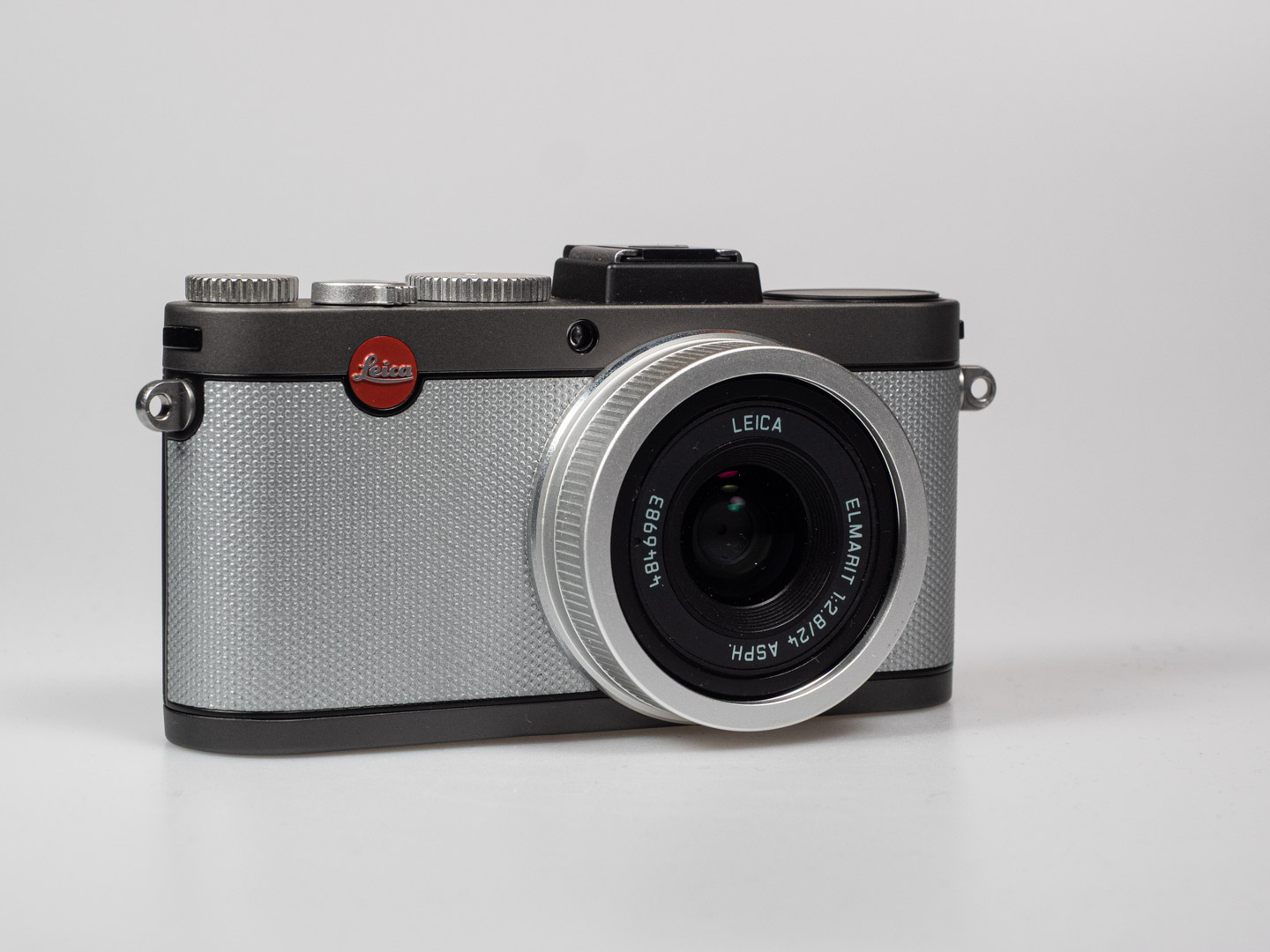
Leica vs. Fujifilm: Success with the X100
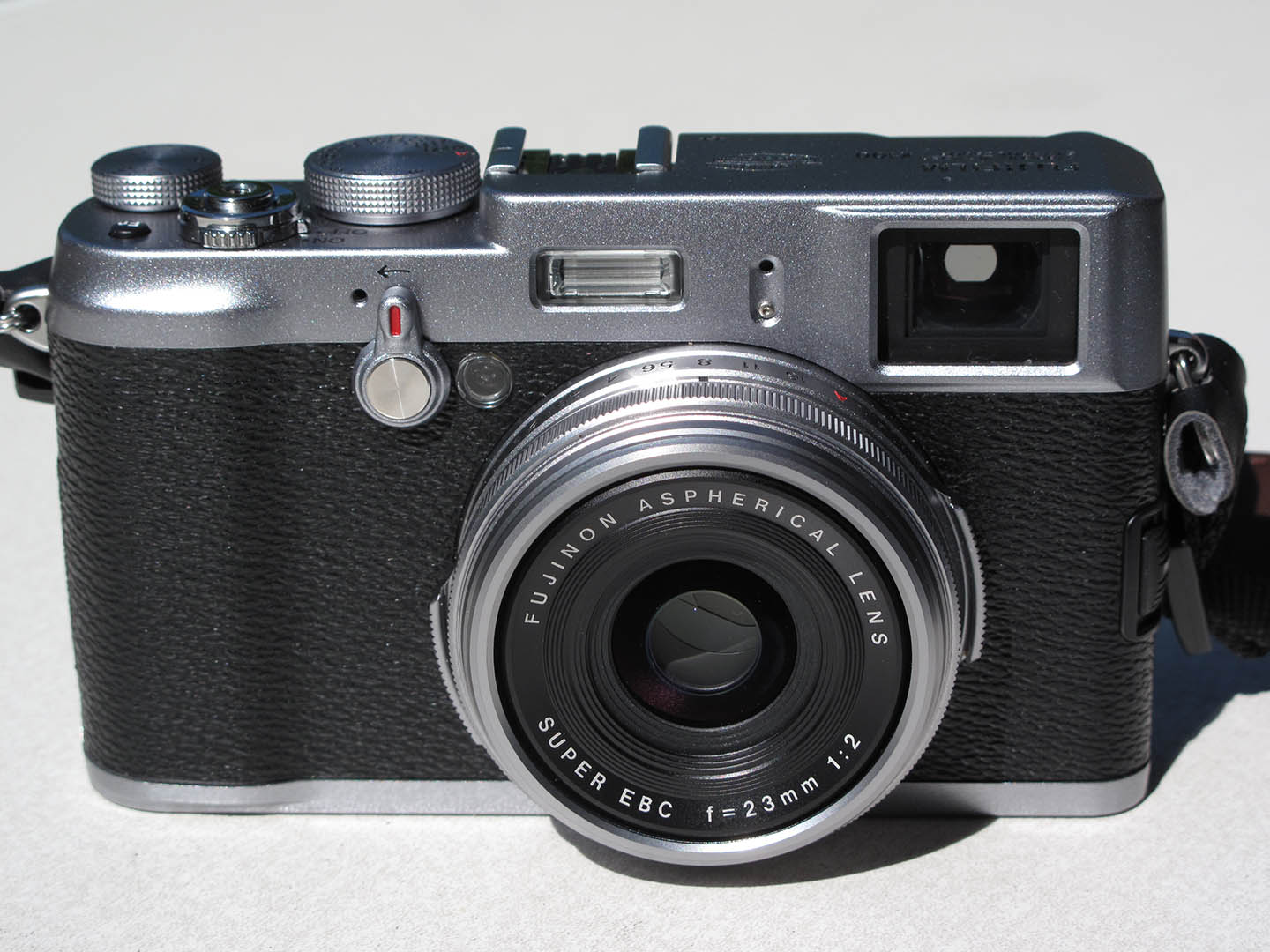
A year and a half later, the Japanese catch up in the Leica vs. Fujifilm race. The first X100 gets launched in 2011, shortly before the Leica M9. It has a bold retro design that does not deny its proximity to the Leica M. As with Leica’s X, the control dials are intuitive.
There is even a built-in viewfinder that you can use in either electronic or optical mode. In the Fujifilm X100, too, the APS-C sensor has a resolution of 12 megapixels. The 23mm lens offers almost the same angle of view as the X1. But is a full stop faster with its f/2 maximum aperture. The old-fashioned yet innovative camera costs €999 and turns out to be an instant sales success.
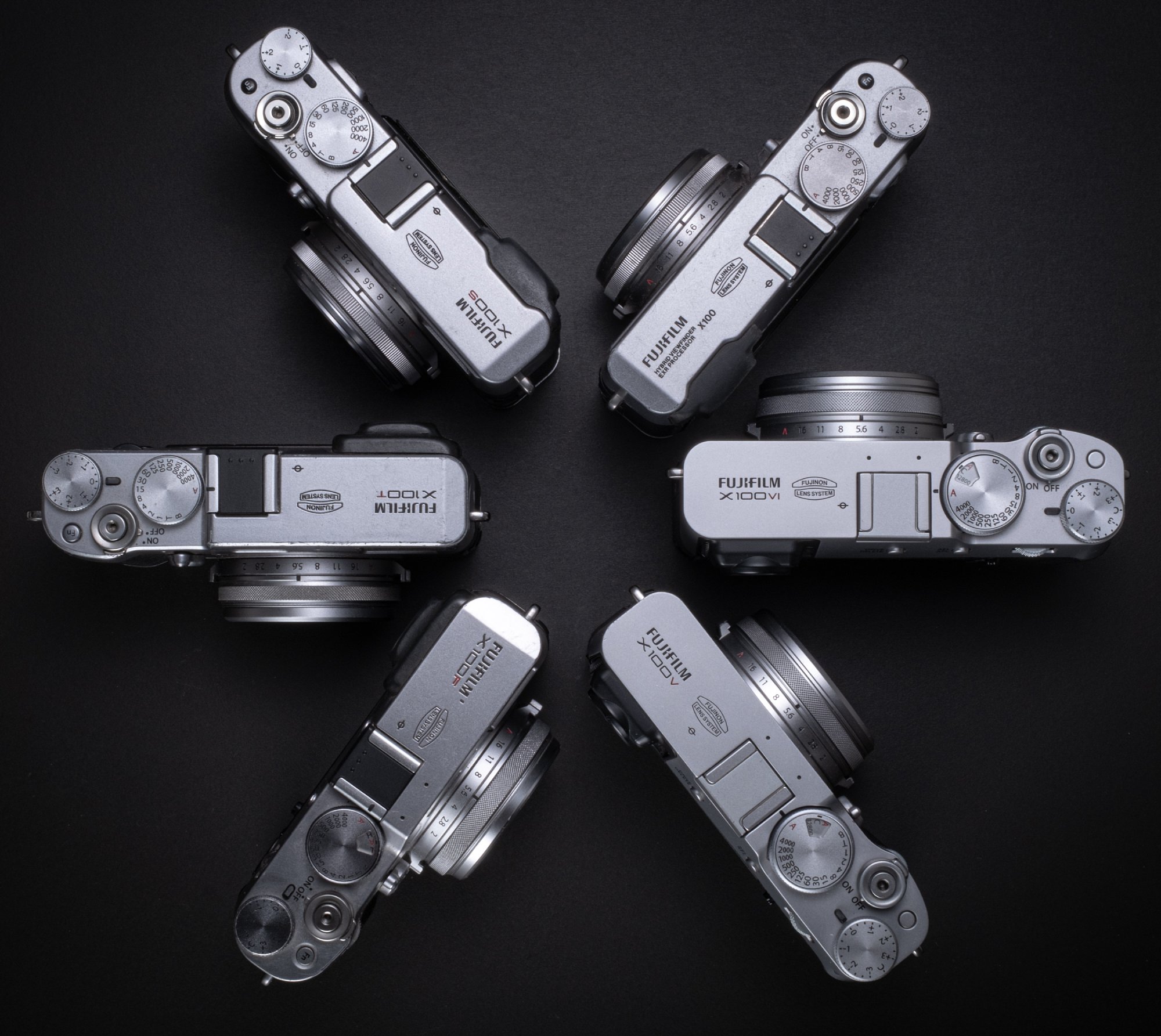
Interestingly, the starting conditions are similar. Leica and Fujifilm are both entering the APS-C market, not with an entire system but with a comparatively modest fixed-lens-no-zoom camera. At this time, the first digital SLR models with full-frame sensors are already available. Remember, in 2005 the Canon EOS 5D made the technology affordable for a wider range of customers. But APS-C is still dominant when it comes to sensor sizes.
The market for APS-C gets under pressure
Two years after the Fujifilm X100, in 2013, the Sony Alpha 7 turns out to be a true game changer as the first system camera with a full-frame sensor. At the other end of the spectrum, the compact Micro Four Thirds system is enjoying success with its small sensor. The niche for APS-C, as had already been pretty clear at the start of the Leica vs. Fujifilm competition, is becoming squeezed on both sides.
The two manufacturers decide to go their separate ways. Leica focuses on the M system, arguably the most important part of the brand’s DNA. Fujifilm opts for the smaller APS-C format and quickly and decisively builds up a system.
Fujifilm releases one camera after another
Fujifilm’s X-Pro 1 arrives in 2012, and the flagship camera is soon joined by more affordable bodies. A system emerges, named after the X-mount. The X lens range grows rapidly. The more expensive cameras feature the (by now admittedly controversial) X-Trans sensor, which offers a special colour sampling method.
Over 20 different camera models are introduced over the course of 13 years, in addition to the continuous development of the X100. In its sixth generation, the X100 has a 40-megapixel sensor, image stabilisation, a newly designed 23/2.0 lens (from the previous version V), plus a whole host of more or less useful electronic functions.
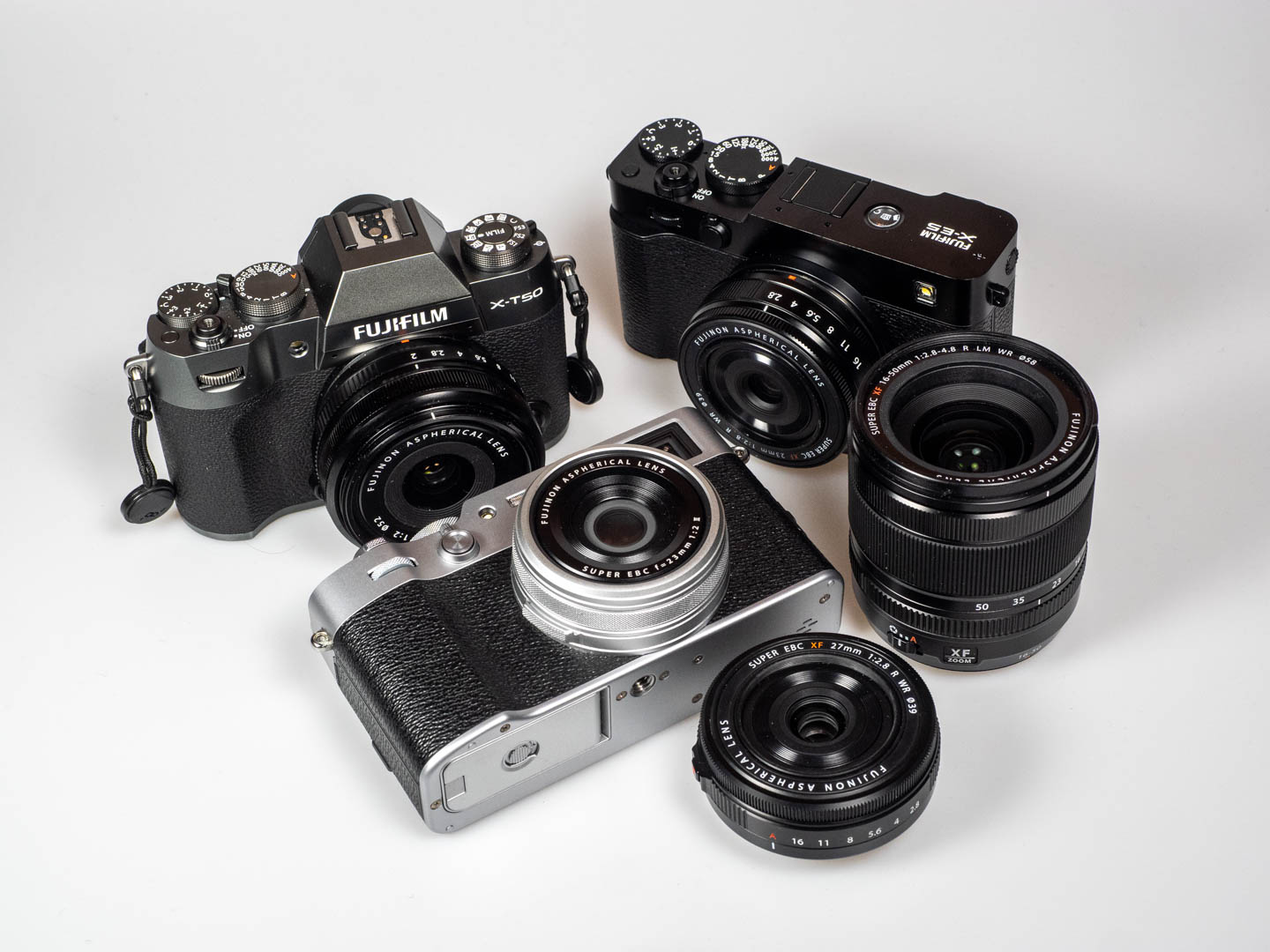
In the competition between Leica and Fujifilm, the German manufacturer does many things differently to the Japanese. The Leica T, the first system camera with an APS-C sensor, will not be introduced until 2014, and the number of lenses is always limited.
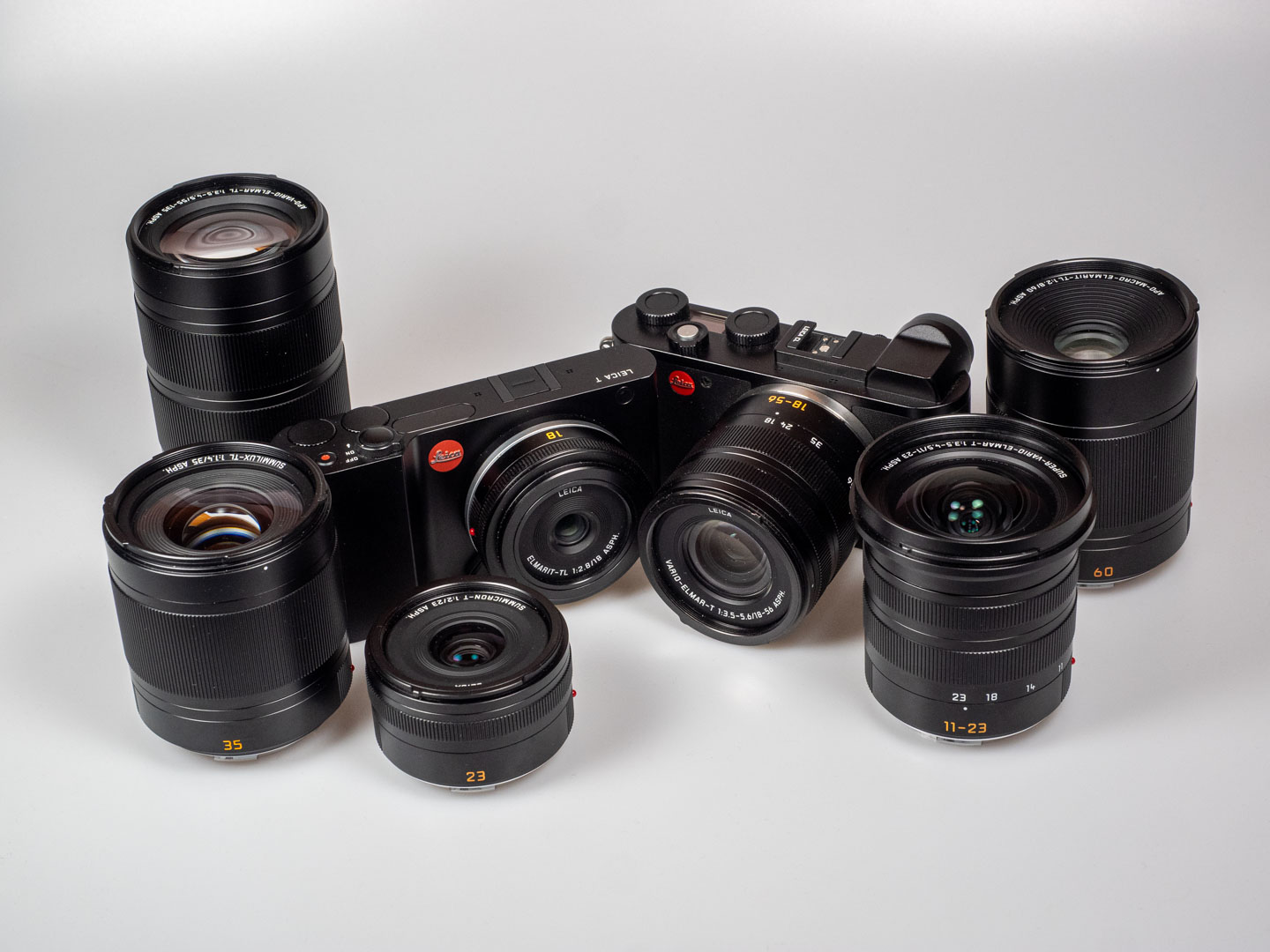
There is a wide-angle, a standard and a telephoto zoom, none with a constant aperture of f/2.8. In addition, there are a few fixed focal lengths. The 18/2.8 pancake and the 23/2.0 Summicron come from an unnamed third-party manufacturer in Japan, as do the zooms. The 35/1.4 Summilux and the 60/2.8 APO-Macro-Elmarit bear the “Made in Germany” though.
Full frame is on the horizon
The T camera and T system eventually became the TL system. This on the one hand documented its integration into the L-Mount and L Mount Alliance. On the other hand, it avoided trademark disputes with the former Deutsche Telekom subsidiary, T Systems. At the same time, however, the future path was pretty evident. The new L bayonet mount had a design to be full-frame compatible.
Leica vs. Fujifilm – the conditions are unequal
Today, we know that the race between Leica and Fujifilm was essentially decided from the outset. Leica, the significantly smaller manufacturer, has several strings to its bow. The M system sees the constant addition of new cameras and lenses. And in 2015, the SL system was added to the Leica portfolio with its integration into the L-Mount Alliance.
In the same year, the Wetzlar-based company introduced the Q and, according to reports, was itself surprised by its (still ongoing) success. With it, they seem to have found their own kind of answer to the Fuji X100 series.
Nevertheless, the CL was launched as the last camera in the APS-C system in 2017. As early as 2022, just eight years after the introduction of the first interchangeable APS-C camera Leica T, the system was officially discontinued.
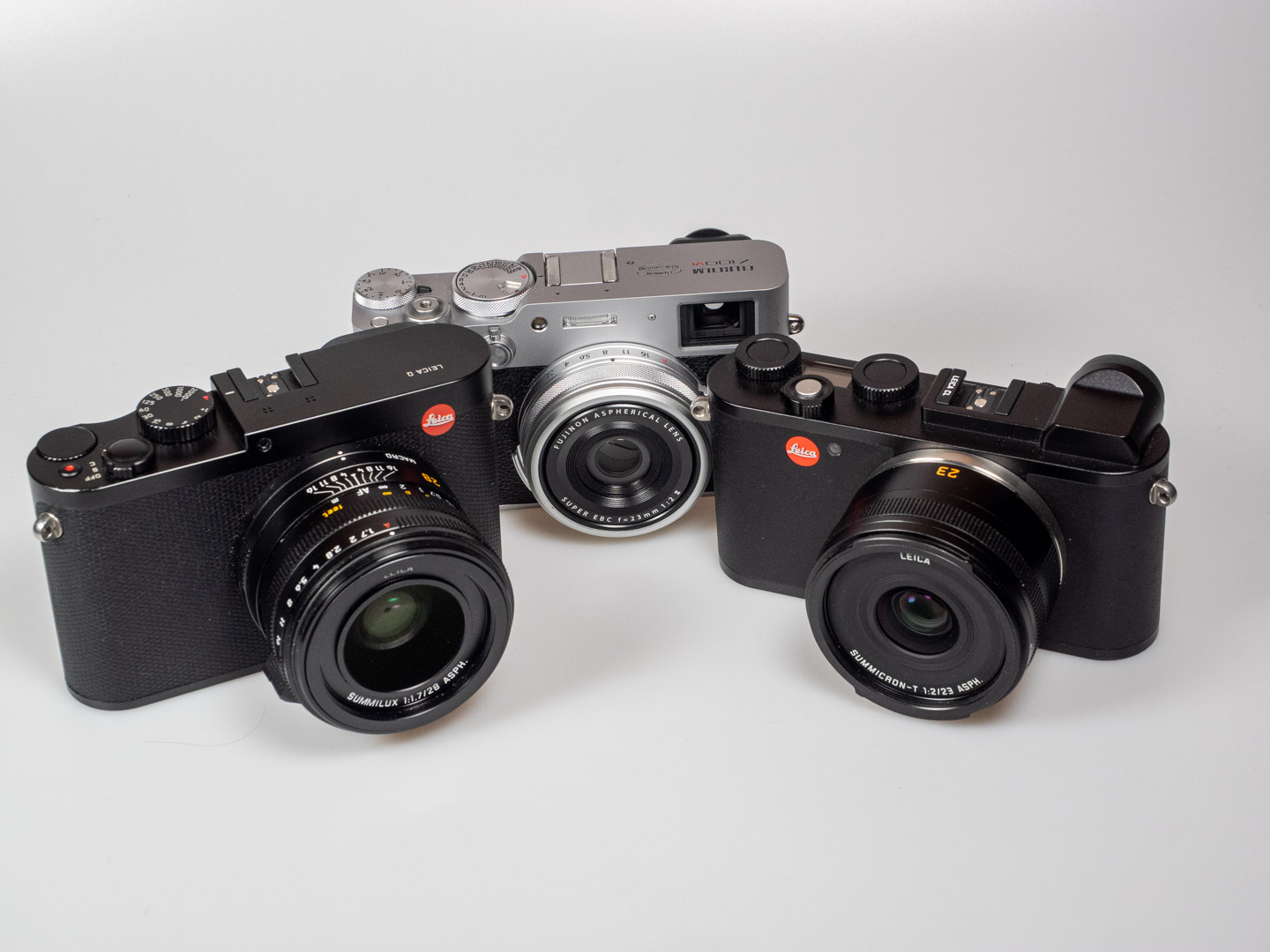
Yet at least one question and one thought experiment remain: What did Fujifilm do better than Leica? And what would have happened if Leica hadn’t given up on APS-C? The latter must remain speculative. But there are a few answers to the core question.

Fujifilm’s strategy: make sure people talk about you
Foremost, Fujifilm has defined its role as a small manufacturer (in terms of market share) in such a way that it is smarter to occupy a niche and hold one’s own in it. Initially, this niche was high-quality compact cameras with classic ergonomics.
Then came the APS-C system and, most recently, medium format (now commonly defined as the 33×44mm sensor size). And because they were at the mercy of this niche, Fujifilm invested not only in development, but also heavily in marketing.
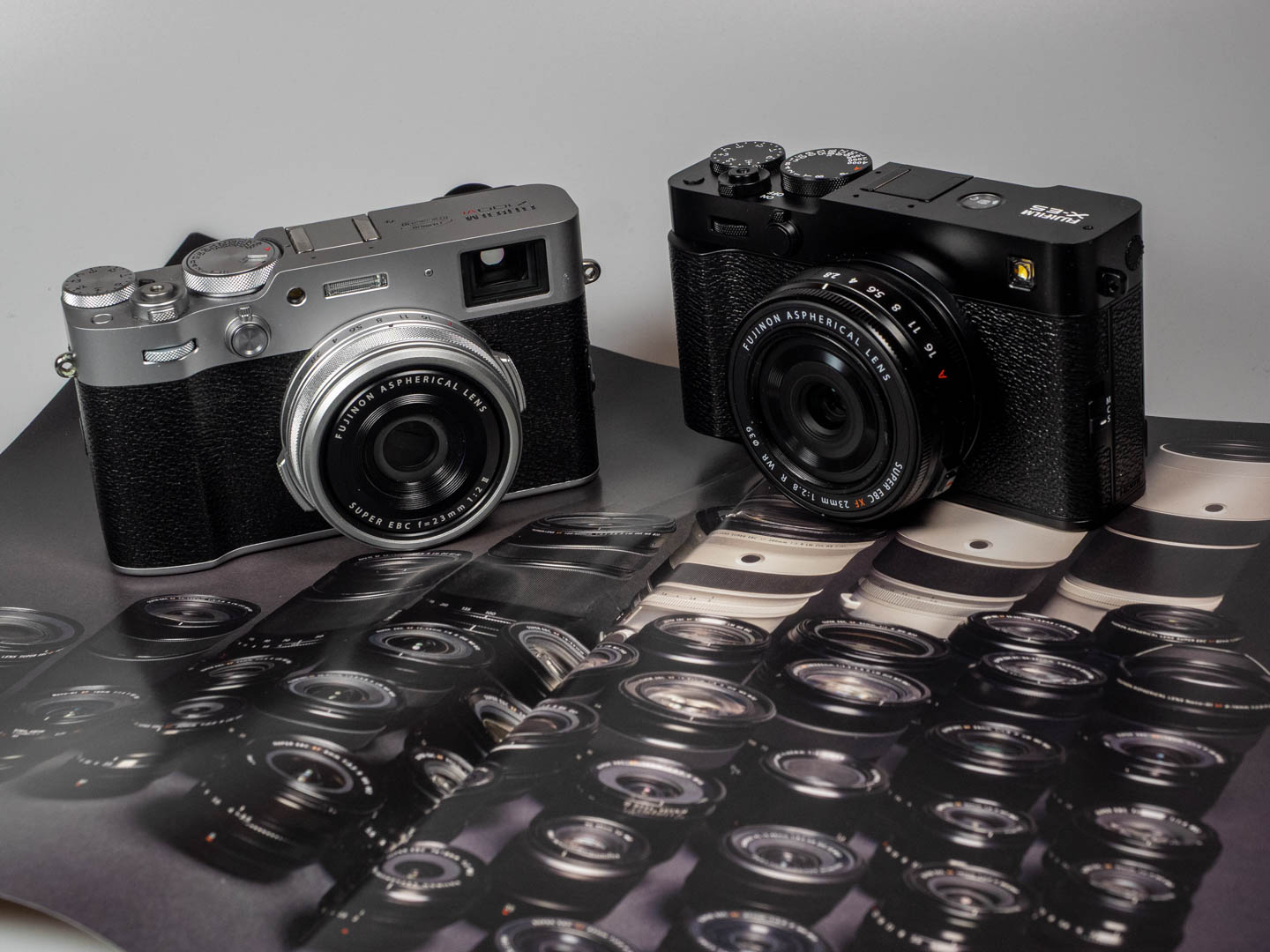
The Fujifilm brand knew and and still understands that it has to promote itself: to retailers, customers, and influencers. This requires a healthy mix of self-confidence and modesty. Flagship stores are part of this, but other factors are crucial for broad success, such as anchoring in the retail sector, competitive pricing, and brand image. And the love of the public. Recently, retailers have had long waiting lists for the X100VI and its interchangeable lens counterpart, the X-E5. Everything done right.


Leica’s strategy: never forget where you come from
Leica also has experience with a niche market, of course, and the red dot brand plays it well. So well, in fact, that Leica is racing from record profit to record profit and has developed from being a candidate for insolvency to a profit gem within 20 years.
The fact that the Japanese have learned a thing or two from the Wetzlar-based company in the Leica vs. Fujifilm race (right down to product design) has perhaps done Leica more good than harm.
Nevertheless, it is probably not presumptuous to say that the APS-C range has never truly enjoyed much love at Leica. Marketing quickly focused on the presumably higher-margin full-frame systems.
That may not have been a bad idea. But Leica now has almost nothing to offer at a price point that is still reasonably affordable for dedicated amateurs. And it leaves behind customers who feel they were pushed into a dead end. It is small consolation that the lenses can still be used on high-resolution L-mount cameras, albeit without really utilising the full-frame sensor.
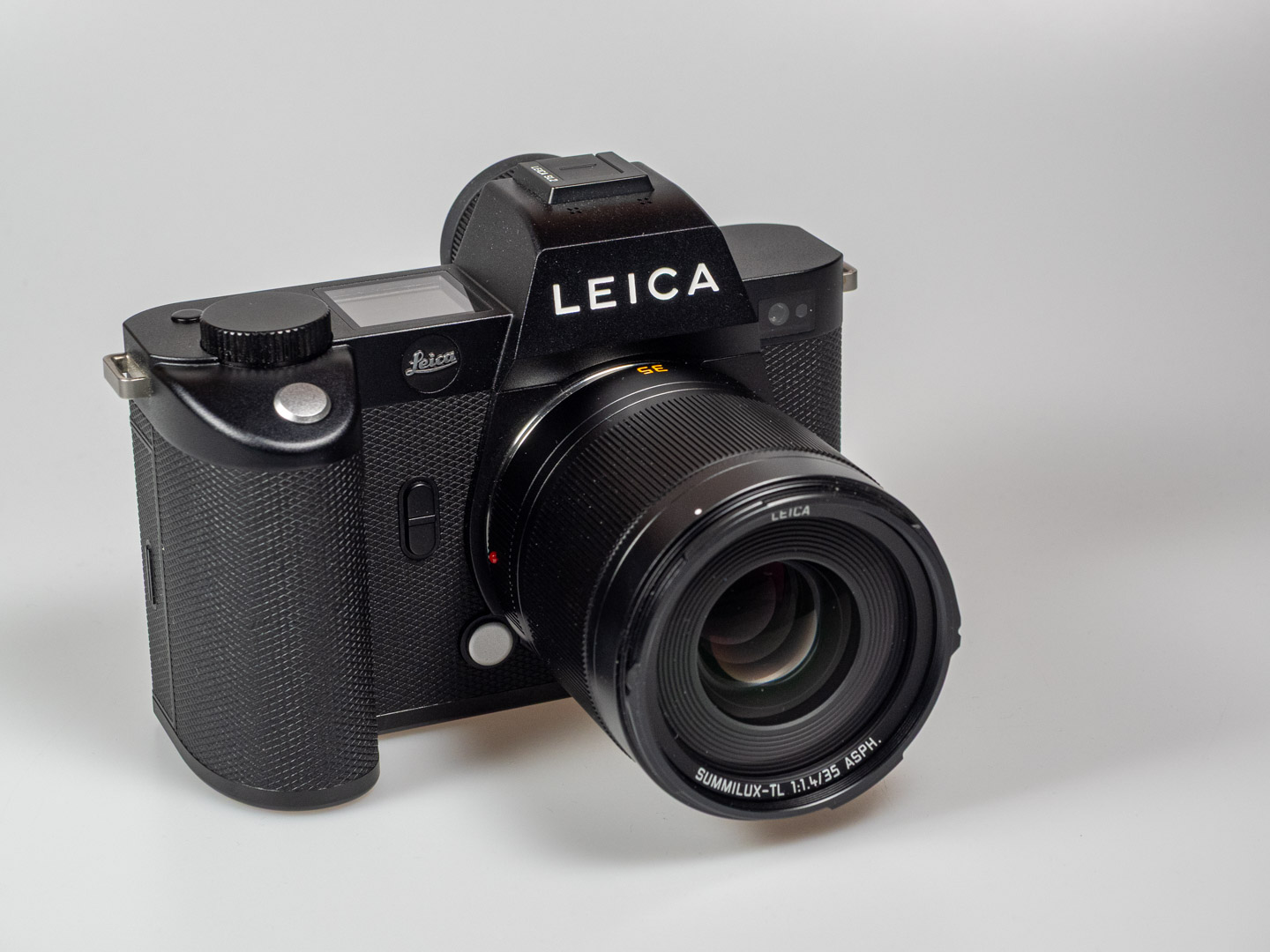
If the Q is doing so well…
The thought experiment I announced above leads into the realm of fantasy. How could it be otherwise? I would like to illustrate what Leica and Leica customers have missed out on with two examples. Firstly, after the X1, X2 and X-E, Leica could easily have stuck with a compact camera with a great fixed focal length lens, APS sensor, IBIS, and a comparatively moderate price point.
The path to what Fujifilm now offers with the X100VI would have been a long one, for sure. And an attractive price would have required some compromises, such as manufacturing outside Germany. But with the Q, Leica has shown that it is fundamentally capable of doing this, and it is superb at implementing it as well. And perhaps the success of the Q was also the reason for saying goodbye to APS, thus avoiding in-house competition.
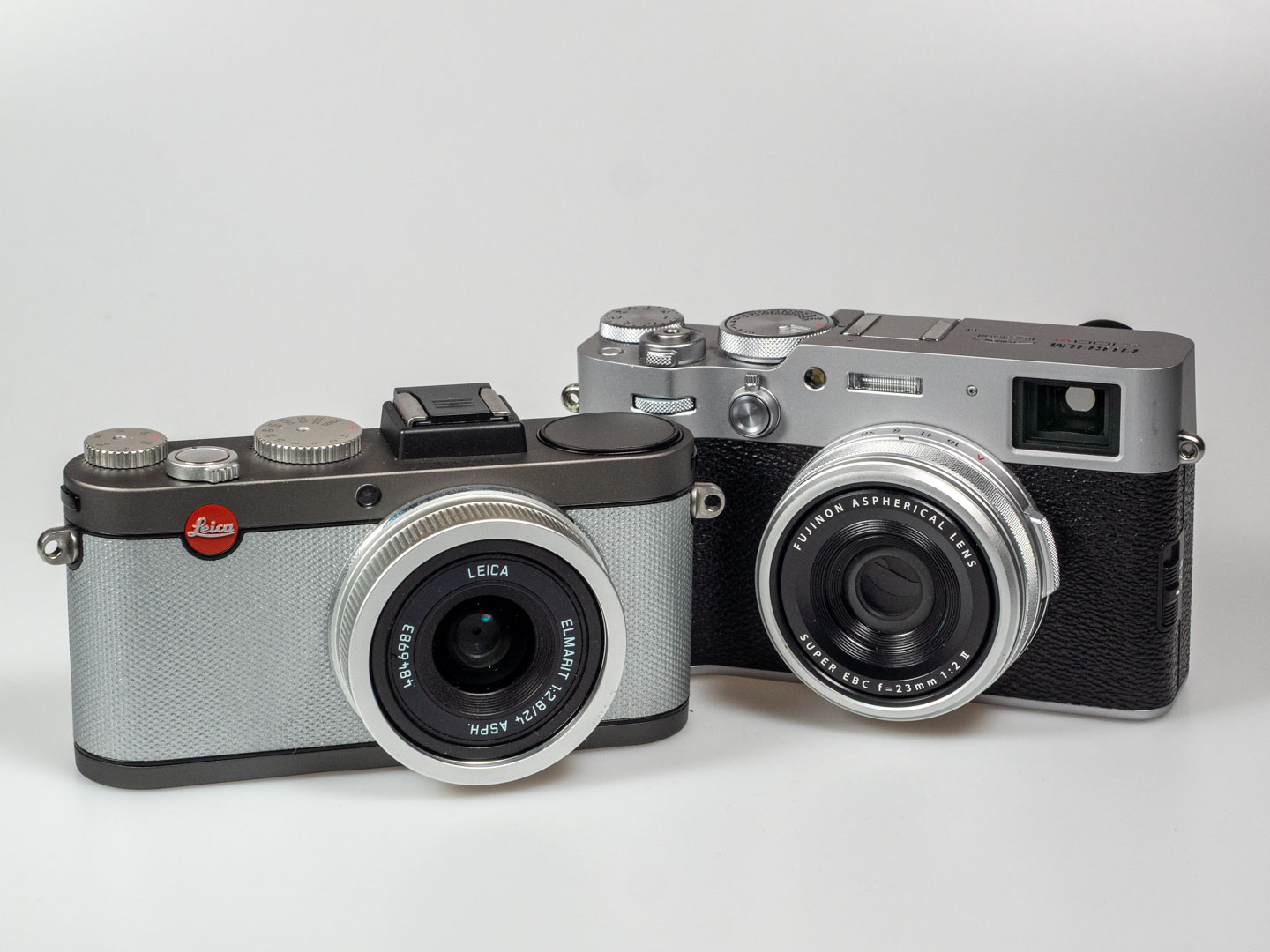
But what could have become of the CL…
Second example: The new X-E5 demonstrates what a successor to the CL could have looked like: With sensor image stabilisation (which would have at least largely resolved a much-lamented shortcoming of TL lenses), contemporary video functions and yet retaining a very traditional operating concept. If you look at the technical data of the CL in comparison (very nicely presented on this page), you might well come to the conclusion that this path might not have been quite so far off.
Leica owners do sometimes look somewhat enviously at the Fuji catalogue. Some of them also actually buy the products. Fujifilm has a good adapter for M-mount lenses in its range. A 50mm Summilux cuts a fine figure on the X-E5 as a high-speed 75mm lens. The same applies to other focal lengths. However, keep in mind that Leica claims that M lenses show their best performance on Leica cameras due to their special sensor glass design.
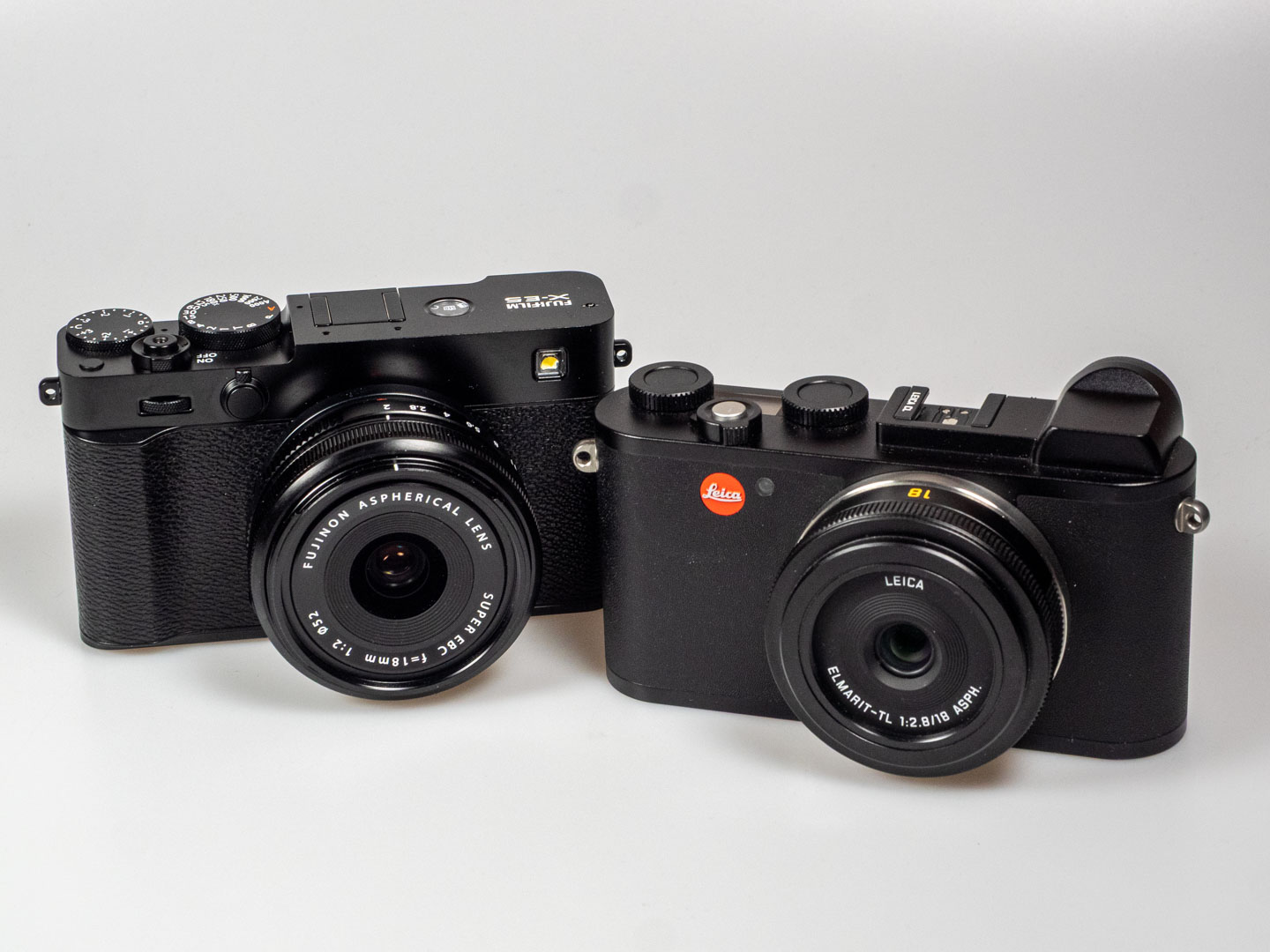
If you want something with a wider angle of view (which a cropped M lens would not cover) or a lens with autofocus for specific assignments, you will find what you’re looking for not only at Fujifilm itself, but also at Sigma and other manufacturers. And often at very reasonable prices.
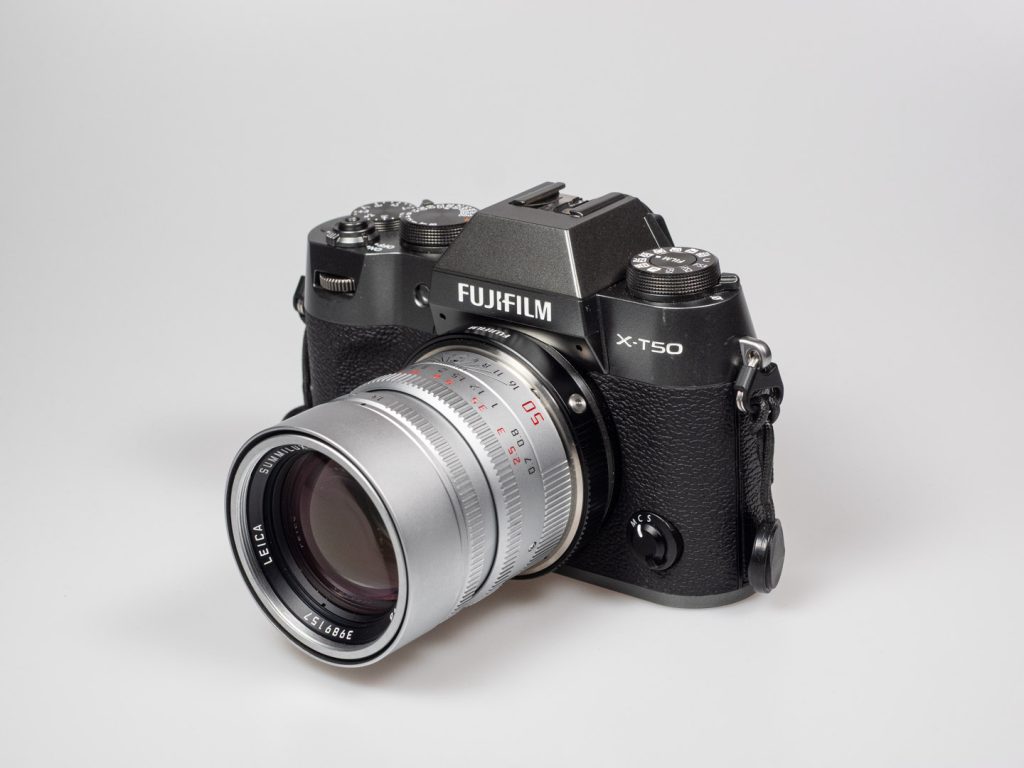
What would Barnack build today?
When Leica introduced the CL, the Wetzlar marketing department went so far as to claim that this was the camera Oskar Barnack would have built today: compact, light, easy to use and at the same time with the potential for technically excellent images. All of this could also be said — and now I’m on the verge of heresy — about Fujifilm’s X-E series.
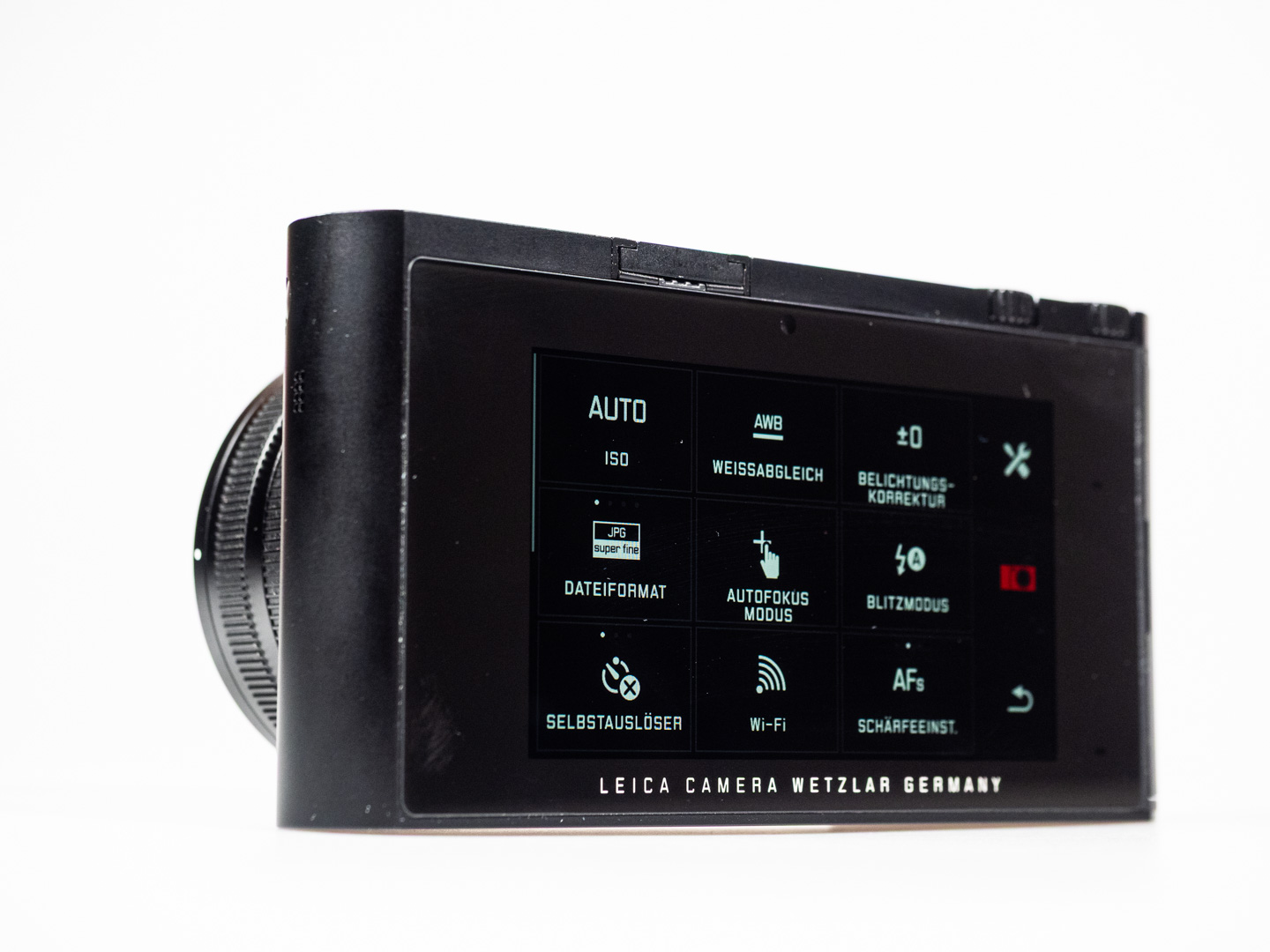
Add to that an operating concept that leaves few questions unanswered. Fujifilm is quite good at that, but not as radical as Leica. Leica’s purist approach to user experience is outstanding, and I sometimes wonder why is doesn’t get copied. I guess this is because you do need some knowledge to get on terms with Leica’s user interface.
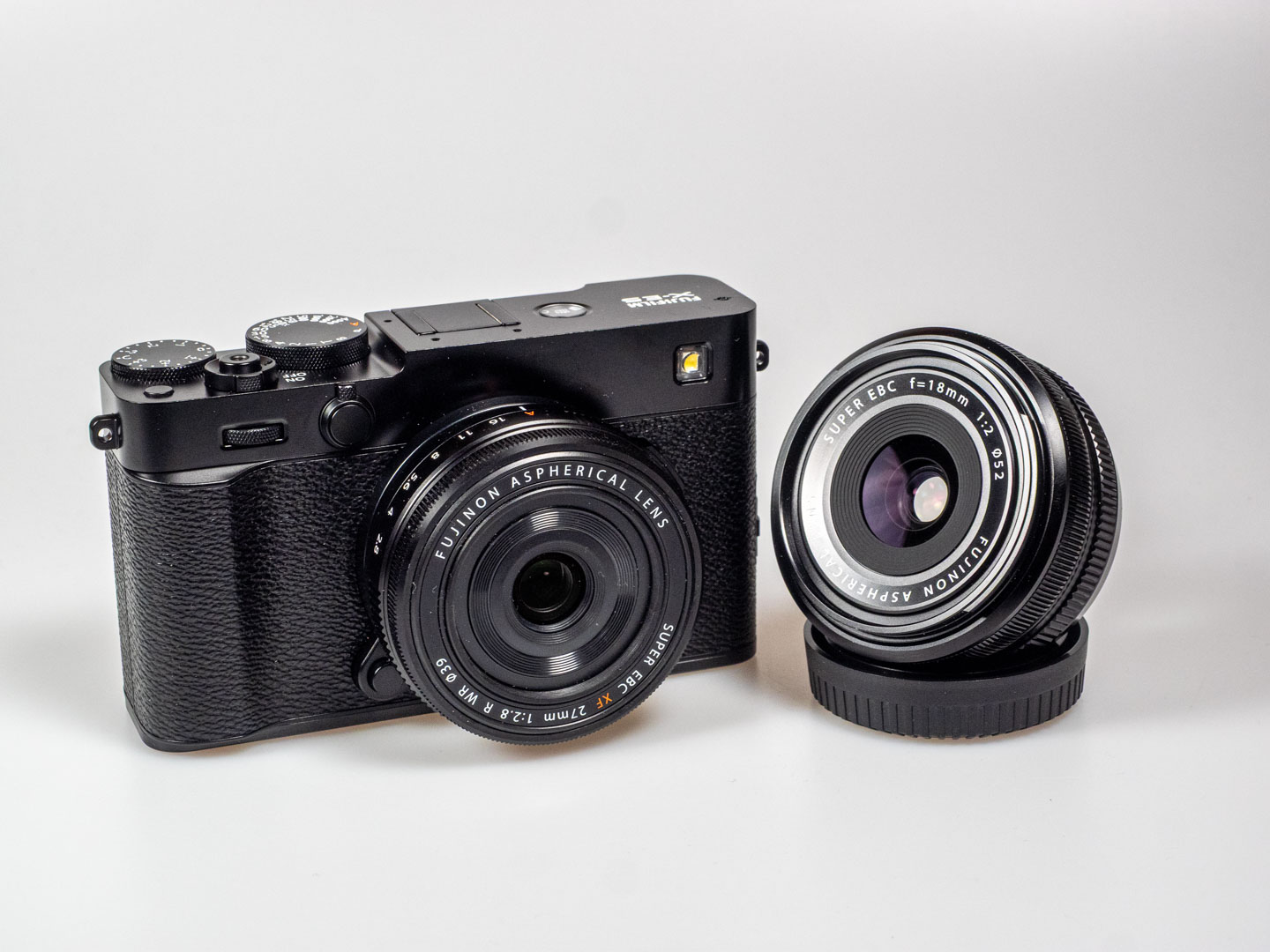
Fuji is more mainstream here, more menu points and by far not as clean in the appearance (both the camera with its buttons and dials and the menu system). But anyone coming from Leica should quickly get to grips with a Fuji without having to spend ages poring over the manual. So, the score of Leica vs. Fujifilm match is least 1–1.


To get the full picture, it’s important to note that Leica, as the pioneer of 35mm photography, had little choice but to stick with the classic 24×36 mm format. Nothing wrong with it; this strategy has proven successful for other brands as well. Leica has done this very well.
In this respect, Fujifilm certainly had more freedom with its strategy of simply omitting full-frame. In a nutshell, one could say that Leica has preserved its DNA, while Fujifilm has created a new one (and has not denied its origins in silver halide film in its brand name).
Leica vs. Fujifilm? Or both?
So, is it Leica vs. Fujifilm, or rather Fujifilm plus Leica? Both options are logical. The brands complement each other well. Yet, a glance at the market shows that Leica has missed an opportunity.
Sony has continued with APS-C, despite a rather half-hearted approach of late. Nikon and Canon have re-entered the market, this time with considerable commitment — also to occupy a specific price segment.
And honestly, often an APS-C sensor is objectively good enough. Forty megapixels, good optics and an excellent image processing engine open massive opportunities.
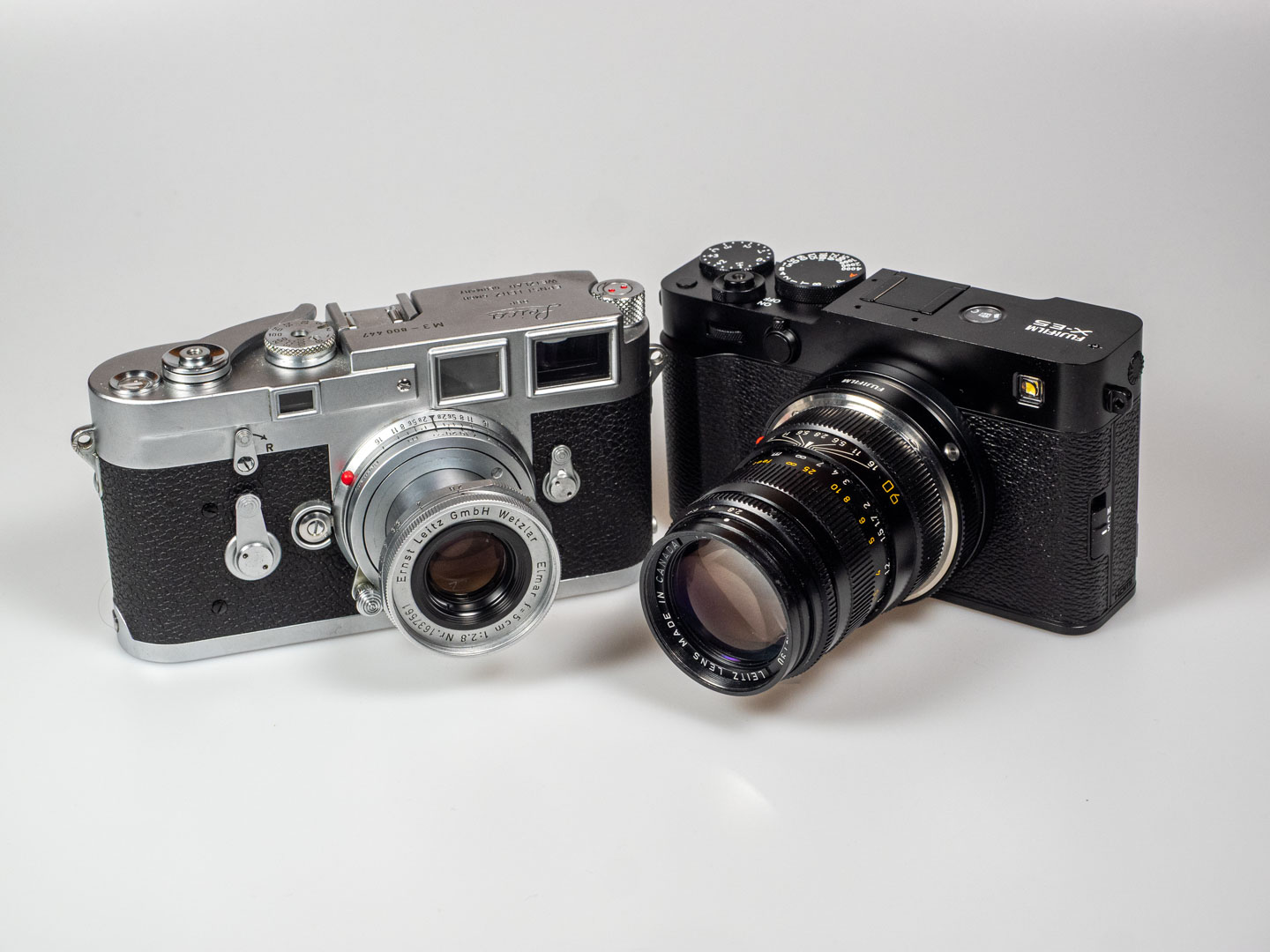
Leica lacks an entry-level system
In some Leica stores, they would certainly be happy to offer customers a system entry point with a new device including an interchangeable lens for, say, just under €3,000. The CL with the 18-56 zoom or even the 18 Elmarit was fantastic for that.
Frequently, customers would certainly not have left it at that. I guess they would either have expanded their APS-C system or eventually switched to full-frame. This low entry barrier no longer exists.


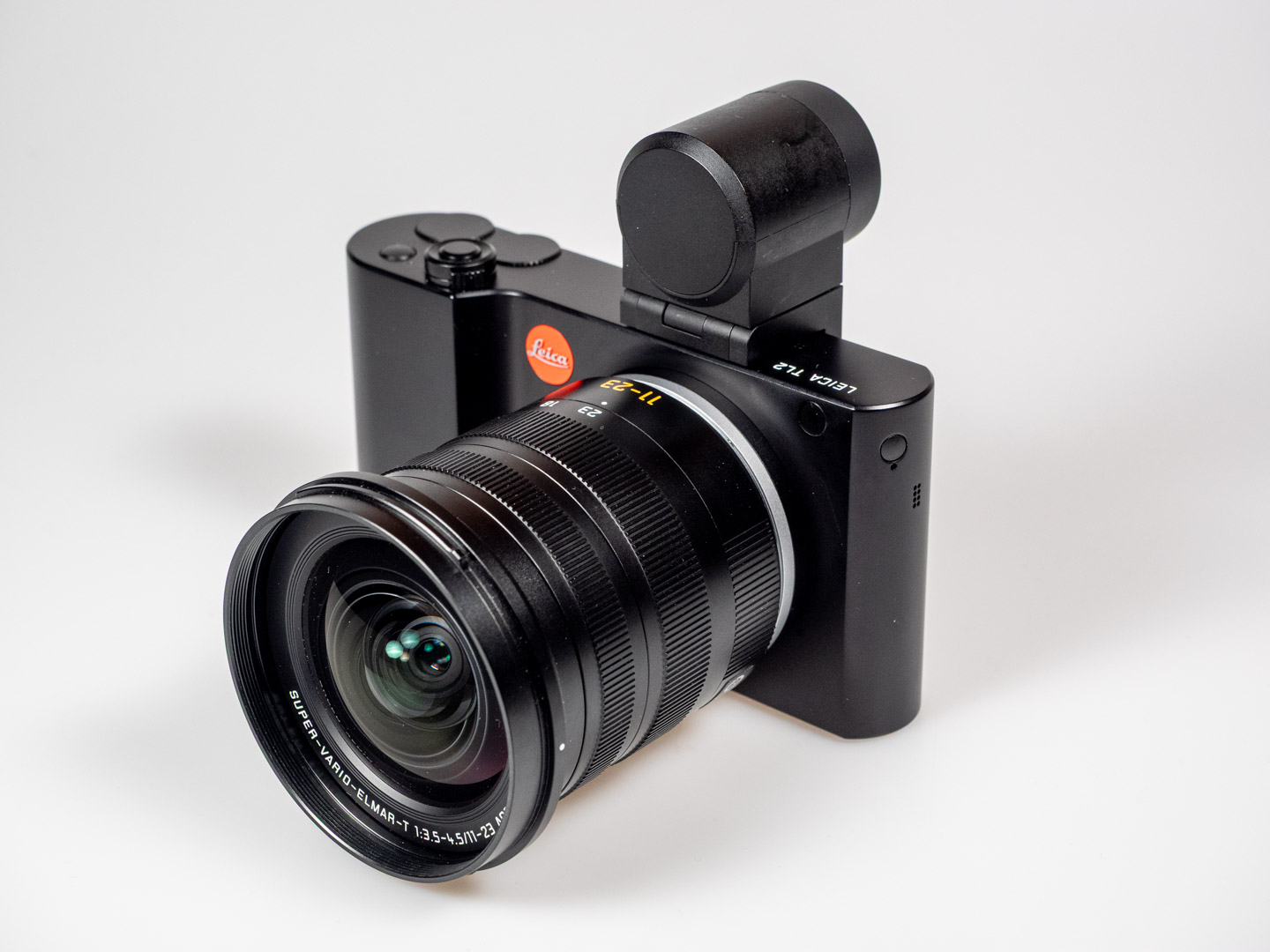
It’s certainly a shame about the T/TL/TL2 cameras with their radical user interface, which were perhaps simply too far ahead of their time. Unused APS-C lenses leave their buyers with a feeling of having made a bad investment.
In fact, these lenses are also increasingly becoming useless treasures. It’s a pity that they cannot be adapted to Fujifilm’s X-mount. But this just seems impossible from a mechanical and electronic perspective.
A good camera remains a good camera
Leica customers will probably have to wait just as long for a Mini-Q with an APS sensor as they will for a resurrection of the APS part of the L-mount. That is, forever.
Panasonic will not fill the gap either, as they have clearly committed themselves to full-frame and Micro Four Thirds. Sigma seems to fully focus on new lenses (fair enough, given the enormous success).
What remains, however, are Leica APS cameras, which you can still use to enjoy photography today. Because a camera that was once good remains good!

So what did Fujifilm really do differently?
Looking at the history of Leica vs. Fujifilm, it becomes clear that for Leica, the APS-C commitment was more of a side project. Perhaps it was planned from the outset as an episode until a broad and convincing full-frame programme was in place. At Fujifilm, on the other hand, the APS-C system has been part of the brand’s core for many years and is maintained accordingly. And with great and well-deserved success.
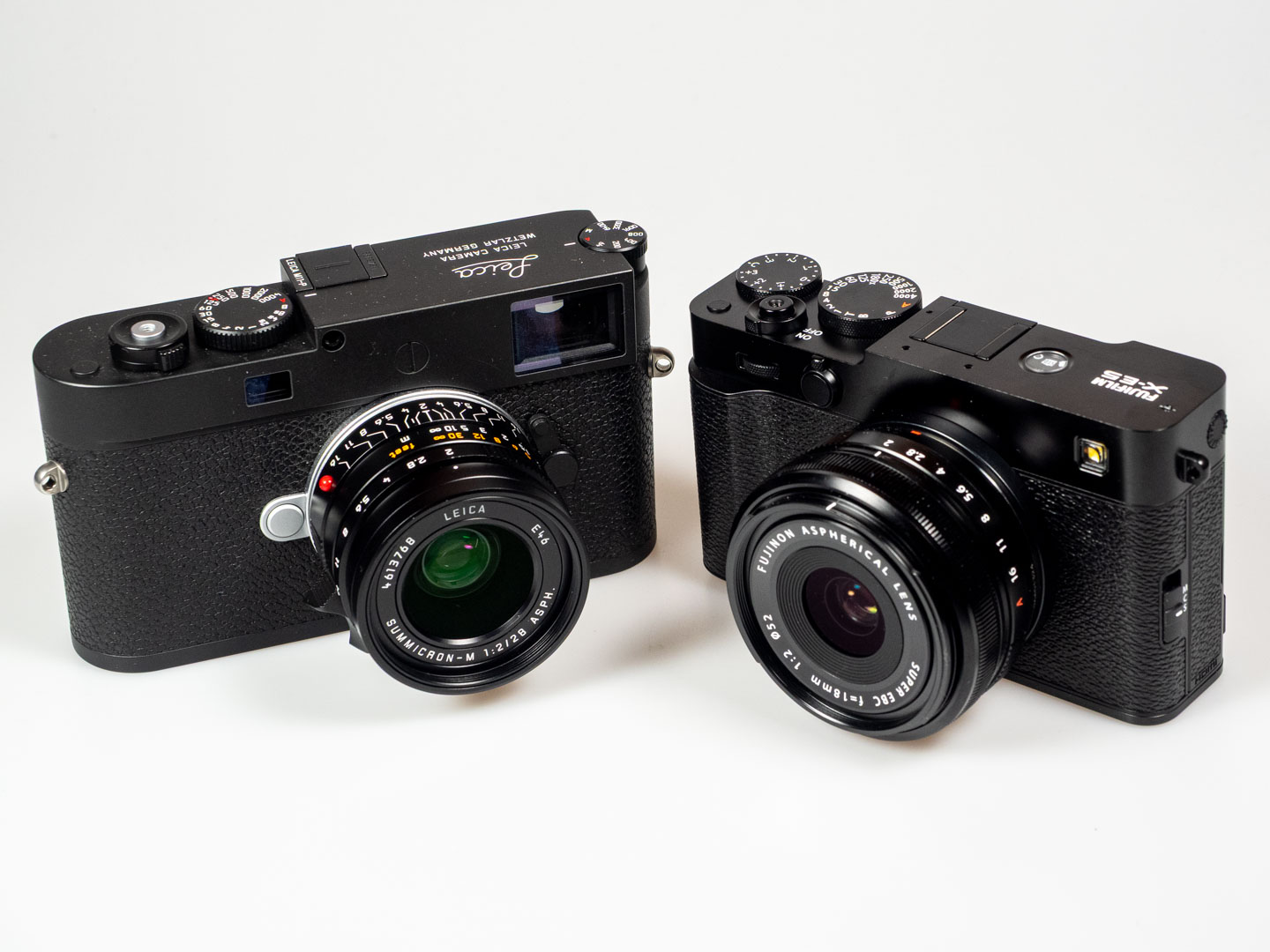
It is understandable that a small manufacturer such as Leica cannot maintain five product lines in parallel (medium format S, full format M, SL and Q, APS-C CL/TL) and additionally engage in the compact market, as was the case at times. And yet, the comparison between Leica and Fujifilm shows how far Fujifilm had actually come and what might have been possible for Leica. Sigh.
What do you think?
Is this comparison between real commitment by Fuji — who put all their eggs in the one basket they had — while Leica blinked and lost out due to the lack of commitment? Or should Leica just never have entered the APS-C field? Or never have lost it? What could Leica do to become as accessible as Fujifilm? Or are we comparing apples and oranges? Please let us know in the comments below.
And please don’t hesitate to leave questions for our upcoming big Fujifilm review which will cover the X100VI, the X-T50 and the X-E5. We selected them because all the three are cameras that will appeal to Leica users and similarly minded photographers. We will pick up on as many questions and ideas as possible.


Make a donation to help with our running costs
Did you know that Macfilos is run by five photography enthusiasts based in the UK, USA and Europe? We cover all the substantial costs of running the site, and we do not carry advertising because it spoils readers’ enjoyment. Any amount, however small, will be appreciated, and we will write to acknowledge your generosity.
This is a great article. I now use only the M system, but for many years I used Fuji X-mount, and for a period I used X-mount and a Leica CL digital at the same time. The colors and industrial design of the Leica were wonderful. But the lack of aperture rings on the lenses was, for me, a real downside. Their presence on my Fuji cameras made them feel like Ms with autofocus. Their absence on the CL made that camera feel like a miniature SL. This was fine when I was shooting a telephoto zoom, but I yearned for the feel of an M with autofocus, which is what Fuji actually offers.
Another problem was that so many of the L-mount APSC lenses were so big. On Fujifilm, it was possible to get extraordinarily small, fast autofocus lenses with aperture rings, while on my CL I quickly found that the lenses were either too big or too slow (or both). The best experiences I had with the CL involved mounting tiny M lenses with an adapter—like the Voigtlander 21/4 or 35/2.5. But those lenses didn’t have autofocus—in which case it was simply better to shoot them on an M.
So, ultimately, I think there were certain choices about lens mount and lens design that made the CL compare unfavorably with Fuji’s offerings. These choices didn’t seem determinative to me at first, but over time I came to realize their importance.
Thanks for your feedback, Joshua Rothman.
Interesting to read about your experiences with using Fujifilm and Leica APS-C parallel. Both systems have their pros and cons in usability. I fully agree on the aperture ring – here, Fujifilm has a clear advantage for everyone who prefers a more „classic“ way of camera use. Of course, the crop factor limits the options for wide-angle photography with full frame lenses, but has obvious advantages when it comes to telephoto photography.
In the competition of systems, Fujifilm did better. Usability might have been one aspect (the Leica menu system is far superior, however), pricing another. Maybe it also favourable when a bayonet mount is not over-dimensional (L-Mount was intended for full frame from the beginning and thus „too wide“ for APS-C). And the rest is history…
Best wishes, Jörg-Peter
I am a Leica user, have been for over 70 years, but back in 2010 Fuji asked me to try out and report back what I thought about what was then a prototype Fuji X-Pro 1. They sent me one camera body and two different length lenses, but to my initial horror did not include a instruction book. Had this been almost any other make camera other than a Fuji or a then Leica I would have struggled, and been out of my depth whilst trying to fathom out what did what, but far from my actually struggling with the X-Pro I instantly loved BECAUSE it and all of those Fuji cameras that followed was designed to work in exactly the same way as my then M7’s, in short a traditional analogue camera with a common sense Shutter speed Dial, likewise a proper aperture adjustment ring on the lenses, and equally important for me a equally easy to see and adjust ISO setting dial.
I could thus work it properly from day one, instruction book or not, and I just loved the resulting colour and image quality from that little Fuji’s sensor and lenses, I still have those pictures and often look back to them as a yardstick and I was so impressed at the time that in my written report back to Fuji I summed it all up by saying ‘This is THE camera Leida should have made.
They were rather pleased by that quote, and said if i wished to keep the entire outfit I could have it for half price, and I was sorely tempted but in those days still wanted to stick with and be loyal to Leica, and quite frankly later proved to be a very big mistake. In short rather than a Fuji to back up my by then Digital M’s I eventually bought such as a new Leica X-Vario, then a new Leica T, followed by a TL2 and finally a complete digital CL outfit plus numerous additional T Type lenses. All though proved to be decidedly underdeveloped at launch time with Leica all to slow to offer any updating firmware’s or fixes if any at all, all but the X-Vario needed the user to trawl endlessly through menu’s to change anything setting wise, which was not always easy if for instance working outside in very bright sunlight, and then worst of all Leica then deserted we loyal followers anyway by not only dropping each of these APSC ranges like a stone, but also stopped servicing or repairing them as well.
The moral for me thus is if you are thinking of buying, then buy a Fuji, and incidentally I have just looked on Fuji Uk’s web site and found myself yet again so very impressed , as they not only can still service those old X-Pro 1’s but they are also still offering free firmware updates for both it, the lenses, and as far as I could see, every other Fuji product made and sold from that day to this., So although I still love my Leica’s, and especially now my Q2, I do hope Fuji soon bring out a X-Pro 4 because if or when they do i will be first inline to buy one.
Moving on f
Dear Don, thanks for joining in. I hope you are doing well. It’s always fascinating to read your thoughts. So much experience and knowledge! I made the same experience with Fujifilm cameras. They were pretty self-explanatory to me, and I had to pave my way through the overcrowded menus only a few times. However, the Leica has another appeal and conveys more of these “irresistible” vibes. But isn’t it great that there is so much diversity to chose from? For now, all the best. Jörg-Peter
“Because a camera that was once good remains good!”
This is a very good statement Joerg. You hit the hammer on the nail.
And this statement was one of the main reasons why I bought a CL system in 2024 to replace my heavy Canon stuff and my Fujifilm x100 series.
I like the CL because of the intuitive-no fuss-menu system and its beatifull TL lenses that fit easily in the pockets of my -also discontinued- Billingham foto vest.
Right now the CL is at Wetzlar. The body will get a new leather dark red cowhide !
Thanks for your article.
All the best,
René
Thanks, René, for your feedback. I am sure you will continue to have a lot of fun with your CL. Interesting to read that UI is so much better on the CL. I fully agree, by the way, and I always wonder why none of the manufacturers offers a reduced, clean looking menu. Maybe even by choice, so customers can switch between “clean” and “complete”. I would be only a matter of firmware… All the best, Jörg-Peter
Dear commentators,
What a wonderful discussion in the comments section. Thank you so much for all your feedback and knowledge. I have started to answer the comments (oldest first). But there are so many interesting thoughts in what you are writing. So, it will take some time to give appropriate replies. And that‘s what you all have deserved. I will continue to answer your contributions in the next few days. Thank you for your patience. And meanwhile, carry on to comment and interact!
Jörg-Peter
Coming to this after 3 hours and 45 minutes of Leica duties today – one hour Q&A with Peter Karbe (hope many Macfilos readers were online for that – I saw Jon Cheffings there among 150 others) and 2 hours 45 minutes of an LSI board meeting. Folks here may think that I would be Leica-centric after that, but Leica clearly took decisions about sensor and image sizes at a point in time and it has stuck with that apart from the D-Lux series which has Panasonic heritage. This is known in the trade as product differentiation and it is a common technique for brand identity and market share protection. The problem with digital cameras today is that there are generally no bad products in the different market spaces for such items and for many the difference between APS-C and so-called full frame is a matter of indifference unless they are into large prints or publishing images. There are other areas of difference and haptics are part of that as well as ‘feel good factor’ and the like. The real test for the manufacturers is what customers will buy and on that score both Fujifilm and Leica have got it right, but both are offering a different customer experience which is fine by me and, indeed, that is exactly what the markets want. It is called competition. For what it is worth Leica has no direct competition in one of its largest product ranges, the M, and the Q is also more than a little ‘unique’, if I can express it that way. it is only the SL range which has real competition. For what it is worth, Leica would perceive (horses’s mouth) Sony as a bigger potential competitor than Fujifilm, but the Leica company has actually always tended to head for spaces where competition is less. To finish, this is what product differentiation is about and Leica and Fujifilm have been very successful at doing this in their respective market segments.
Jon Cheffings may wish to comment with his advertising/marketing background.
William
Thank you William,
As J-P says, Leica APS-C was caught in the middle with an ambitious and focused Fuji on one side, and the “Big Boys” on the other side with full frame. As said before, many of us felt cheated. But when you have limited resources compared to those competitors, you make every euro count. So the closing of the APS-C line was possibly the only sensible fiscal line that could be pursued.
The refocusing on the historic Leica heartland and full frame makes sense on multiple fronts. Leica has an historic abundance of riches with incredible marketing assets. Not least the inventor of the full frame camera, and the harnessing of the “Messucher” as the focusing mechanism.
Das Wesentliche could be construed in two ways; a focus on a minimalist approach to photography — which applies even more these days with confetti-like showers of features being offered — but it also works from a business perspective of focusing on what you really need to do to prosper. With those two points to focus on, then a marketer would be proud to mine that heritage and make it future-focused, to reassure existing owners and to bring in new users.
While Leitz was working its way towards a 35mm camera there were at least 40 other individuals or companies also working their way towards such a camera and frame sizes varied. Eventually Leitz and others settled on 24mm x 36mm which we now call ‘full frame’. Most rollfim cameras back then had larger frame sizes, but 35mm prevailed for many and various reasons. Back then, Barnack and the Leitz team often referred to the project as ‘small negative, large print’ but it took several years and input from a lot of people such as Dr Paul Wolff to make this into a reality. A century later on the market place is completely different and the technical quality of the images and the processing possibilities have increased enormously. So, APS-C is probably well in excess of anything that Barnack might have dreamed of.
I don’t know why Leica closed down its APS-C line, but it would have been aware of the possible consequences of doing that. It is a company that has people watching what is said online and even on WhatsApp groups and that goes all the way to the very top. I have seen some responses to such posts from Leica personnel. Leica and Fujifilm are totally different companies addressing totally different market segments and both are successful doing that. They don’t so much compete as exist alongside one another. For Fujifilm, cameras are, I believe, less that 20% of what it makes whereas Leica is in a totally different situation with Leica Microsystems having been detached many years ago. Consumers have a very wide and sometimes bewildering range of products to choose from these days.
William
Dear William and Jon, I can’t reply to all your important points. That’s why I’ll leave it at a thank you. Leica has made a strategic decision, and I hope they enjoy lasting success with it. I just think it’s a shame that there are almost no products left at a reasonably affordable price point. All the best, Jörg-Peter
Hi William/Jon, respectfully, there are (perhaps necessary) business decisions, and then there is the way they are executed. In the case of APS-C Leica just dropped its customers, plain and simple, it almost immediately no longer guaranteed service, did no longer provide essential firmware updates a/o the firmware upgrade for L-mount stabilization (battery drainage Sigma lenses) it was implementing around the same time for the SL, etc etc. Please note the difference with the S system users, these were almost immediately teased with a new medium format system on the horizon as a potential future upgrade path. Leica wants to keep those customers, it does not care about the (cheap, low profit margin) APS-C customers. In my opinion it is symptomatic for the boutique luxury company Leica aspires to be, nothing more, nothing less.
It is such a shame about the CL. I was so enamoured with mine, and I felt like I had been betrayed by Leica when it became so clear they were abandoning it. I also loved a very cheap (£300!) new Leica T that I bought. What a lovely piece of engineering.
I bought and sold an X100VI, sad about the user interface. I remain delighted with my Q3 though, which does all my heavy lifting.
I think the author is correct in thinking that cannibalisation of Q sales was the main reason for killing APS-C. Somewhat short sighted, as the success Fuji has shown indicates a healthy market Leica could have had.
Thanks, Andrew, and sorry for replying only now. I agree with all your points. I got used to Fujifilm’s interface, but then I originally came from Olympus. Working with their menus for a few years gives you strength for any camera usability challenge! Best regards, Jörg-Peter
Since Lyca started the monochrome series I am waiting or hoping for a fujifilm x100 monochrome.
Fujifilm is a master class in how to reinvent your core business – when the film market shrank in the face of digital cameras. Today, the X and GFX series of cameras account for only approximately 6-7% of total group sales; they are a very diversified group, with their Healthcare division being the largest by turnover. Their decision to not compete in the Full Frame sector and, instead, forge a path in ASPC and Medium format was a clever move, because they avoided head on competition with the major brands (Canon, Nikon, Sony). Of late, their demonstrated innovation (Instax, Fujifilm X Half, GFX100RF, GFX Eterna) shows that they are still willing too take risks and not ‘follow the crowd’. Definitely an interesting company.
I recently saw a press report stating that although “full frame” is often held as the “best” sensor format for “serious” photographers, the sales ranking shows that a large number off the top selling cameras are APSC, so maybe, in the next few years, we will see the major camera companies putting more effort into not only ‘compact’ cameras in general, but also specifically APSC bodies, where the total system cost of body and lenses can be less than Full Frame.
Thanks, Andrew, for your contribution. Yes, Fujifilm did clever, that’s what I wanted to point out. And APS-C can be a sweet spot in many respects. To me, it seems important that the manufacturers maintain one USP, the compact size of cameras and lenses. I think that’s what went wrong with Micro Four Thirds lately. We will see what the future holds! Best wishes, Jörg-Peter
J-P carefully and fairly spells out where Leica went wrong and where Fuji got it right. Arguably, Fuji had already invested in APS-C and needed to be committed to it, whereas Leica had different formats it could consider, before placing its bets.
Like any number of contented CL owners, I was waiting for the arrival of a CL2, which would have made me happy. Sadly, that never came to pass. Leica had placed it’s bet on full frame and excluding APS-C. I still own my CL and can see no real reason apart from GAS to replace it, or the 11-23mm, 18-56mm, or 55-135mm lenses.
I made a few attempts to buy an XT3 and a X100IV, but on each occasion I balked at the UI. It was like reading one of those 50 page laminated menus from an American diner. The Leica UI on the CL was much clearer and more logical with Profiles.
I ended up buying a brace of Q3s which may be all I will ever need. But that glint of new kit never quite leaves you unmoved.
Hi Jon. thanks for adding your experience here. I am repeating myself, but yes, the CL still is a good camera. I hope your own copy serves you for years to come, together with its zooms. I always loved the 11-23. And as for menus: great comparison. Couldn’t agree more, but one can get used to the Fujifilm user experience. JP
Einmal mehr ein sehr fundierter und kluger Artikel von Herrn Rau.
Die Schwierigkeit liegt doch wohl in einem gewissen Grössenwahn der Firma Leica. Kein anderer Hersteller hat sich 4/3, APS-C, zwei 24/35-Formate (M und SL) und Mittelformat angemasst. Alle blieben bei ihren Kompetenzen.
Nach meinen Leica-Jahren (M240, den Weggang bereue ich noch heute, kamen SL, SL2-s und andere mehr) bin ich bei einer Fujifim x-e4 mit 27 oder Viltrox 16 und einer Z-Nikon (unglücklich!!!) angelangt. Analog sind’s eine Pentax 67 (grossartig, immer noch) und eine F3. Aber ganz ehrlich, eine M11 lockt mich nicht.
Wenn Leica dann mal eine M mit elektronischem Sucher, Klappdisplay, IBIS und einer vernünftigen Auflösung so um 40 MP macht, bin ich wieder dabei. Versprochen.
Hi Hans-Peter, I chased your text through Google translate and you touch upon an interesting point. About a decade ago, I made the decision to standardize upon Leica gear. As I had APS-C, full frame and medium format cameras that seemed to make sense at the time. Leica was the only company that supported all 3 formats (and additionally m43) and they were quite proud of that. We all know where this went: APS-C and medium format are gone, m43 almost certainly looks like a dead end, and only full frame remains. In slightly over a decade the X, TL, CL and S product lines were trashed and its customers mostly abandoned. The question remains though. What was Leica thinking at the time? Were they just delusional? Or incompetent? Or what? It is still very very unclear to me. The decision to focus on full frame might have been a good one, but what made them believe that they could take on all of these formats in the first place?
Certainly medium format was incredibly stupid. I was considering CL but decided to wait until more lens appeared. Hence, I saw the light, and did not purchase.
Hi SlowDiver, I don’t want to speculate about these questions. But I think you got my point, also to be seen in my replies to all the comments. Sorry that I can only answer all our wonderful readers now, but it just needs some quiet hours to read and think about it all before answering. JP
Lieber Herr Huser, danke für den Kommentar. Ja. Leica hatte sich viel vorgenommen und dann eben dort weitergemacht, wo Stückzahlen und Rendite am besten gepasst haben. – Eine M240 lässt sich ja vielleicht mal zu einem akzeptablen Preis auftreiben. Und was die Wunsch-M angeht: Die Fujifilm X-E5 kommt dem recht nahe. Es gibt einen M-Adapter. Nur mit dem Crop-Faktor muss man halt leben können. Gerade im Weitwinkel-Bereich wird’s da halt gerne etwas schwierig. Herzliche Grüße, Jörg-Peter Rau
[Dear Mr Huser, thank you for your comment. Yes, Leica had big plans and then continued where the numbers and returns were most favourable. – A used M240 might be available at an acceptable price. And as for the ideal M, the Fujifilm X-E5 comes pretty close. There is an M adapter. You just have to be able to live with the crop factor. It can be a bit tricky though, especially in the wide-angle range. Best regards, Jörg-Peter Rau]
I am very impressed by this article and comparison by Jörg-Peter because it is relatively rare for Leica lovers to give praise in writing where due to other systems (in this case, Fujifilm). This fairness in the article makes the content all the more convincing. In my own case I do use both systems and though that is more than I really need each has its own advantages. For me, who doesn’t like to spend time working on raw files, the quality and film simulation choices from Fujifilm JPEGs are a major plus point for that system, while I can continue to enjoy film photography with Leica M3 and M4 and older or newer M lenses, still supported by the manufacturer and one or two well-reputed independent workshops. I like the look of the retro Fujifilm X-series offerings, which is of course an ‘imitation is the sincerest form of flattery’ compliment in part to Leica!
Dear Thomas,
thanks for your kind comment. And welcome to this lively discussion! I work with Leica cameras for very good reasons but I would not call myself a fanboy. There are some of these around; and unfortunately, they kind of shape the image of a typical Leica photographer. It’s interesting to read how you use the two systems alongside, and I am also sure they each has its own advantages. One central point that speaks for Fujifilm is value for money in my eyes – see my reply to Kathy Davis below. About straight of of cameras JPGs and film modes I can’t say anything as I always shoot RAW. But I know a lot of Fujifilm photographers who love these looks!
Best regards, Jörg-Peter
Thanks Joerg-Peter for this excellent articles. The Leica aps-c cameras are wonderful tools. I still stick to my X2 and XVario as long as they’re working but Fuji have been at the back of my mind for some time. When they die, i’ll certainly pair a fuji with some Thypoch, TT artisan or Voigtlander lenses. These lenses may not be as good as Leica ones but they’re affordable and make sense for an amateur
Dear Jean, your positive feedback means a lot to me. I have always admired your photography with the X2 and XVario. Let’s hope you won’t have to think about a Fujifilm camera in the near future. And yes, there are many lens options for X-Mount. Not to be underestimated are the Sigma zooms and prime lenses. All the best, Jörg-Peter
Let me start by saying how wide ranging and carefully thought out this article is. There are a couple of points I would like to add.
First, a technical issue. As these Fuji’s have autofocus, using Leica lenses is slightly complex — I’ve learned that one needs to learn how to ‘ride the aperture’. With that proviso, I’ve had excellent results.
The second is a personal issue: price. I’d been reading about all these high megapixel cameras, and wanted to try one myself. The obvious entry camera might be something like a (used) Leica Q2. What I actually bought was used Fuji equipment: an XT5 and three primes, the total still well below that of the Leica. And — below that of some of the used CL cameras. I won’t claim that Fuji glass is comparable to that of Leica glass, but at my level, Fuji seems quite nice.
The third is a general point: you mention coming reviews of the X-T50 and X-E5. These strike me as the same kind of cameras, the former being mentioned in reviews as ‘entry-level’, both serving photographers interested in SOOC photos, and both offering an EVF somewhat crippled for a 40mp camera!
Thanks for adding and sharing your thoughts, Kathy.
I agree that you get excellent value for money at Fujifilm. Sure, it’s not Leica in many respects, but certainly good enough for serious photography. I just used the Fujifilm 50/2. No, it not up to the Leica APO-Summicron 75/2. And no, the Fujifilm cameras don’t feature the excellent user interface Leica has refined over the years. But rationally seen, you never need “the best” but “good enough”. However, it can be more fun to work with “the best” or possess “the best”.
As for your comment on the X-T50 and X-E5. These are very similar, mid-level cameras. I have used them both, and the main difference is the more rangefinder like form factor of the X-E5 which means no built-in flash, though. The EVF is “good enough”, maybe a bit on the small and low-res side, but sufficient also for a 40MP camera. If you want to check super critical sharpness, you would enlarge your shot anyway.
All the best, Jörg-Peter
Great piece Joerg-Peter, many thanks. It nudged my memory, which is partially broken, in regard to some of my Leica regrets and satisfactions.
My favourite digital Leica camera, was and remains the digital CL. However, I sent that into touch, when the Q2 emerged, I wanted so much to have (so called) ‘full frame’, incidentally, at the same time that I had that CL (18-56), I also had a 1932 Leica ‘Barnack’, with a fixed lens.
I regret selling that too, as it had an incredibly smooth mechanism. I remember being at Ramsgate (Kent), which is a rather picturesque location with it and it ran out of film, so I popped into a shop and bought a new roll, then had a really difficult time loading it, I didn’t have a trimmer, or pair of scissors with me, I quietly lost my cool, and sold them both shortly after and purchased the Q2 that I still have.
However, when I look back at my digital library along with my scans of those Barnack negatives, I wish that I still had the CL and instead of all the selling/trading, just bought myself a few CL primes, namely the 18, the 23 and the 60. I still think that the CL is my favourite Leica, and I regularly look at the various used outlets to see what is around.
I think that I would still have sold the 1932 Leica, and replaced it with the MF Hasselblad SWC, but waited until a nice T* coated example turned up for a reasonable price. The Hassy is quite heavy, but the negatives are wonderful, and with the T* are still some of the best snaps that I have made.
With 20/20 hindsight, I would still have the CL along with the SWC, and I would have added a 4×5 pinholio specifically for World Pinhole Photography Day, which is April 29th this year. I am currently assembling that 4×5 system with WPPD in mind, I have the camera which was made by James Guerin at Reality So Subtle, I have two wooden film holders in the post, both made by the old English company MPP. I have some Ilford paper and I am currently studying what negative film to use as my initial stock. Currently, I am looking at either Ilford, most of which is either out of stock at Harman, or Foma, a great and revered company that still produce fresh stock. A third and rather more esoteric choice is to paint my own negatives, which might be messy and fun!
Finally and more on point, that CL was wonderful, I wish Leica had kept going with it, and not bothered with the Q series, I would still have it.
Edit: “The Hassy is quite heavy, but the negatives are wonderful, and with the T* are still some of the best snaps that I have made.”
I did not own an SWC with T*, I just remember seeing the difference between a coated and an uncoated version on a blog somewhere.
It remains to be said, that I would still have the CL if it hadn’t been for the introduction of the Q2, and I would have traded my SWC for one with the T* coatings, my original one was £400, and are now somewhere between £1300 and £2500. The T* versions go from £2000, up to £4000+.
Nowadays, as an impoverished English senior citizen, I mess around with the Campsnap cameras, which are cheap American digital cameras, that have been quite fiddly to use until now. Yesterday, I received in the post my new Campsnap Pro, which has the colour/B&W switch on top of the camera, easily accessible. They have doubled the pixel count to 16mp and I am just nipping out to take a few snaps this morning to see what it does.
Oh and if I sell my house, or Mr. Starmer gives me a £20000 Easter Bunny, I will go for the new version of the Hasselblad SWC the 907x special edition. There are a good number of reviews around the net, and this camera with its “natural colour” is second to none… No… really!
On the other hand, I might just dump the lot and buy the iPhone 17pro, which seems to do everything and fits into a capacious pocket. My daughter who is a photo editor for PA, sometimes (when she has already allocated jobs to her available professional photographers), goes out to cover a particular assignment herself, and she only takes that iPhone with her.
NB: There is an American chap called Steve Huff, who has an extensive review of the new digital Hasselblad 907x.
Thanks, Stephen, for your comment.
Sorry to read about your grief over the CL. As I wrote, this was, is and remains to be good camera. I think it would not be too late to trade the Q2 in for a CL if one turns up at a good price. Which will not happen with a SWC T*, I am afraid. At any rate, don’t let yourself be held off from photography. Any camera can produce images that mean something to its user (and ideally also to others)…
All the best, Jörg-Peter
Thanks for this comprehensive analysis. It’s become clear the second time that Leica are afraid of cannibalism. The fantastic analogue Leica CL introduced in the early 70’s was discontinued far too soon. Leica was afraid that they had introduced their own fierce competition. And with the APS-C range – wonderful T, TL and TL-2 cameras I think the same happened.
What Fujifilm did right is the principle of “frapper toujours” and stick to your guns.
Thanks, Gerard, this comparison is striking. I should have mentioned the film-loading CL from back then. And this all the more as I even dedicated a full episode in the M Files to this wonderful camera: https://www.macfilos.com/2021/03/29/leica-alternative-leica-cl-with-leicas-40-2-and-90-4/. Blame on me and thank again for bringing this to our attention. JP
Thanks. Fascinating article.
I agree that Leica lost its way.a bit. The Q3 is a very good camera, its just not as comprehensive as the X-series.
I shoot an M3, an XE2 and an X Pro and use the Summicron that goes with my M3 on the Fujis via an adapter. The ‘cron on the XE2 makes a great camera and despite the limitations of the Fuji’s sensor produces a good image.
The optics from Fuji aren’t quite up to Leica standards, but they go a long way. Of course there are the Chinese M-mount lenses that promise a great deal of quality at a fraction of Leica lens prices, even if not quite Leica quality (see the various articles in Macfilos recently).
Price is evermore of an issue – of course I would like an M11-M, but against Fuji’s price points, it is becoming less and less of a realistic prospect. I was talking to a Leica dealer about all this and, as you indicate, they were sensitive to the issue and hinted that they too would like to see the ability to compete more. But I think that for me I will use both as in your photo,
I do wonder whether the current pricing model is sustainable for Leica in the longer term. The camera becoming a luxury good in the face approaching quality? Is that the way they want to go. Where is the heritage and how are the young, upcoming would-be I really think Leica need to revisit some of their earlier thinking.
Hi Peter,
thanks for your feedback and joining the discussion. The Q vs. X100 comparison is a never-ending story, and I think both cameras have their strengths. I own the first Q model and continue to use it, but have to confess that it take the X100VI out of the drawer more and more frequently. Well, it’s a far more modern 40MP sensor, a more versatile focal length, I find the built-in flash often useful, and it is smaller. In good lighting conditions, however, I personally prefer the RAW (DNG) files from the Q.
Leica’s long-term strategy is another story. They might feel they need no entry-level products right now, but as you are saying, they should not forget the next generation. Not all of the youngsters are happy with a worn-out M4 plus an old Summicron which is arguably the cheapest way to get into Leica right now. The future will tell.
Tanks again and have fun with your beautiful kit of gear. Jörg-Peter
I was astonished last year when my Leica T’s internal battery died and Leica Australia told it was a hard NO on replacing it. Everything reset everyt time I turned it off, not just the clock, so it was nearly unusable.
What Leica did offer was a trade in on a new CL. Brand new. At a very good price. As I already had a CL and several lenses I took them up on it and am very happy with my CL outfit now.
Hi Mark, it is worrying to hear that a Leica T can’t be serviced any more – but good to read you got a replacement that suits you. Have fun with your CLs. These were, are, and will remain to be good cameras. JP
Leica T made out of a block of aluminum, esthetics is important to Leica. The T is beautiful. Yet it had no built in viewfinder. I fear that the long awaited S4 will never arrive. Two systems, dead. Did the Q undermine both?
Hi Daryl. The Q was certainly an unexpected success for Leica, and it will have taught them what customers want. The T was beautiful and revolutionary, but it did not sell well. And about the S I don’t want to speculate. Leica will know that Fujifilm and Hasselblad are doing well on a very small market. You will remember that there were rumours already some years that the new Leica medium format camera could be a mirrorless. And in fact, it makes no sense to bring a new SLR camera. But a new mirrorless system would require a new bayonet, new lenses and all. And with the not really encouraging figures from the SL system, they are likely to think twice in Wetzlar. So, you might well be right with your comment on two dead systems. In how far the Q is responsible, I cannot say, though. Jörg-Peter
I am a Leica M11M and Q3 43 shooter and love them both but I still long for a true “pocket” Leica, like the C/M or Minilux they used to produce. The CL + 18mm was close and the image quality was excellent. I would settle for a small fixed lens (43mm f/2.0) camera in the style of the Rollei 35S, with auto focus and IBIS (to keep the lens tiny), with manual override on the aperture and shutter speed. The D-Lux is not quite small enough. When traveling light, it is nice to know when your primary camera fails, you have a backup in your pocket that is more capable than your phone.
Hi Bill, thanks for joining the discussion. I can only reply now, sorry. I can image what you wish for, but I am not sure if this is feasible. The Ricoh GR some pretty close to the Rollei 35 – maybe you have read my article on exactly this comparison: https://www.macfilos.com/2022/11/18/40mm-compacts-from-ancient-to-modern-with-the-rollei-35-and-ricoh-gr-iiix/. The CL+18 was a wonderful kit, but certainly not smaller than the D-Lux (but with a better, higher resolving sensor for sure). Maybe you want to give the new GRIV a try… All the best, Jörg-Peter
I had the X1, then the X100 and X100s. They were superseded by the Sony RX1 and RX1R2, themselves superseded by the Ricoh GR, augmented with the Q3 43, and I also have a M11 and a Nikon Z8.
Leica was right to abandon APS and focus on full-frame. Even Sony has largely abandoned APS and 1″, so a much smaller company like Leica needs the focus and not disperse its resources into a quixotic pursuit of an entry level line that would have bankrupted the company.
APS makes sense if you can deliver portability as Ricoh has done with the GR. I have zero interest in getting a X100 again.
Companies like Fuji and Ricoh that commit themselves to APS-C have enjoyed immense commercial success. It is all about commitment. The fact that Leica wasn’t able to do that really says nothing about other companies. And even Canon is rumored to release a 40MP R7 Mk II and a 32MP R10 Mk II in 2026, both APS-C. Why would Canon do that if APS-C was dead?
Thanks, Fazal, and sorry for the late reply.
I agree that Leica can’t be invested in so many different systems. And I also agree that they were simply too small to run such a huge line-up. But still, it’s a pity, and I can understand that people who bought a T, T2 or Cl are now disappointed. And I agree with SlowDriver that there IS a market for APS-C system cameras beyond the mini pocket solution from Ricoh. Portability is not all, at least not for all customers. See the tremendous success of the Fujifilm X100VI. I know from dealers that they sell ten or twenty as many as Ricoh GRs. And why? Because it is objectively the better camera, apart from small size.
Best wishes, Jörg-Peter
Having used a Leica X1, Fuji X-E1 and 2, various Leica Ms and a Leica Q2 (but admittedly no L-mount based cameras), I think it all comes down to user experience and unique selling points. Some users will buy Leica for the brand name but most will want to get something unique for the price, something they can’t get with the competition.
The Leica M combines a very traditional camera experience (optical rangefinder, manual focusing, dedicated speed knob and aperture ring) with top-class lenses in a very compact package with a full frame sensor and a (now) modern, clean menu. They basically have no competition and they can (unfortunately) charge as much as they want for it.
The Fuji X system probably delivers the next best thing if you are after that kind of experience (rangefinder-shaped camera with dedicated speed knob and aperture ring on most of their lenses) and, with an X-Pro (or an X100), you even keep an OVF. You trade a smaller sensor for much cheaper prices. Fair enough. Again, not much competition.
Now, did the Leica APS-C mirrorless system bring anything unique to the APS-C mirrorless market, already occupied by Sony and Fuji? The lack of viewfinder until the CL and the very limited lens range (mostly slow zooms) certainly did not help.
Thanks, fiatlux, for your feedback.
I agree that it is mostly about user experience. There are no more bad cameras around these days, and you can shoot masterworks with a low-end smartphone. Leica M is maybe the best example in point. Certainly, the lenses are arguably the best in terms of optical performance. But the real „value“ of using an M lies in the manual focus, manual aperture setting, framing via rangefinder experience. I find that this „educates“ me to take better pictures, but this is a very personal perception, and I would never claim that this is an automatism.
As for your final question: Leica‘s APS system brought the unique Leica user interface to the APS-C market, along with some very good lenses (most notably 11-23, 35, 60 in my opinion), and an „entry level“ (by Leica standards) line to access the brand. Obviously this was not enough to justify al longer commitment. For the customers who had trusted in Leica‘s normal long-term perspective and invested into Leica APS-C, this is more than disappointing for sure.
Al the best and thanks again for joining the discussion,
Jörg-Peter
Excellent article JP. Commitment is essential. And having seen what happened to the T/CL I would e.g. strongly advise Leica against (as rumored) releasing a new medium format system on the market. Unless Leica finds its own niche it would have a very hard time competing against Hasselblad and Fuji. Both Hasselblad and Fuji are 100% committed to their systems whereas Leica is truly only 100% committed to the M. It does not stop there though, both Hasselblad and Fuji listen to their customers, every release is a significant improvement over the previous one, they operate at a much faster pace than Leica and they are honestly much more innovative than present day Leica as well.
I suspect you are right on this. You might have seen on a rumour site recently, that the L-Mount system accounts for only about 8% of Leica sales. I don’t know if this is true or not, but it shows that the M and Q lines are dominant. I also think a venture into MF could be problematic without full commitment to development and a rapid lens road map.
It was 12%, wasn’t it? The 8% was for D-Lux and Sofort if I recall correctly. First of all, even if these numbers are correct, we don’t know what they mean: are lens sales included? are we talking dollar value or number of units sold? etc. Assuming these numbers are correct, the 12% would have been more than I expected… My gut feel would have been more something like 55% Q, 40% M and 5% SL (making abstraction of D-Lux/Sofort). That being said, I still do believe the L-mount has a lot of potential, especially in the video (hybrid) market, but that potential would need to come from companies like DJI and Blackmagic stepping in. I do not expect much organic growth from Panasonic/Sigma/Leica.
You are probably right… I was writing from memory and didn’t check. I agree on the potential for L-Mount.
Leica did venture into medium format with the S2 and S3 DSLRs, discontinued in 2023.
Yes, that is why I said a “new” medium format system. I still have an S2-P and S007 system. It is a story very similar to the T/CL systems. After the last lens release in 2014 Leica kept the system kind of going without much investment and R&D, on life support if you want, till it was finally discontinued in 2023. To Leica’s credit, the “portable” medium format system market is probably a market that Leica helped to create paving the way for Fuji and Hasselblad.
Thanks, SlowDriver,
I agree that a medium format venture is risky for Leica. Their core competence if full frame, and I would add to your view that Leica is not only committed to M, but at least as much to Q and, from my point of view, also to SL. In the SL System, they also show what value can lie in good cooperation. Leica is a small manufacturer after all, and their line-up in L-Mount is impressive. I would only wish for a smaller body, but maybe they are afraid of cannibalising their Q line.
One point where I would like to contradict: Leica does listen to their customers. I can‘t speak of Fujifilm and Hasselblad, as I have no experience with them. But Leica invests a lot in direct relations with customers, and they do not only listen, but also give replies. Maybe there just weren’t all that many APS customers, or the ones that were didn’t reach out to Leica actively enough.
Just my thoughts and experiences…
All the best, Jörg-Peter
Hi JP, I might indeed have a slightly different view on things, especially on the SL. Leica listens to its M-customers and the M is a very well managed product line. No disagreement. The M11 was also (within its context) very innovative with a lot of new features, too many actually for some. To me it almost feels like all R&D within Leica goes to the M. The Q is a bit of an odd duck. It was a smash hit for Leica, there is virtually no competition, it will do well under all circumstances. I personally don’t see much investment though either. Leica only released a Q 43 after Ricoh paved the way with its GRIIIx and Leica has not even bothered to improve the lens in the Q28 in 3 iterations. I agree that Leica is committed to the Q though but also in my opinion we will only be able to truly get a feel for how committed Leica is to the Q when sales growth has tapered off. Then the SL… Leica is committed to the SL in the sense that it keeps it going, it is after all also their video solution, and it will try to achieve “acceptable” numbers. That is about it. To me that is not 100% commitment. No innovation, no announcements for Leica designed lenses since 2018 (EIGHT YEARS AGO!!!). And Leica does not listen to its customers… people have asked for a much much smaller L-mount body since the day the original SL was released. Whatever Leica’s reasons might be for not willing to go there, fact remains it does not listen to its customers. I also keep hearing from people that Leica continues to invest heavily in the SL, but if they are getting the technology from Panasonic, and they don’t design their own lenses anymore, what exactly are they doing? I would love know. Also, about direct relationships with its customers, perhaps in Europe, not in the US, I have bought 13 Leica bodies in a decade, 6 new, no requests for feedback ever.
For me this says it all as it really is rather than as the sycophant’s and dare I suggest the Brain washed would wish it.
Hi SlowDiver and Don, views can de different, and that’s a good thing. And I do agree that Leica refuses to bring a smaller L-Mount body. But as I understand it, to some degree, R&D is done jointly within (parts of) the L-Mount Alliance. And we all know how many innovations came there. What genuine Leica lenses would you have expected? I think, two telephoto primes are missing, and maybe the long announced 24/2. But maybe funds (and translate this to commitment, if you want) are limited giving the small market share and the resulting sales figures.
Hi JP, the recently rumored (but denied by Leica) APO 135mm would be a good candidate but I am not necessarily only talking about new focal lengths. Other companies are already releasing a version 2 of their mirrorless lenses and the goal is always the same. Make a Mk II that is optically as good or better and physically smaller and lighter. That should also be the goal for Leica. The 24-90mm is 11 years old now. During that time other companies have made advances in miniaturizing their lenses while at the same time maintaining or improving the image quality. Also, the Sigma 35mm f/1/4 DG II was announced this week. A quick check on leicamount.com learns me that there are already 15 other 35mm L-mount lenses, in other words the basics are (more than) covered. In my opinion the L-mount alliance should start thinking about lenses that set them apart from the competition rather than always very similar modern clinical variations on the same focal lengths.