
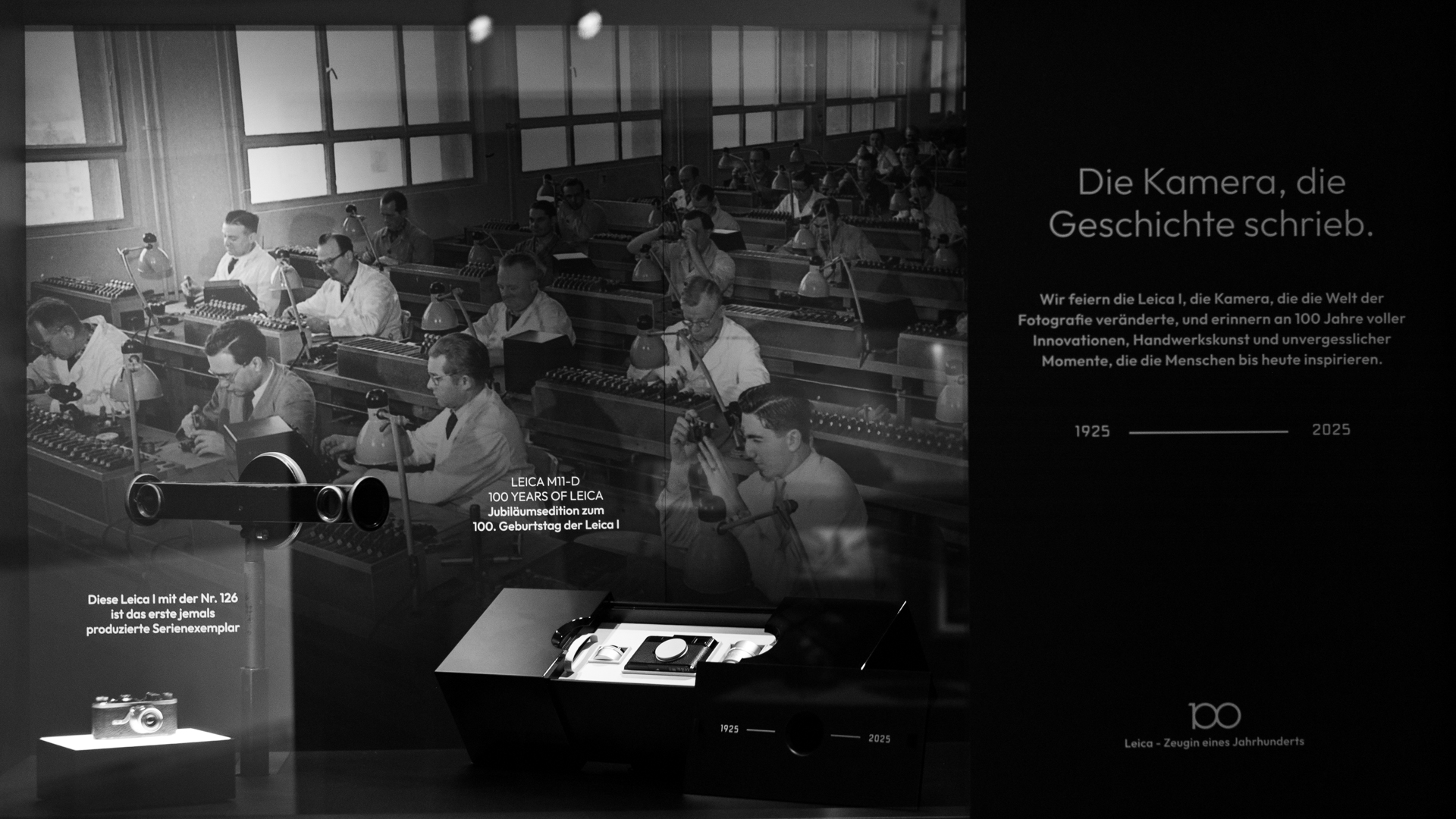

The 1920s was a decade of massive technological innovation. Loewe, Shure, Rollei, Bang & Olufsen, RCA, Pentax – you name it. Much of the visual and audio technology we use today sprang from that era, including Leica. Companies that have survived a century deserve celebration, as the world they entered became fiercely competitive, with many imitators and followers.
The 100 of 100s
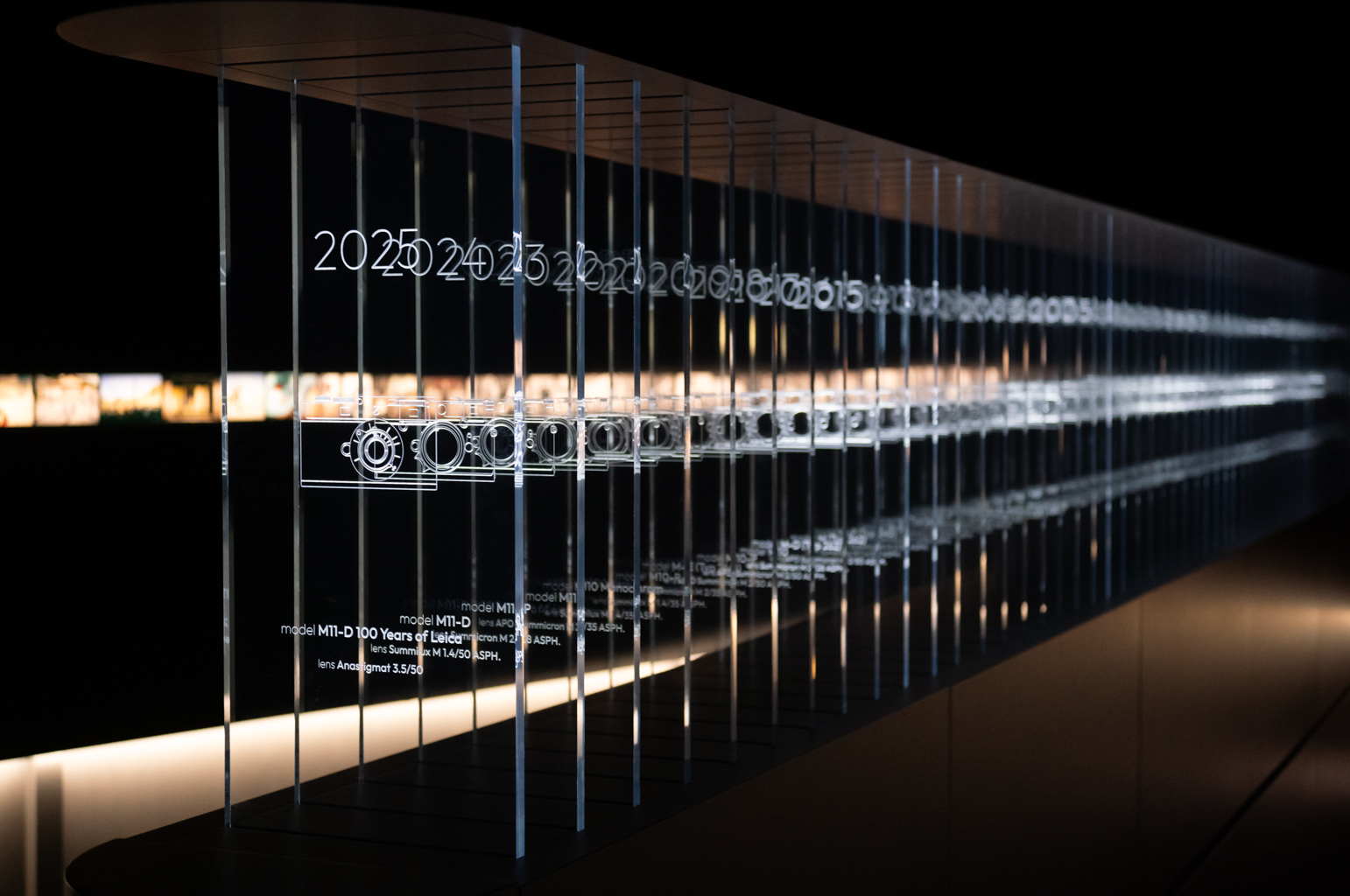
To mark a century of Leica photography, the Leica M11-D “100 Years of Leica” Centennial set was announced one year ago on 26 June 2025, during the historic 100-year celebration in Wetzlar. By then, Leica had already released city‑based 100‑year M11 editions around the world — Dubai, Milan, New York and Wetzlar, with Shanghai and Tokyo scheduled later that year — each limited to 100 pieces.
While the Wetzlar editions flew off the shelves during the celebration event, Leica was quietly forging another 100 pieces — The 100 Centennial Edition “to rule them all”. Technically, it was an issue of 101 units, featuring serial numbers from 6,000,000 to 6,000,100, intended as the definitive set. Unlike the earlier single‑body releases, the set included a resonant M11‑D body and two lenses: a 50mm Summilux‑M and a 50mm Anastigmat‑M.
These 100-year editions in 2025 weren’t Leica’s first centenary nod. A decade earlier, in 2014, Leica marked 100 years since Oskar Barnack built the Ur-Leica in 1914. To celebrate their first 100-year event, they released 500 special M240 bodies and 101 five‑piece sets that included two bodies and three lenses: M‑A, M Monochrome, plus 28mm, 35mm and 50mm Summilux‑M.
Of all the 100‑year editions, 2014 and 2025 combined, the M11‑D Centennial set arguably stands out the most. Not only does it pair the youngest, screenless digital body with a 50mm Summilux echoing the original 1925 Leica, but its second lens — the revived Anastigmat — is the set’s defining highlight.
An-a-stigmat, negating the negation
The word Anastigmat comes from Ancient Greek roots:
- an / a = “not” or “without”
- stigmat = “a point” or “a mark burned in“
The term described a prominent type of lens around the time Leica (LEItz CAmera) was born; it was not coined by Leitz. First invented in 1890 by Paul Rudolph at Zeiss, the anastigmatic formula was an industry-wide breakthrough that finally corrected optical distortion. As the name implies, it specifically referred to an optical design engineered to negate aberrations that affect the sharpness.
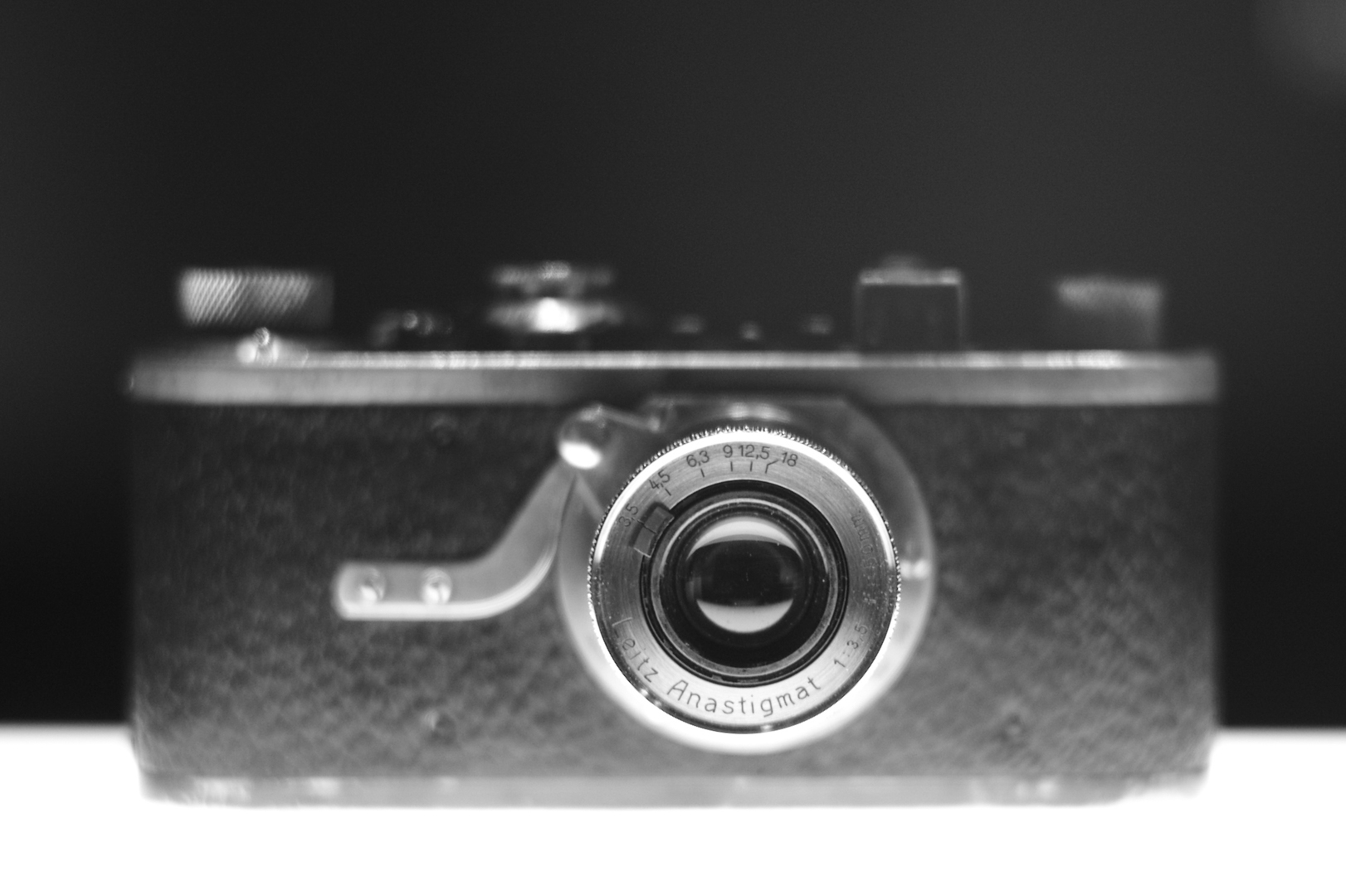
In the following year of 1890, many manufacturers started producing “anastigmatic” lenses, a generic optical term that was not copyrighted by Zeiss. For Leica, the use of the designation was short-lived. Roughly the first 150 production lenses carried the “Anastigmat” label before being renamed “Elmax” and finally “Elmar” – all within Leica’s first commercial year, 1925.
The brief “Elmax” label stood for Ernst Leitz Max, a tribute to Max Berek, Leica’s legendary lens designer. At the time, Leica resembled a small, fast-moving craft workshop, distilling ideas and developing rapidly, much like today’s high-tech startups.
Beyond the stigma
Some people tend to attach themselves to older objects over new ones because they appreciate and cherish the history behind them. I happen to be one of them.
When I first encountered a rare, vintage Anastigmat lens years ago, the derivational root of the word, “astigmat”, caught my eye. Having astigmatism myself, I instinctively knew there was a connection to my vision. Soon after, I learned that the anastigmat design was engineered precisely to negate the aberrations that blur focus, much like the corrective eyeglass lenses I wear.
The announcement of the new Anastigmat for the Centennial set therefore felt like déjà vu. But what makes this release truly extraordinary — elevating it far beyond mere nostalgia — is that the lens was built for the M-Mount, something Leica had never done before. While they did include an Anastigmat lens in the 0-Series replica releases in 2000 and 2004, those optics were permanently fixed to their respective camera bodies.
Take it or leave it
When the Centennial set was announced, Leica stated it would be available in Spring 2026. Yet, when I walked into my local Leica store this past December to check on something entirely unrelated, the store manager caught me completely off guard by saying it had arrived a couple of days ago.
“What! How can it be so early?”, I wondered in disbelief. Like a doubting Thomas, I asked him to bring the 16-kilogram box over (very heavy due to the solid presentation case being made from hardwood) so I could see it with my own eyes.
Ever since picking up my first Leica, an M9, fourteen years ago, my love for that camera naturally drew me deep into the history and other products of the company. Over the years, however, when it comes to special editions, Leica seems to have released so many that I have become desensitized to them — except when they are as truly distinct as this Centennial set.
Knowing that only 100 sets were produced — meaning there are actually fewer sets than there are Leica stores worldwide — I knew the chances of getting one were next to none. Therefore, I never expected it to ‘pop up’ out of nowhere, especially months ahead of the release schedule.
I actually had been quietly waiting for a “Monochrom-D” to accompany my forever-M9 as my new future camera, though it was pure speculation on my part and might not even be built. But looking down at the sealed, massive box before me, I told myself to stop waiting on the fantasy and said to the store manager, “She just found her master!”
When I acquired the Centennial set, I celebrated with all the store staff over champagne. While we were celebrating, one of them asked me if I would actually use it. The question struck me as a bit odd for a second, but it was a fair question. Objects like this can easily become pristine shelf ornaments, which is also understandable.
Yet, I began shooting with it soon after. Cameras are ultimately built to take photographs, especially when they embody meaningful innovation. It would be a shame to leave a masterpiece this beautiful untouched.
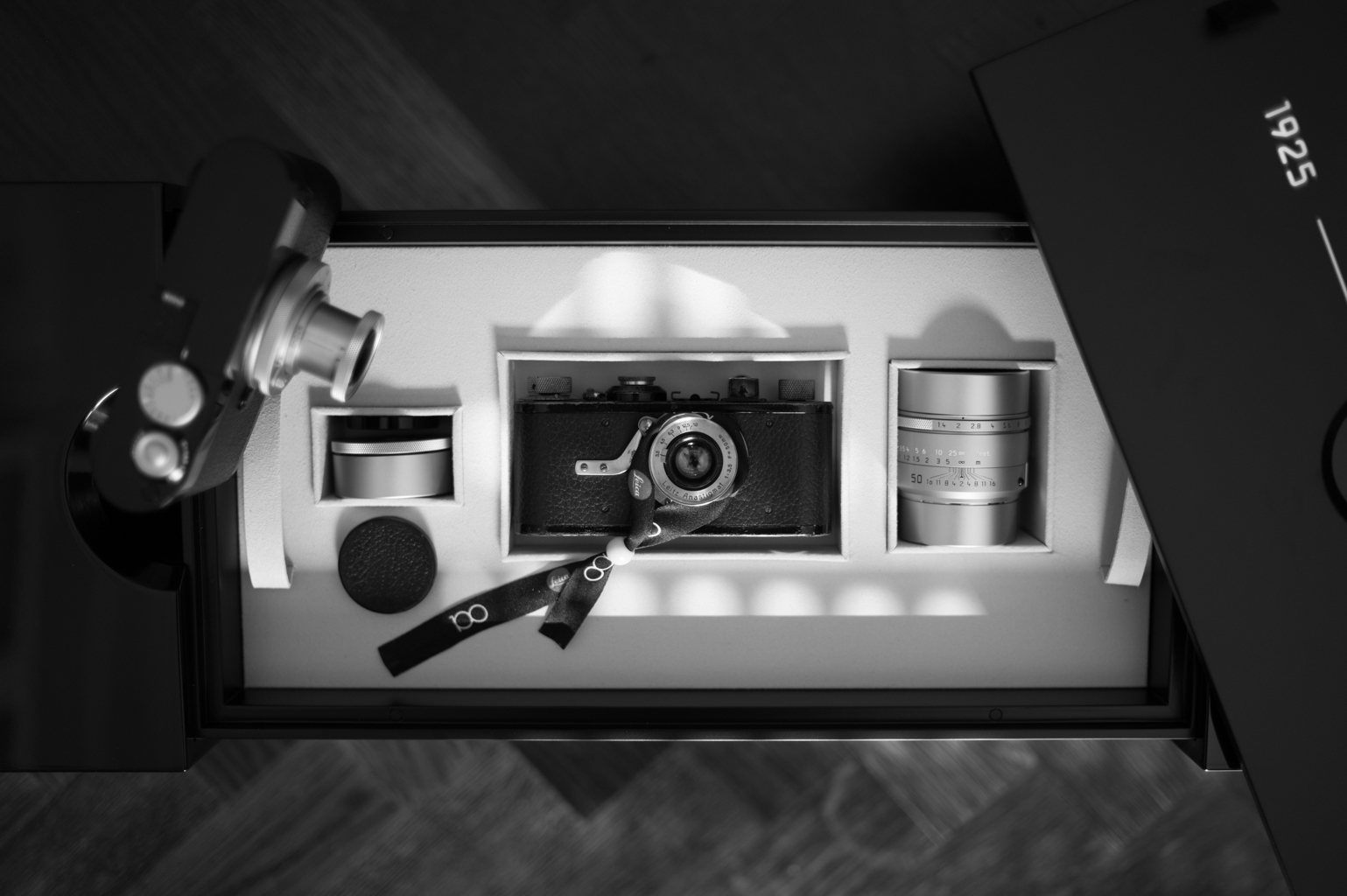
Furthermore, after another 100 years, someone will look at this Leica the way I look at a 100-year-old Leica now. That is three to four generations. After my usage, I’ll pass it down to my children, and they to theirs — descendants who might live in an age where cameras are integrated into their bodies or humanoids take photos for them. If it shows no signs of use, there will be no memoirs or remnants of human experience left for them. Leaving it unused would be a missed opportunity, especially since a time will come when its specific batteries and memory cards are no longer manufactured. Yet Leicas are built to last, and even when that technology inevitably fades into obsolescence, its story will still endure.
The M11-D(ank)
I have never bothered to find out what the letter “D” actually stands for on the Leica M(whatever)-D. I’ve heard something ranging from “Digital” — because it lacks a screen, making it look like a film camera — to “Display” or “Displayless.” Whatever it is, I prefer to think of it as “Dank”, the German word for thanks.
In the late 1960s, Leica advertised the M4 as “The Think Camera”, reminding photographers to rely on their own minds rather than the electronic automation which was then taking over rival systems. Because the M4 lacked the circuitry of its competitors, the ad made sense. Decades later, that same spirit of simplicity — what Leica calls “Das Wesentliche” (The Essential), an essential theme throughout most of Leica’s history — still lives on in the M11-D.
My journey with this concept of a screenless digital M took some time. When the first model arrived in 2014 with the M60 (60-year M anniversary edition based on M240), I was just as confused as many others. “Who wants to use a digital camera without a screen? It seems counter-productive”, I thought. But as the D-series persisted through the M262, M10, and now the M11, my bewilderment turned into appreciation.
As screens increasingly dominated every corner of modern life, I found myself experiencing digital fatigue, deliberately minimising my screen time wherever possible. In that light, the “D” could fittingly stand for “Dank”, a thank you to Leica for a much-needed digital detox.
Yet, despite championing a screen-free experience, the M11-D doesn’t leave me stranded. It pairs effortlessly with my iPhone for quick file viewing when necessary. Because checking photos on my phone requires a conscious, extra step, it creates a psychological barrier that encourages me to opt out most of the time. When I do need it, the system is a massive leap forward over the sluggish M10-D, and a welcome evolution from the original M-D (Typ 262), which lacked wireless connectivity altogether.
Visually, the Centennial M11-D joins the original M-D as the only D-models to feature a black paint finish over a solid brass top plate, ensuring it will age beautifully and acquire a unique patina over time. By pairing this classic construction with seamless modern connectivity, I think the Centennial M11-D truly offers the best of both worlds. It represents the perfect intersection of analogue soul and modern convenience.
The duo
When a camera set includes multiple lenses, it normally comes with different focal lengths, which makes sense. Yet, the Centennial set was shipped with two identical focal lengths: 50mm. The goal is likely to demonstrate the century of progress between Leica’s earliest and latest optical chapters.
In any event, both lenses honour the heritage design with knurling on the aperture ring and a nickel finish. One main difference from the original 1925 design though is that their barrels feature an aluminium construction rather than brass. This is because the historic process of applying nickel over brass is now recognised as toxic and environmentally unfriendly.
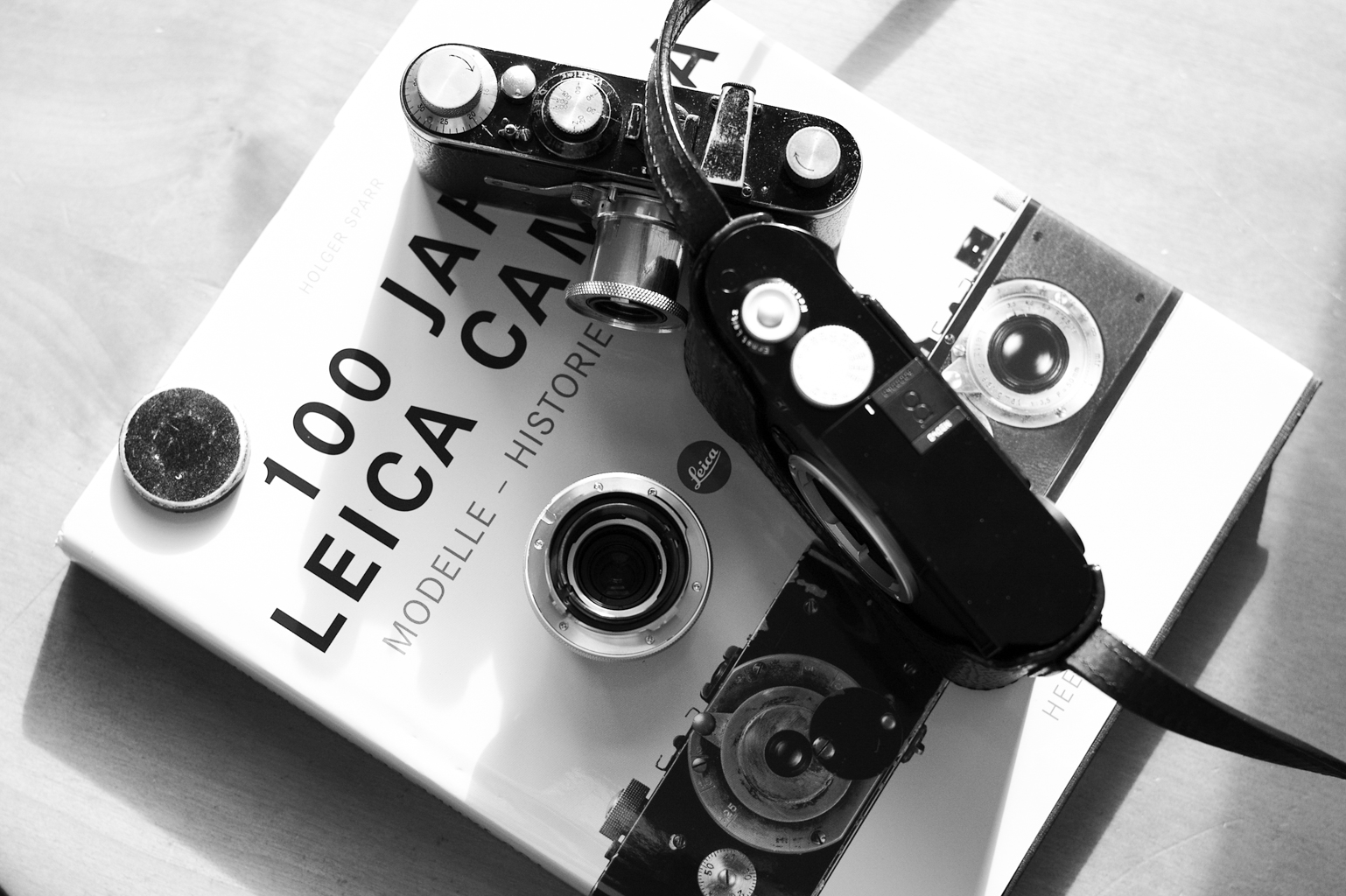
Beyond the physical construction of this duo, another detail that really stands out is that the Anastigmat-M lacks 6-bit coding! I believe the omission was entirely deliberate, highlighting its status as a specialised time capsule, while the paired 6-bit-coded Summilux can be used as a practical driver. Whenever I import photos taken with the Anastigmat, Adobe Lightroom Classic (latest version) defaults to “Leica APO-SUMMICRON-M 50”.
Persist, undefeated beauty
The Centennial set included dedicated accessories, most notably a cognac/brown leather case modelled on the original ESNEL case from the 1920s. That early protector featured a strap sewn directly into the leather sleeve because the original Leica I lacked strap lugs. Although the Centennial case beautifully honours that classic ESNEL design, I wanted a black case to match the camera body and make it less conspicuous while shooting on the street.
Since almost all camera cases assume cameras have built-in strap lugs, I had to order a custom case that integrates with a strap. While I was at it, I opted for custom engravings as well.

In my town, Heidelberg, Germany, stands a 16th-century building known as the Hotel zum Ritter St. Georg (formerly Haus zum Ritter). During his visit in 1840, Victor Hugo was left awed by the structure. He discovered it was the only residential building to survive the multiple fires that ravaged the town in the 1600s, and that its inscriptions echoed that resilient history.
One phrase felt like the perfect tribute to the Centennial M11-D, and a fitting wish for the future
Among those inscriptions, one phrase — “Persta Invicta Venus” (meaning “Persist, Undefeated Beauty”) — felt like the perfect tribute to the Centennial M11-D, and a fitting wish for the future. With that vision in mind, I commissioned the engraving, along with the other Latin phrases, on the black case from Arte di Mano, the highly respected workshop for handmade Leica leather goods in Seoul, Korea.

The custom case arrived two or three months later. The craftsmanship was nothing short of superb, and the fit was perfectly precise. It stood in stark contrast to a previous case I had mistakenly bought from another vendor before remembering this camera lacked strap lugs.
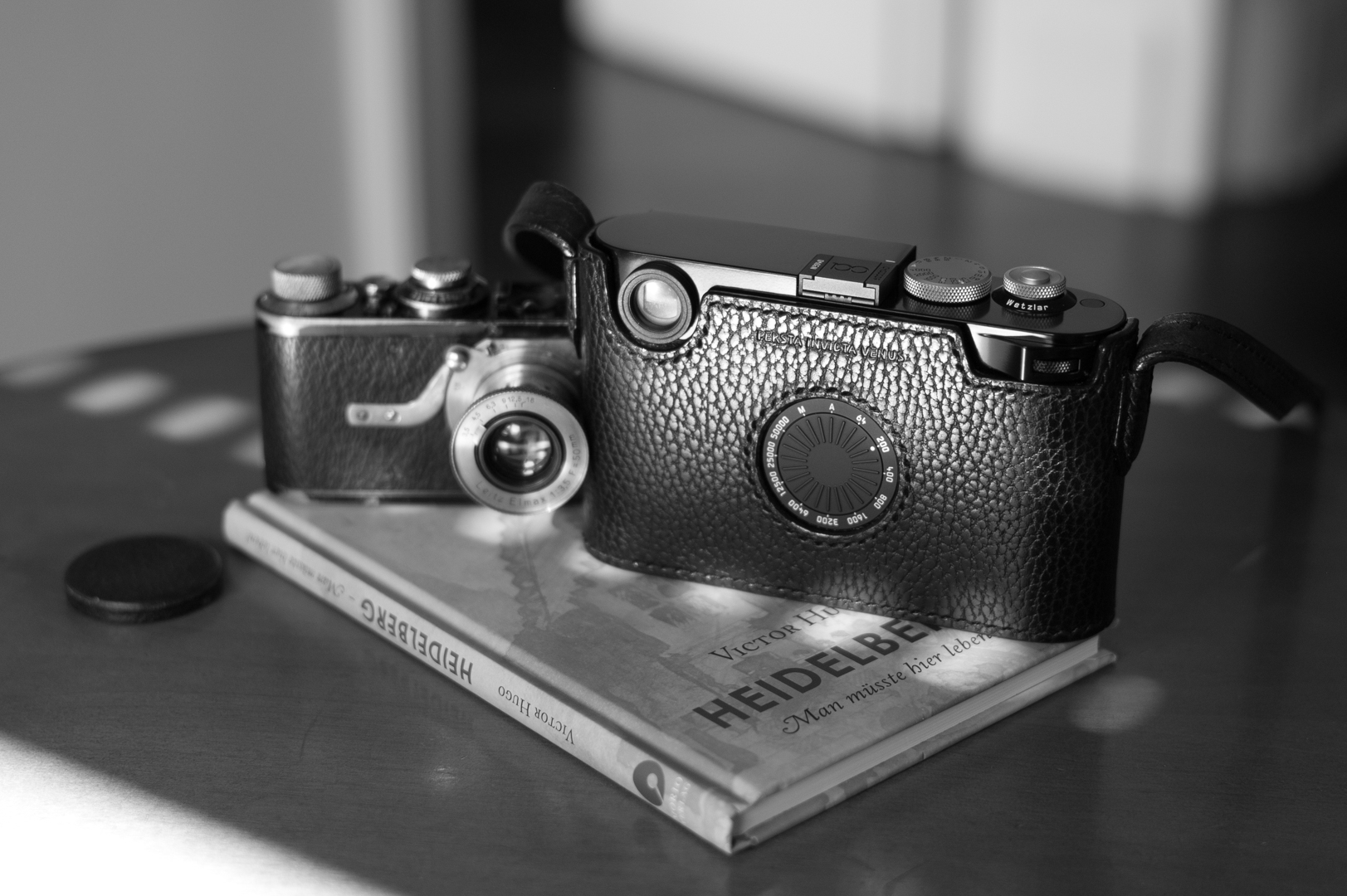
That said, I did spot one minor design flaw, though it was actually a result of my oversight during ordering: the sleeve for the shoulder strap was located too high for the type of strap. Fortunately, when I contacted them, the artisans were more than happy to work with me to make the correction.
To love is to be vulnerable
Years ago, I read a book called The Four Loves by C.S. Lewis, and a particular passage stayed with me. It still resonates quietly in the back of my mind, surfacing periodically when I need it most:
To love at all is to be vulnerable. Love anything, and your heart will certainly be wrung and possibly be broken. If you want to make sure of keeping it intact, you must give your heart to no one, not even to an animal. Wrap it carefully round with hobbies and little luxuries; avoid all entanglements; lock it up safe in the casket or coffin of your selfishness. But in that casket – safe, dark, motionless, airless – it will change. It will not be broken; it will become unbreakable, impenetrable, irredeemable.
C.S. Lewis, The Four Loves
While Lewis was mainly speaking of human relationships, I believe his philosophy applies deeply to the objects we cherish as well. When I first acquired the Centennial set, I did hesitate to use the camera. But Lewis’ words helped me see the bigger picture. I realised that the only way to keep my Leica from “breaking” was to “destroy” it myself by refusing to use it.
I’m glad that the Centennial set was released last year instead of this year because it perfectly bookends the full century of history.
A year ago, a few days after the announcement of the M11-D Centennial Edition, the Ernst Leitz Museum in Wetzlar opened its doors to a special exhibition titled “Leica – Witness to a Century”. This week, that retrospective reaches its end. Yet while the exhibition itself concludes here, the profound history and legacy will live on every time I press the shutter on my “100-year-old” M11-D(ank).
Celebrating 100 years of what Leica means to members of the Leica world
Click on the following links for individual views on What Leica Means to members of the Leica world.
| 1. Introduction | 2. John Shingleton | 3. Dennis Anguige |
| 4. Tom Lane | 5. Ed Schwartzreich | 6. Dirk Säger |
| 7. Andrew Tobin | 8. Mark Catto | 9. Kathy M. Davis |
| 10. Andrew Owen-Price | 11. Brian Nicol | 12. Claus Sassenberg |
| 13. Paul Glendell | 14. Jean Perenet | 15. Erwin Hartenberg |
| 16. Wayne Gerlach | 17. David Suchet | 18. David Smith |
| 19. Keith Walker | 20. Bill Royce | 21. Jono Slack |
| 22. Bud Parr |
Make a donation to help with our running costs
Did you know that Macfilos is run by five photography enthusiasts based in the UK, USA and Europe? We cover all the substantial costs of running the site, and we do not carry advertising because it spoils readers’ enjoyment. Any amount, however small, will be appreciated, and we will write to acknowledge your generosity.
Comments: Please add a comment to this article. Our comments section is a thriving community and everyone is treated with respect. In addition, please identify yourself (and add an email address, which will not be published, if you would like to see answers to your posting). Our system will automatically delete any “anonymous” posts on the basis that they are likely to be spam.
Thanks for this, Samson!
Nicely written article where I learned some new things about the history of Leica! There are some fun parts in your personal story that you’ve woven into this article! I am not a Leica owner yet, but I’m definitely intrigued!
Excellent article, full of heart and soul! And understandable even to me, an ignoramus when it comes to photography and its history. Thanks Samson!
A wonderful story Samson… Many thanks.
A few years back, I bought the first example, a Leica M-D (Typ 262) from Mike… I don’t know about Mike, but I regret moving it on, and have looked at trying to buy a replacement more than once. The price of the few that I have seen reflects its rarity and I quickly look away, 50 years of experience tells me that the wife would not appreciate such a purchase… 🙂
In the meantime, I will make do with my Q2, and I am not selling that!
The -D (all three versions) are very scarce on the used market, and this perhaps reflects the fact that it is so simple in operation that later iterations make very little difference. Moreover, from my experience, the -D models are a better “investment” than standard Ms. Wasn’t it an M240 P you bought from me?
Hello Mike, forgive me, I have a severe memory issue, on reflection I think that you are correct. We had a cup of coffee and a croissant at Maison. Bertaux… and did the deal.
I have definitely had the M-D though, I now have no idea where I obtained it, the chap that bought it from me will almost definitely have gained a bargain, I am a useless salesman!
Sounds about right! Our camera-owning lives are full of regrets. Yes, I should have kept the M10-D and ceased watching new developments. My problem, though, is that I have to try to keep up to date so I can talk knowledgeably about the latest models.
Constantly living in the past, waffling on about M9s and M240s and trying to prove they were just as good, can get rather tedious. There’s a place on Macfilos for this sort of introspection, though. It’s just that our editorial team needs to keep up to date. We can remember the X1 or X-Vario, or even the CL. But they are gone, never to return. The mistake is to suggest that they are better than what is now on the market.
Wasn’t it Omar Leitz or some other body who wrote,
“The Moving Shutter writes; and, having writ,
Moves on: nor all thy Piety nor Wit
Shall lure it back to cancel half a megabyte,
Nor all thy Tears wash out a pixel of it.”
Now I’ll stick to my day job.
Mike
Great to meet you in London and see the gorgeous kit you write about in person.
Lovely to see you writing here, Samson. We must finally unravel the mysterious journey of what became ‘the Leica lens’ from Anastigmat to Elmax to Elmar. As you know, some of the texts on this contain errors and others contain unproven suppositions. Perhaps when he has fully retired, Peter Karbe may be able to spend time in the Leica Archive to look at the records from the 1920s and the contemporary blueprints. Back then, a lot of the development work was done on hand-written notes, generally heading in the direction of Oskar Barnack.
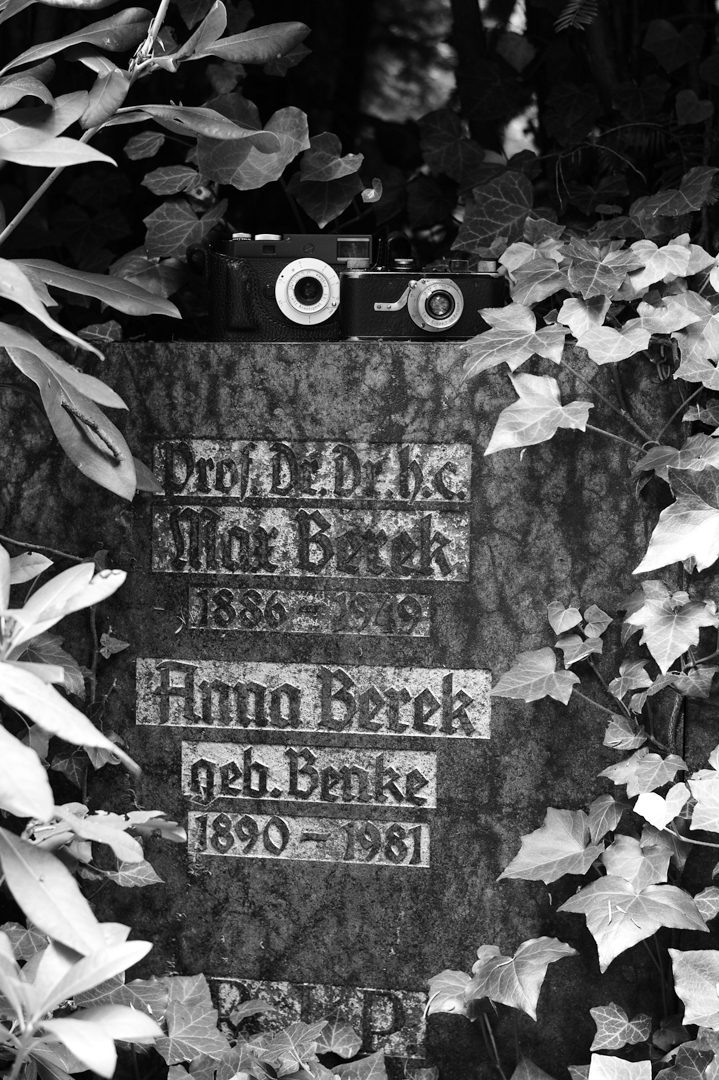
I like the fact that you brought the Berek designs to his grave. I have done the same in the case of the 19th Century Irish lens designer called Thomas Grubb and his son Sir Howard Grubb. At our funeral services here in Ireland people often place items associated with the deceased on their coffin as a memorial for the life they have lived. I see the items on a gravestone as an extension of this type of memorial. My friend George Hurst hung his working Ur-Leica replica on Barnack’s grave when we were in Wetzlar with LSI (then LHSA) in 2018. A photo of that appears somewhere in the annals of Macfilos.
I like your quote from C.S. Lewis who was born on the island of Ireland, in Belfast, in 1898. His notion of the importance of certain artefacts is, of course, far removed from the consumerist notions of today. It can take time for the importance of any item to evolve and be recognised.
Great article, Samson.
William
Thanks William – it’s great to be writing here! You’re spot on that the evolution from Anastigmat to Elmar involves a bit of historical smoke and mirrors. Yes, having someone like Karbe sort through the Archive and set the record straight would be a dream. I’d love to collaborate as we dig deeper!
Speaking of the working Ur-Leica of George Furst, that was unbelievable. Yes, I saw the pictures you’re referring to a while back, which can be found here: http://www.macfilos.com/2018/10/19/2018-10-18-lhsa-meeting-in-wetzlar-cruising-down-the-rhine-and-losing-my-heart-in-heidelberg/
Regarding Lewis, glad you picked up the point. I like the way he connects significance to patience and context. Some artifacts only become important once we understand what they mean and why they matter.