

The growing collection of camera and lens manufacturers within the L-Mount ecosystem opens up some unlikely opportunities for camera-lens combinations. I have been exploring just such a quirky pairing. It’s a Chinese-manufactured anamorphic lens plus a long-discontinued Leica gem. Read on to learn where my exploration has taken me.
Warning! Highly contrived joke ahead…
Hey, Leica TL2, who was that fancy anamorphic lens I saw you with yesterday? Oh, that’s my new squeeze, a 35mm Sirui Super 35. Nice! You’re a pair with a lot of flare, I mean flair…
Apologies for the attempt at a joke, which requires a passing knowledge of anamorphic lenses and their properties to appreciate the awful puns.
If you read my earlier post about anamorphic lenses, you might have already acquired that passing knowledge. Not to worry if you didn’t. I’ll first give a quick recap, then provide a bit more detail about this intriguing corner of the optics world.
Anamorphic lenses and the movies
Back in the 50s, film-makers drove the development of anamorphic lenses to shoot spectacular, wide-screen movies. These lenses solved the optical challenge of fitting a wide-screen image onto readily available, industry-standard, 35mm film stock.

In effect, anamorphic lenses ‘squeeze’ the information contained in a wide-screen field-of-view onto a narrow strip of film. The cinema projector, in turn, also needs a special lens to ‘de-squeeze’ the image. These days, the image is squeezed onto a digital sensor, and the ‘de-squeezing’ is done via software.
In my previous article, I included diagrams illustrating how an anamorphic light path differs from a spherical light path. Here, I will show you what that squeezing looks like in practice.
In each of the sets of images below, I scaled them so that the number of pixels in the vertical dimension is equal. They are all therefore directly comparable, differing only in how the image is squeezed onto the sensor, or how the horizontal dimension in the de-squeezed image is wider. I did this using Photoshop, inserting the spherical and squeezed images into a white canvas of identical dimension to the final de-squeezed image.
I took the first image below with a spherical lens. The second image shows what happens with an anamorphic lens of the same focal length. The image is ‘squeezed’ horizontally to fit on the same size sensor.


As explained above, to view an anamorphic image in its correct proportions, it must be ‘de-squeezed’. I will illustrate that transformation, shortly.
Anamorphic lenses and the cinematic look
Video-content creators are drawn to the use of anamorphic lenses for the cinematic look they offer. This comprises a wide-screen perspective, distinctive bokeh, and characteristic flare. However, we photographers don’t have to be left out of the picture — so to speak. That cinematic look can make for tasty stills images too.
Using anamorphic lenses for photography requires familiarity with a few new terms, concepts, and techniques. My aim in this article is to outline these, using my set-up as an example. I’ll cover both in-camera and post-processing aspects of taking an anamorphic shot.

Anamorphic lens specifications encompass the following parameters: focal length, maximum T-stop, squeeze-factor, focus-type, and sensor compatibility.
Thus, mine is a Sirui 35mm, T1.8, 1.33-squeeze, manual focus, Super 35, anamorphic lens.
I took all the anamorphic photos in this article with this lens mounted on my Leica TL2. I will say more about this unusual combination later in the article. Many of the images are self-portraits. That’s not because I like looking at myself! I think anamorphic lenses offer an interesting option for portrait photography, and in the absence of a model, especially one who would tolerate my incessant fiddling with exposure settings, it was simpler to photograph myself.
I also think seeing a human subject helps one appreciate the effect of squeezing an image.
Focal length and squeeze factor
The focal length quoted for these lenses is straightforward; just as with a spherical lens, it indicates the distance from the centre of the lens to the point at which light rays are focused. And, as with spherical lenses, the shorter the focal length, the wider the field-of-view.
However, while the field-of-view of an anamorphic lens is the same as a spherical lens in the vertical dimension, it is wider in the horizontal dimension. The net result is that no sensor real estate is forfeited in the vertical dimension when capturing an image using an anamorphic lens.

As an aside, this is unlike the situation where a wide-angle image, captured with a spherical lens, is cropped to achieve a comparable aspect ratio. I will discuss this further, below.
The squeeze factor determines how much wider an anamorphic image is than one generated using a spherical lens of the same focal length. My lens has a 1.33 squeeze. Therefore, the image captured by the sensor must be stretched, or ‘de-squeezed’ by a factor of 1.33 in order to produce a final image with the correct proportions.
Gimme a squeeze…
A 1.33 squeeze is modest. For an image shot on a 3×2 sensor, it produces an aspect ratio of ~2:1 (1.33 x 3:2, or 3.99:2). If your sensor is set to a 16×9 format, a 1.33 squeeze results in a 2.36:1 aspect ratio (1.33 x 16:9, or 21.3:9).
Some anamorphic lenses offer a 1.6 squeeze, or even a 2.0 squeeze. These produce an even more dramatic, wide-screen look. Probably, the most common anamorphic-generated aspect ratio is 2.39:1. This is essentially the same as the ‘XPan’ aspect ratio popular with medium-format cameras. For comparison, the famous CinemaScope anamorphic format is 2.55:1.
For photography, I think a 1.33-squeeze works well. It is not too extreme, but nevertheless allows inclusion of additional, horizontal context compared to an image shot with a spherical lens.
Sensor compatibility
Although there are now affordable full-frame anamorphic lenses available, my 35mm, 1.33-squeeze lens is designed for a Super 35 sensor. This is very similar to an APS-C sensor. Consequently, I have to take a 1.5x crop-factor into account. What does this mean in practice?
Imagine a 35mm spherical lens mounted on a camera with an APS-C sensor, such as my Leica TL2. The resulting field-of-view is comparable to that of a 35mm x 1.5 = 52.5mm focal-length lens on a full-fame camera. Since it’s a spherical lens, that field-of-view holds in both vertical and horizontal dimensions.

The situation is different with a 35mm, 1.33-squeeze, Super 35 anamorphic lens. The field-of-view in the vertical dimension is still that achieved with a 52.5mm full-frame lens. However, the horizontal field-of-view is wider. How much wider? It’s what would be seen using a 39.4mm full-frame lens, that is, 52.5mm divided by 1.33.
If we were dealing with 35mm full-frame lenses on a full-frame sensor, the situation would, admittedly, be simpler to understand. A spherical lens would deliver a 35mm field-of-view in both vertical and horizontal directions. An anamorphic lens with a 1.33 squeeze would deliver a 35mm field-of-view in the vertical dimension, but a 26mm field of view in the horizontal dimension (35mm divided by 1.33).
Wide-screen image without a wide-angle perspective
Anamorphic lenses capture more of the scene, but retain the perspective of a longer focal length lens. This is a very cool feature. What does it mean in practice, though?
The two images below should make this clear. The first was generated with a 35mm spherical lens at f/2.8. As mentioned above, I placed it on a canvas the size of a de-squeezed image taken with a 35mm anamorphic 1.33-squeeze Super 35 lens. I took the second photo with that specific lens.

Hopefully, you can see that the subject in each image looks roughly the same. They are not identical, because of minor changes in the subject’s position and the impact of changing lenses. Nevertheless, the subject in the anamorphic shot is seen from the perspective of a 52.5mm full-frame lens, even though they sit in a scene with the field-of-view of a 39.4mm full-frame lens.
Photographers choose different focal length lenses to exploit their unique optical properties. These include field-of-view, perspective, and depth-of-field. With a single anamorphic lens, a photographer can, in effect, exploit the perspective of lens A and the field-of-view of lens B.
Anamorphic bokeh
The two images above illustrate another difference between spherical and anamorphic lenses: their bokeh. The specular highlights in the spherical image, shot with a 35mm Leica Summilux at f/2.8, are clearly circular. In contrast, those highlights in the anamorphic shot are oval.
These oval highlights are a unique feature of anamorphic lenses. They exemplify how the unfocused regions in anamorphic images possess a different texture from those found in images from spherical lenses. As alluded to earlier, this is part of the supposedly magical cinematic look of these lenses.

Anamorphic flare
Perhaps the most striking feature of pictures taken with an anamorphic lens is their flare. Anamorphic lenses possess a cylindrical element at the front of the lens, which enables them to squeeze the image. A bright beam of light hitting that cylindrical element generates a pronounced horizontal flare.
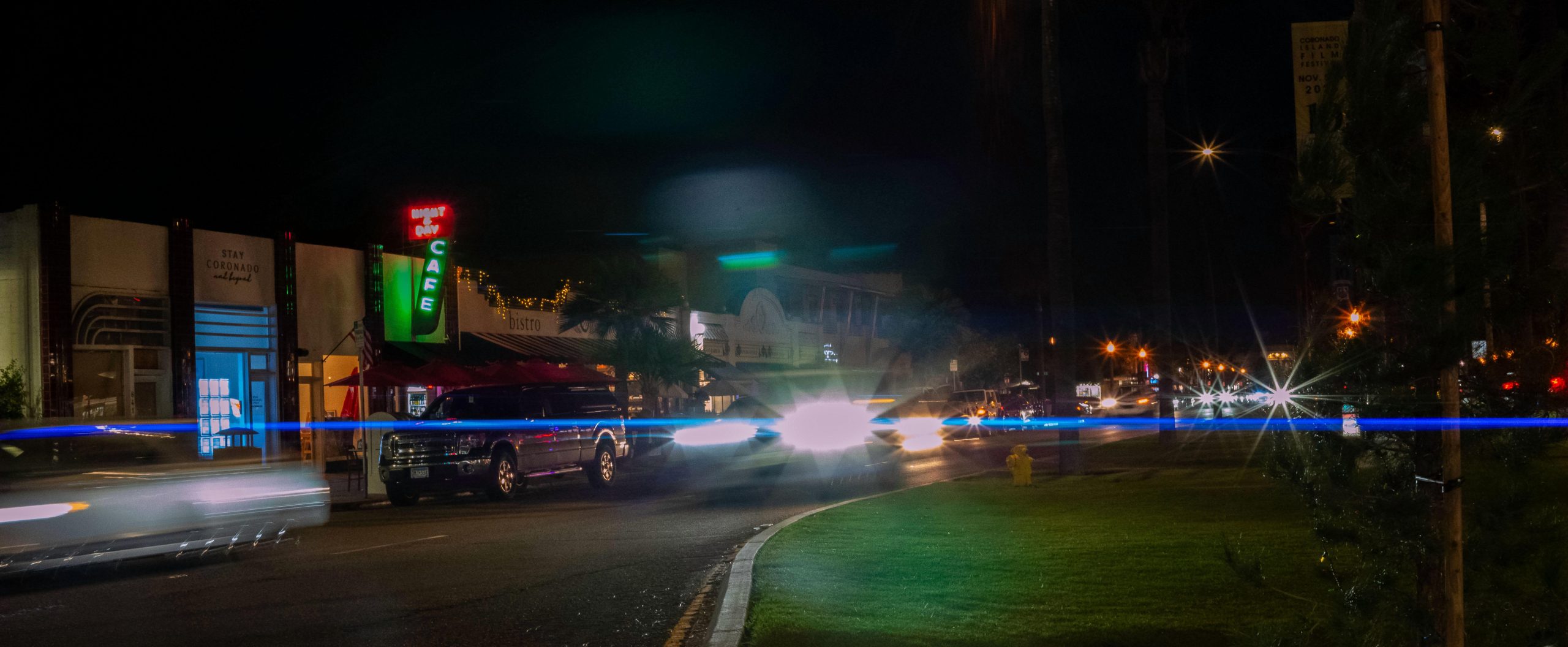
In many anamorphic lenses, that flare is blue, since the lens coating preferentially scatters blue light. However, some manufacturers offer lenses with a ‘neutral’ flare, which instead matches the colour of the light source.
The blue flare is one of the most prominent optical features of anamorphic lenses. In fact, it is instantly recognizable as a signature of anamorphic lens use in a movie.
I shot the first image below with a 35mm spherical lens, and the second with the 35mm anamorphic lens. You can clearly see the presence of the flare in the latter, but not the former.


Aperture numbers
I mentioned that my 35mm anamorphic lens has a T1.8 maximum aperture. As explained in the previous article, f-stops and T-stops are different ways of measuring aperture. Whereas an f-stop indicates the theoretical amount of light a lens should transmit, a T-stop (Transmission-stop) indicates the actual, measured amount of light a lens transmits.
Cinematographers prefer T-stops because when switching lenses during filming, they can be confident of achieving a very consistent exposure throughout the film. In practice, f-stops and T-stops are very similar.
Because I use my T1.8 maximum aperture lens on a camera with an APS-C sensor, the crop factor affects aperture. Hence, it behaves more like a T2.7 lens when shot wide open.
Manual versus autofocus anamorphic lenses
Early generations of budget anamorphic lenses, like mine, were typically manual focus. However, several companies now manufacture full-frame anamorphic lenses with autofocus.
In my experience, the manual focus-aids available on my Leica TL2, such as focus-peaking, work perfectly with an anamorphic lens. I am able to achieve sharp focus either by viewing the rear screen, or using a Visoflex attachment, perched on the hot shoe.
Here is another set of spherical-, squeezed anamorphic-, and de-squeezed anamorphic-images, this time featuring flowers rather than faces. The Sirui lens does a good job of delivering sharp images at the centre of the frame.

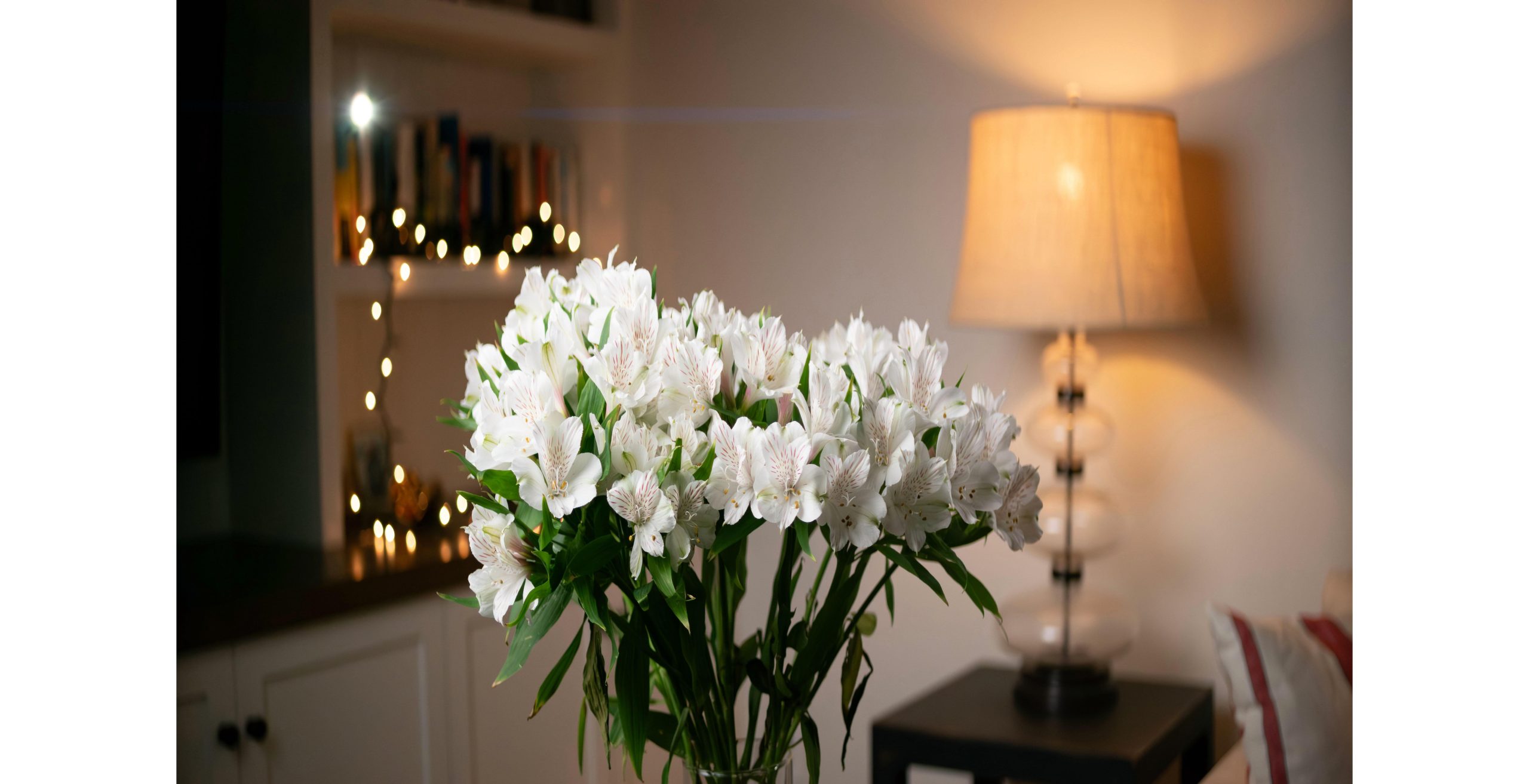

All the images in this article were shot using manual focus lenses. These include the Sirui 35mm T1.8, a 35mm Leica Summilux M, or a 25mm Zeiss Biogon f/2.8 ZM. I am not aware of anamorphic lenses currently available with a native M-Mount, but I understand there are several in development.
Sirui Astra full-frame, autofocus, anamorphic lenses, as you might expect, are larger and heavier than their manual counterparts.
Reproducing an anamorphic look via a wide-angle crop
As discussed above, a photographer can use an anamorphic lens to capture a wider scene than possible with a spherical lens of the same focal length. I wondered how closely you could replicate an image generated with an anamorphic lens by shooting with a wider focal length spherical lens and then cropping.
The images below illustrate an attempt to do that. As discussed above, in the horizontal dimension, my anamorphic set-up delivers an image comparable to one shot with a 39.4mm full-frame spherical lens. I therefore mounted a 25mm Zeiss Biogon f/2.8 ZM lens on my TL2 using an M-to-L adapter. Taking the crop factor into account, this is equivalent to a 37.5mm full-frame field-of-view.
Shooting the same scene therefore gave me an image which was slightly wider in the horizontal dimension, but much taller in the vertical dimension. To create an image with the same aspect ratio as the de-squeezed anamorphic shot, I had to crop both above and below the subject.

As demonstrated by the images above, the anamorphic and spherical images look similar. However, the specular highlights are noticeably smaller in the cropped spherical image, since it is a wider-angle shot. This is clearly the case when compared to the third shot, taken with a 35mm spherical lens.
Moreover, the cropped, wide-angle shot has fewer pixels, and is therefore of lower resolution than the anamorphic shot.
I concluded that you might come close, but it is not possible to fully replicate the look of an anamorphic image by shooting wide-angle with a spherical lens, then cropping. And, you lose heavily on sensor resolution.
Post-processing anamorphic shots
I de-squeeze my RAW anamorphic shots using the following sequence:
- After downloading to Lightroom, I check for sharpness and then, if necessary, adjust perspective, exposure, saturation etc.
- Then, under the ‘File’ menu, I select ‘Edit in Photoshop’.
- When the image appears in Photoshop, I select ‘Image size’ from the ‘Image’ menu.
- This opens a panel in which the dimensions of the image are displayed. Since the image was captured on a sensor with an aspect ratio of 3×2, this is reflected in the dimensions currently displayed.
- I multiply the horizontal dimension by 1.33 to reflect the lens’s squeeze ratio, and then hit return.
- The de-squeezed image is then displayed, with the subject in correct proportion. This can be saved and downloaded as a JPEG.
Simple!
Shooting anamorphic on the Leica TL2
I have written several articles about this wonderful camera: the Leica TL2. I have previously paired it with both a native TL-lens, and various M-lenses, using an M-to-L adapter. So, using it with a manual-focus anamorphic lens was straightforward.
I also own a Visoflex 2 external electronic viewfinder, which fits on the camera’s hot-shoe. It has seen little use until now because I think it spoils the beautifully sleek aesthetics of the camera. The lenses referred to above are all silver finish, matching the silver finish of the camera.
However, since the Sirui lens is black, aesthetic considerations went out the window, and I slapped on the Visoflex to assist in focusing.
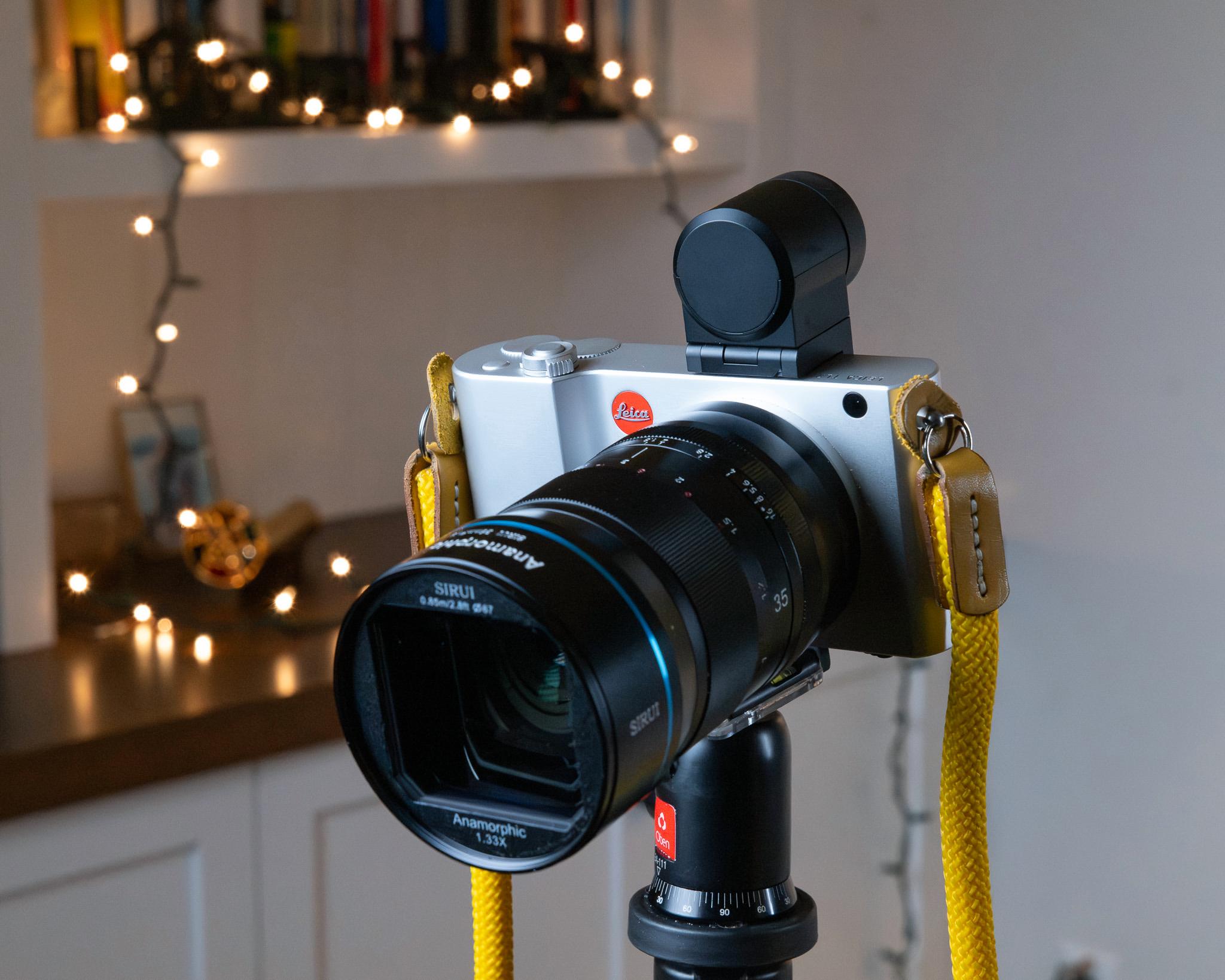
I took the indoor shots using a lighting set-up I have described previously, with the TL2 mounted on a tripod. I set exposure manually using a Sekonic Flashmate light meter, and set either a 12- or 2-second timer before pressing the shutter release.
The TL2, despite being at least five-years old, continues to perform superbly. Its touch screen-based menu system is a breeze to navigate, making it easy to configure the camera for shooting in manual mode.
The Sirui 35mm T1.8 Super 35 Anamorphic lens
For a budget lens with a complicated optical design, the Sirui lens is surprisingly sharp in the centre when shooting wide open. Stopped down to f/4-5.6, it is very sharp, to the point that fine details on flower petals were clearly discernible.
I don’t think anyone expects a budget anamorphic lens to be as free of distortion, or as corner-to-corner sharp, as a Leica 35mm Summilux. In fact, online reviews point out that this lens suffers from pincushion distortion. However, if one embraces these shortcomings, it’s a great little lens, with lots of character, which is fun to use.
Final thoughts
A Sirui anamorphic lens, and a Leica TL2, make an unlikely pair. The combination is made possible by the L-Mount alliance, and the compatibility of the TL2’s APS-C sensor, and the Sirui lens’s Super 35 optical design. It turns out, they work like a charm together, providing me with a new, if quirky dimension to my photography interests.


Down the road, when there is more used inventory available, I can even see myself springing for a 35mm full-frame Sirui 1.6-squeeze anamorphic lens that I can use with my Leica SL2.
Isn’t the L-Mount world great?
Make a donation to help with our running costs
Did you know that Macfilos is run by five photography enthusiasts based in the UK, USA and Europe? We cover all the substantial costs of running the site, and we do not carry advertising because it spoils readers’ enjoyment. Any amount, however small, will be appreciated, and we will write to acknowledge your generosity.
Great Article – Thanks! Great explanation and comparison photos!