
The L-Mount system, jointly developed by Leica, Panasonic, and Sigma, has matured into one of the most coherent ecosystems for full-frame mirrorless shooters, and nowhere is this more evident than in the 50mm prime landscape. The alliance now spans everything from relatively affordable compact lenses to flagship f/1.2 and f/1.4 designs that can satisfy demanding professionals.
The classic 50mm focal length, the so-called “nifty fifty”, with its natural perspective and versatility, sits at the heart of the system and offers a particularly rich set of choices for L-Mount users. Within the L-Mount ecosystem, 50mm functions as the workhorse focal length for general-purpose photography.
Role of 50mm in the L-Mount system
This focal length is commonly used for environmental and tight portraits, reportage, low-light work, and even certain types of product and documentary photography.
System designers have therefore treated 50mm as a strategic category rather than just another prime, resulting in multiple overlapping options at different price and performance levels. You can choose apertures between f/1.2 and f/2.8 and prices from the low hundreds to the thousands.

For Leica, 50mm is the spiritual successor to its M-system “standard” lenses, reinterpreted for high-resolution, autofocus-capable full-frame bodies. For Panasonic, 50mm primes serve as anchor points for coherent prime line-ups that share size and handling. Sigma, meanwhile, uses 50mm to present both its no-compromise Art series and its more compact Contemporary designs. This convergence explains why there are several distinct 50mm primes rather than a single generic offering: each occupies a deliberately chosen niche.
High-end professional 50mm primes
At the top of the range sit the heavy, optically ambitious lenses aimed at professionals and enthusiasts who prioritise image quality above all else. These lenses are typically large, weather-sealed, and designed to resolve well beyond current sensor resolutions.
Panasonic Lumix S Pro 50mm f/1.4
The Lumix S Pro 50mm f/1.4 is widely regarded as Panasonic’s reference standard prime for the L-Mount system. It employs a complex optical formula with multiple aspherical and extra-low dispersion elements, enabling high sharpness across the frame even at its maximum aperture. The lens is optimised for contrast and resolution on 40–60 MP full-frame sensors, providing very crisp detail from centre to edge when stopped down.
A key feature is its dual-motor focusing system, which pairs linear and stepping motors. This arrangement delivers fast and near-silent autofocus performance suitable for both stills and video, even when focus breathing control is required. The lens is large and heavy, reflecting its emphasis on performance rather than portability. Many users view it as the “no excuses” 50mm in the system: expensive, heavy, but capable of outstanding results in demanding conditions, including low light and professional portrait sessions.
Leica Summilux-SL 50mm f/1.4 ASPH
Leica’s Summilux-SL 50mm f/1.4 ASPH occupies the premium, flagship slot in the L-Mount standard prime category. Its design philosophy leans not only on high technical sharpness, but also on what Leica users often describe as a distinctive rendering. The lens prioritises micro-contrast, colour fidelity, and smooth bokeh, aiming to produce images with a strong sense of depth and “roundness” to subjects.
The Summilux-SL is large and notably heavy, making it more of a deliberate-choice tool than an everyday walk-around lens for many photographers. Build quality is robust, with full weather sealing and a level of mechanical refinement aligned with Leica’s positioning in the market. On current high-resolution Leica SL and Panasonic S bodies, the lens is capable of resolving extremely fine detail, while still rendering out-of-focus areas with a characteristic smoothness that appeals particularly to portrait and editorial shooters.

Sigma 50mm f/1.2 DG DN Art (L-Mount)
Sigma designed the 50mm f/1.2 DG DN Art to showcase what it can achieve with a mirrorless-specific, ultra-fast standard prime. The f/1.2 aperture allows for very shallow depth of field, providing separation and background blur that place it in the same aesthetic league as classic f/1.2 and even some f/1.0 lenses, but with modern computer-optimised correction of aberrations.
The lens incorporates advanced glass types and sophisticated element groupings to maintain high sharpness and control of chromatic aberration wide open.
Despite its fast aperture, Sigma has engineered it to be reasonably manageable, with autofocus performance that is more than adequate for everyday use and event work. Users who value subject isolation and “cinematic” background rendering often gravitate toward this lens, especially when shooting close portraits, fashion, or low-light scenes where the extra third of a stop over f/1.4 can make a practical difference.

Balanced Standard Options
Not every photographer wants or needs the size and cost of these heavy f/1.4 or f/1.2 designs. The L-Mount system therefore offers 50mm primes that balance optical performance, size, and affordability, becoming more realistic options as everyday lenses.
Leica APO-Summicron-SL 50mm
The Leica APO-Summicron-SL 50mm f/2 ASPH is frequently hailed as one of the world’s finest lenses. It delivers extraordinary sharpness, rich contrast, and a “medium format” look, with virtually no distortion or chromatic aberration. Its apochromatic design ensures perfect colour alignment across the frame. While expensive and heavy, its fast, silent autofocus and 35cm close-focusing distance make it a versatile, optically perfect tool for professional L-mount users.

Leica Summicron-SL 50mm f/2 ASPH
The Summicron-SL 50mm f/2 ASPH offers a more compact and lighter alternative to Leica’s f/1.4 Summilux-SL and the 50mm APO-Summicron-SL while maintaining a premium construction standard. The f/2 aperture is still fast enough for most low-light and depth-of-field needs, especially given the high ISO performance of modern full-frame sensors.
In practical terms, photographers often choose the Summicron-SL when they want Leica’s signature optical performance and build quality in a lens that’s easier to handle for travel, street, and documentary work.
The Summicron-SL series maintains Leica’s reputation for consistency, matching colour and contrast closely across focal lengths and making these lenses especially attractive for multi-prime kits.
The 50mm f/2 follows this pattern, delivering high levels of sharpness and well-controlled aberrations without the weight and size penalties of the f/1.4.

Panasonic Lumix S 50mm f/1.8
Panasonic’s Lumix S 50mm f/1.8 is the workhorse standard prime for many L-Mount users. It is designed as part of a cohesive series of f/1.8 primes (24mm, 35mm, 50mm, 85mm) that share a common physical size, filter thread, and similar weight.
This uniformity benefits video shooters who use gimbals or rigs, as switching lenses requires minimal rebalancing. For stills photographers, the lens offers a compact and unobtrusive alternative to the S Pro f/1.4.
Optically, the S 50mm f/1.8 provides a strong level of performance for its class, delivering good sharpness and contrast, particularly from f/2.8 onwards. Wide open, it produces attractive bokeh without overly harsh outlining, making it a sensible choice for portraiture and general photography. Autofocus is quick and quiet, and the lighter weight makes it a strong candidate for everyday carry and travel.
This lens is very similar in internal construction and image performance to the Leica f/2 Summicron-SL (see above).

As the system has evolved, manufacturers have increasingly paid attention to photographers who value smaller, tactile lenses that still offer high optical quality. In the L-Mount context, Sigma has played a particularly significant role here.
Sigma 50mm f/2 DG DN Contemporary
The Sigma 50mm f/2 DG DN Contemporary belongs to the brand’s “I-series” of compact primes. These lenses feature metal construction, knurled control rings, and often include a dedicated aperture ring. The design language appeals to photographers who appreciate a more traditional, mechanical feel without reverting to manual focus.
The 50mm f/2 balances portability with a bright enough aperture for shallow depth of field and low-light capability. While not as extreme in its rendering as the f/1.2 Art lens, it is considerably smaller and lighter, making it comfortable for long shooting sessions or discreet street work.
Optical performance is strong, with corrections tuned for mirrorless sensors and a rendering that feels modern but not clinical. Many L-Mount users see this lens as an ideal everyday 50mm, particularly when paired with smaller bodies in the system.
Other compact full-frame 50mm options
In addition to the prominent Panasonic and Sigma designs, the L-Mount ecosystem also includes third-party manual-focus 50mm primes aimed at users who prioritise character, experimentation, or budget.
Brands such as TTArtisan and other niche manufacturers offer fast manual 50mm lenses with apertures as wide as f/0.95. These lenses often trade clinical sharpness and autofocus convenience for distinctive rendering, heavy vignetting wide open, and sometimes pronounced aberrations that some photographers value for creative effect.
While these manual lenses do not match the autofocus convenience of native Panasonic, Leica, and Sigma options, they appeal to users who enjoy a slower, more deliberate shooting experience. Or who want a specific aesthetic that mainstream lenses do not fully provide. In the context of the L-Mount system, they broaden the stylistic palette available at the standard focal length.
Basic specifications
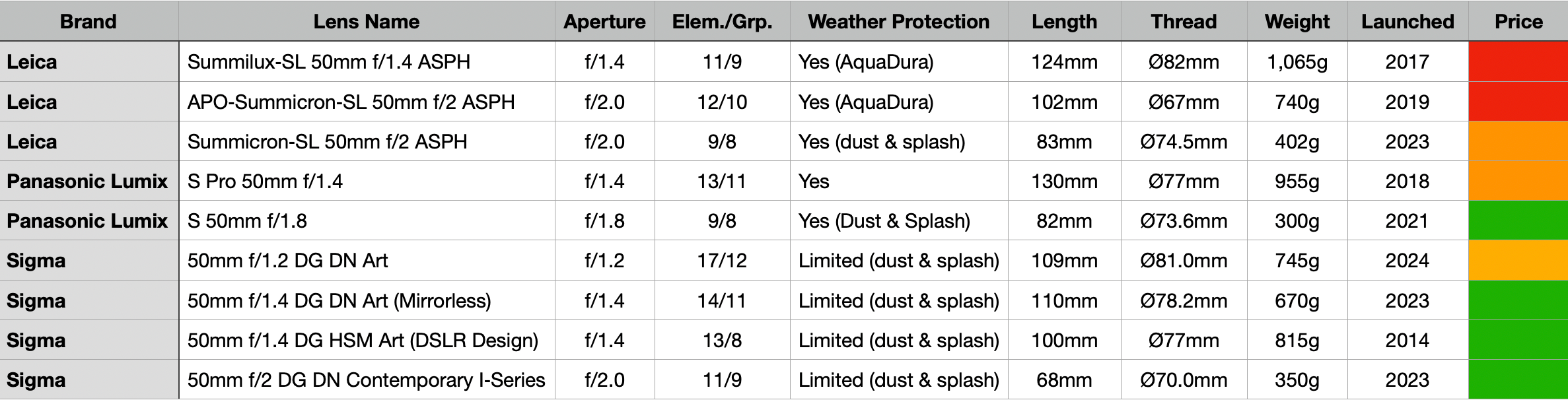
Here is a basic overview of L-Mount 50 primes. We thought it best not to quote prices because they differ in many countries and, of course, will change over time. Instead, the traffic-light price point (where red is the most expensive and green the least costly) gives you an idea of relative costs, which can range from as little as $300 to over $5,000. Please also consider second-hand examples of these lenses; there are probably some bargains to be had.
Sigma 45mm f/2.8 Contemporary: The odd lens out
While we are considering 50mm primes, let’s not forget Sigma’s little 45mm f/2.8 Contemporary. It is nearly a nifty fifty, and offers L-Mount fans the opportunity to try out the now-famous 43mm “natural” focal length of the Q3 43.
This lens got off to a chequered start. It was introduced as a kit-lens when Panasonic launched the S models in 2019. Presumably, at that time, they Lumix have a suitable lens at the right price to fit the marketing profile. Since then, the lens has been very underrated. If you can work with a maximum aperture of f/2.8 this lens is a little gem.
If you doubt it, see what Hugh Brownstone thinks of it, and also check out Gordon Laing’s love of the Sigma forty-five. This lens is a bargain which competes well with 50mm f/1.8.

Practical considerations in choosing a 50mm L-Mount prime
Given the broad range of 50mm primes available, choosing the right one for a particular workflow involves balancing several factors: maximum aperture, handling, size, autofocus performance, and price.
Aperture and rendering: Photographers focused on portraiture or low-light shooting frequently look toward the Panasonic S Pro 50mm f/1.4, the Leica Summilux-SL 50mm f/1.4, or Sigma’s 50mm f/1.2 Art. These lenses provide pronounced subject separation and creamy backgrounds, with the trade-off of larger size and higher cost.
Portability and versatility: For travel, street, and general reportage, the Panasonic Lumix S 50mm f/1.8, Leica Summicron-SL 50mm f/2, and Sigma 50mm f/2 DG DN Contemporary are more attractive. They preserve good low-light ability in significantly smaller, lighter packages, making them easier to keep on a camera all day.

System consistency: Those building a matched prime kit may consider how each 50mm fits within a broader set. Panasonic designed its f/1.8 series for physical and operational consistency, while Leica’s Summicron-SL line maintains a coherent look and handling across focal lengths. Sigma’s I-series provides a tactile, metal-bodied family for users who value compactness and shared design language.
Video and hybrid use: For hybrid shooters, features such as focus breathing control, linear focus response modes, and quiet focusing motors become important. The Panasonic S 50mm f/1.8 and S Pro 50mm f/1.4 are particularly suited to this kind of work, as are Sigma’s DG DN designs, which were created with mirrorless video requirements in mind.
Budget and value: Price gaps between these lenses can be significant. Sigma’s lenses typically deliver strong optical performance at comparatively aggressive price points, making them appealing for cost-conscious users who still need professional-level results. Panasonic’s S 50mm f/1.8 also occupies a very attractive value position. Leica’s SL primes, while premium-priced, offer a blend of build quality, rendering, and system integration that some photographers deem worth the premium, especially in a fully Leica-centric setup.


The 50mm landscape in context
What makes the L-Mount 50mm ecosystem particularly notable is how it mirrors the broader philosophy of the alliance: openness to multiple design approaches under a shared standard. Users can choose between optics that emphasise technical perfection, lenses that focus on size and usability, and others that appeal to more subjective notions of rendering and character.
All of these share mount compatibility and AF support (where applicable), allowing photographers to mix and match across Leica, Panasonic, and Sigma bodies without sacrificing core functionality.
For new entrants into the L-Mount system, a 50mm prime is often the first or second lens purchase. The availability of multiple 50mm options at different tiers makes it possible to tailor that choice very closely to personal shooting style and budget.
Small beginnings
Some may begin with a Panasonic 50mm f/1.8 or a Sigma 50mm f/2 DG DN Contemporary as an all-purpose tool, and later add a heavier f/1.4 or f/1.2 lens for dedicated portrait or low-light work. Others, particularly those already invested in Leica bodies, may go straight for a Summicron-SL or Summilux-SL to maintain a consistent optical signature.
As the L-Mount alliance continues to evolve, 50mm remains a focal length where manufacturers are willing to invest significant design resources. It functions not only as a practical everyday lens choice, but also as a showcase for optical expertise and brand identity within the system.
Make a donation to help with our running costs
Did you know that Macfilos is run by five photography enthusiasts based in the UK, USA and Europe? We cover all the substantial costs of running the site, and we do not carry advertising because it spoils readers’ enjoyment. Any amount, however small, will be appreciated, and we will write to acknowledge your generosity.
Great article. Interestingly the little Sigma 48mm was also offered as the prime “kit lens” by Leica when they introduced the SL2-S. The Leica 24-70 f/2.8 was the other bundled option available at the time.
Steve,
Thank you for your comment. I can’t recall the Sigma 45mm being bundled with the SL2-S, although I do recall it came with several Panasonic S cameras for a time. This lens has been very much underestimated and remains something of a bargain (not least because the bundling resulted in a lot of them on the market). If you can accept 45mm (and Q3 43 owners couldn’t object to that premise) and the slower aperture, it’s a great addition to any L-Mount kit. Its small size makes it even more attractive.
Hi Mike, it was here in Australia at the time of release, not sure about other markets. It is a great lens, I’ve owned one and been using it for years 🙂
Another satisfied customer! Thanks for commenting.
Just a comment on something that was said in the context section, lenses that appeal to more subjective notions of rendering and character are currently very few in the L-mount world and in the mirrorless world in general. Most lenses try to achieve clinical perfection as most as possible, a few chase size and weight, hardly any are concerned with rendering and character, and the few that are tend to be manual focus only. Perhaps AF character lenses could be niche market for a new smaller Chinese company. Also Leica is completely absent in this area as just like size/weight this is already covered by the M system.
AF Leica lenses the size of Sigma contemporary or smaller would be awesome… why not? Leica has the knowledge to build small lenses with very high quality! That would be a real competitor to the M lenses. As Steve Jobs apparently said: you can better be your own competitor.
Interesting point
I think that character in this context can usually be synonymous with ‘poor quality’ in just the same way as ‘clinical’ is synonymous with with ‘good quality’ – and it’s hard to expect manufacturers to make poor quality lenses! So I think we will have to put up with either using old M lenses – or perhaps getting adapters and using older AF lenses when they too were crap!
Not really, it is obviously a pretty subjective term, and certainly some older lenses are now considered character lenses because lens design constraints at the time did not allow to design better lenses, but if a lens has a unique character wide open, and then sharpens up nicely when stopped down, for me that is probably a character lens. I would consider most Leica Noctilux lenses as character lenses, they go by design for a certain look that is not necessarily corner-to-corner sharpness (especially wide open). I would also consider the Japanese MS Optics lenses character lenses, they were designed to have a certain look which might not be for everybody.
Interesting point
I think that character in this context can usually be synonymous with ‘poor quality’ in just the same way as ‘clinical’ is synonymous with with ‘good quality’ – and it’s hard to expect manufacturers to make poor quality lenses! So I think we will have to put up with either using old M lenses – or perhaps getting adapters and using older AF lenses when they too were crap!