
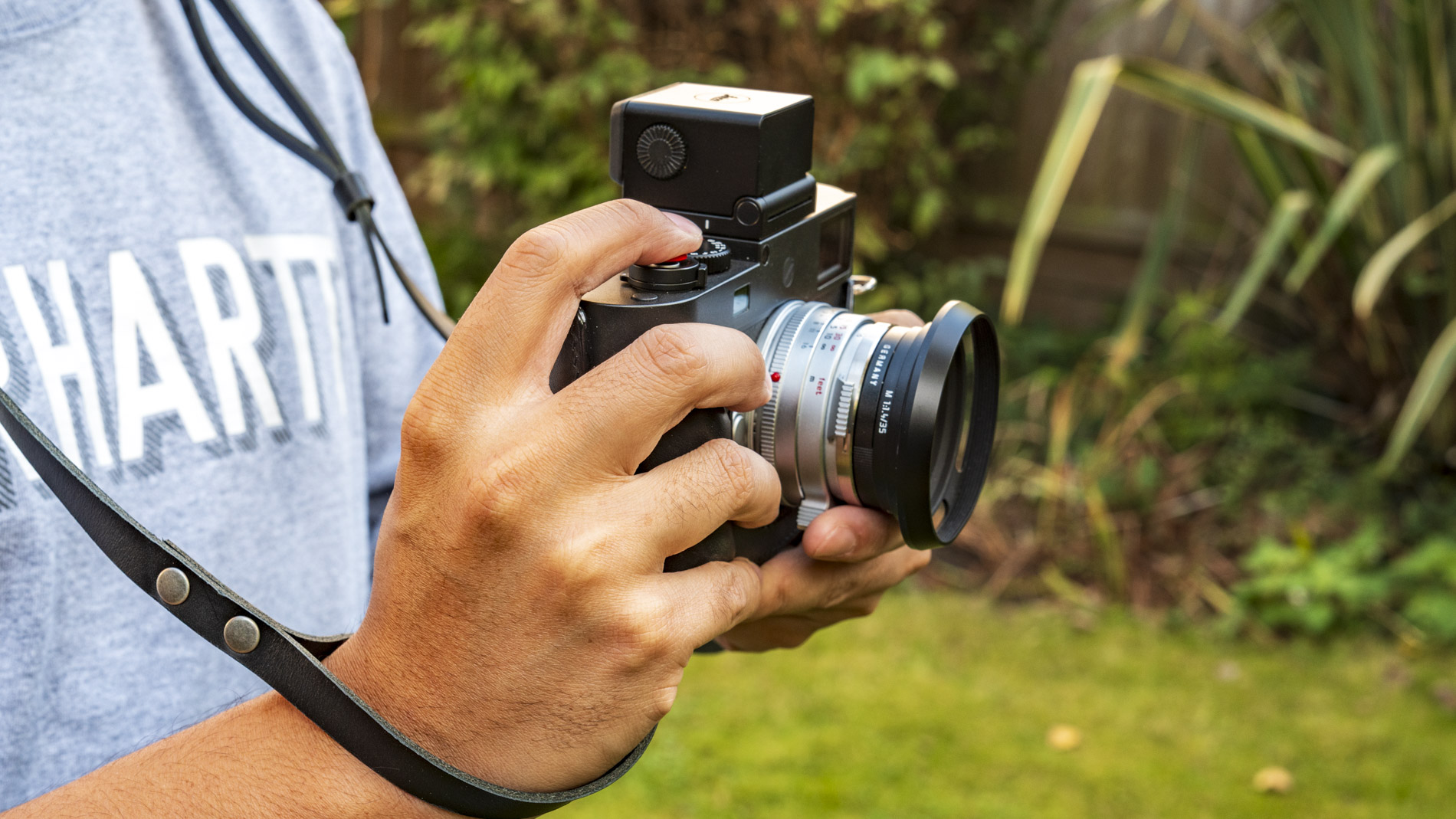
Leica announced on Monday that it will introduce new sensor designs for future models, thought to be the M12, Q4 and SL4. The company has formed a strategic partnership with the Chinese manufacturer, Gpixel, a leading global provider of CMOS image sensors based in Changchun in north-east China. The move will enable Leica to collaborate in their design and will provide the ability to tailor new high-performance imaging sensors for the next generation of Leica cameras.
Wetzlar claims that the collaboration brings together Leica’s long-standing expertise in premium imaging and Gpixel’s cutting-edge sensor design capabilities. The company believes that the new strategic partnership will enable it to push the boundaries of what is technically possible in digital photography.

Bespoke engineering
Unlike a simple supply deal, Gpixel and Leica are working together across the entire development cycle, including validation, image tuning, and production readiness. This long-term cooperation involves engineering teams across multiple global sites, including Wetzlar (Germany), Antwerp (Belgium), and Changchun (China).
The sensors developed through this collaboration will be “purpose-engineered” to meet specific Leica standards in several key areas:
- Dynamic Range and Detail: Pushing the technical boundaries of detail rendering and dynamic range.
- Colour Reproduction: Ensuring high fidelity in how colours are rendered.
- Noise Optimization: Improving performance in low-light imaging.
Xinyang Wang, CEO of Gpixel, emphasised his admiration for Leica’s uncompromising approach to craftsmanship and image performance. He said that collaborating with Leica would provide an opportunity to combine Gpixel’s sensor-engineering strengths with the legendary Leica heritage. The new generation of sensors, he said, would empower photographers with extraordinary image-making capabilities.

Global leader
Gpixel is a global leader in advanced CMOS image sensor solutions, serving industrial, professional and scientific imaging markets. The company is known for delivering state-of-the-art performance across a broad portfolio of sensor technologies — from high-resolution and high-speed imaging to low-noise and specialised sensor architecture.
Make a donation to help with our running costs
Did you know that Macfilos is run by five photography enthusiasts based in the UK, USA and Europe? We cover all the substantial costs of running the site, and we do not carry advertising because it spoils readers’ enjoyment. Any amount, however small, will be appreciated, and we will write to acknowledge your generosity.
Comments: Please add a comment to this article. Our comments section is a thriving community and everyone is treated with respect. In addition, please identify yourself (and add an email address, which will not be published, if you would like to see answers to your posting). Our system will automatically delete any “anonymous” posts on the basis that they are likely to be spam.
If memory serves me correctly, the Leica SL2, SL2-S, Q2, and the Panasonic Lumix S1, S1R, and S5 all used image sensors from a Panasonic subsidiary. Which was later sold, possibly to TowerJazz. As noted below, the newer cameras are all using sensors from Sony Semiconductor.
I am of mixed feelings about Leica moving to new partnership with an unknown (to me) sensor provider. While they may gain more influence in the nature of the sensor details, they may be losing out on the benefits of using a larger and well established provider such as Sony, or TowerJazz.
PaulB
There’s still more intrigue to this yet. It turns out that GPixel doesn’t have any fabs of its own. It has partnered with TowerSemi for its sensors (TowerJazz renamed to TowerSemi). https://www.eetimes.com/startup-launches-record-resolution-150mpixel-sensor/
Panasonic did partner with TowerSemi, but it looks like Panasonic sold its fabs to Nuvoton (based in Taiwan), which most likely inherits the deal with TowerSemi (based in Israel, but with fab capacity in the US, Japan and Italy).
So I had a few idle CPU cycles to burn on the matter, and after digging around, I found out that a number of GPixel’s team members come from CMOSIS (which made the sensor for the Typ-240). CMOSIS had been previously bought by AMS, and then folded into OSRAM (which made the sensor for the M10). It appears that not everyone stuck around the new corporate overlord. Being an engineer and having been through a few acquisitions myself, all I can say is that they are tough.
The engineers formerly at CMOSIS apparently did not just leave for China. There’s a GPixel design team in Belgium (source: https://www.gpixel.com/en/about.html), and these must be the engineers described here: https://www.gpixel.com/en/details_76.html (specifically, “Gpixel NV was formed in August 2018 by founders and key staff of former FillFactory and CMOSIS, combining a very experienced and high-caliber team of designers and product specialists with a solid technology background in the realm of advanced CMOS image sensor solutions.”). It appears that they will get to continue their previous work for Leica, and then some.
It appears that GPixel specializes in custom solutions. So I imagine that if Leica wanted an edge on Hasselblad vis-a-vis a stills-focused camera (e.g. the M11 which doesn’t even take video and has just 4fps, a playbook that Hasselblad copied in the X2D2), then GPixel would be it. Given the amount of competition going on in the semi space right now (forget about image sensors, try getting some RAM for a DIY PC), I’d bet that no other company is able to come close. Anything that Leica does with Sony absolutely won’t just stay with Leica.
No, No, No!
Europe must learn to be self sufficient with technology and production. Exporting production of nearly everything to China will end in tears.
Well, Looks like I’ll have to keep my Q2, and Q2M forever because I will NEVER buy a Leica with a Chinese sensor. What the heck am I paying for???!! Seriously Leica. Come on!!
As far as I know, only Canon and Fujifilm use their own sensors. Current Leicas use Sony sensors, and they are all made in Japan. I’m assuming Leica feels that it can gain more influence and develop custom solutions. China is probably the only place to get this sort of deal.
Did you mean Panasonic? Fujifilm uses Sony sensors. But I think that Panasonic spun out its fabs. Even not-so-cutting-edge process nodes are oftentimes too difficult (both capital and specialized-labor wise) for most companies to operate these days.
As far as I know, Leica’s sensors are made by Sony, but they never specifically state that. I also assumed Panasonic and I’m not absolutely Panasonic make their own. You may know more about this than I do.
In our interview with Stefan he confirmed that Sony were Leica’s partner for sensors.
I knew I’d seen it somewhere!
If you read Arthur’s comments and follow the links, you will realize that what you assume to be Chinese is nothing of the sort. The company is international and the technical leadership for this project with Leica are people the company has worked with before. Production of sensors is also likely to be based in Europe.
As with the automotive industry, there is no such thing as a German or Italian vehicle anymore. Components can come from other international companies, and can be assembled in a number of sites scattered around the globe.
China is well know for stealing technology. I used to work for a high tech company that sold equipment to Chinese customers. They stole the proprietary product information well protected by patents and put the Canadian company out of business. I do not think Leica is wise in doing this.
Hi Brian. I understand the skepticism-given that history, it’s a reasonable concern, and what happened to your previous firm is a fair cautionary example.
We’re seeing similar patterns elsewhere recently. Carmakers like Volkswagen, Renault, Nissan, and Hyundai are working with Chinese partners to move faster on EV and autonomous tech. In healthcare, companies such as AstraZeneca and GE Healthcare are also expanding R&D efforts there.
We’re seeing similar moves elsewhere. Carmakers like Volkswagen, Renault, Nissan , Hyundai etc are teaming up with Chinese firms in China to accelerate their EV and autonomous tech. In healthcare, companies like AstraZeneca and GE Healthcare are shifting a large portion of R&D to China.
It may not be an easy shift from different perspectives, but it seems like many industries are weighing collaboration alongside the risk of missing out on where a lot of innovation is currently happening.