
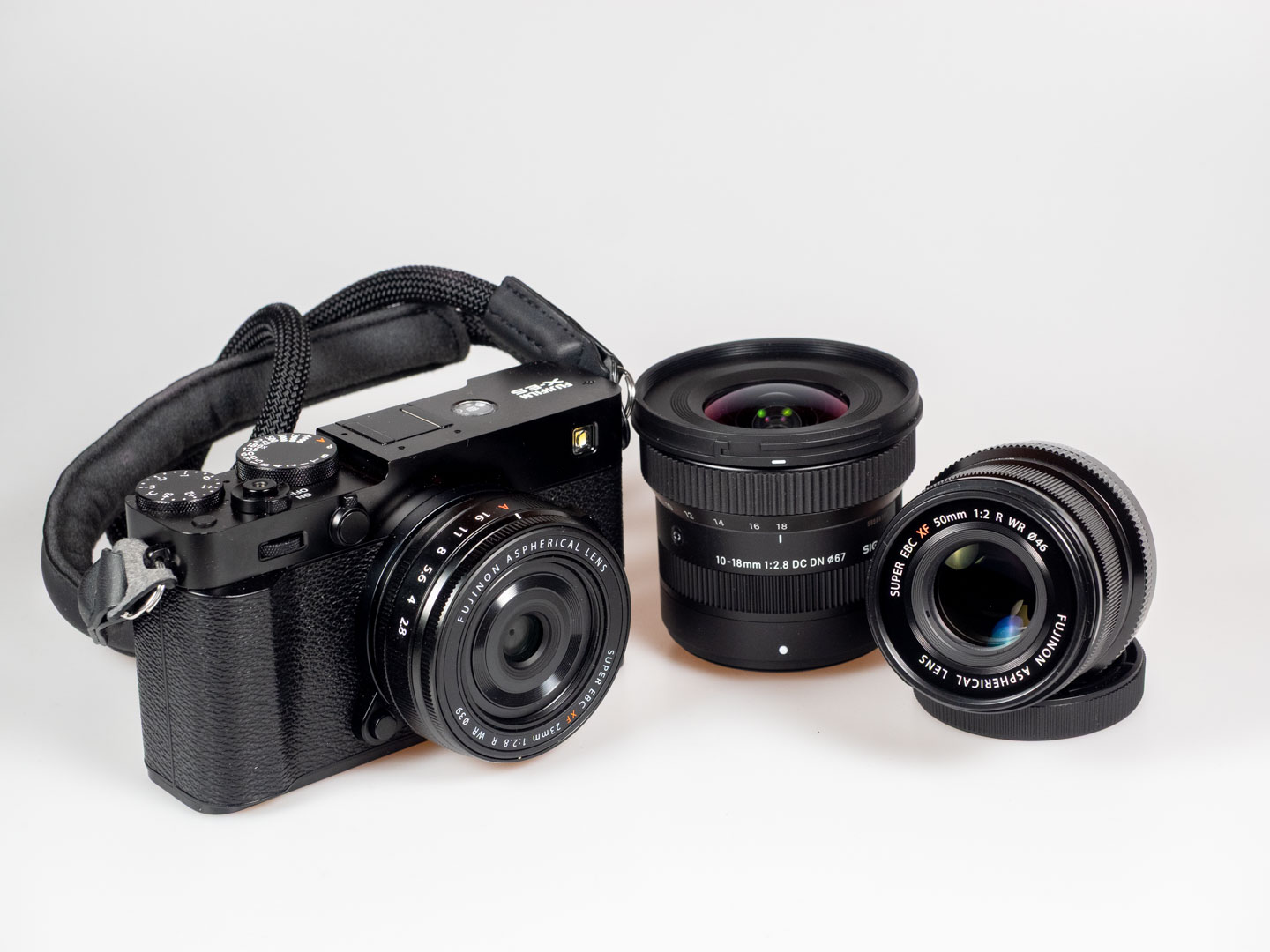
This is not about leaving Leica for Fujifilm. It is about building a small kit in addition to my beloved rangefinder cameras, as a successor for my Leica APS-C gear. Read here which thoughts guided me in choosing camera and lenses. And why the Fujifilm X system was love at second sight for me.
In a previous article, we explained why the editorial team of Macfilos sees Fujifilm as their preferred APS-C-system after Leica left this segment. I, personally, think that Fujifilm and Leica — both as brands and products — have much in common (while there are also important differences) and wrote about this in a much-debated article. In this follow-up, I want to explain how I came to Fujifilm and how I use the gear.
Fujifilm X system: It started with a brief fling
I first came across Fujifilm digital cameras in 2016. While travelling, I saw an X-E2 camera kit in a shop window at an irresistible price, so I thought it might be worth a try. I thoroughly liked the camera and the results, but it remained a brief flirt.

At that point I had decided to stick to Micro Four Thirds and Leica M, so the Fujifilm with its excellent 18-55/2.8-4 kit zoom (discontinued now) had to go. I lost nothing, fortunately. And I never seriously missed the Fujifilm as MFT made many improvements, especially in autofocus performance and, more important to me, noise reduction.
The X100VI as a Leica Q replacement?
The way back to Fujifilm started with an X100VI. I bought it, after some waiting, shortly after it came out in February 2024. The idea was to find a possible successor for my venerable Leica Q (first version). The 40MP sounded promising, and the price of a Q3 was way beyond my means, and all the more for a “relaxed photography” camera. Oh, I never meant to enter the Fujifilm X system with interchangeable lenses at point.
“I had never fully bonded with the Q’s 28mm angle of view”
What were my thoughts? I had never fully bonded with the Q’s 28mm angle of view, it was not cutting edge in high ISO performance, and I really liked the idea of having a built-in flash, which the X100VI offers. Especially for images that are meant to be printed in the newspaper and news site I work for, some fill-in flash can be crucial. Of course, new sensors have an impressive dynamic range, but you will never get the same punch as with some well-dosed fill-in flash.

Over time, the X100VI became a favourite travel companion. The 35mm equivalent lens turned to out to be just right for me, and the slightly smaller size as compared to the Leica Q is practical. I took the X100VI into the wilderness of the Italian Alps, to the bustling cities of Northern Spain, to festivals — partly solo, partly as an addition to an M kit. For the occasional outing on evenings, for handing it over to friends and family and also in day-to-day use, it proved to be nothing less than a wonderful camera.
How I finally entered the Fujifilm X system
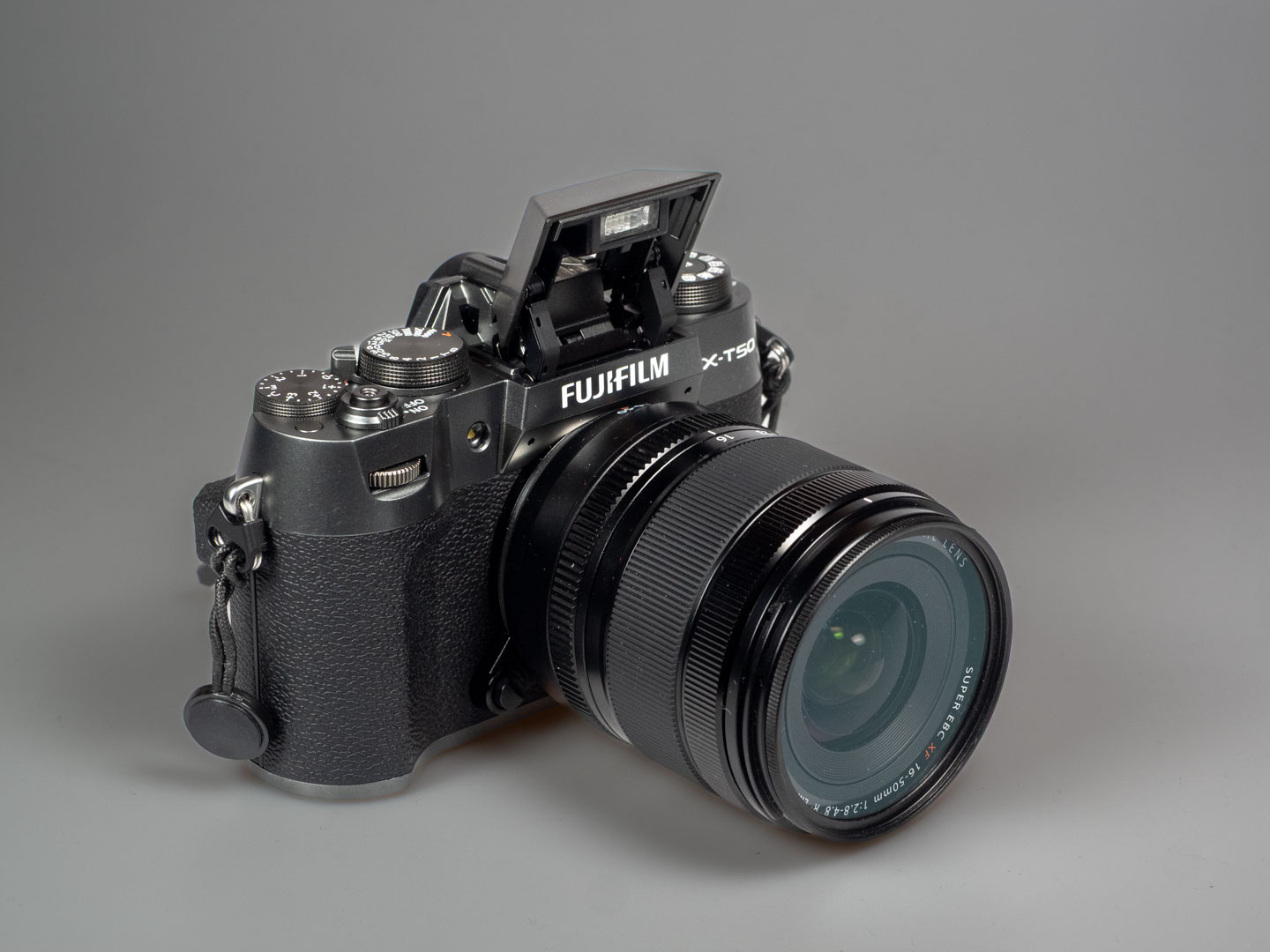
While I never really planned to enter Fujifilm’s X System, I had the opportunity to use an X-T50 camera in my daily work as a journalist, and I quickly came to appreciate it. It was so similar in handling to my familiar X100VI, and this convergence of user experience (Jon Cheffings has written an excellent article on this topic here on Macfilos) somehow hooked me — although the Fujifilm cameras do lack the simplicity of Leica’s user experience.
The X-T50 as carry-always camera
I have to carry a camera with me every day for unplanned journalistic tasks, and for years, a Sony RX100III had its own little corner in my bag. After many years, it ended its service life. And after a close look to the then line-up of Fujifilm’s X system, the X-T50 took its place (or better: three times its place). The originally intended X100VI could not fill this gap, I had soon found out, as it was lacking a zoom for this specific use case. Neither could the iPhone, for it lacks a longer focal length.
The X-T50 turned out to be a reliable tool, and especially the JPEG files fitted perfectly into the newsroom’s out-of-camera workflow with minimal post-processing. Speaking of it: I steer clear off the “A” lever which activates additional in-camera processing that make images look unnatural. I set ISO and shutter speed to automatic and adjust aperture. Often, there is simply no time for much tweaking in post in a journalistic context.
40MP for mighty crops
Obviously, the much-described film simulations are no option in this use scenario, so I only use the standard setting. All I need to do is closely monitor the film simulation dial because it can easily misalign unintentionally. The 40MP resolution allows for mighty crops, so the 75mm equivalent of the 16-50 (24-75 full-frame) kit zoom is sufficient. That said, f/4.8 at the long end is not ideal in low light situations or when you wish for much background blur.

The 24mm equivalent at f/2.8 is extremely helpful, though, especially indoors. Add to this excellent image stabilisation (in the camera), a decent electronic viewfinder and a small form factor, and you have a capable tool for any reporter as long as you don’t have to shoot sports or other stuff that requires highly specialised gear (there are options also in Fujifilm’s X system).
The appeal of the X-E5
Before long, the question of a back-up body arose, and I also wanted something emotionally attractive (which the X-T50 doesn’t quite fulfil). You can call this irrational, but I am sure that a tool you have really bonded with is more fun and enables better results (you can read my extensive X-E5 review here). So I opted for the X-E5, even though it lacks the built-in flash. Otherwise, the two cameras are pretty similar, and switching from one to the other is easy.
The X-E5 came with the kit lens, the 23/2.8. I wasn’t sure if this was sensible as the X100VI offers the same 35mm equivalent focal length, albeit at f/2. As you will read, Mike had the same dilemma but made the opposite decision. The X100VI offers a full aperture stop more, but as the price difference was low, I gave the kit lens a chance, and this turned out to be a good decision.

I can carry the X-E5 in a larger kit with several lenses in case they are needed. And I can, so to speak, easily transform it into an X100 with the 23mm when I want a minimal burden. That’s a strong point if you go for a Fujifilm X system kit instead of a fixed-lens camera.
Three lenses make for a good Fujifilm X system kit
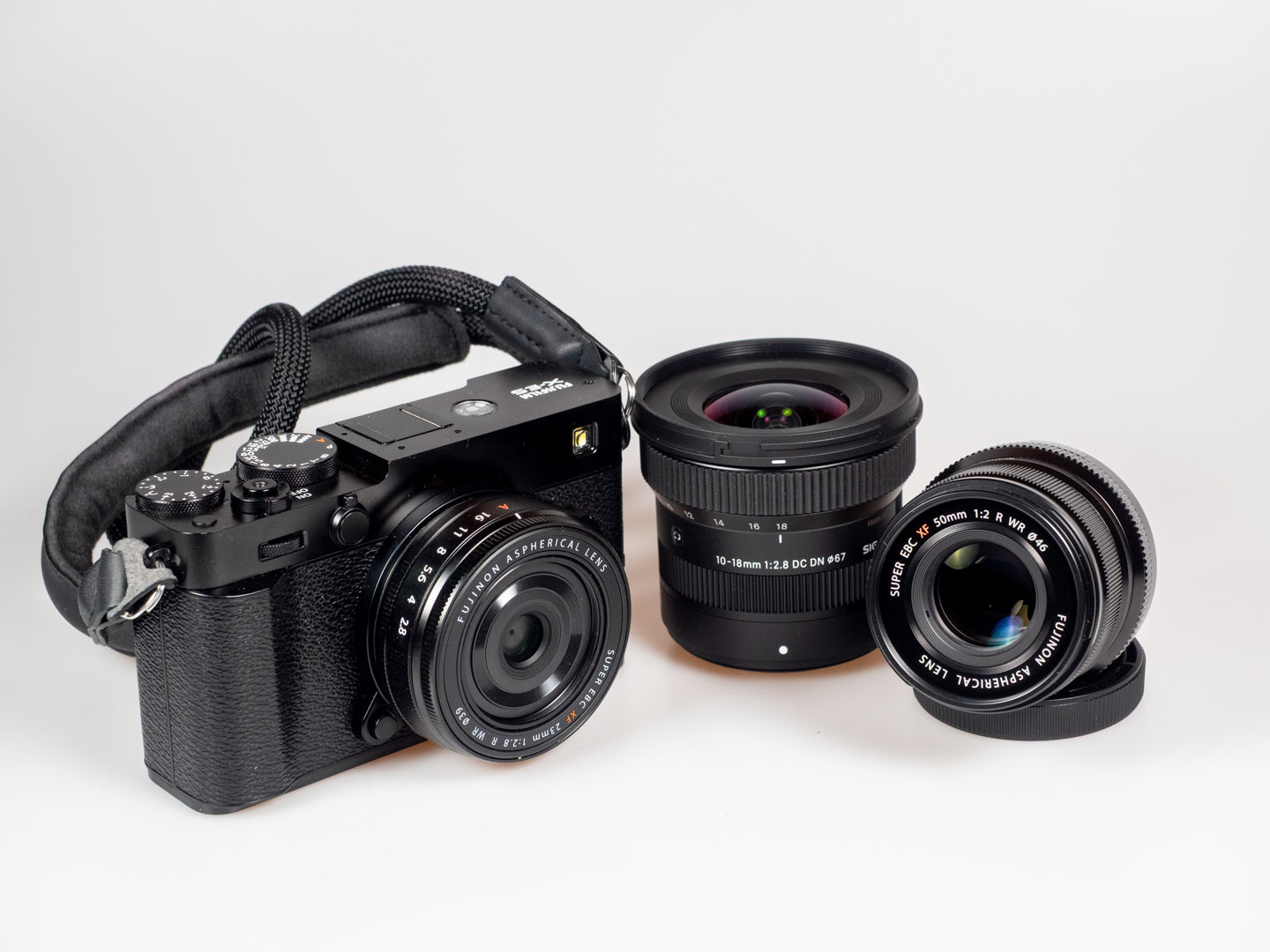
The other lenses I opted for are the Sigma 10-18/2.8 and the Fujifilm 50/2. This way, with my Fujifilm X system, I can cover a range from 15 to 75mm with a minimal package. If I require more reach than 50(75)mm or something between 23(35)mm and 50(75)mm I use the cropping margin a 40MP sensor offers — the leeway is impressive. Truth told, a mid-range bread-and-butter 16-50mm zoom has also its benefits, as mentioned above.
Super-wide zoom or prime lens?
The 10-18/2.8 is a 15-27 equivalent super-wide zoom. It offers good, albeit not excellent, rendering and is very useful indoors, for nature (stopped down!) and reportage photography. I went for this sensible solution and decided against the Sigma 12/1.4 which I was able to test in Rome. This one is two full stops faster, but with its 18mm equivalent angle of view, it’s basically a one-trick pony.

The 50/2, so far, has turned out to be a good compromise. There are faster lenses; I also tested the rather old Sigma 56/1.4 which is built well, performs well on the 40MP sensor—but lacks an aperture ring. The 50 offers enough background blur when shot wide open, and the electronic shutter makes an ND filter often unnecessary, at least with more or less static subjects.

What lenses will I add next to my Fujifilm X system? The 27/2.8 pancake attracts me because I really like the 40mm equivalent angle of view, but there is no rational reason for buying it. A very fast 35 (50 equivalent) could be worth considering, and also a longer, fast telephoto zoom or prime, of course.
In any case, Lichtblick Fotofachgeschäft at Konstanz will be my outlet, it has been my dealer for decades now, and it has risen to become one of the biggest and best-stocked independent shops in the German-speaking area. Macfilos doesn’t carry advertising, and nor do I wish to advertise, but maybe you want to check their offerings.
Buy second-hand or ask for ex-demo gear
Lichtblick also ships abroad. The staff are used to customs formalities, as Switzerland is on the doorstep, and speak English. And you can always ask if they have ex-demo gear or young second-hand items (my favourite choice, and I thus paid considerably less than the RRPs listed below).
For now, however, I am pleased with what I have. And, by the way, the Leica M is far from collecting dust. It is and remains just a different, more conscious way of photographing. And no Fujifilm camera has so far caused me to question that.

What my Fujifilm X system outfit cost
| THE KIT | THE COST |
| Fujifilm X-E5 with XF 23 f/2.8 R WR | £1,499 | €1,799 | $1,899 |
| Fujinon XF 50 f/2 R WR | £392 | €499 | $499 |
| Sigma Contemporary 10-18 f/2.8 DC DN | £599 | €749 | $679 |
| Total | £2,647 | €3,047 | $3,077 |
What’s your view?
Would you use a Fujifilm APS-C kit in addition to a Leica? Or maybe even instead? And for which body and lenses would you go? Do you think Fujifilm’s X system mid-range gear as described here is inferior to their top-of-the line camera with better EVFs and further nice features? And what do you prefer: fixed optics or exchangeable lenses?
| FujiFilm vs. Leica: How the APS-C race was won | A very different Fuji camera: the X-Pan |
| Interesting accessories for Fujifilm cameras | Fujifilm X20: The beloved retro camera |
Make a donation to help with our running costs
Did you know that Macfilos is run by five photography enthusiasts based in the UK, USA and Europe? We cover all the substantial costs of running the site, and we do not carry advertising because it spoils readers’ enjoyment. Any amount, however small, will be appreciated, and we will write to acknowledge your generosity.
Comments: Please add a comment to this article. Our comments section is a thriving community and everyone is treated with respect. In addition, please identify yourself (and add an email address, which will not be published, if you would like to see answers to your posting). Our system will automatically delete any “anonymous” posts on the basis that they are likely to be spam.
An interesting article by Jörg-Peter, backed up by his solid photojournalistic experience. I have used Fujifilm X-series since 2013 while continuing to use Leica M cameras with Kodak Portra and Ilford films when the mood takes me. Interesting too to find another shooter who is not so comfortable with 28mm (18mm APS-C). I just work more comfortably and successfully with the ‘either side’ lenses 24 & 35mm (16 & 23mm APS-C) whether for street, travel, architecture or scenics. Hence I never considered a Q -series. As I use fast lenses I have resisted the rather nice X-E5, however — unlike the writer — and look forward to an eventual X-Pro4, on which the 16/1.4 and 90/2 in particular would find better balance, even though they are already quite light in comparison with other makers’ fast FF offerings.
Dear Thomas, sorry for replying so late. Thanks for sharing your thoughts and interesting to read that you also prefer 24 or 35mm over 28. That said, it is of course possible to shoot decent images with a 28mm angle of view, but it takes some extra care in my experience. You might imagine what a relief it was for me when the fist 24-70mm zooms came out after decades of 28-70 standard. And I fully understand what you are writing about a suitable body for faster and heavier lenses. And, with an X-T5 or another of the higher end cameras, you avoid the (in my eyes) weakest point of the X-E5, small and low-res viewfinder. All the best, JP
I am contemplating saying goodbye to my very adequate Sony kit. I will keep my beloved RX1Riii, but my a7c bodies and lenses are on the way out. I bought an e-x5 and x-t5 with some lenses. First experience with the older 35mm f1.4 on the e-x5 are very promising.
Erwin, that’s interesting. For some reason, everyone seems to be moving to Fuji, and I’m not quite sure why it is happening now (given that the brand has been successful for many years). There’s no doubt that the X100VI has brought the brand into the mainstream and, for APS-C, it’s comforting to know that Fuji is so dedicated.
You could imagine Canon, Nikon, or even Sony deciding to discontinue APS-C just as Leica did. So Fuji is a fairly safe haven with an assured future.
Welcome to Fuji, and I hope we can have the pleasure of publishing one of your articles on the brand.
Mike
Hi Erwin, would you also sell your A7c if a standalone Zeiss Sonnar T* 35mm f/2 lens were available? There are lots of available 35mm lenses for Sony but all seem to have a very similar fairly modern clinical rendering. None of them has a unique rendering like the Zeiss Sonnar T* 35mm f/2 lens. The 35mm GM is obviously excellent but rather big for the A7c. I have been thinking about the Sony RX1Riii for a while now. Not sure whether I will ever pull the trigger, I am trying to downsize, and it is overpriced I feel, but the images are very beautiful in my opinion.
Oh, that‘s a small surprise, Erwin, I never knew you were interested in Fujifilm. a am very curious about your experiences. The X-E5 for small size and X-T5 for all features, weather sealing, dual card slow and so one are extremely sensible as a kit! Do keep up updated…
Hi Jörg Peter,
I enjoyed your excellent article. It’s always interesting to hear about others’ Fujifilm journeys. I have a pretty extensive Fujiflm system. I tried an X-Pro1 briefly but started out with conviction with a couple X-Pro2 bodies and several lenses back in 2016. It’s now been more than a decade with several camera and lens changes along the way. I must say, as a full time photographer using the Fujifilm gear, it was a bumpy road in the beginning but I’m now pretty happy with the system. It’s a great complement to my Leica gear and allows me lots of extra versatility.
I used to own the X-E4 with the 27mm f2.8 (great lens and agree it’s a great focal length) but I didn’t use it enough so I sold it. I also tried the X-E5 briefly but returned it. However I may revisit that. When I want to go light I tend to take my M11 and one or two lenses or my Q3. On my recent trip to England for the LSI event I also brought my X-T5 infrared body with the 18-135mm zoom. Not as compact as an X-E5 but still not a heavy beast like many full frame systems.
Thanks for this article! I hope to also contribute some articles to Macfilos about my experiences with the Fujifilm ecosystem.
Dear Joel, I feel honoured by your feedback. I think we have pretty much the same idea with Fujifilm an Leica M. I am eager to hear from your experiences. For the time being, I will check in which circumstances my full frame L-Mount kit brings a significant benefit to APS-C…. All the best, Jörg-Peter
First: thank you for posting the link to your photojournalism article; I overlooked the original. Not only was it truly engaging, I learned about the profession of photojournalism.
As to Fuji, Leica, etc: I’m strictly an amateur, taking photos for my own pleasure. Yet, like you, I found I wanted a camera lighter and smaller than the Leica M240. For a time, the Leica D-Lux Typ 109 was exactly what I needed, until the dreaded ‘dust’ problem disabled the camera.
I found that the Fuji X-E3 with a Sigma zoom was an excellent substitute. An heretical thought: would the X-E3, fitted with Fuji’s excellent new 16-50mm zoom, be a reasonable way forward from the Leica X-Vario? (I am going to be in so much trouble for even suggesting this)
Lately, reading about the Q2 and especially the Q3 43, I was seduced by the siren call of high megapixel sensors, and bought a (used) Fuji X-T5. Nowhere near as easily carried as the X-E3, yet in so many ways an excellent camera.
In my latest trip to Japan, I carried the X-T5 and one of the 35 f/2, the 50 f/2 and the 14 f/2.8 — when I knew I’d be at a major temple, museum, or cultural event — that latter including off-the-street obento or onigiri from a grandmother’s stall (I don’t photograph in restaurants; it feels inappropriate, especially in Japan). For simple walking about, I took the Fuji X30, to my mind, a better implementation of the Leica D-Lux.
So it seems, against my original intentions, I am now firmly in the Fuji camp. With the M240 always at the back of my mind.
Kathy, The X-E5 with the 16-50 compact zoom is definitely an ideal replacement for the old X Vario. The lens is as good (I would suggest) as that in the Leica, and it is faster. The whole kit is of a similar size and, of course, there’s the viewfinder and the ILC flexibility. It’s a definite option.
Thanks, Kathy, you’re welcome. I know about your love for the X-E3, and I can understand it well. However, I prefer the better build quality and the modern sensor of the X-E5. But, no question, you can shoot excellent images with the older camera. And, I agree also here, you can build your own X Vario replacement wich will, of course, not have the Leica appeal and maybe also not Leica‘s truly excellent colour science, but can be a wonderful companion even to the more risky places. I hope you will stay happy with your kit, but with your „amateur“ (in the true sense of the meaning) attitude, you will always produce wonderful images which are made with love. All the best, Jörg-Peter
Thanks for this articleJoerg-Peter.
I just stick to my X2 and XVario along with my Ricoh GXR system. Leica for colour and Ricoh for B&W. If I needed a “new” camera that would be a second hand Leica X (typ113). 16 or 12 MP is just enough for what I’m doing. I can enlarge up to 50×75 cm. The tilting EVF on the Leica is a plus for aging knees, different from a tilting rear screen as I can shoot with the viewfinder. In my opinion a higher pixel count is a commercial argument that won’t make me a better photographer. I prefer attending Leica workshops when they come to my camera shop.
I know, Jean, and I am in awe of your commitment for the Leica Xs. You are showing us again and again that it‘s the photographer who takes the images (and who masters his cameras, with all their stronger and weaker points). I still remember my Olymps E-3 Four Thirds SLR camera with its modest 12MP. The images look stunning to this day. And in most cases, ultra high resolution is not needed, but in professional use it is more than practical because if allows for robust cropping. Sometimes, we just don’t have the time during our assignments to work at a slow pace… All the best and do enjoy your Leica APS cameras! JP
I just stick to my X2 and XVario along with my Ricoh GXR system. Leica for colour and Ricoh for B&W. If I needed a “new” camera that would be a second hand Leica X (typ113). 16 or 12 MP is just enough for what I’m doing. I can enlarge up to 50×75 cm. The tilting EVF on the Leica is a plus for aging knees, different from a tilting rear screen as I can shoot with the viewfinder. In my opinion a higher pixel count is a commercial argument that won’t make me a better photographer. I prefer attending Leica workshops when they come to my camera shop
Since I fell while putting up Xmas lights and messed up a couple of discs in my back and broke my arm I can no longer carry my 100s and 50r plus my six/seven lenses. Now, I only take my Leica Q2, Q2M and depending on what I’m shooting my X-T5 with my 70-300, 50-140, 14mm. I also have a lightweight Fuji GF 100RF which is honestly amazing and weighs less than my Q2 kit..
Jorge, thanks for commenting. Portability is not to be underestimated. I camera at home in the drawer, „too heavy for today“ oder „too precious for where I am going“ is basically not a very good investment. And I can immediately understand what a relief it must be for you to have a lightweight alternative how. I wish you all the best and hope to meet you again here in the Macfilos comments section. Jörg-Peter
Thanks for this! This is a very good article and it explains your thought process very well. Just like yourself I had a brief fling with Fuji (X-Pro1, X100T and X-T1) and just like yourself I was not fully convinced by the original Leica Q either, so perhaps there is also a Fuji X-E5 in my future, who knows? Its main competitor would probably be a full frame Sony a7C II, or a couple of Ricoh cameras.
You‘re welcome, SlowDriver. Maybe you finde someone to borrow a X-E5 from. But be warned, it could be fatal… The small Ricoh APS-C fixed lens cameras are wonderful, and I can wholeheartedly recommend them. Maybe you have read my article on the GRIIIx in joint use with a 1960s Rollei 35 on a trip to South Italy a few years ago. The only thing is the missing viewfinder… but this was already discussed extensively here on Mafilos. All the best, JP