
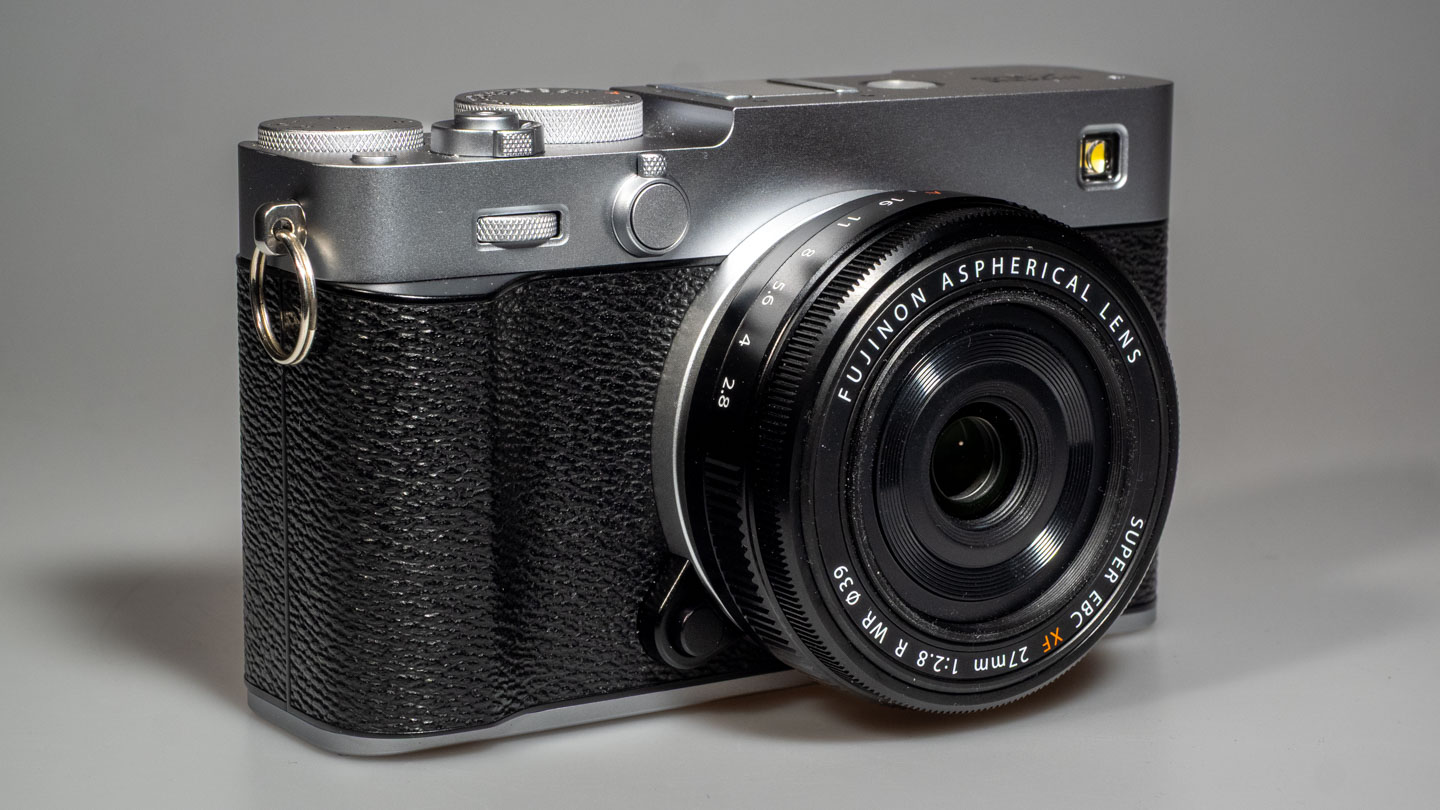
These similarities are certainly no coincidence. The Fujifilm X-E5 looks like a rangefinder camera and seems to deliver much of what users expect from a Leica M. But is the Fujifilm X-E5 a Leica alternative to the Leica? As a long-time rangefinder photographer, I put it to the test.



Sant’Anselmo all’Aventino. Fujifilm X-E5 with Sigma 12/1.4; 1/340 sec at f/2.5, ISO 125.
Santa Maria della Vittoria with Bernini’s Ecstasy of Saint Teresa. Fujifilm X-E5 with Sigma 12/1.4; 1/80 sec at f/2.5, ISO 12800 (denoised in Lightroom).
Piazza della Rotonda. Fujifilm X-E5 with Fujifilm 50/2.0; 1/150 sec at f/2.0, ISO 125.
©Jörg-Peter Rau
Let’s start with a trigger warning. I know that there is a certain kind of question that commonly divides the Leica world: can anything truly be an “alternative”? Not a competitor on paper, not a camera with similar specifications, but something that captures at least a trace of the experience — of seeing, handling, and ultimately photographing — that has defined the M system for decades. With the release of the Fujifilm X‑E5, that question has resurfaced once again, perhaps more insistently than before.
In this article, I will focus on whether Leica users might find the Fujifilm X-E5 interesting and if so, for what reasons. While the X-E5 will seem a logical alternative to the CL, I am also keeping M, Q, and SL users in mind. They could be attracted by a camera that looks much like a rangefinder camera but is a modern mirrorless system camera with a purely electronic viewfinder indeed.
How the Fujifilm X-E5 wants to evoke a Leica feeling
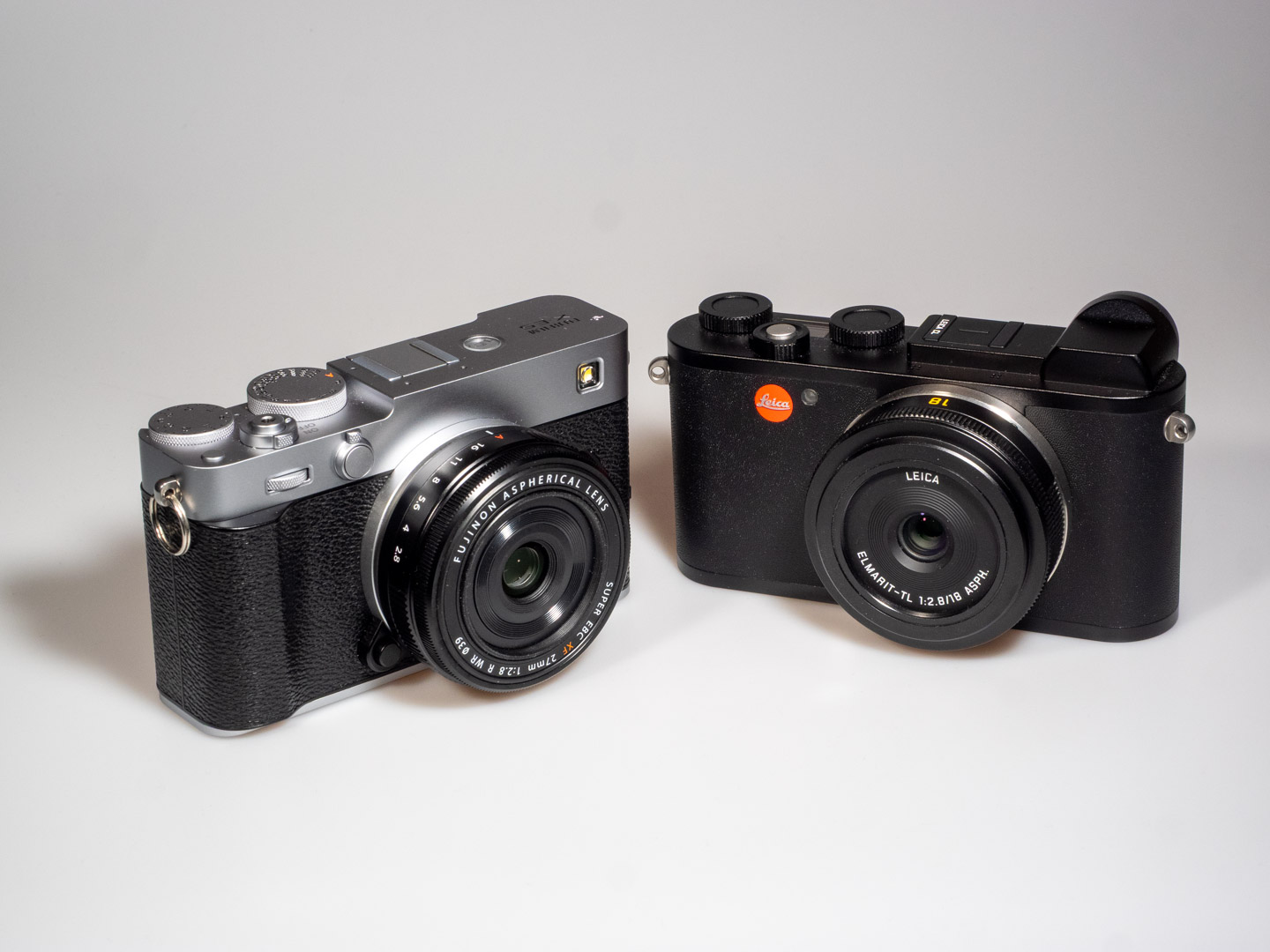
At first sight, the X‑E5 seems almost tailor-made to provoke the comparison. It is compact, understated, distinctively rangefinder-styled. And seems to be built around a philosophy that prioritises deliberate photography over technical excess (that’s at least the feeling Fujifilm wishes to evoke). But beyond appearances and spec sheets, the real test lies in use: how it behaves in the hand, how it shapes the act of photographing, and whether it can hold its own not just as a camera, but as a photographic companion in the Leica sense of the word.
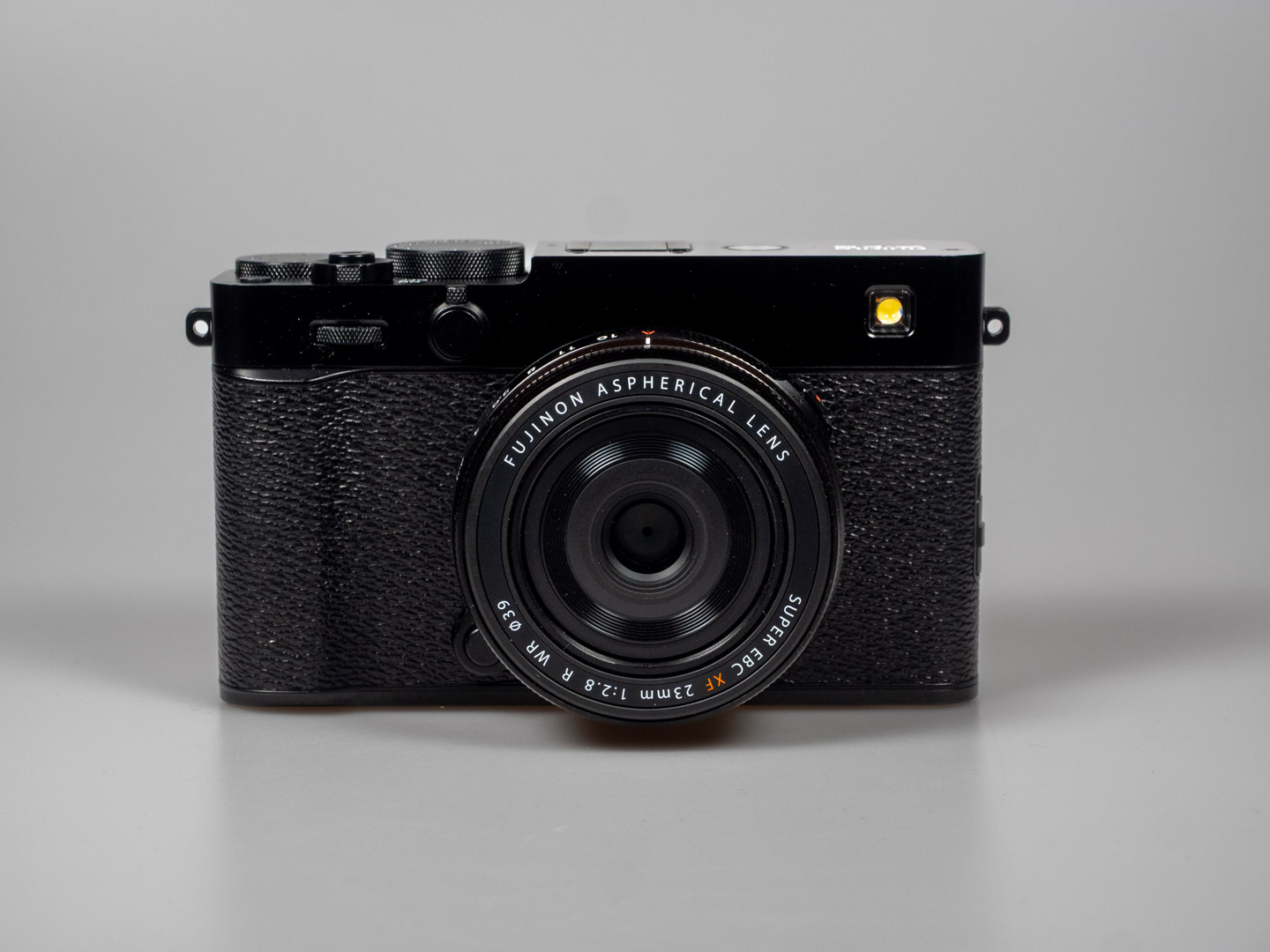
To get it straight out of the way: There are far more differences than similarities between a Leica M and the Fujifilm X-E5. One has a full frame sensor and has to be focused manually, the other is APS-C and features autofocus. Differences are less when compared to a Leica Q. But also in this case, we will see that user experience is far from similar. You could even go as far as to say that the closest link between these two cameras is the fact that your viewfinder is on the body’s left side, instead of a middle position as it has been the SLR tradition.

The Fujifilm X-E5, apart from the Leica alternative question
But let’s leave the comparison aspect for a moment and just look at the Fujifilm X-E5.
First impression
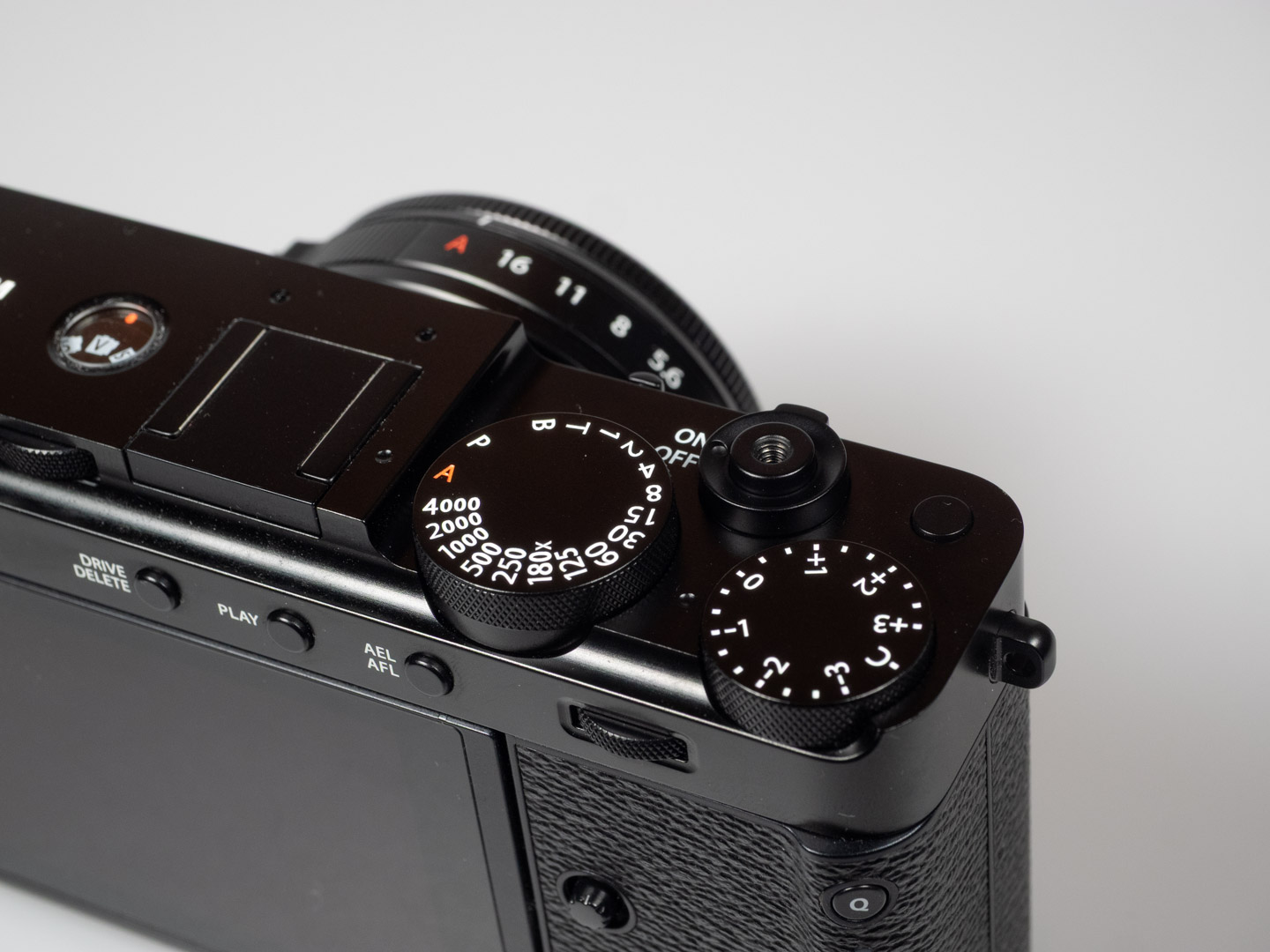
The first impression the X-E5 makes is a “wow” effect. When you take the camera out of its box, it oozes quality. There is a lot of solid metal used for the body, and all the main control dials are intuitively understandable. The aperture can be selected on most Fujifilm X-Mount lenses directly.
The beautifully knurled shutter speed dial sits exactly where it is supposed to be. The only thing missing is the hidden ISO setting inside the dial we know from the X100 series. An exposure correction dial is ideally located for easy use. Everything else also appears to be very, very sensibly designed.
Image quality
If you see the first images from the Fujifilm X-E5, you might well understand a bit better why it is so often called a Leica competitor. The 40MP sensor delivers pictures of excellent quality and with a remarkably high contrast range. Often, you can recover even the darkest areas, and the danger of blown highlights is significantly lower than on the M10 I have been using for so long now.

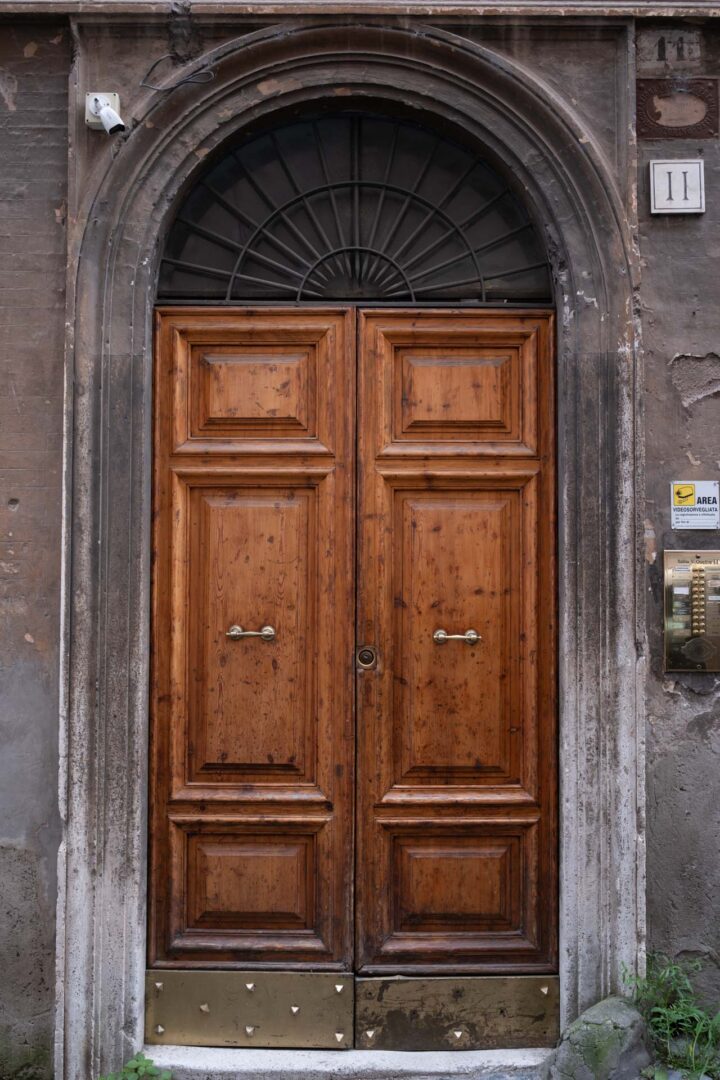

Trastevere. Fujifilm X-E5 with Fujifilm 23/2.8; 1/120 sec at f/3.2, ISO 125.
St. Peter’s. Fujifilm X-E5 with Fujifilm 23/2.8; 1/120 sec at f/4.0, ISO 1600.
©Jörg-Peter Rau
Add to this excellent high ISO performance (6400 fully usable, the rest can be taken care of in post-processing). White balance can be a bit off, however, especially in mixed light situations. As a dedicated RAW photographer, I don’t care that much about it anyway.
Film simulations
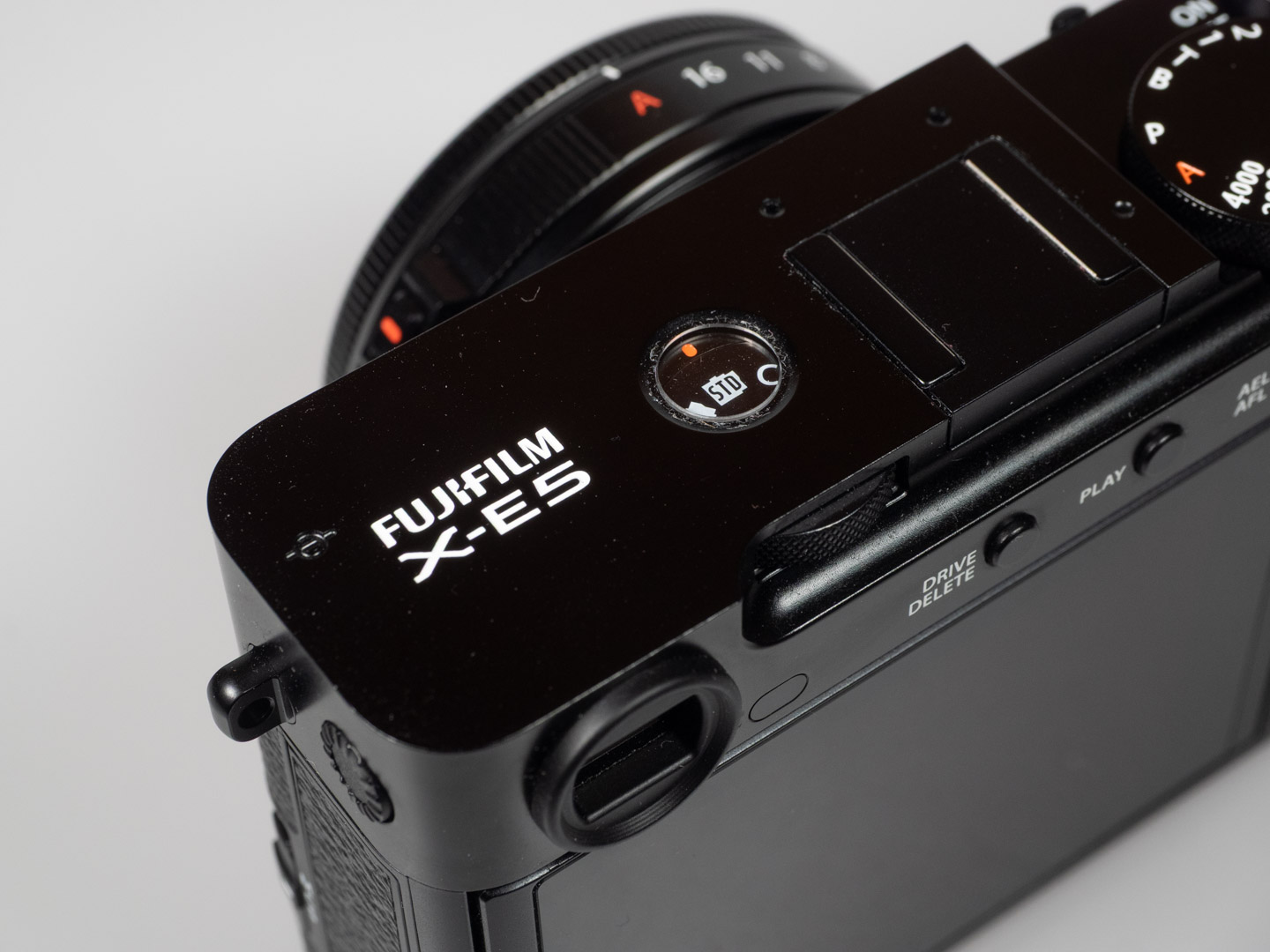
Speaking of this: Fuji cameras are also renowned for their film simulation modes. Shame on me, but I have used them only sporadically so far. I always see the beautiful film stetting dial under its glass cover on the top of the camera when I take the X-E5 in my hands. And I keep reminding myself to finally do some serious testing with this typical Fujifilm feature.
Maybe I can overcome my deep-seated preference for shooting RAW only and manage to write a small article on this in the future. You can read here about Mike Evans’ experience with film modes on a different Fujifilm camera, meanwhile. Or you have experience and want to share it in the comments section.
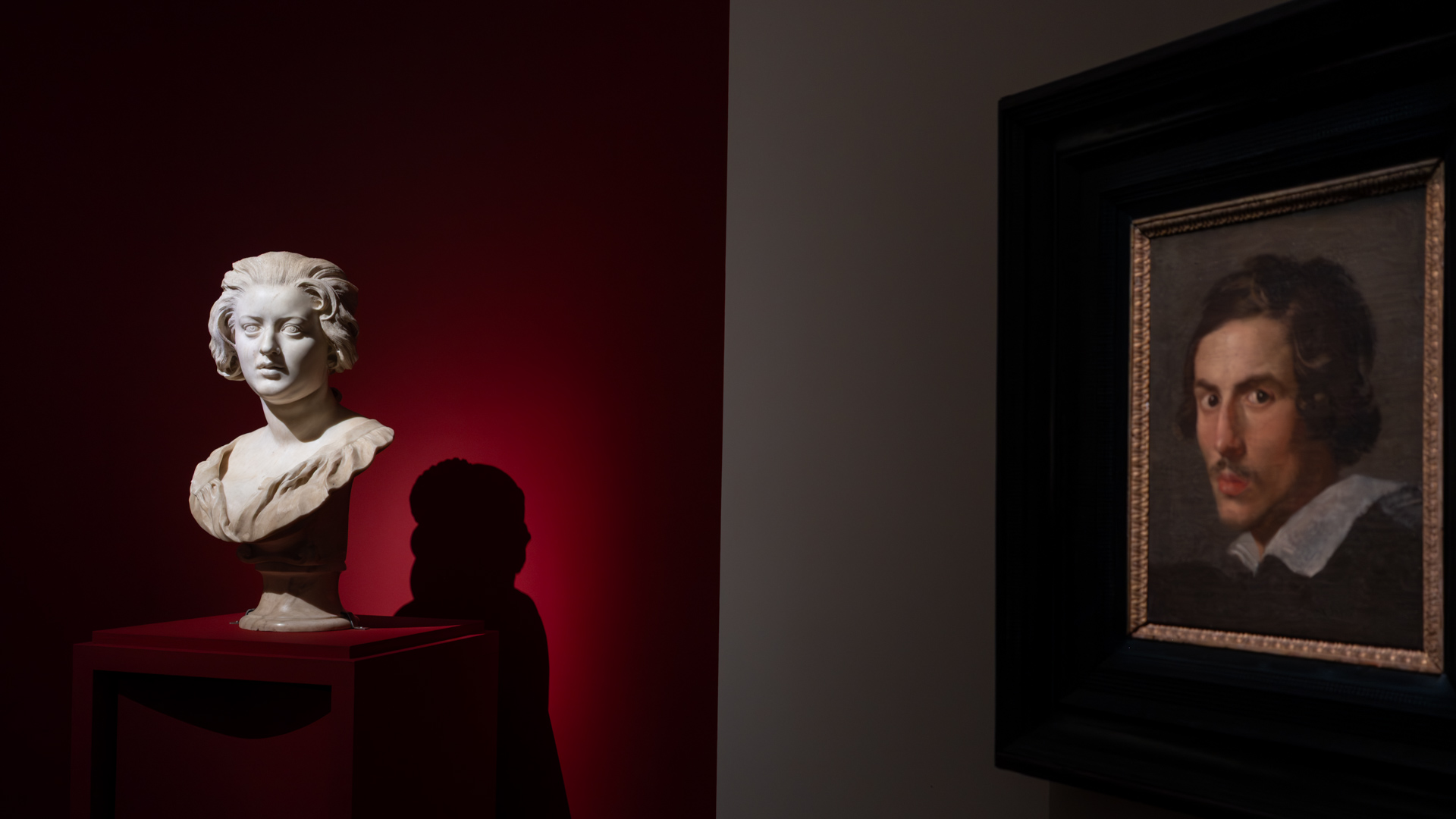
As an interchangeable lens camera (ILC), the Fujifilm X-E5 offers great versatility. You can attach lenses from fisheye to super telephoto. Fujifilm, as well as third-party manufacturers, have nearly 80 to offer here. You are not limited to a certain number of frame lines in your rangefinder, and neither are you to lenses with manual focus and manual aperture setting.
Versatility
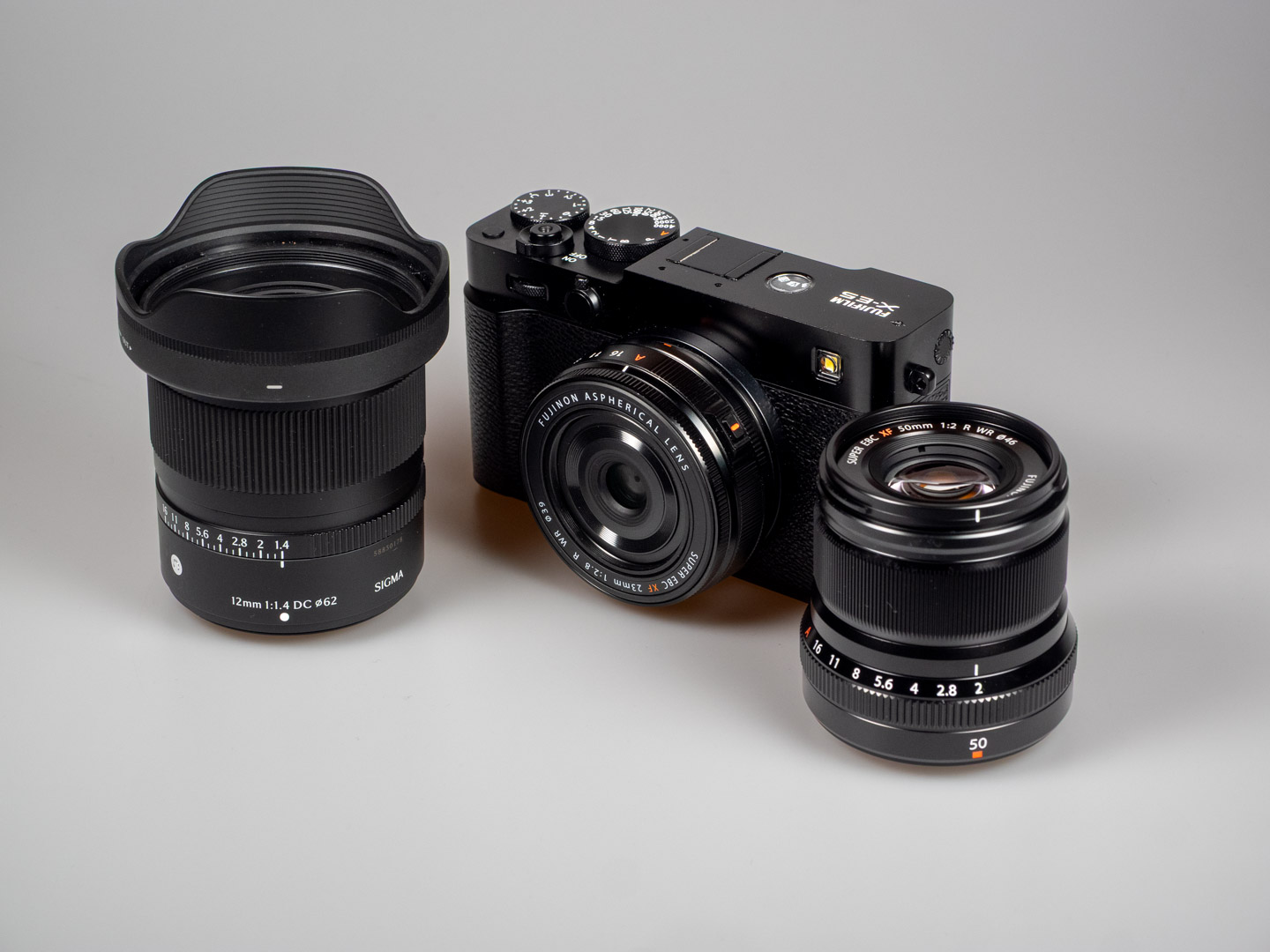
For a trip to Rome, I combined the camera and the 23/2.8 kit lens with a Sigma 12/1.4 (18mm equivalent) and the Fujifilm 50/2 (75mm equivalent). I knew I needed a fast super wide angle for indoors and a small telephoto lens for details. And the pancake for moments when you don’t want to carry around a proper photo bag or backpack. And all suited into a small and inconspicuous bag!
I made sure that all lenses are ready for the 40MP sensor — the Sigma 12 is quite new, the Fujifilm pancake 23/2.8 as well, and even the 50/2 from 2017 is rated as 40MP ready. For other older Fujifilm lenses, I would recommend reading reviews carefully. Remember, the small APS-C sensor is densely packed with pixels. This also poses high requirements on the optical quality of lenses, of course.


Termini train station. Fujifilm X-E5 with Fujifilm 23/2.8; 1/125 sec at f/3.2, ISO 125. ©Jörg-Peter Rau
User interface
All in all, the user experience turned out to be satisfying, but it never even came close to the simplicity and the logistics of a Leica. This is true for a recent M, SL or Q camera. As Jon Cheffings recently pointed out in his excellent article, Leica has made great efforts to achieve user interface convergence. Fujifilm’s menu system is far from being self-explanatory, and many options have to be ferreted from deep inside a complex menu. Why can’t other manufacturers learn from Leica here, also in terms of design and typography? The good news is, however, that you won’t have to delve into the menu often once you have set up the camera to your preferences.

Why people feel the Fujifilm X-E5 is a Leica alternative…
But, then, is it like a Leica? If yes, in what respect, and if no, why? Mind you, it’s getting really subjective now. Maybe you have used the Fujifilm X-E5 as a potential Leica alternative yourself. Or you have already ruled it out for this purpose. Or you are not particularly keen on rangefinder photography, but you find the X-E5 simply cool. In any case, the X-E5 can be a competitor for Leica cameras: It is remarkably smaller than an SL outfit, it is more versatile than a fixed-lens Q, and many will find it easier to use than an M. So, can it hold up to this comparison?
Build quality
One feature a Leica M (and, in fact, Leicas in general) and the Fujifilm X-E5 have in common that any user will immediately perceive: build quality. Among all these plasticky system cameras, these two brands stand out — and Fujifilm even more so, given the moderate price point.
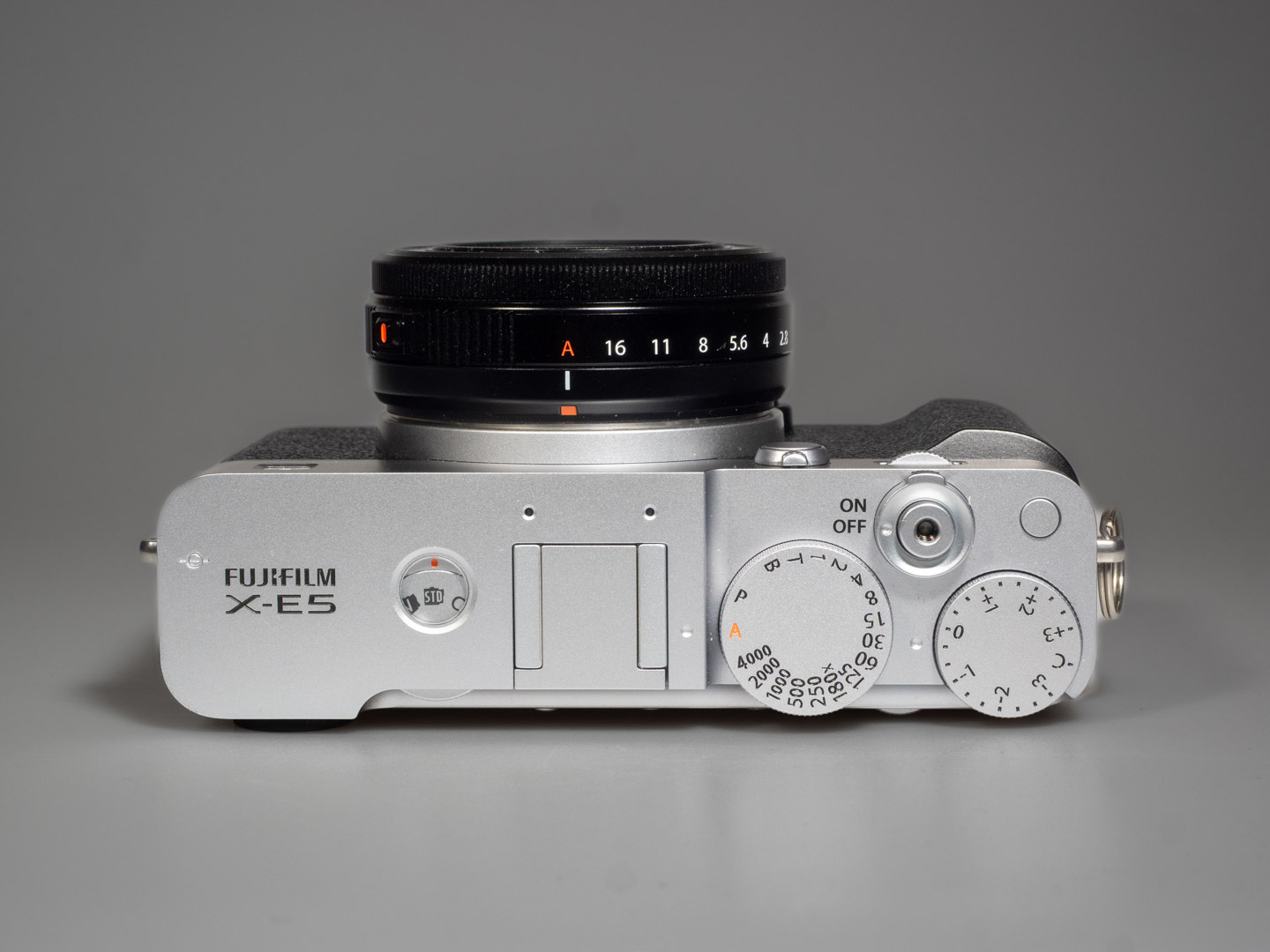
The X-E5 is a particularly good confirmation that good manufacturing quality and a great haptic interface is also possible outside the luxury segment. I don’t see that the enormous price difference — the X-E5 costs one fourth of a Leica Q and one sixth of a Leica M, the latter without any lens.
Haptic controls
And one more thing reminds of a Leica M: You don’t have to look into the viewfinder or at the rear display to read most of the essential settings of this camera. You don’t even have to switch it on to read aperture setting (distinct values with most Fujifilm lenses, or A), shutter speed (between 1s and 1/4000s or A), exposure compensation (between +3 and -3 or C, a programmable value).
Sadly, the ISO setting is not displayed on a custom dial, but then most users will work with auto ISO. You can use one of three individually adjustable limits. You can even set several parameters for each of these limits, including minimum shutter speed, to avoid any risk of blurring. Not only here, the small, but well-designed joystick for moving your autofocus field is very helpful.
Unobtrusiveness
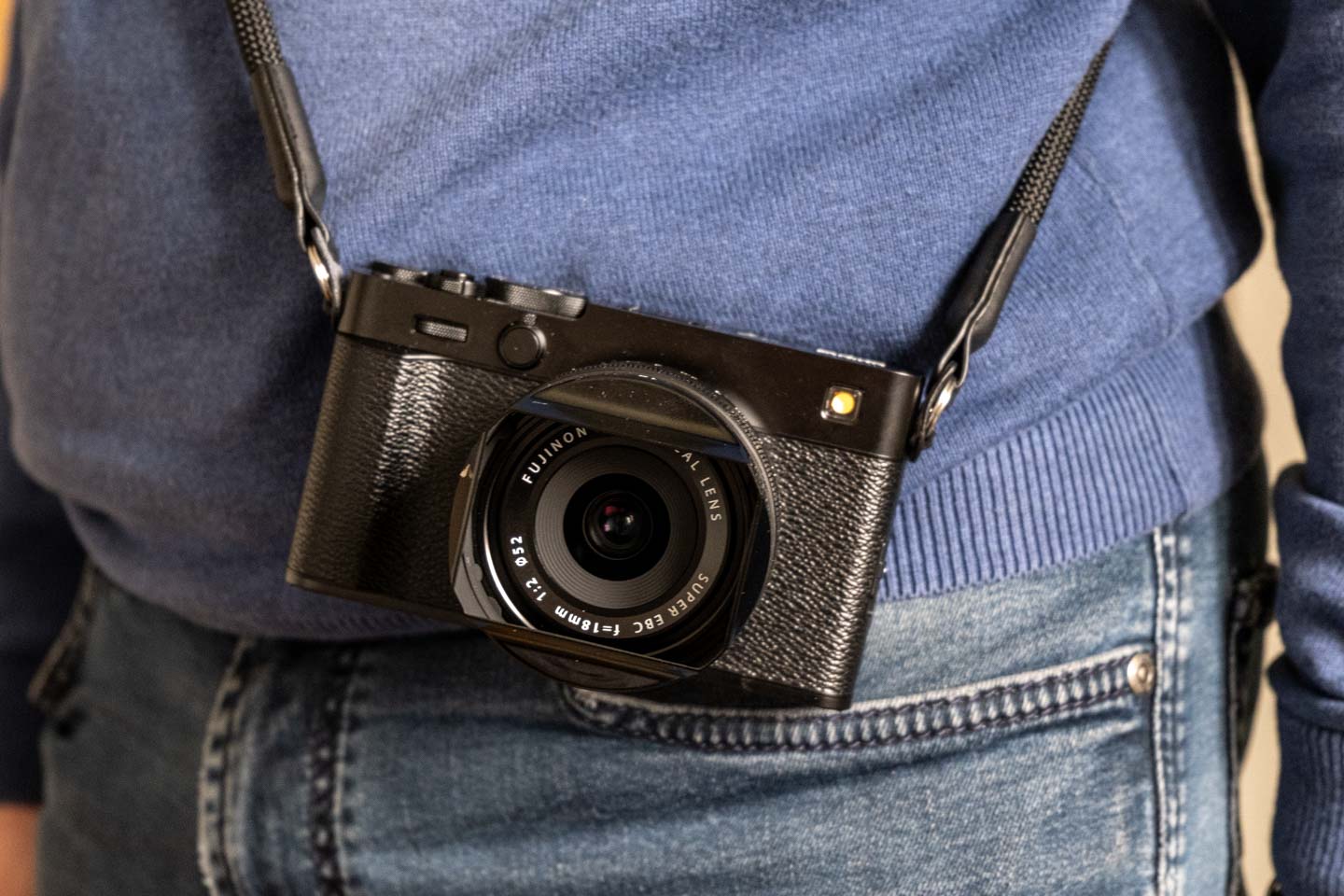
Leica M users will also feel immediately at home with the Fujifilm X-E5 because of its size and the unobtrusive character of this camera. It is a bit smaller than a Leica M and comes at a weight of 445g (M11 black: 530g, all values with battery and SD card).
Many Leica M users love their cameras for their inconspicuous looks, and it does look relatively old-fashioned if you are holding the camera to one side, rather than immediately in front of our face.
This is because the viewfinder sits at the edge of the camera body, of course. We will see how long this exclusive feature will work in case more rangefinder-styled cameras get launched. But for now, it has its undeniable effects, as I noticed in my field tests.
Ecosystem and community
And finally, both Fujifilm and Leica cameras are part of ecosystems which are more than a set of certain technical specifications — at least according to many users, who see themselves more as Fujifilm or Leica fans and less as just customers. Kudos to Fujifilm for playing the niche topic so efficiently.
The proposition of belonging to a community is certainly something that links the two brands. I experienced more than once how another Fujifilm user looked at my camera and started a conversation — something I have only known among Leica users so far. I wouldn’t be surprised if some Fujifilm spokesperson said one day that they looked very closely at what makes Leica successful.
M lenses
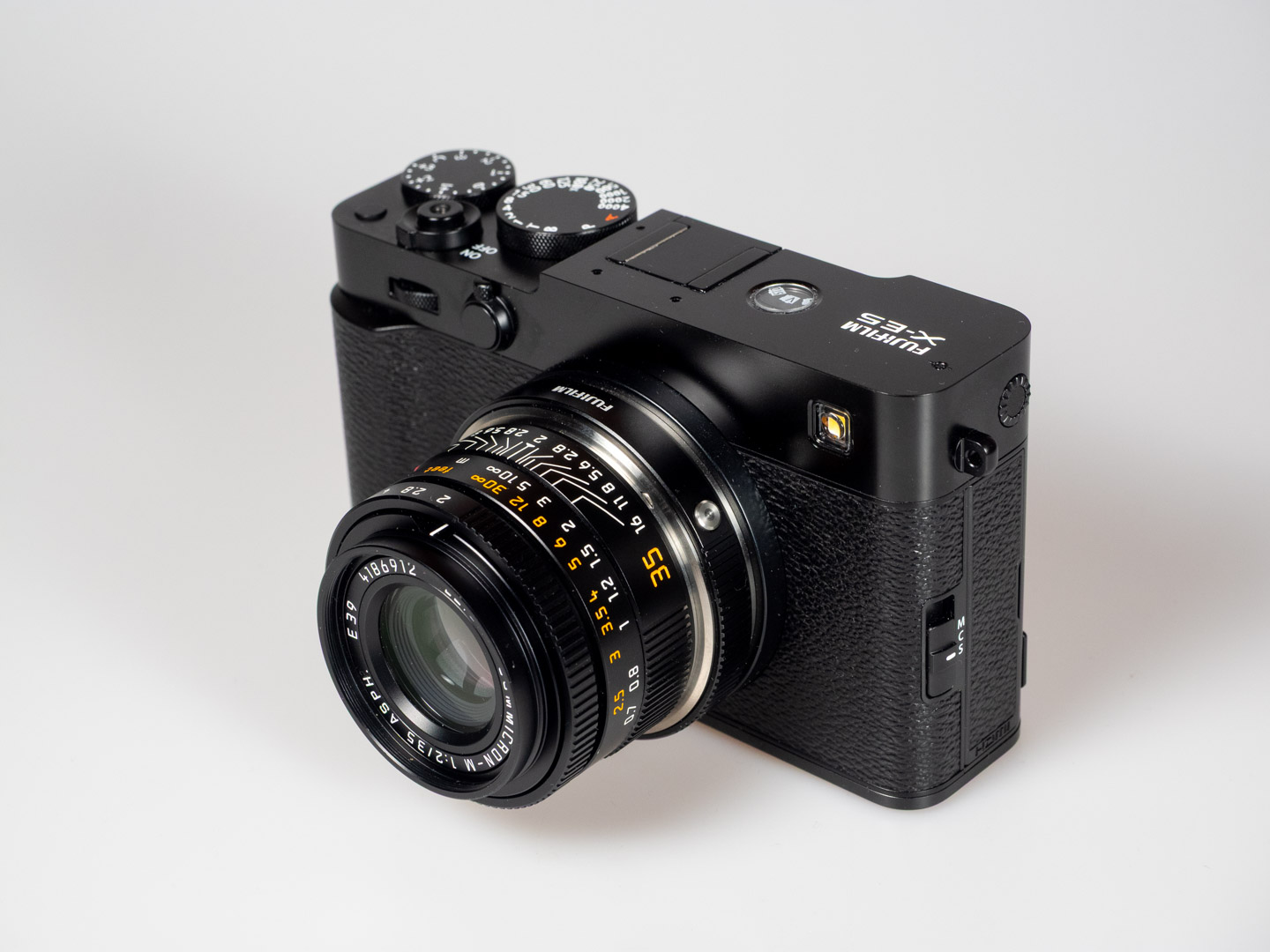
An attractive option, especially for Leica M users, might be the possibility to adapt M lenses to the Fujifilm cameras. Fujifilm’s own M adapter is good. Of course, it can’t read out the 6bit code like Leica’s M to L adapter. But you can set six lens profiles with focal length (important for image stabilization), vignetting control and more. For me, these details felt too clumsy, so I make the necessary corrections in Lightroom. I left it at focal length and was happy to see that this value even gets written into your EXIF files.
The 1.5 crop factor turns your 50 into a 75 and your 135 into a 200. And you get the additional advantage that only the best part of your lens will be used. The downside is, of course, that you hardly get very wide angles of view even with the shortest M lenses (the 16-18-21 turns into a 24-27-32). But truth to be told, you can also attach your M lenses to Sony, Canon, or Nikon mirrorless cameras.
… and why the Fujifilm X-E5 can’t be a Leica alternative
We have seen plenty of similarities between Leica M (but also Leica Q) cameras and the Fujifilm X-E5. After many weeks of real-life testing, I have also found numerous things that set the cameras (and brands) apart.
Sensor size
First, we are speaking of different sensor sizes. There certainly is some almost religious zeal for “the bigger, the better”, but you can’t deny that a full frame sensor gives certain unique opportunities, especially when it comes to narrow depth of field.

The 60.2MP full-frame sensor as used in the Q3 or M11 camera features about 70,000 pixels per square millimetre, Fuji’s 40.2 MP sensor has almost 109,000 pixels packed on one square millimetre. However, I never had to complain about the Fujifilm X-E5 in respect to noise or dynamic range. But it is a matter of fact that the individual pixels are smaller than in any full frame sensor. This means that you can still expect better image quality with a bigger sensor.
Viewfinder
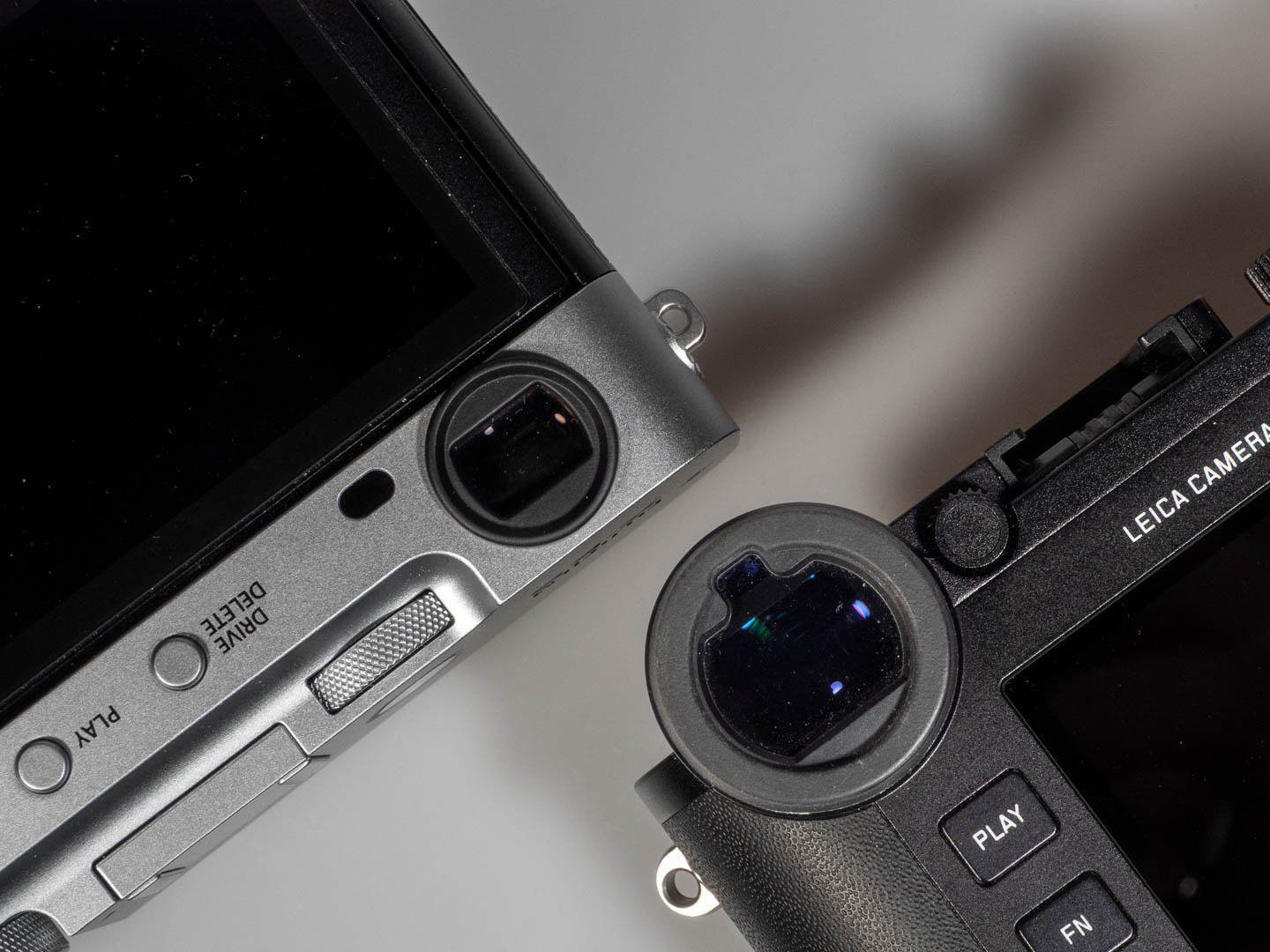
Second, despite silly videos on the internet calling the Fujifilm X-E5 a “rangefinder” camera, it isn’t, of course. Others refer to “rangefinder style”, which is a better description. Other than a camera with an optical rangefinder which serves for both framing and focusing, the X-E5 has only an electronic viewfinder.
With its 2.36 MP resolution, it is certainly not state-of-the-art. You can excuse this with the fact that the camera is beautifully small in overall physical size. But it’s still a pity that Fujifilm cheapened out on EVF resolution and size on the X-E5, especially since the equivalent-sized X100VI has a 3.96MP finder.
This somewhat limits the usability of MF lenses (for example, M-Mount via adapter): To check focus, you will have to enlarge the critical part and zoom back afterwards. You can also activate focus peaking with any MF lens. But do make sure the AF/MF switch on the camera is set to M (actually a smart way to turn peaking on and off without going to the menu).
Leica’s newer electronic viewfinders all have better resolutions (5.6MP) than the one in Fujifilm X-E5 (2.36MP). And nothing matches an optical rangefinder when using M-Mount lenses. But that’s another story.
User experience
You can argue that all modern cameras are good, or maybe even very good. But not all are good to use. And it’s especially here where the comparison between a Leica and Fujifilm cameras shows the big difference.
The Fujifilm features a Quick Menu (which can be customised to a certain degree), a main menu, plenty of buttons and dials and comes with a 154-page printed “basic” and a 424-page digital handbook. In a way, it is astonishing how many settings you can change — but it is also confusing and can make working with the camera slow. Sure, you can forget most once you have set up your camera, but it’s still annoying. And it shows how well Leica is doing with their focus on user experience.



Ponte Sant’Angelo. Fujifilm X-E5 with Fujifilm 50/2.0; 1/420 sec at f/3.2, ISO 125.
St. Peter’s. Fujifilm X-E5 with Sigma 12/1.4; 1/100 sec at f/4.0, ISO 1000.
©Jörg-Peter Rau
I really do wish for a firmware update for the Fujifilm X-E5, giving a new option for “simplified use”. This would feature a cleaner looking Quick Menu and a stripped-down main menu. But maybe that’s not what many Fujifilm customers want, unless they are coming from Leica.
Lenses
I have not yet tested a wide range of Fujifilm X-Mount lenses. The 16-50/2.8-4.8 (24-75 equiv.) zoom on an X-T50 saw much use for my professional assignments, and I found the lens surprisingly good for a kit lens. I also used the 18/2, the 23/2.8 (which came with the X-E5), and the 50/2.
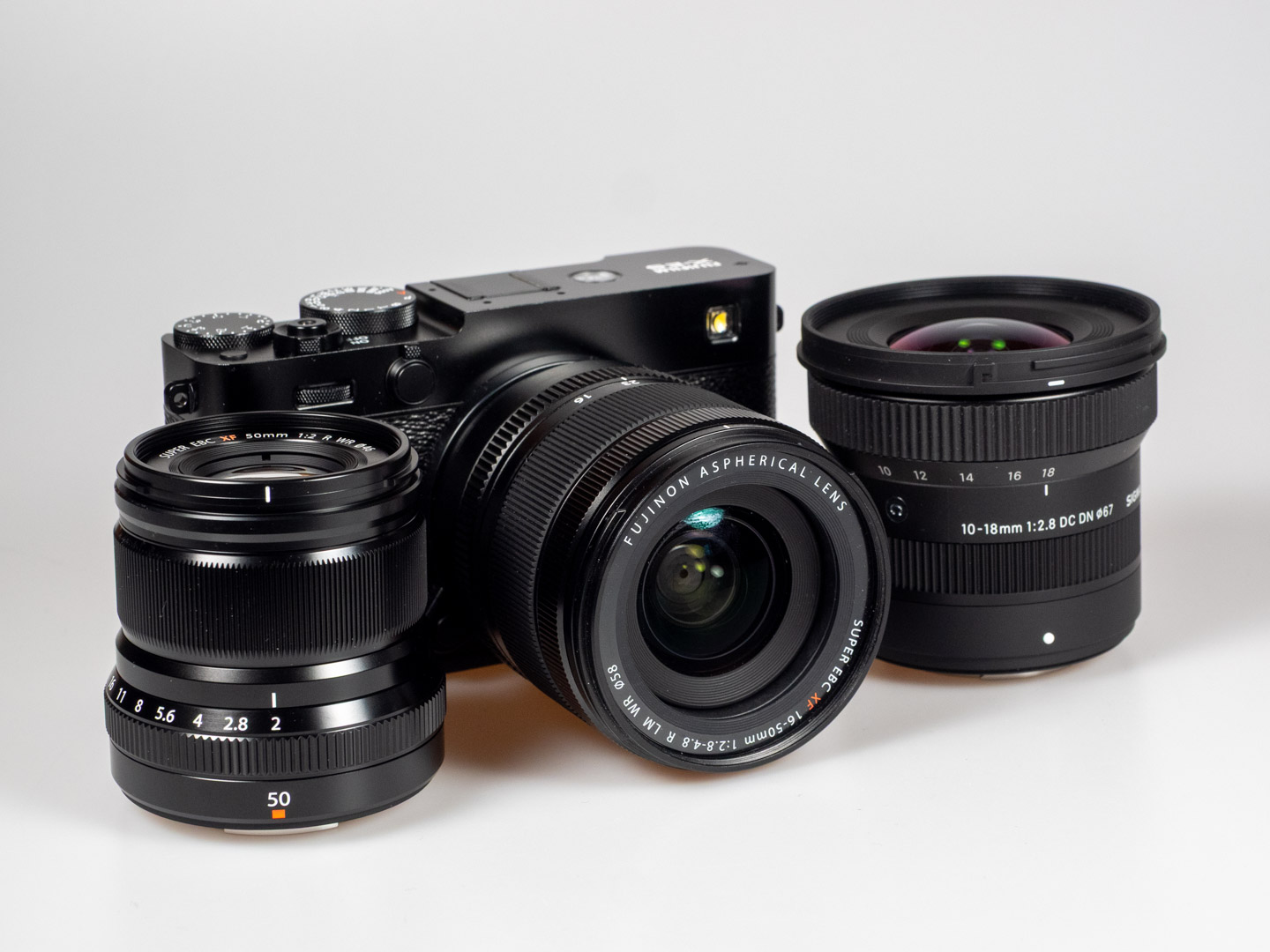
All of them were good, but maybe you can’t expect highest-end optics in this price range. I made no 1:1 tests. But I would say that I liked Leica’s APS-C lenses better. I always cherished the compact Summicron 23/2, the Summilux 35/1.4 and the 11-23 zoom.
I also used the Sigma 10-18, which is tiny yet fast at f/2.8. In addition, I was able to test the Sigma 12/1.4 which has exciting tech specs, and it does hold true to that. A few additional shots I took with the (rather old) Sigma 56/1.4, which is also available for L-Mount. The results looked promising.
This review is certainly not a dedicated lens test. But I’ll go so far as to say that photographers for whom the newer Leica M lenses or the 28mm or 43mm of the Q models are something of a standard will have to expect a few compromises with Fujifilm.
Is the Fujifilm X-E5 a Leica alternative? Who this camera is for?
We have noted that the X-E5 isn’t a Leica M killer. It can’t replace the unique experience of rangefinder photography. One thing is autofocus, one other is program mode. I guess most Fujifilm X-E5 users will activate both. And rightly so, both auto functions are excellent. Nailing your focus is easy thanks to face, animal, car or almost whatever recognition. And exposure as almost always spot-on.
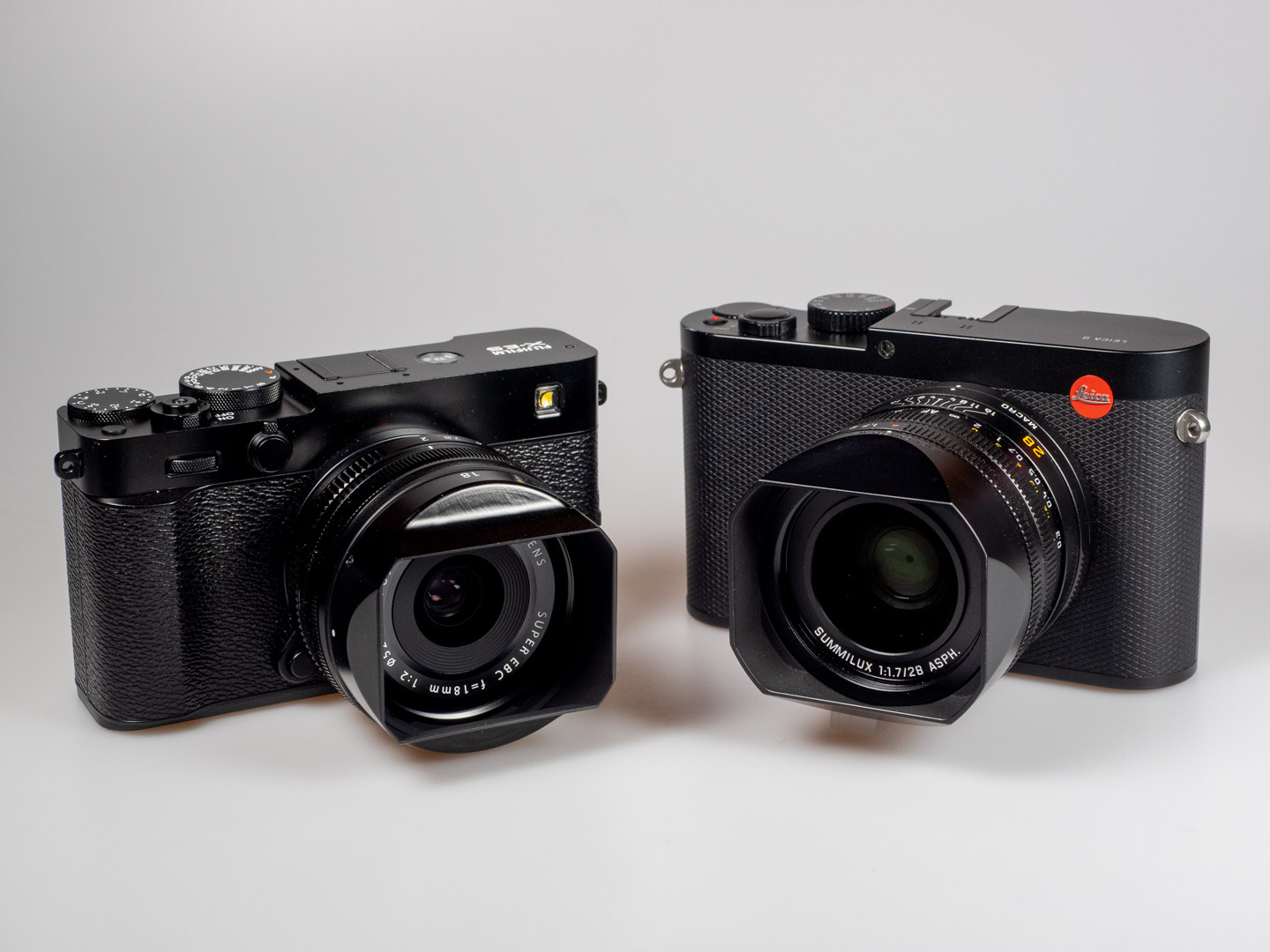
So I would rather compare the X-E5 to a Leica Q, adding the benefit of interchangeable lenses. In a way, you can get a 28mm plus a 43mm equivalent (X-E5 with the small 18/2 and the 27/2.8) at third of the price for one Leica Q. You trade in sensor size, resolution and speed, but get a very viable solution for many photographic tasks. As Mike Evans points out, the X-E5 with the new 18/1.4, which he regards highly, makes an even more interesting Q3 substitute.
For M users, the X-E5 can be a nice addition to their kit. I can also recommend it as an alternative when you need something for easy-going photography. Or if you want to give the camera to some less experienced shooter at times, for example during a family reunion.
In all these respects, the Fujifilm X-E5 can be a Leica alternative. That’s simply because it shares quite a few of the appealing qualities of a Leica. And it can’t be a Leica alternative because it lacks many of the typical Leica qualities. But for many photographers who yearned for a Leica but were never able to afford or master one, the X-E5 might well bring relief.
A wider look into the Fujifilm universe
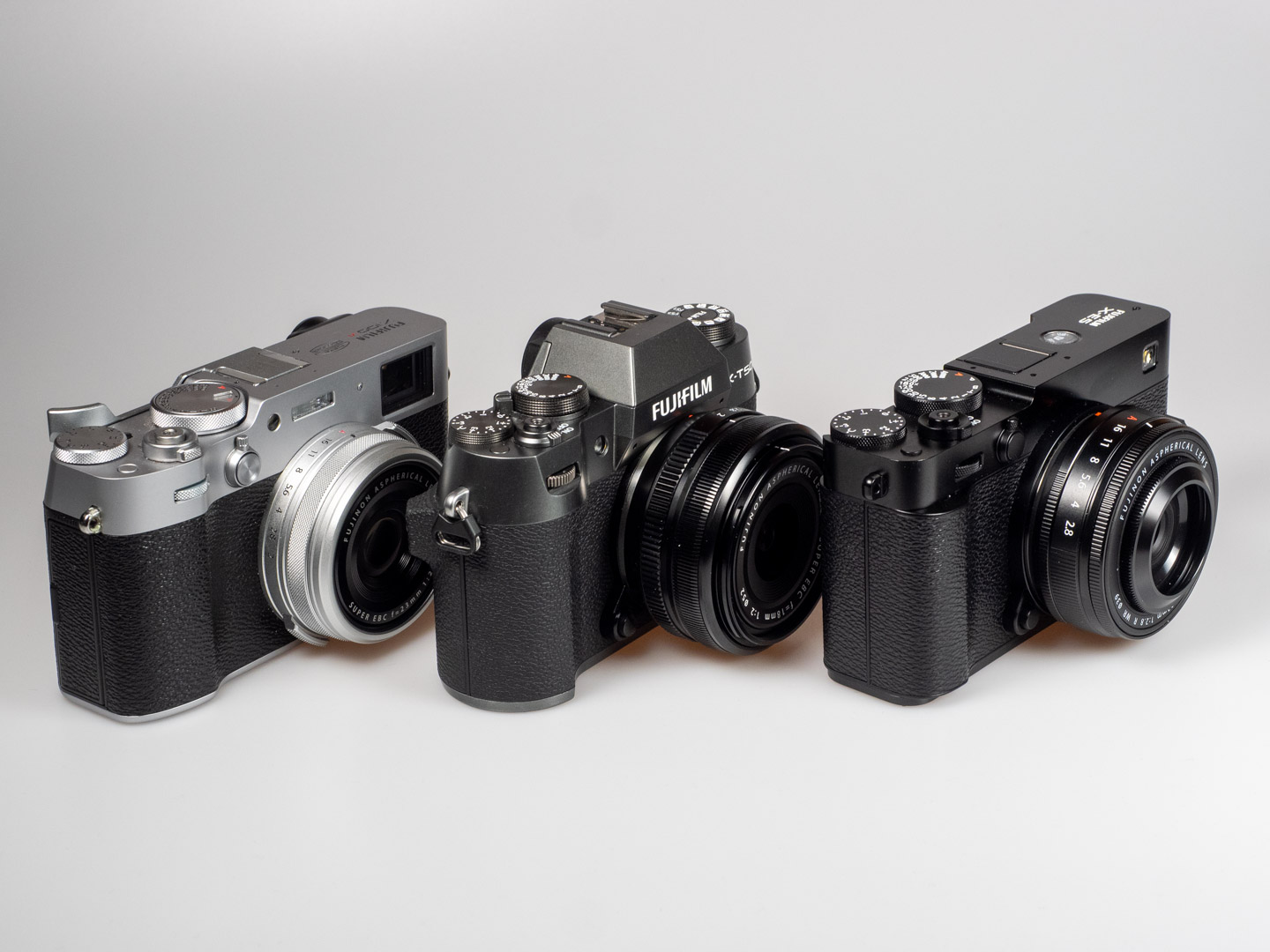
Fujifilm has established itself as a highly innovative and ambitious camera and lens maker. Their belief in this niche and their success is remarkable. One part of this niche is a “classic” user experience with traditional aperture, shutter speed and other settings. And if you look around, you will soon see that not only older men, deeply rooted in the film era of photography, are attracted to this concept. So, the Fujifilm alternatives to the X-E5 come to mind.
Most notably, these are the X100VI with its fixed focal length lens and the X-T50 with its more SLR-like design. The latter one I used a lot more often in the past year than the X-E5. But, in principle, everything to do with the sensor and the lenses can easily be applied to the X-E5, just as it applies to the X-T50.
All three cameras (X100IV, X-T50, X-E5) share the same 40MP sensor. A comparison between these three similarly priced Fujifilm cameras is already in the works. We will cover it again from the viewpoint of a long-term Leica user.
Conclusion: Is the Fujifilm X-E5 a Leica alternative? Yes and no…
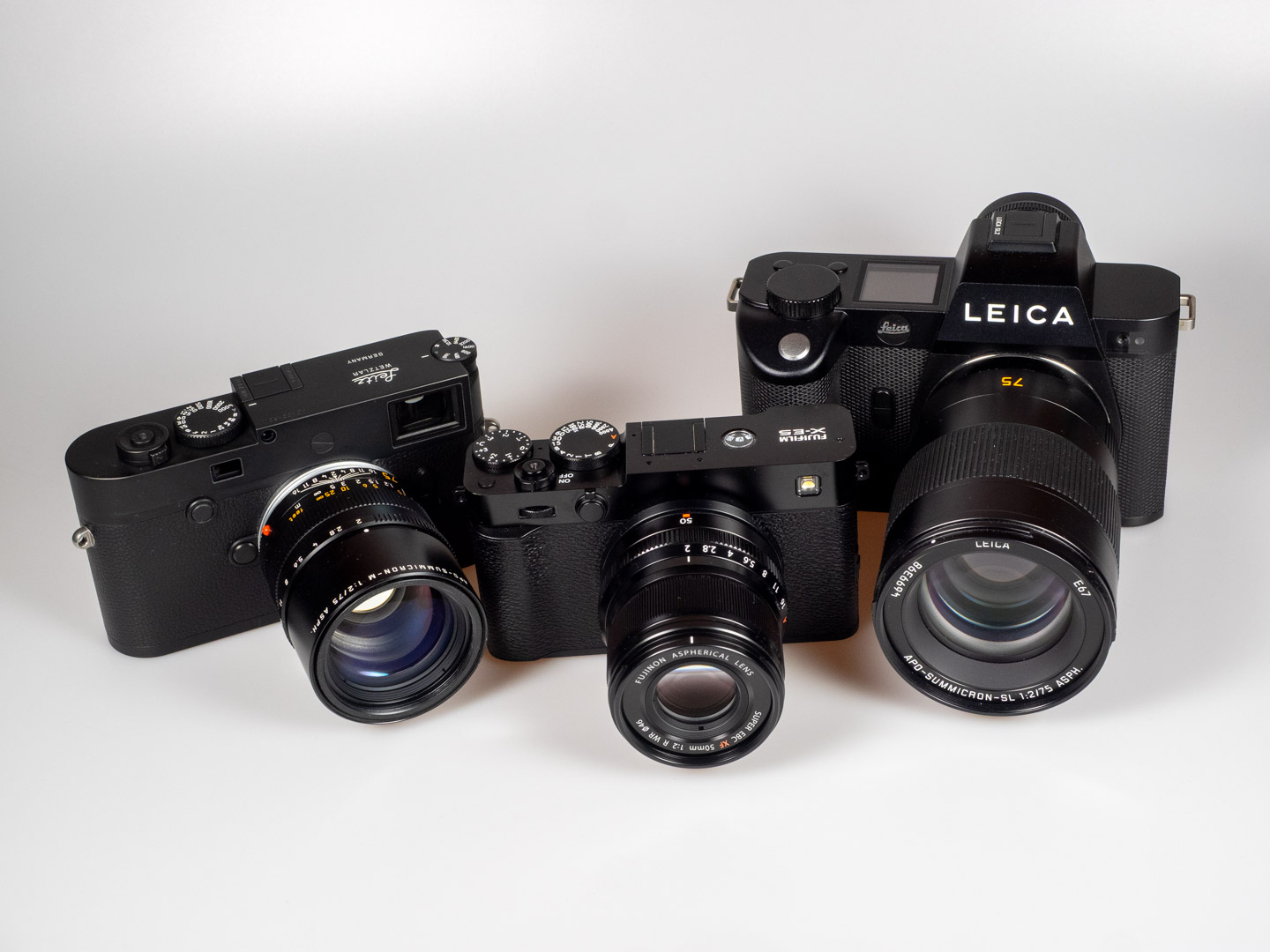

Is, to come back to the initial question, the Fujifilm X-E5 a Leica alternative? I would say that it depends on what you mean by “Leica”.
If an M camera is the point of reference, the answer is No. The Fujifilm X-E5 will, with its electronic viewfinder, never give you the rangefinder experience, for better or for worse. And it won’t link you to a 100-year-long tradition of photography with all these big names and iconic images. Furthermore, the user experience will not even come close to the pureness and easiness of handling a Leica M. Here, even the Fujifilm X-E5’s closest recent Leica M counterpart, the M EV1 with its electronic-only viewfinder, is miles ahead.



Former Post office, Via Marmorata. Fujifilm X-E5 with Sigma 12/1.4; 1/1100 sec at f/4.5, ISO 125.
Trastrevere. Fujifilm X-E5 with Fujifilm 50/2.0; 1/180 sec at f/14, ISO 125.
Poste Italiane HQ in the EUR district. Fujifilm X-E5 with Fujifilm 50/2.0; 1/150 sec at f/8, ISO 250
©Jörg-Peter Rau
But if “Leica” means for you a remarkably compact, unobtrusive camera which is capable of delivering high-quality images even in difficult conditions, the answer is Yes.
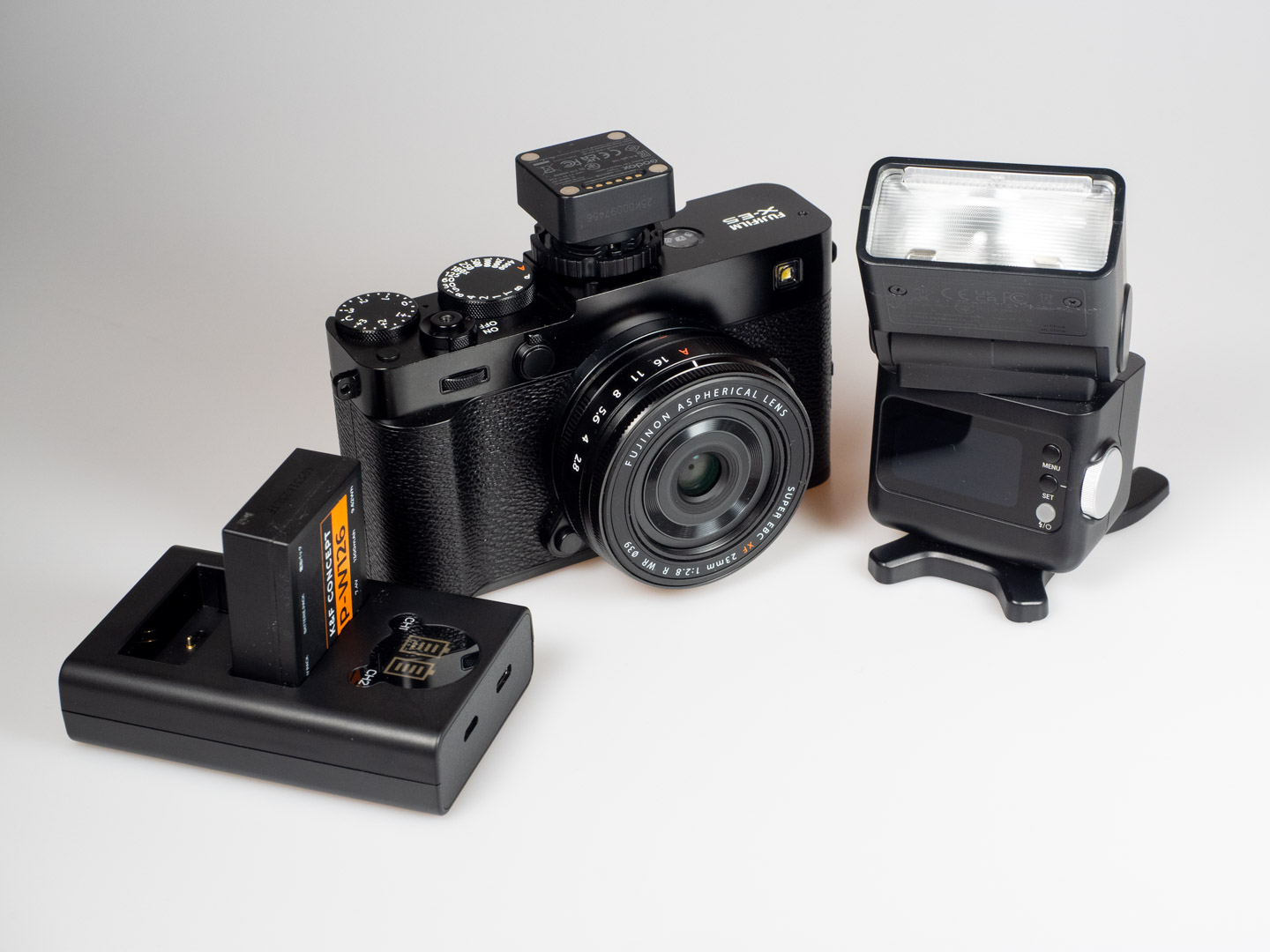
Add to this a price tag that makes this camera far more widely accessible. And the fact that you might feel more comfortable when strolling around with a €1,700 kit instead of a €15,000 camera and lens combo. At the end of the equation, you might well feel that the Fujifilm X-E5 can easily be a very valid Leica alternative.
Just to put it into perspective: The Fujifilm X-E5 with the 23/2.8 has a recommended retail price of €1,799 | £1,549 | $1699.95, the 50/2 comes at €499 | £429 | $314.95, the Sigma 12/1.4 at €599 |£519 | $579.00 and the Sigma 10-18/2.8 at €749 | £649 | $679.00. Street prices can be considerably lower.
And just in case you are still mourning your Leica CL and its beautiful lenses, be it as a standalone kit or as an addition to your M outfit: console yourself with the Fujifilm X-E5. The camera outperforms the CL and T/TL/TL2 in almost every respect. It’s only a pity that you can’t adapt the L-Mount lenses.
And, for what it’s worth, I have a strong feeling that Oskar Barnack, in his quest for a small and capable camera, would have liked the Fujifilm X-E5.


Colosseum: Fujifilm X-E5 with Fujifilm 50/2.0; 1/900 sec at f/5.6, ISO 125.
Palazzo: Fujifilm X-E5 with Fujifilm 23/2.8; 1/280 sec at f/8, ISO 125.
©Jörg-Peter Rau
Discover more:
Make a donation to help with our running costs
Did you know that Macfilos is run by six photography enthusiasts based in the UK, USA and Europe? We cover all the substantial costs of running the site, and we do not carry advertising because it spoils readers’ enjoyment. Any amount, however small, will be appreciated, and we will write to acknowledge your generosity.
An excellent overall review. Thank you jorg-peter.
I’m currently sorting through my priorities for a camera to take on a Camino later this year , and about the only one that the X-e5 doesn’t tick is that of weathersealing.
Camera companies remain in that slight stage of limbo where they close in on my “perfect camera” but manage to leave off one key requirement that I have.
Regards and thanks.
Exactly. I would have preferred weather sealing on the X-E5 to the simulations dial! Most of my lenses are weather resistant, so the camera is out of step. I think the forthcoming X-T6 will be the perfect choice for your purpose.
As far as I can tell, weather resistance/weather sealing is hard to pin down. The Fuji X-T5 has weather resistance, but no official IP rating. So — no warranty coverage.
I like my X-T5: compared to the X-E5, it has a better viewfinder, weather sealing, and an ISO dial. But is bulkier.
I wish it were otherwise.
Thanks, Jason. In my private work, keep my cameras in the bag and only take them out for shooting. A short exposition to bad weather has not done much harm until now not non-weatherproof cameras. If you are looking for something compact and extremely robust, do have a look at OM Systems / Olympus. The sensor is small, but the cameras and lenses are very well made. Good luck with your pilgrimage! Jörg-Peter
Thank you very much for this detailed comparison and review of this Fuji camera—it’s a must-read article! My compliments and respect!
Allow me to ask a provocative (tongue-in-cheek) question: “What will the term ‘Leica’ encompass in 2026?” – In terms of external appearance and brand recognition, it is (still) the “M Series” or the design language of an “M.” From a business perspective, the answer would have to be “Q, SL, and software,” although the “Q” also incorporates the design concept of the “M.”
I believe I know and understand that you are, of course, referring to the “M,” but as I wrote, I wanted to be a bit provocative and remind you that the company is (fortunately) developing in many different directions.
One can make the comparison between a Fuji X-E5 and a Leica M, but in my view it is not productive: On the one hand, we have the X-System, which is partly based on the form of the “M” and yet offers all modern technical achievements, including good, compact lenses at moderate prices. Leica shuns (without any judgment) these technical options; even with the new M product line “E-V1,” they’ve omitted a flip-up display or the improved EVF from the Q3, reduced the internal memory compared to the “M11-P,” or left out the ISO dial from the M11 series. Design language and compactness take precedence over technical innovation.
This comparison therefore does neither camera justice: The Fuji is a wonderful, high-quality, and modern tool in a compact design at a fair price; the Leica is a wonderful, high-quality tool that consciously forgoes what is technically possible, coupled with a strong preference for an almost dogmatic design language. In my view, Fuji has identified a niche and filled it perfectly; Leica preserves the DNA of the “M” and fills the associated niche just as perfectly.
Good afternoon all,
Some of you may remember me. I used to be a regular – if not incessant – contributor to Macfilos a few years ago. Feel free to look me up in the archives. I haven’t the time these days to do so, but I felt moved to write to comment on Jörg-Peter’s even-handed, thoughtful but slightly flawed article.
By way of my “credentials” to comment, please excuse a short list:
Previously owned: Leica IID, IIIc, LC1, Leicaflex, Minilux zoom, M2, M4, M6, MP4 (a la carte), M7.85, Digilux 2 and more lenses than I can count.
Fuji X10, X20, X100S, X100T, X100F X100V, X100VI, XM1, XT1, XT2, XE1, XE2, XE4, XPro1, XPro2, XPro3 and more lenses than I can count.
Currently owned:
XE5, X20 (Ricoh GRIIIx)
I switched to Fuji from Ricoh over a period of time, starting from the 25th of May 2012 in a process that took about two years for the main switch. I kept my IID until about 18 months ago.
To the point, comparing Fuji with Leica is ultimately pointless – they are different companies producing different cameras for different use cases and demographics. I swapped for my own reasons, some of which but not all are touched upon above, and I think it is worthwhile exploring some of my rationale.
Let me explain. Most of my photography falls broadly into the headings of “street”, “travel”, “event”, “people” and “abstract”. I carry a camera pretty well everywhere, usually my GR or an old Minox GT. The XE5 is my main system camera these days. I changed initially for the following reasons:
Lens compatibility between different body types
Compactness and light weight (bodies and lenses)
Pedigree – Fujifilm was founded in 1934; it’s hardly new on the scene, albeit not as venerable as Leica
Innovation – certainly at the time I switched, Leica lagged badly in this regard. Fuji listens actively to their community and is willing to take risks. The XE4 was less flexible, less well made and less usable than it’s predecessors or successor. They learn and are willing to reverse previous decisions in a matter of years not lustrums
Customer experience – Related to the above. The kaisen approach to software upgrades was refreshing. They still do it to this day albeit the pace has slowed.
The recipes. This is a key point glossed over above. There are significant online libraries of Fuji recipes online and the XE5 leans into their importance through the top plate dial and it’s three blank slots. They have taken an “if you can’t beat ’em join ’em” approach to recipe creation and made it easy to add your own. This alone, allied to the sheer quality of the SOOC jpegs, makes a huge difference. Judging a current Fuji camera without properly exploring the potential of the recipes is like test driving a sports car without putting it into sport mode.
The ease of use. The UI is complicated because the camera is so flexible BUT 90% of the settings are “forget and fire” – you don’t have to go menu-diving as you would in a Sony, for example, to change the most minor settings. It pays to burn a battery the first time you pick up an XE5 to learn what everything does (I’ve never opened a manual in my life…) but once you have it set to your tastes and needs that’s pretty much it.
Just a quick word for the Fuji app, too – it’s about as user-friendly as I have ever used for a camera – and I own a company that produces mobile apps…
Would I ever go back to Leica? Possibly – but neither Fuji nor Leica gives me a reason to. Is the XE5 a rangefinder? Nope. But it doesn’t try to be, other than in form factor, which is a matter of usability. Go for an XPro3 (or 4) if you want to go down that road and do a fairer comparison. Having had all the X-Pros, by the way, I find the more compact XE5 a better travelling companion.
In summary, both Fuji and Leica are “photographers’ cameras” – they appeal to the enthusiast and can give the pro the reliability and solid results they seek. Overall, I’ve used many more systems than I have listed here and I am content with Fuji – and isn’t that what it’s all about these days?
P.S. I’m old enough to remember when the early Leica digital cameras were rebadged Fujis, long before the collaboration with Panasonic. I’ve often wondered what articles like this would be saying if that collaboration had continued to the present day…
Hi Bill, it’s good to hear from you again after several years. As you say, you were a mainstay of Macfilos in the early years. I don’t know what I would have done with you at the time. I will leave Jörg-Peter to answer your points, but I am glad to see that you have maintained your Fuji passion. It seems you’ve had more Fuji cameras and lenses than Imelda had shoes, or Mrs. Shilling had hats. So I can accept your expertise. Why not consider returning to our ever-growing band of authors? We’d be genuinely interested to get your views on Fuji.
Mike
Thank you, Bill,
for sharing your knowledge. I am grateful that you added some points I did not mention. As I only shoot RAW in my private work, the recipes and film simulations are just beyond my use case, but I do appreciate Fujifilm‘s appoach for sure. I also have the feeling that they managed to build a community around their products and that they do listen to their customers. This has become rare and would have earned more space in my article. All the more grateful am I to you for adding this.
When it comes to the question what you can or can‘t compare: I think you can always compare cameras, especially if there are similar design principles, target groups, use cases or any other obvious link. I see this link between Leica and Fujifilm, but I am happy to accept that others don’t. The only thing I would like to contradict is the notion that my comparison was unfair. I don‘t think I haven‘t done justice to the X-E5, but looked at the camera from a different perspective.
I don‘t remember you as a Macfilos author as I joined later. But I can conform what Mike is writing: Good articles are always welcome. And interesting comments as well, of course!
Do enjoy your beautiful („photographer’s“, as you a aptly put it) camera, I am genuinely happy to read that you have found what you were looking for. In the end, it‘s all about taking pictures, isn’t it?
Jörg-Peter
Dear Bill, Jörg-Peter and everyone else,
Firstly thank you all for some very interesting thoughts. Personally I keep teetering on the edge of going XE-5 (I have an XE-2) rather than saving for a Leica.
Bill, you write “…like test driving a sports car without putting it into sport mode”. As a sports car owner of many years I have to point out that no serious sports car has a “sport mode”, it either is or it isn’t (and I don’t care if it has a prancing pony or whatever else on the bonnet!).
But therein lies a more serious point. When you shoot a classic Leica, or Minolta, Fuji, Nikon or whatever you shoot in a particular way, with different goals from shooting with a digital camera even though it comes from the same manufacturer (where they still exist!). Digital cameras open up a different style of shooting and things like recipes or formulae are just a facet of that. Digitals also encourage a less reflective – and cheaper – way of shooting (especially with ever-increasing film prices). Just like cars with a “sport mode” they are built for different markets.
Will I upgrade my XE-2 to an XE-5 instead of a Digital M? My wallet definitely says I should – and this discussion has clarified quite a few things – but my heart cries out for another red dot. My head is telling me to think carefully about the extent to which I want to change how I photograph and is asking me if I think I really need 60M pixels. Is 40 enough? At a fraction of the cost of the 60Mp?
To answer the original question as to whether Fujis are viable as alternatives, I have to agree that the answer, IMHO, has to be both Yes and No.
Peter
Dear Mr Jörg-Peter Rau
Thank you for your well written article regarding the Fuji film Camera.It’s always interesting to read about how you observe the fine details.If I had needed in such a camera, it would sure have been tempting.
But I have a question. you write, the following sentence
But it is a matter of fact that the individual pixels are smaller than in any full frame sensor. This means that you can still expect better image quality with a bigger sensor.
The smaller the Sensor pitch is, the higher is the resolution.This is pure Nyqvist .Therefore, a 25 megapixels sensor for ABS-C have a higher resolution than a 25 megapixels sensor for 24×36mm sensor.This is the reason why chief engineer Peter Knabe tells that we should primly use TL lenses on the TL/CL series camera and M lenses on the M cameras.This was also the reason why he told that the aim of the TL lenses have to be 60 Cycles/ mm Instead of 40 cycles/mm that’s usual for lenses used on a 24×36 mm sensor/film.
Presumably I have misunderstood your sentence.
I fully agree on your conclusion that it is not a M Leica a substitute.If you’re only aiming as a image quality, it will probably do. But in M photography has many of the characteristics of good travelling. The end of the journey is less interesting than the travel to the goal and the pleasure of being on the move.The Danish fairytale writer Hans Christian Andersen said : to travel is to live.
High regards
Paul de Kruiff
Dear Paul de Kruiff,
thanks for you comment and question. When I speak about resolution in this context, I am referring to the image. An image with 7,728X5,152 pixels (Fujifilm X-E5) shows more details than an images with, say, 6,000×4,000 pixels (as in a Leica M10). Adding to this the smaller sensor area, each individual pixel is remarkably smaller. And from all I know, smaller pixels are more prone to noise.
And, I fully agree, a relatively smaller sensor that in addition has a higher resolution requires higher performance of a lens. I know what Peter Karbe says, and who am I to argue against such an expert. But then, the digital M have grown from 24 to 60 megapixels, and I know that some lenses that gave stunning results on an M10 show weaknesses on the M11. So, it‘s not just „use M lenses on M cameras“, but also „make sure the lens is not the limiting factor“.
I hope this clarifies the issue,
All the best
Jörg-Peter Rau
Dear Mr. Jörg-Peter Rau.
Thank you for your answer. I think we understand each other. I fully agree with you regarding the newest M cameras. These cameras with huge sensors for sure demand the latest lenses from Leica for instance the 50/f2 APO the 35/f2 APO and the 35/f1,2.The 135 mm APO f 3.4 would probably also work.
With high regards
Paul de Kruiff
I might have extended the life of my Leica CL by buying the Sigma 16-300mm f/3.5-6.7 DC OS Contemporary Lens. I am about to embark on a cross-country trip and was looking for a longer lens. My main system is the Hasselblad X2Dii but Hasselblad does not have long lenses, and the Sigma seemed at this point in time the most inexpensive option for me, probably also lighter I would expect than similar full frame options. I don’t expect to be using it much but I do want to have one when needed. It comes with OIS which is pretty rare for a Sigma lens I believe. On APS-C, I also have a Ricoh, I don’t see myself ever getting into Fuji again (but who knows) and I have giving up all hope of Leica ever producing a (in my opinion sorely needed and long overdue) lighter weight full frame L-mount camera.
Thanks for commenting, SlowDriver! Glad to read that you still use your CL with satisfaction. I never used this Sigma 16-300, but I can imagine it is very versatile, and the comparably low speed can be overcome with a higher ISO setting, maybe with additional de-noising in post. I hope you have a great trip with wonderful photographic opportunities!
I suspect that the only valid comparison is to the (now abandoned) Leica CL and maybe TL2. Comparisons to the M11 or M EV1 fit the same form factor but the difference in manual and auto-focus makes them fundamentally different experiences.
I would be interested in a comparison between the nearest Fujifilm equivalents of the Leica TL 11-23mm, 18-56mm and 55-135mm lenses. I still use mine on a Leica SL3 body for a “lighter” travel kit but the SL3 body is still large and heavy for these superb lenses.
I bought my daughter a Fujifilm X-S20 with a 23mm f2 and a 16-80mm lens and I was amazed at the image quality. The menus are a mess though with varying sized fonts and compressed fonts to fit in the long menu descriptions.
Thanks, Tom, for you comment, and I can only agree on all you are writing about the menus. Horrible typography. Your request of a comparision between the zoom lenses is recorded. Maybe one of us has the opportunity one day. The problem will be that you will also compare a new camera with a ten year old one. So it might not be all that easy to isolate what is the lens quality and what the rest… Best wishes, Jörg-Peter
A diplomatic Review! I would add the Fuji X-E3 with the same Viewfinder but more Classic Design and without Stabilizer because Leicas had no stabilizer. The M is the M and the X100 is the X100. Fuji Use the Special viewfinder/rangefinder in the X100 like Leica uses the Special rangefinder in the M. Both have their Solo Alleinstellungsmerkmal.
The Fuji XE5 is in my opinion with the Q Menu easy to use. Thank you for your thoughts!
You`re welcome, Michael.
The X-E3 is certainly an option and it is readily available on the second hand market, albeit not cheap. I would prefer the X-E5 though for its higher resolving sensor, superior dynamic range and, most importantly, for the powerful sensor stabilisation. This is really helpful, and it also works with adapted third party lenses (Leica M or others). As for Leica, the M rangefinder cameras don’t have stabilisers, but the fixed-lens Q and the DSLM SL series do. So, it‘s horses for courses
Jörg-Peter
I agree, and also still love the image quality and AF results from my now rather old 24mp Fuji X-Pro 2. So given I only want to take pictures why on earth would I pay such as Leica truly exorbitant price for such as a M11? No wonder the likes of Fuji and Ricoh and other such cameras as the X-E5 are doing so well.
Hi Don, thanks for your comment… and I can’t disagree. Best wishes, Jörg-Peter
WTF! Where is the comparison?
Hi Anonymuous, I guess you are new here and not yet used to our Macfilos netiquette. We encourage readers to comment with real names and to use a civilised language. If this makes sense to you, you are very welcome to join the discussion. Jörg-Peter
Thank you for your detailed and comprehensive review of this camera. At the risk of lese majesté, I’d like to add some personal comments, as one who moved from a Leica M240 with a couple of (older) Leica primes, to Fuji’s with three primes and a long and short zoom.
On the Leica, I still find that photos taken with the rangefinder, and then with the Visoflex, are essentially identical. The 5X magnification of the latter certainly helps, but in either case I find a feature with strong contrast and focus on that.
I have a Fuji X-E3 24mp “rangefinder”-style camera (2017, US$700 used), EVF 2,360,000 pixels and .93 magnification. I’ve used this for most of my photos in the past few years; the small size and weight made it a perfect every day camera, but with high quality Fuji lenses.
I became curious about higher megapixels, and bought the Fuji X-T5 40mp “DSLR”-style camera (2023, US$1300 used), EVF 3,690,000 pixels and 1.2 magnification. I don’t enjoy the extra bulk of the camera, but the images are fantastic and the better EVF makes it much easier for me to see the details I want to capture. From this perspective, going back to the viewfinder on the X-E3 is — not precisely painful, but certainly more difficult to use.
Now, the US$ 1700 X-E5 shares the same sensor and processor as the X-T5, but with the lower viewfinder resolution of the X-E3. I can’t see the point of spending an extra $1000 for a much poorer EVF.
A second point you brought up: what is the effect of forcing more pixels onto the same-sized APS-C sensor? Sean Reid did a very careful review of the X-T5 and this issue in particular Again, the X-E5 shares the same sensor and processor as the X-T5, so one might expect his work would be relevant to the X-E5 as well. Reid also has reviewed many of the Fuji lenses.
My advice is, that if one is going to spend thousands on the X-E5 and several Fuji lenses, then it costs next to nothing to subscribe to Reid’s site and read his analyses of the sensors and lenses.
One last thing — I have a 50-150 Fuji zoom; it’s very hard to focus on the X-E3, and much easier on the X-T5. I put it down to the higher quality EVF.
Hello I use the XE3 too but only with Autofocus until 35mm. For Zoom I use a bigger Body because the relationship between Body and Lens … But it is interesting with a Manual Lens I can use the viewfinder Very Good like the 55 F1.2 because I like the digital Schnittmesser or Focus Peaking in the XE3 and I make Slow photos.
I find what you say to be true. The X-E3 is just as good a camera, and just as much fun, as when I bought it 8 years ago.
And, certainly not every photo requires 40mp! On my most recent trip to Japan, the camera I used most often was the Fuji X30 — a 12 mp 2/3″ sensor. I used it because it was able to capture the scene in ways I liked. Though, when I planned to go to a museum, I did take the X-T5 — it handled low light, high ISO better 🙂
I’ve recently been looking at some of my pictures from the X-E1 (!) and am surprised by the quality. You are right in that almost any X-system Fuji camera is still capable of good work and there are many bargains to be had.
I can only repeat myself. A good camera remains a good camera. Cameras normally (if they don’t suffer from sensor corrosion or other sorts of real rot) don’t deteriorate over the years when in the hands of loving amateurs. It’s always up to you to believe or not believe the industry that one the latest and the greates does justice to your abilites. I, for example, still love my M10. Was good, is good, will always be good.
Thanks, Kathy,
for sharing your thoughts and your experience. As I replied above, the X-E3 is certainly an interesting option, however the X-E5 brings substantial improvement (albeit not for the viewfinder, which really is a pity). I wouldn’t want to miss the sensor stabilisation as this also applies to old MF lenses.
And what I can say for sure is that the X-E5‘s manufacturing quality is on a different level.
But I generally agree: A camera that was very good nine years ago is very good today, the only thing that has changed is the market around the products. You can make wonderful images with a 70 year old M3 or a 13 year old M Typ 240. Unfortunately, with many manufacturers servicing is becoming increasingly difficult once the cameras are a few years old.
JP
I agree with you on many points; from my experience with the BSI 40mp sensor and IBIS on the X-T5, it is very hard to go back! I had been looking forward to the X-E5, but …
But . . . there’s no reason for me to stop using the X-E3! It’s still a good camera and, on occasion, I manage to take pleasing photos with it 🙂