
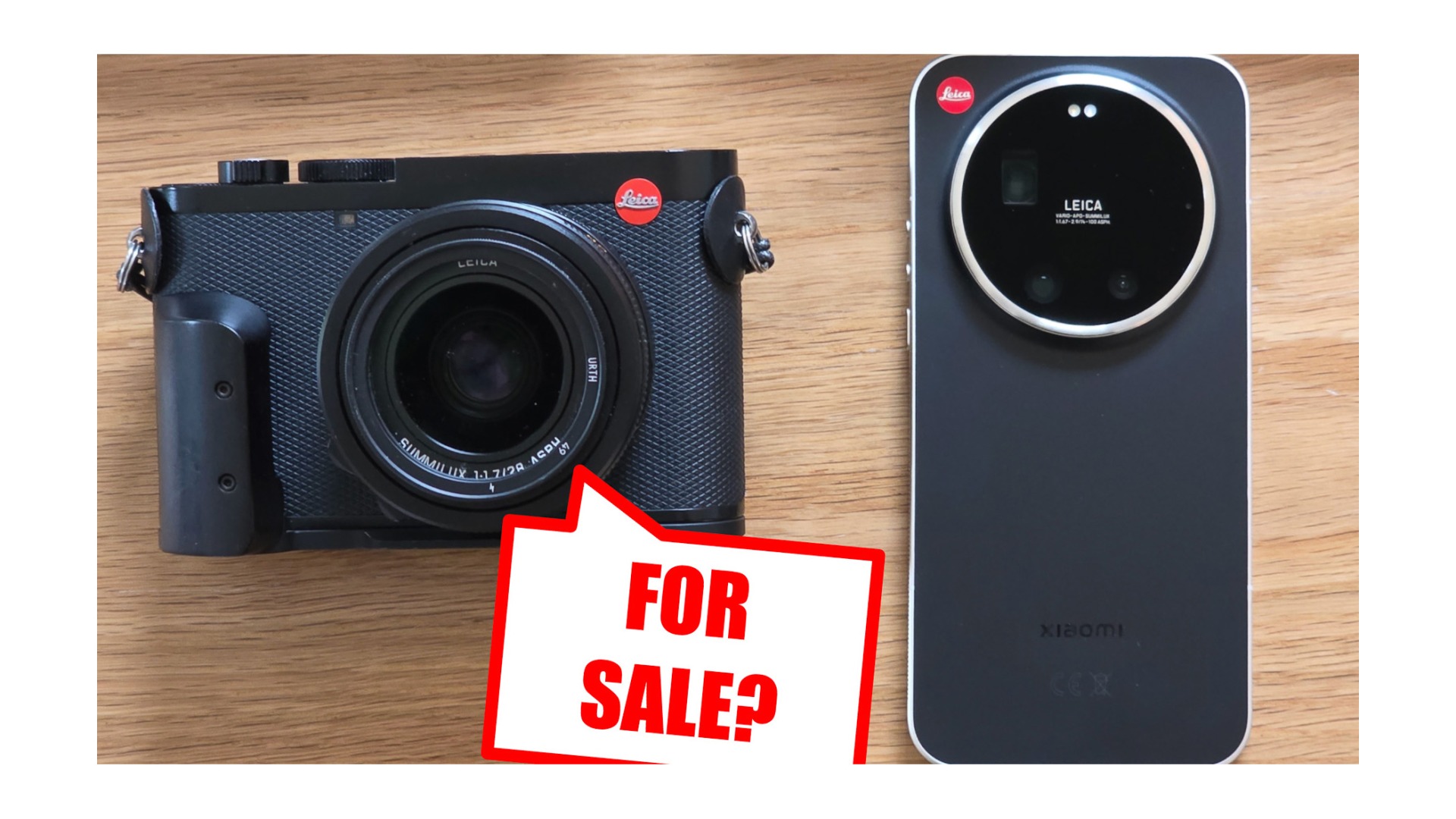
This is the first time Leica has sent me a product to review. It may be the last. I started out with a simple premise: Has smartphone tech and “computational photography” risen to such a level that it can replace “proper camera” hardware, glass, and sensors? Could I ditch my Leica Q3 and just use a phone?
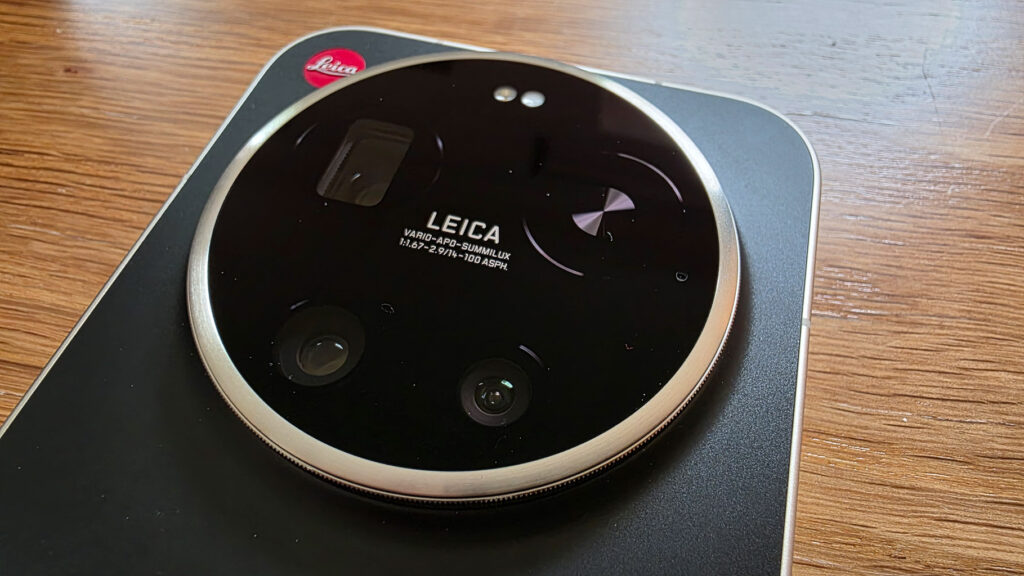
The new Xiaomi 17 Ultra (£1,499 for 1TB) has a Leica-branded version called the “Leitzphone” (£1,699 comes with 1TB). Both have the about the same hardware and cameras, but the Leitzphone has some additional bits for the £200 premium such as:
- Leica branding & Red dot.
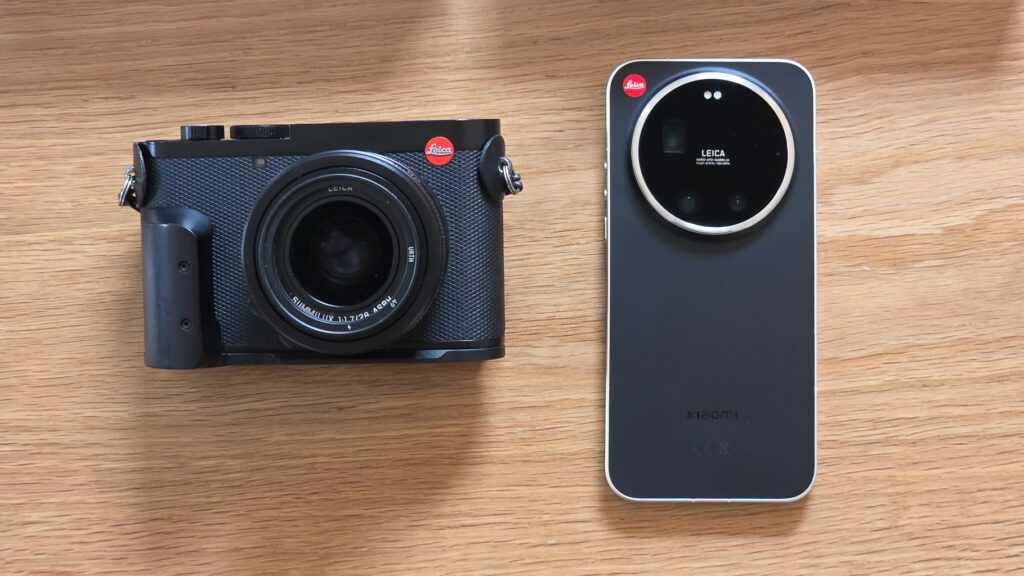
- Ridged metal frame.
- Turnable “Control Ring” around the lens.
- Some nice accessories (case, lens cap, wrist strap).
- Leica-specific software for lens selection, camera selection etc. which I’ll look at closely in this review.
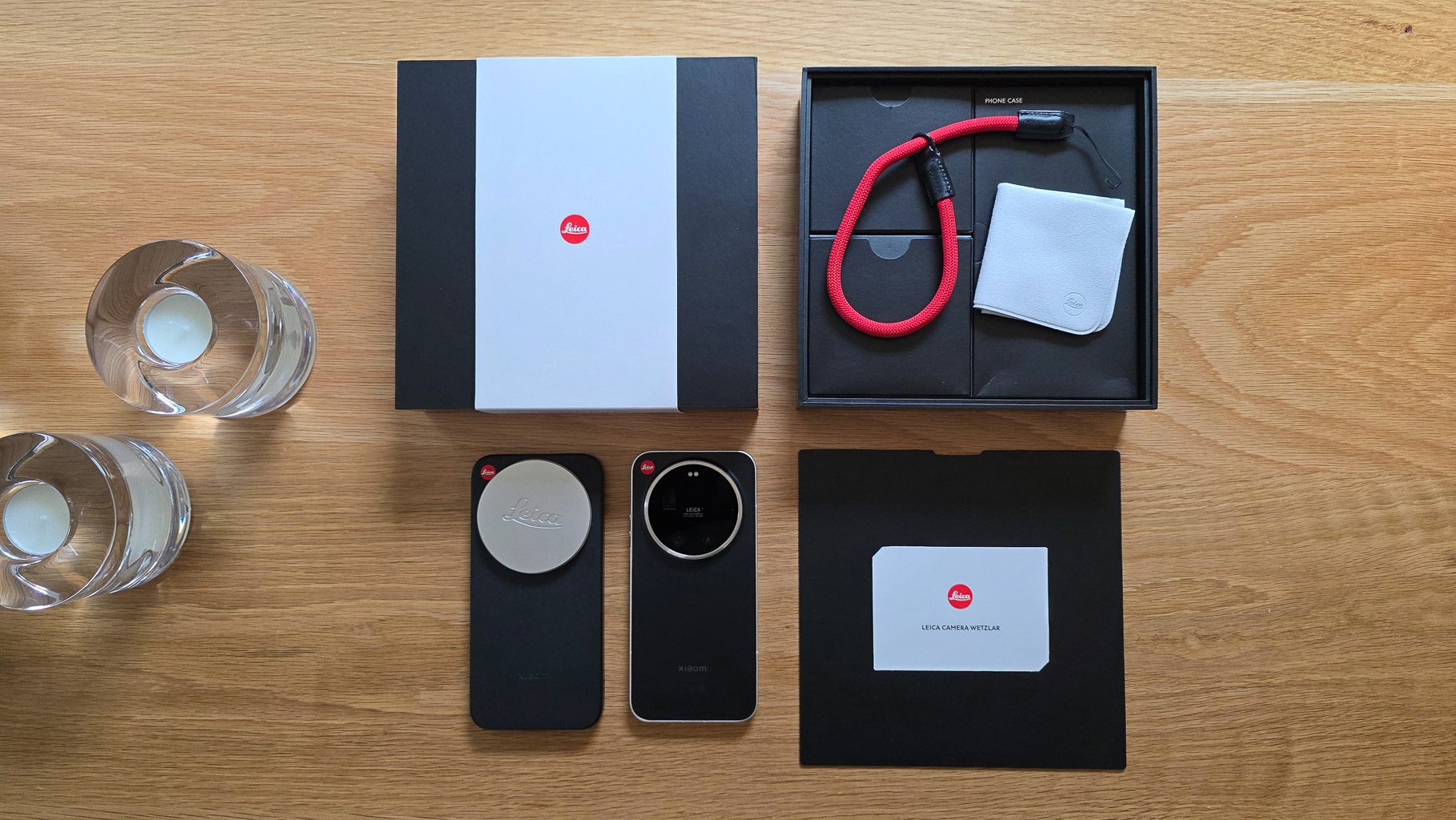
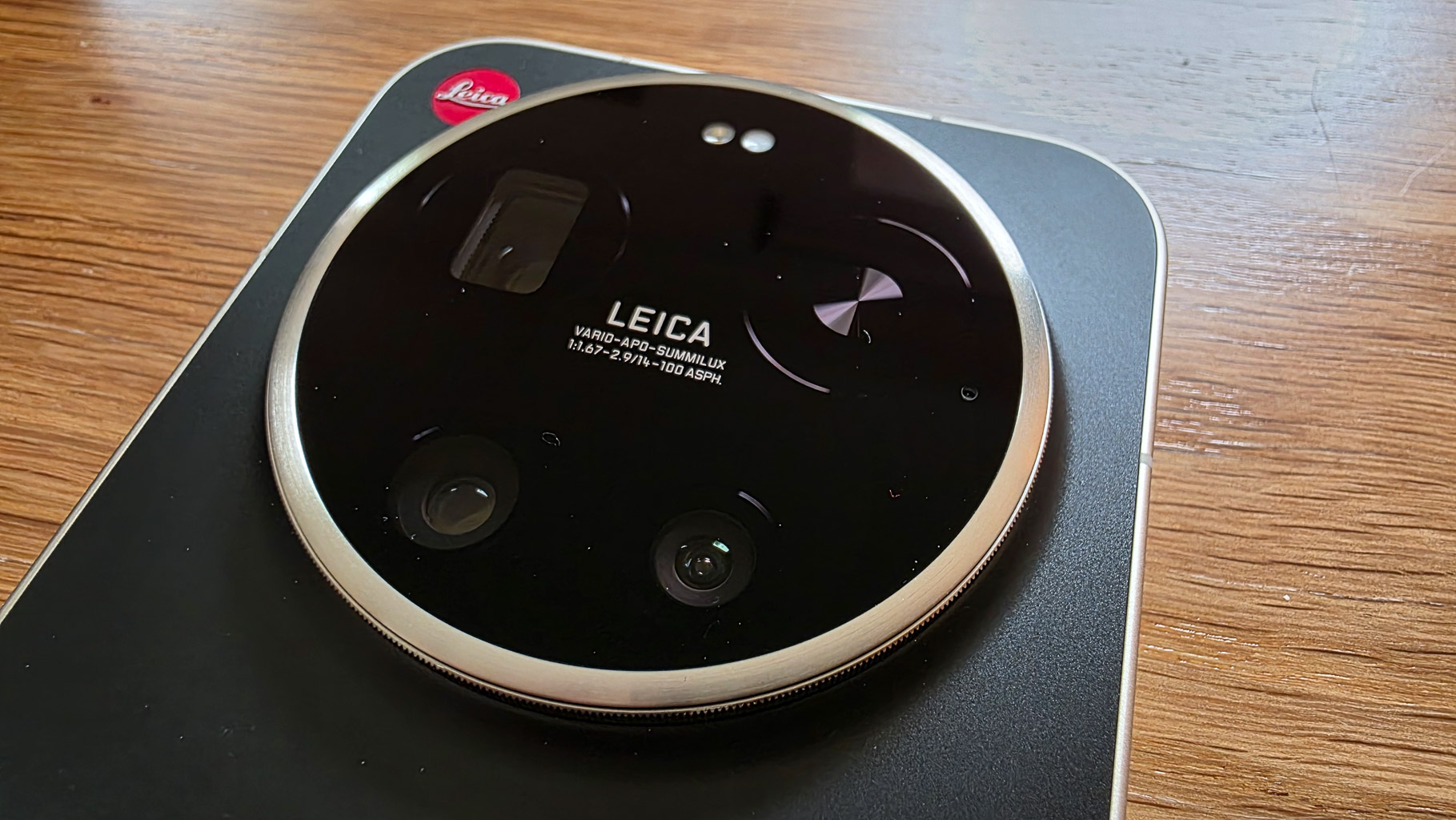
The Leica-specific image processing sounded fascinating to me, as did the high spec triple camera setup. I asked Leica, and they were kind enough to send me a rather lovely Leitzphone to test up here in the Isle of Skye. I have spent days delving into it with this comparison with the Q3 in mind.
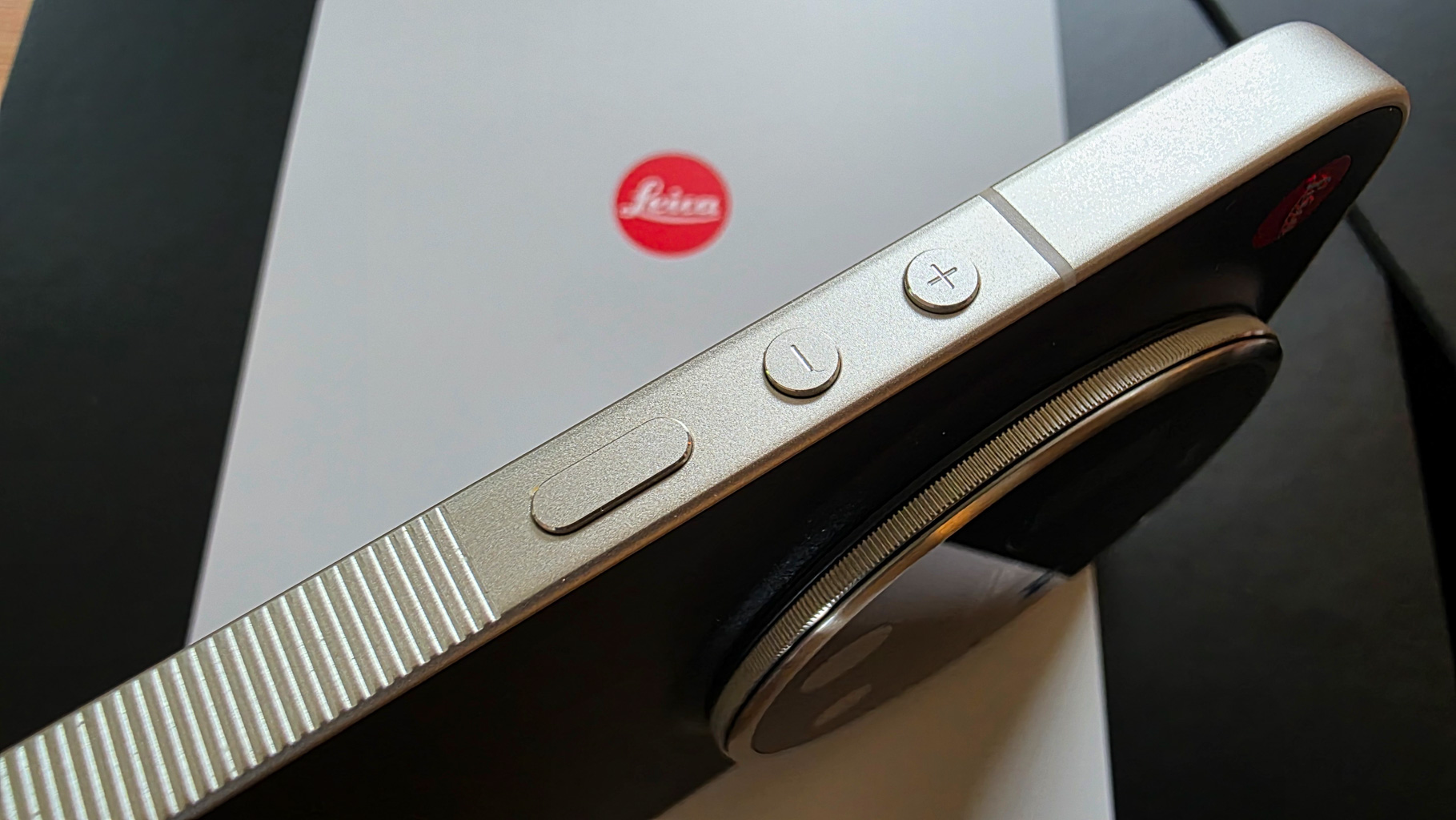
I’m not going to do a deep technical review of all the specs, as you can find plenty of those online. Instead, I am going to do a “real-world review” from the perspective of an experienced Leica-loving photographer, with a focus on whether the Leitzphone could replace a “real” Leica camera, in my case the Q3.
Review in two parts: a) User interface and usability, and b) Image comparison/quality
a) User interface and usability
For anyone who has spent years enjoying the mechanical perfection of a Leica M or the elegance of the Q series, picking up a smartphone built in partnership with Wetzlar and wearing the sacred red dot brings high expectations. Leica spends a lot of time on solidity, density, feel, and usability of their products which makes them such a pleasure to use.
On paper, the Xiaomi 17 Ultra “Leitzphone” promises the world. In the hand, the initial impressions are actually quite positive. The ridged metal frame feels premium, substantial, and very Leica. The whole thing looks and feels gorgeous. The complex camera module on the back looks very premium. It is very fast in operation and incredibly snappy. More so than my flagship Samsung S25 Ultra.
The under-screen fingerprint reader is so fast, it seems to grab your fingerprint before you’ve even laid it on the screen. It is Android so it can be tuned and tweaked as much as you like. The Google suite of apps means it is easy to switch to this phone if you’ve been using another Googly phone. Overall, it is an impressive piece of kit.
However, once you start trying to use it as a serious photographic tool, the cracks in the experience show up pretty quickly.
The handset hardware: Form over tactile function
A “proper” Leica is a masterclass in tactile feedback; every click of an aperture ring or shutter dial is definitive and firm. Unfortunately, the Leitzphone’s built-in camera lens ring misses the mark completely. It is loose. It rattles. Haptic feedback “clicks” are no substitute for proper ball-bearing-and-spring physical clicks. It is incredibly easy to rotate inadvertently.
It’s so imprecise that I eventually turned it off completely in the menus, just to avoid accidentally changing settings or triggering the camera. Very disappointing as this is a special feature of the Leica version, and it could have been so good. Sadly, this is the same on the Photography Kit Pro grip/case, more of which later.
Compounding this is the lack of a dedicated physical shutter button on the handset itself. To get around this out of the box, I had to map the volume-down button to a double click just to launch the camera from sleep. But even that workaround is flawed: if the screen is already turned on, double-clicking volume-down simply lowers the audio volume rather than triggering the camera. It’s an annoying inconsistency when you’re trying to catch a fleeting moment.
A mishmash of software
The camera user interface is so far below par for Leica I am surprised it was released to the public. It is a shocker. The phone has Xiaomi’s standard Android variant operating system, so I won’t spend much time on that. Instead, I’ll focus specifically on the camera experience. Where the Leica Q3, as other Leicas, sets the standard for a minimalist, photography-first menu system, the Leitzphone’s software feels rushed, overly complicated, and frustratingly unoptimised.
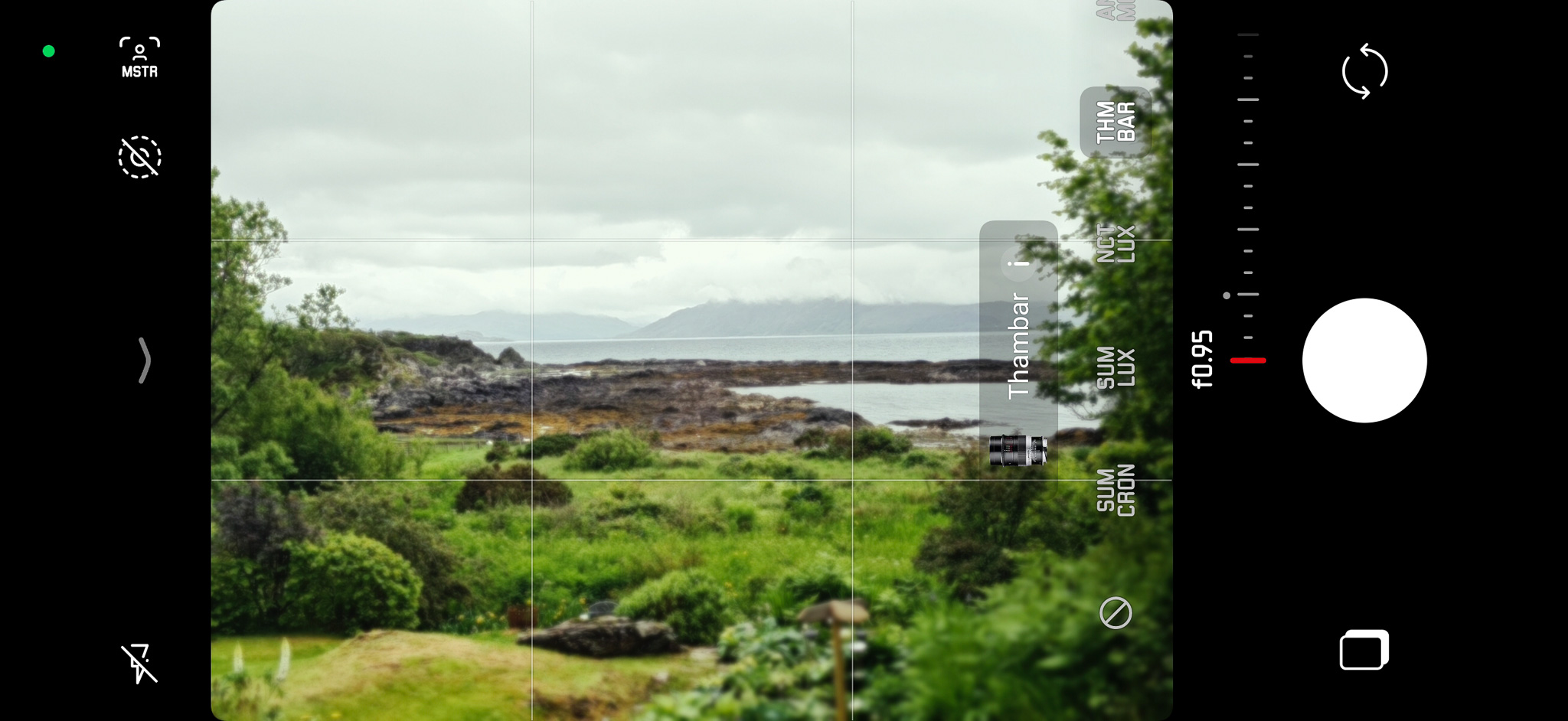
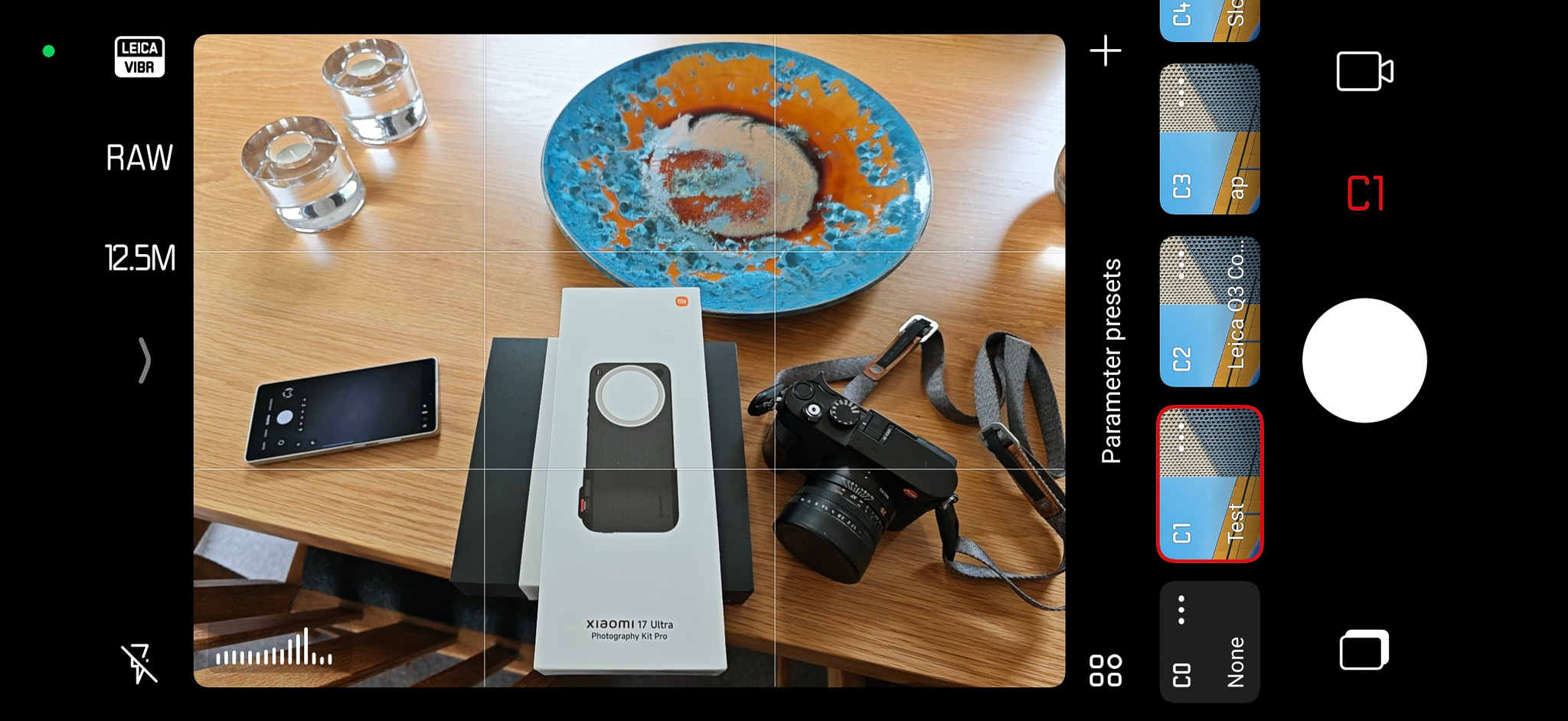
The biggest offence is the lack of consistency. For instance, the screen text doesn’t fully rotate when you switch the phone into landscape orientation. Some does rotate, other text doesn’t. It is as though the product manager couldn’t be bothered. As an example, if you tap on the shutter speed slider in Pro mode while holding the phone horizontally, you are greeted with a vertical slider where all the text remains stubbornly un-rotated.
A chaotic puzzle of split identities
Furthermore, the interface feels like a chaotic puzzle of split identities across “Camera,” “Pro,” “Portrait,” “Fastshot” and “Leica Essentials” modes:
Inconsistency
The sloppy camera ring can be set to do different things in different camera modes (“Photo”, “Portrait”, “Pro” etc), which is confusing. It can be set to be zoom, focal length (same as zoom?), exposure compensation, or filters.
But in Portrait mode, you can’t set it to exposure compensation. Personally, I would want it to be consistent across all modes, and I’d set it to exposure compensation if it was an effective piece of hardware that I hadn’t turned off. I hate it when a single control does different things depending on other settings.
The scale confusion
When using the zoom, rather than putting the zoom dial on screen there is a selector for 0.6x, 1x, 2x and so on. And when you hit that, it then turns into a zoom dial. Furthermore, some settings have focal length in mm shown only when selected on the dial and not before. Why not have it jump from one focal length to another and show the focal lengths in mm? As a Leica user, I just want to see the focal length in 35mm equivalent. This is a criticism editor Mike Evans made of the D-Lux 8. The old step zoom to “round” focal lengths was excellent, but Leica ditched it.
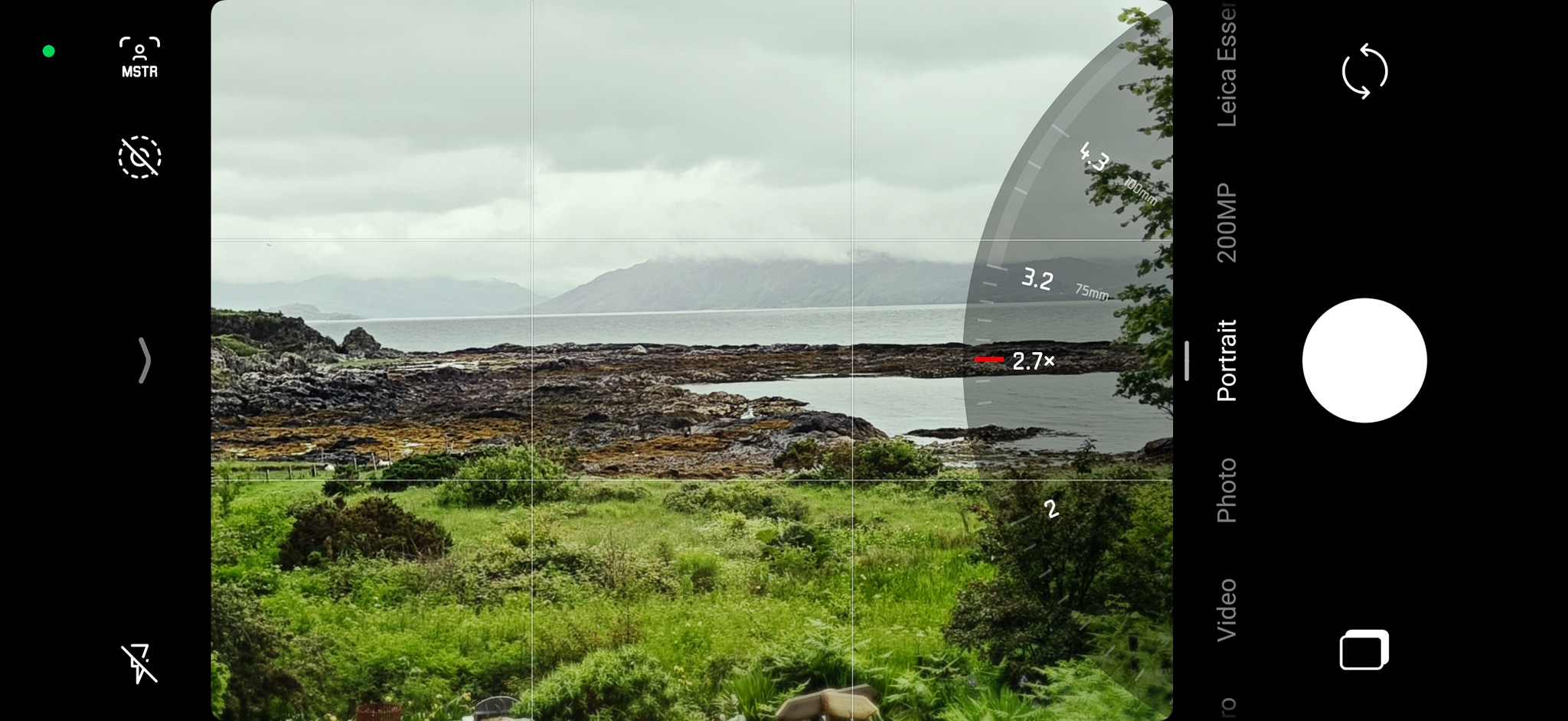
- If you are at 1x, it shows 23mm. If you go to 1.1x, the focal length in mm disappears. Common Leica focal lengths like 28mm, 35mm and 50mm are not even listed. There is another set of selectors (why??) to jump from 0.6-1.2-2-3.2-4.3-8.6 but between 3.2x and 4.3x it shows 75mm and 100mm.
- Why show magnification at one point on the dial, and focal length in mm at another point? Very odd and annoying. Instead, allow the user to select one or the other and stay consistent. Pick a scale and stick to it!
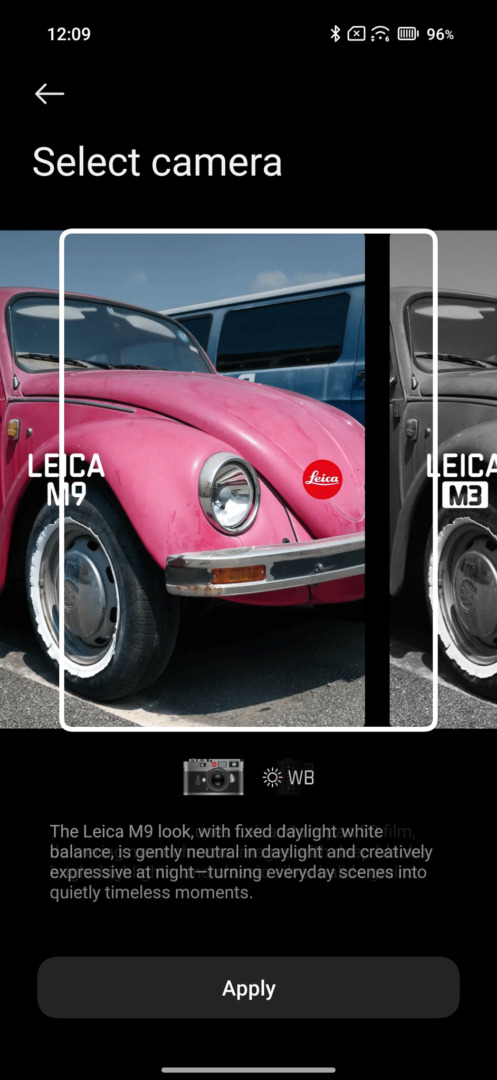
Leica Essentials Mode
This should theoretically be the Leicaphile’s heaven — a clean, manual interface mimicking a selection of Leica cameras and lenses. Instead, it’s remarkably poor. It essentially just lets you toggle between two simulated camera types, an M3 (black and white) or M9 (colour).
Why these aren’t just presets or “looks” within a unified menu is baffling. A true “Leica Mode” should seamlessly unite camera type, lens selection, aperture, ISO, shutter speed, and colour profiles into one comprehensive interface.
The filter overload
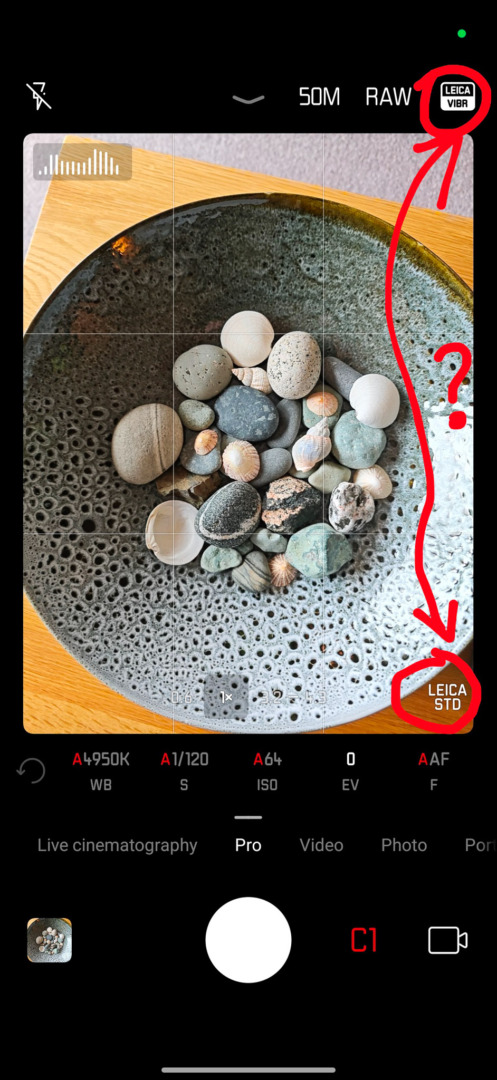
This perplexed me. When not using Leica Essentials mode, the top left of the screen lets you cycle between “Leica Vibrant” and “Leica Authentic” inbuilt styles. At the top right there is a completely separate selector to cycle through various Leica filters and looks.
- The functional differences between these competing layers are never clearly explained, resulting in an interface that feels built for marketing to smartphone users rather than catering to Leicaphiles.
- The filter/look name (Natural, Vivid, Chrome etc) doesn’t rotate with the screen. Doh!
- Ultra HD only works with Leica Vibrant” and pops up as an error message. This is the photography style, not the Leica filter/look. I believe this is because the Leica Standard style eschews artificial dynamic range boosting, but once again, it is confusing.
Portrait mode and hidden delights
Portrait mode is where the good stuff lurks. I spent a long time trying to work out where the much vaunted Leica lens profiles were. Of course, there is no user manual in the box. Having tapped around for a while, I found an innocuous little red f/2.8 icon at the bottom of the screen.
I had thought this was just telling me what aperture was set. But if you tap it you enter into a world of magical Leica lens configuration. But why isn’t this in the “Leica Essentials” or “Fastshot” mode and a lot more obvious? Here are some other features, with more detail in the Images section.
- You can choose from a Summicron, Summilux, Noctilux, Thambar or “Anamorphic” lens.
- Computed bokeh (out of focus blur) is tuned to replicate these lenses.
- The aperture adjustment changes the degree of focus blur. You can change this after the shot has been taken in the phone’s gallery, like with a Samsung or Apple phone.
- Every lens goes to f/0.95! Incredible. You can now have a 100mm Thambar Noctilux!
- Sadly, you don’t get any RAWs, just 12mp JPEGs. More on this in the Images section.
- Why not allow me to select the actual Leica lens I want to emulate (eg a 35mm Summicron M) and automatically apply the correct bokeh and zoom setting?
Why five when one will do?
There are four different places to set the “filter” or “look” that is applied to an image. If you add lens selection into the mix, there are five. This is usability madness. The user interface should be completely redesigned.
My recommendation is to create a single mode for Leica that combines filter/look, camera selection, lens selection, aperture, ISO and shutter speed. In fact, let me create a virtual “camera bag” of simulated lenses and bodies that I can use. Put it into “Fastshot” mode, that already has nice Leica framelines applied.
The Pro Mode and Preset Pitfalls
For those planning to shoot RAW/DNG, the software introduces several headaches.
Pro mode gives direct control over AF, EV, ISO, Shutter Speed and White Balance, but not physical lens aperture, which is fixed. All very good and as expected.
If you are shooting in Pro Mode at 1x using the main 23mm equivalent 50MP sensor in RAW, and you zoom out to use the ultrawide lens, the camera silently drops you down to a 12.5MP JPEG without any prominent warning.
Even worse, if you zoom back in to the 1x main camera, the software doesn’t automatically switch back to RAW—it stays in JPEG until you manually hunt down the setting again so it is so easy to miss it and shoot JPEGs accidentally, which I did a lot. Similarly, if you are at 1x and go to 3.2x, it stays at 50mp but changes to JPEG and doesn’t change back to RAW when you go back to 1x. Ugh.
A zoom with steps only
In Pro mode, you can’t granularly zoom through the zoom range. You are restricted to 0.6x, 1x, 3.2x, 75mm, 100mm and 4.3x. Honestly, who came up with this mixture of magnification and focal length. I zoom smoothly throughout the range with my Samsung S25 Ultra, in RAW and JPEG or both combined.
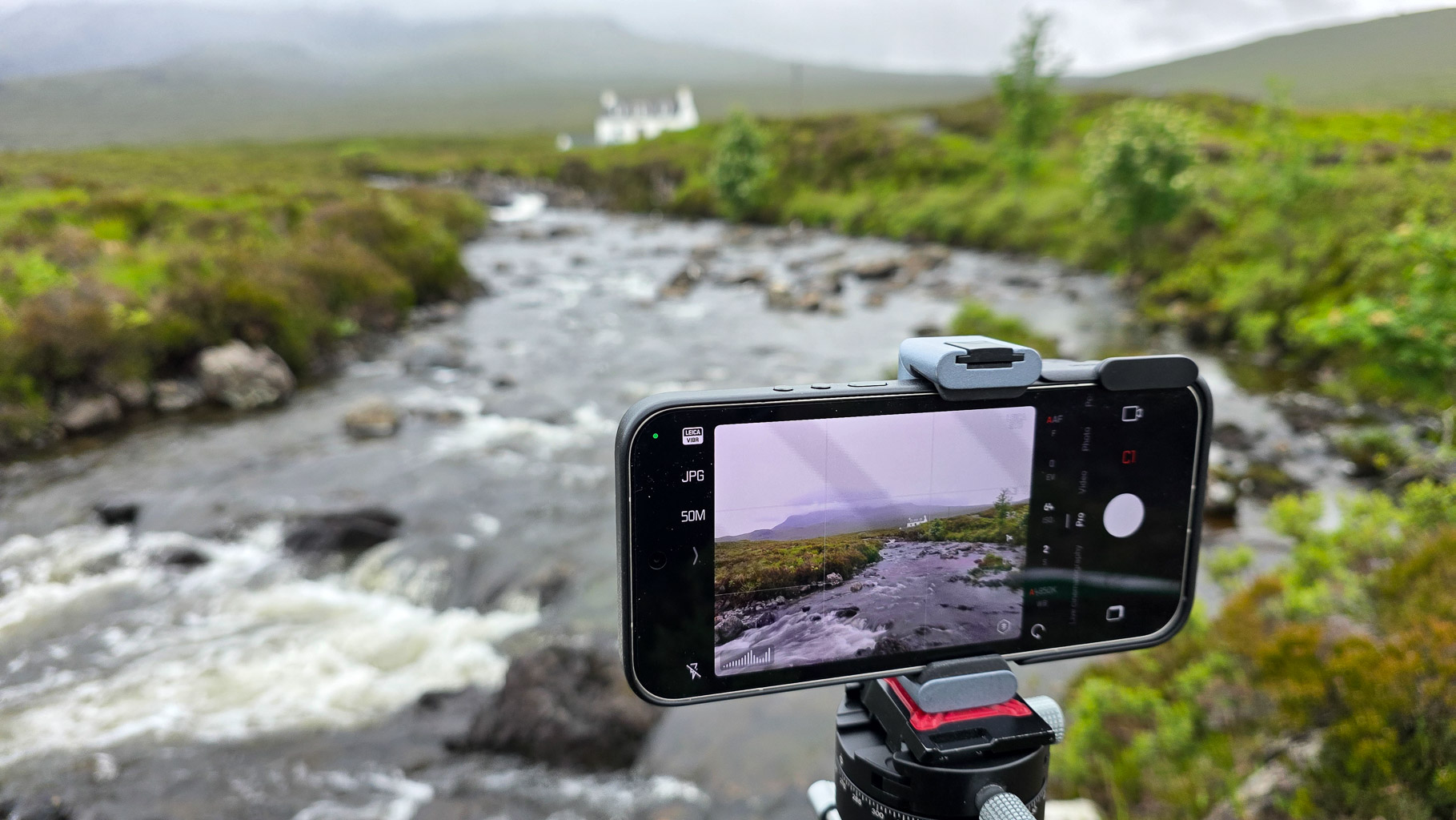
To top it off, the Parameter Presets feature that allows you to store custom parameters (shown as C0, C1, C2 on the screen) has a fatal flaw: it doesn’t save the RAW setting. If you save your settings as a preset and you have RAW set up, then switch to a JPEG mode, and then switch back to your preset, the format reverts entirely to JPEG as the preset doesn’t remember your image format setting. Not smart!
So it is a real mess. If there was a single Leica camera mode that combined filter, camera, lens, aperture, ISO and shutter speed, the presets would make a lot more sense and could also save image format and other settings, just like on a “real” Leica camera.
The saving grace? The Photography Kit Pro
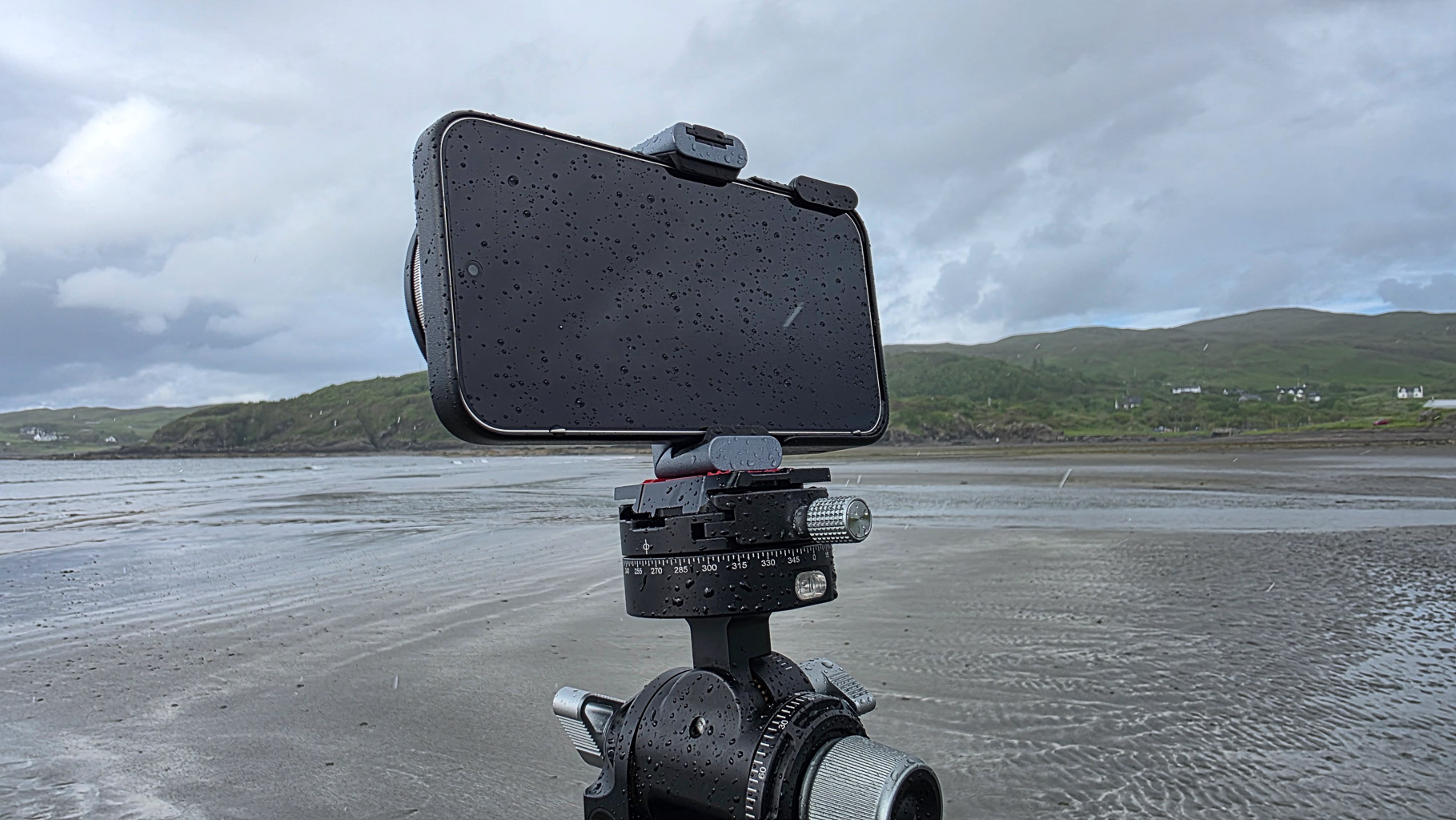
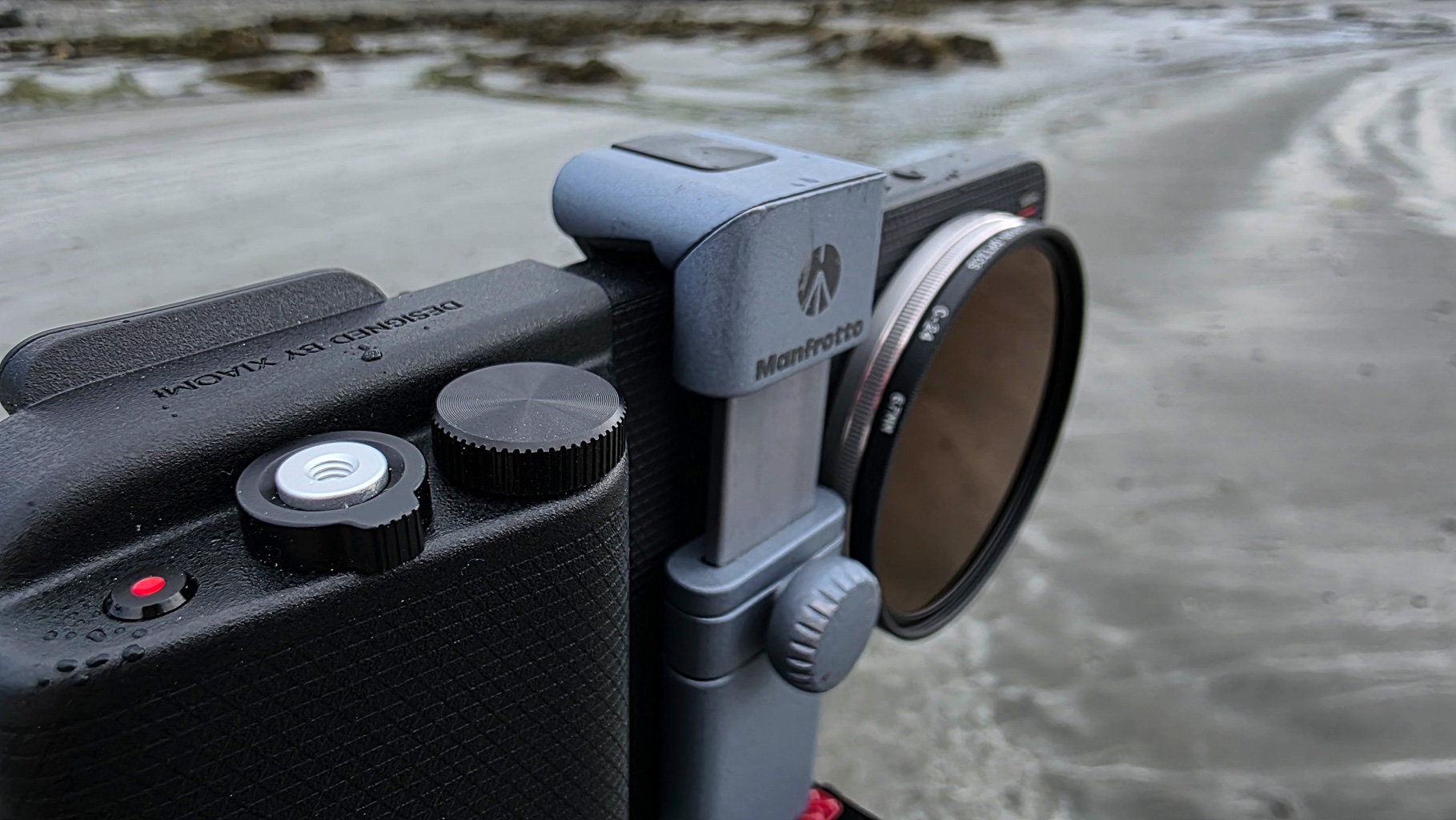
If there is one thing that saves the Leitzphone from usability disaster, it is the £179 Photography Kit Pro accessory case/grip. I, personally, bought this from Xiaomi with my money, since the Leica kit doesn’t come with it. I wanted to include it as I think the provision of dedicated physical controls and a filter ring for the lens would make a big difference to usability. And it does.
Click pics for larger images:
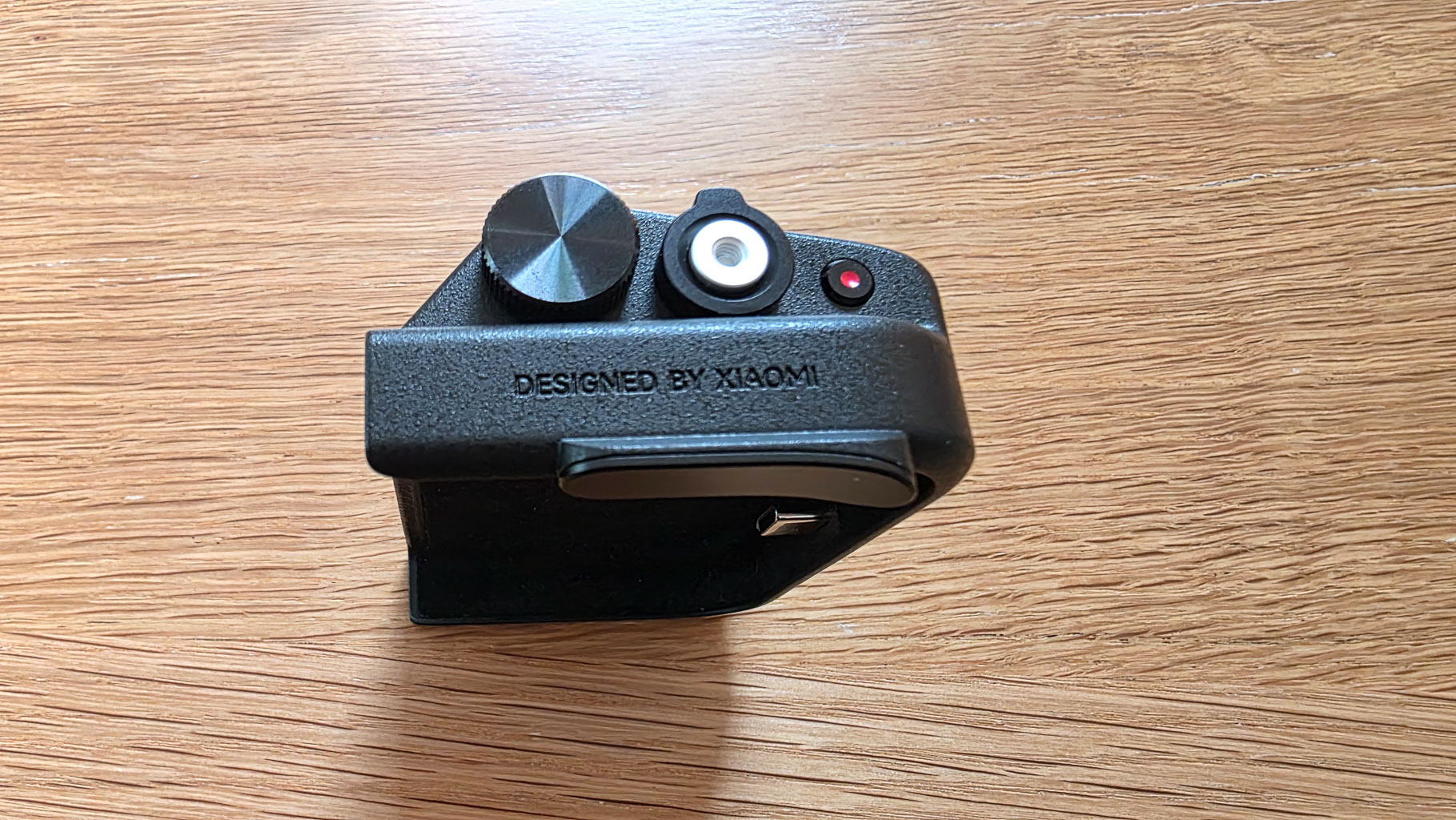
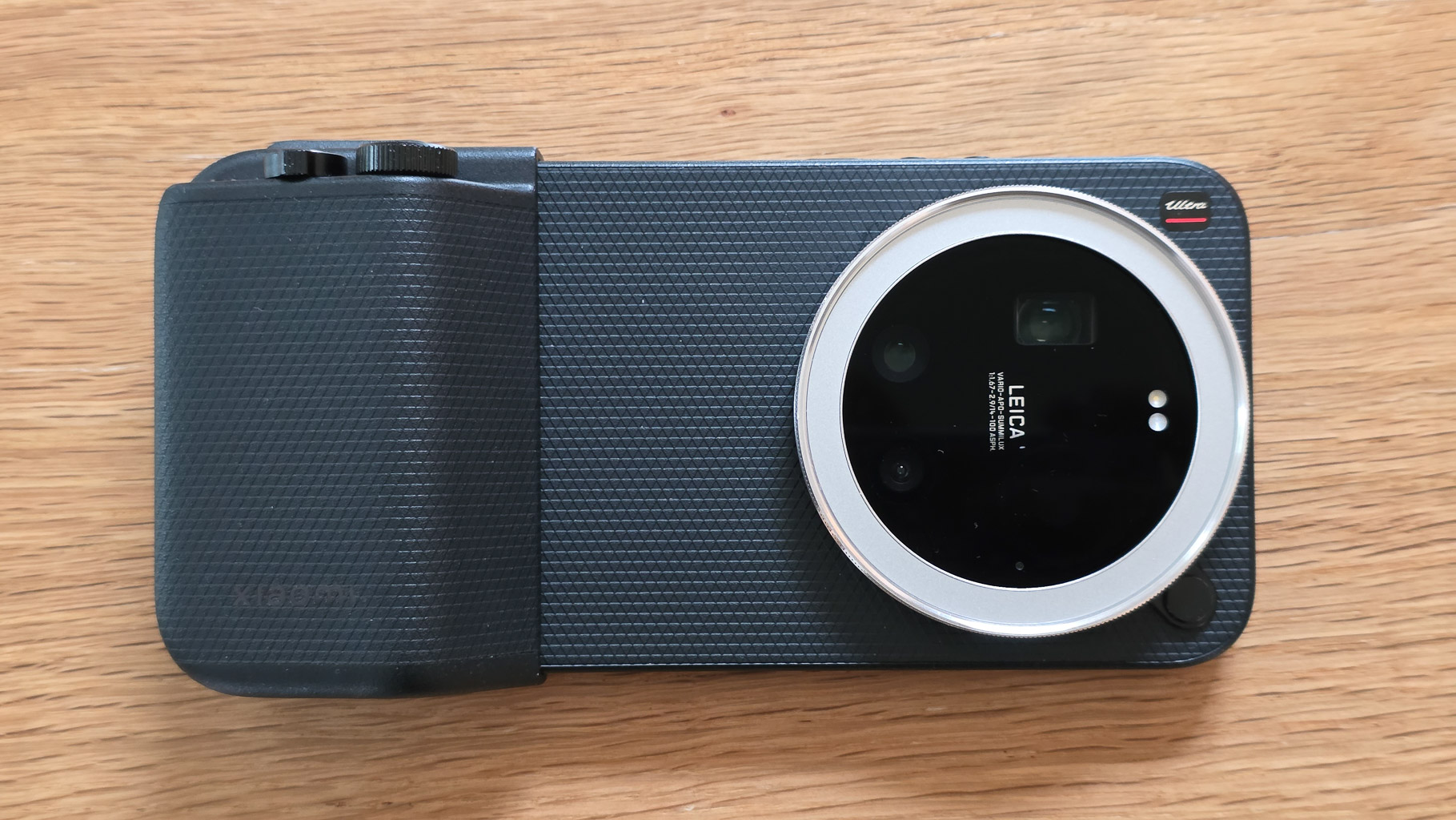
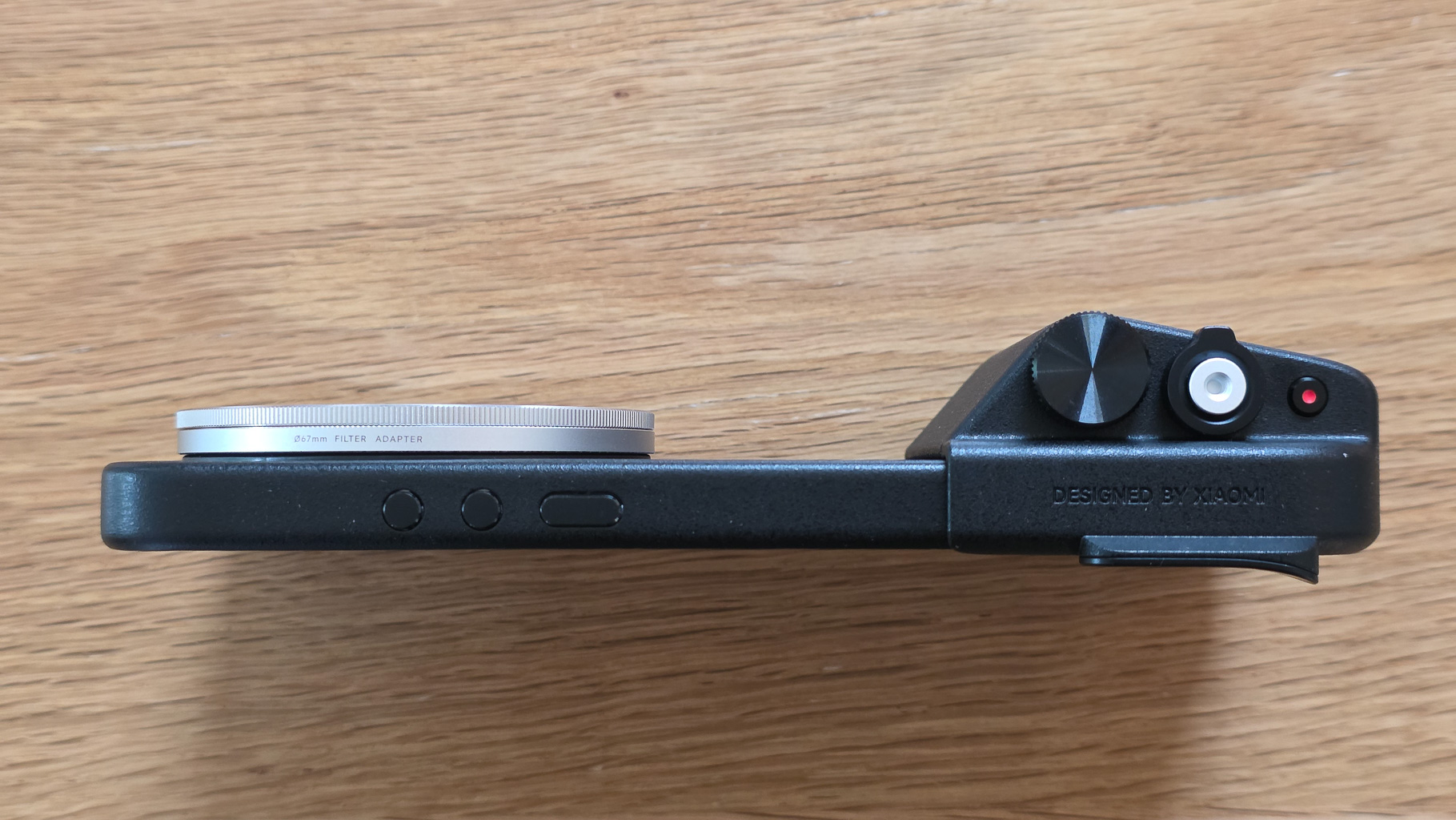
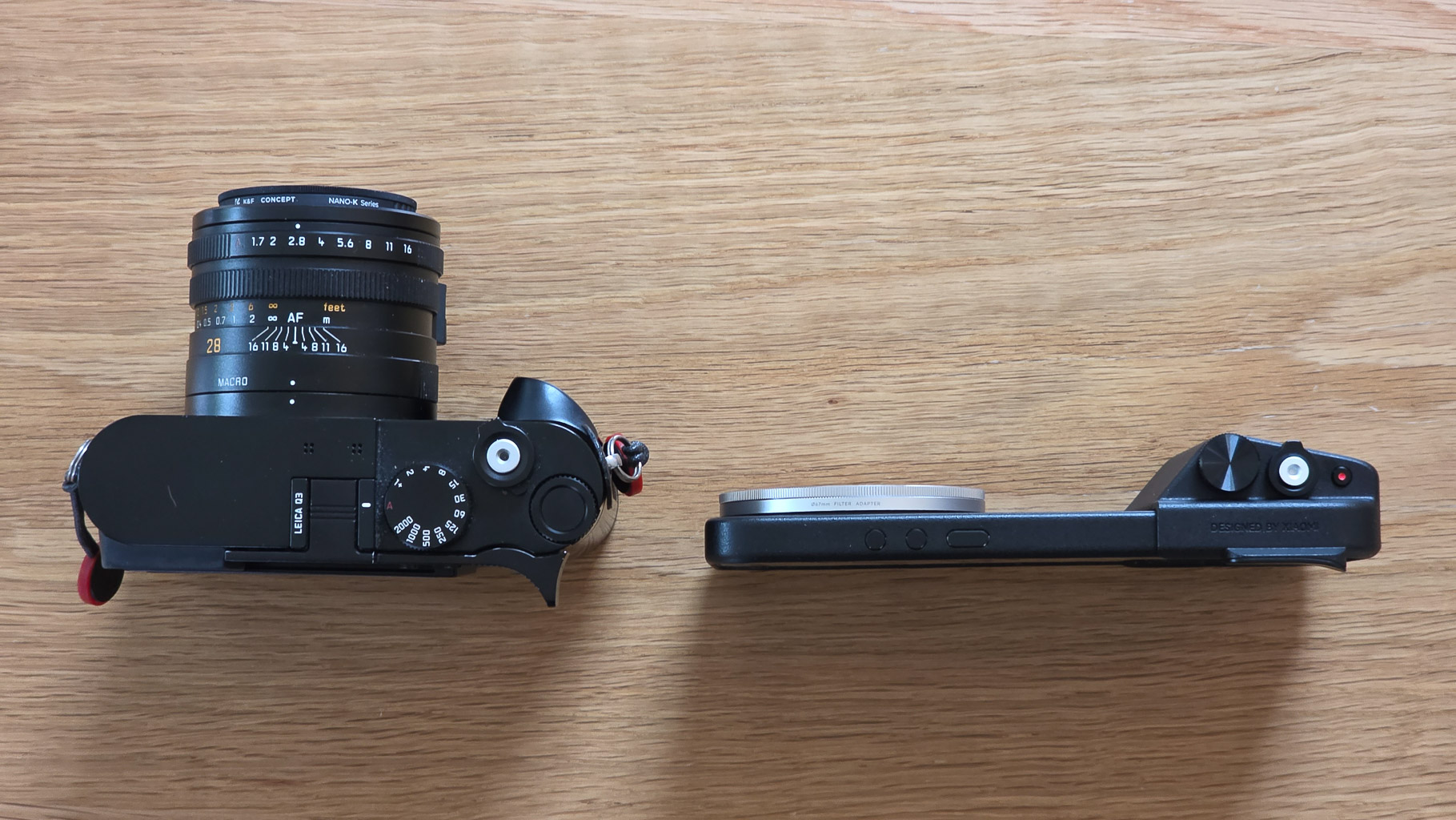
(Bottom Left) Reminds me a lot of a Leica TL. (Bottom Right) With Leica Q3
All © Andrew Tobin
The kit has two parts. First the case goes on the phone, and you can press a little button like a lens release button on a camera to switch the standard lens ring for one that has a 67mm filter thread, which is what I did. The second part is a solid and dense grip that fits over the side of the case and locks into place.
Transforming ergonomics
This grip completely transforms the ergonomics. It provides a beautifully textured, comfortable hand hold and even has a thumb-grip that allows for confident, one-handed shooting. It also includes a red rope wrist-strap like the one you get in the Leitzphone box. More importantly, it fixes the handset’s hardware omissions by adding:
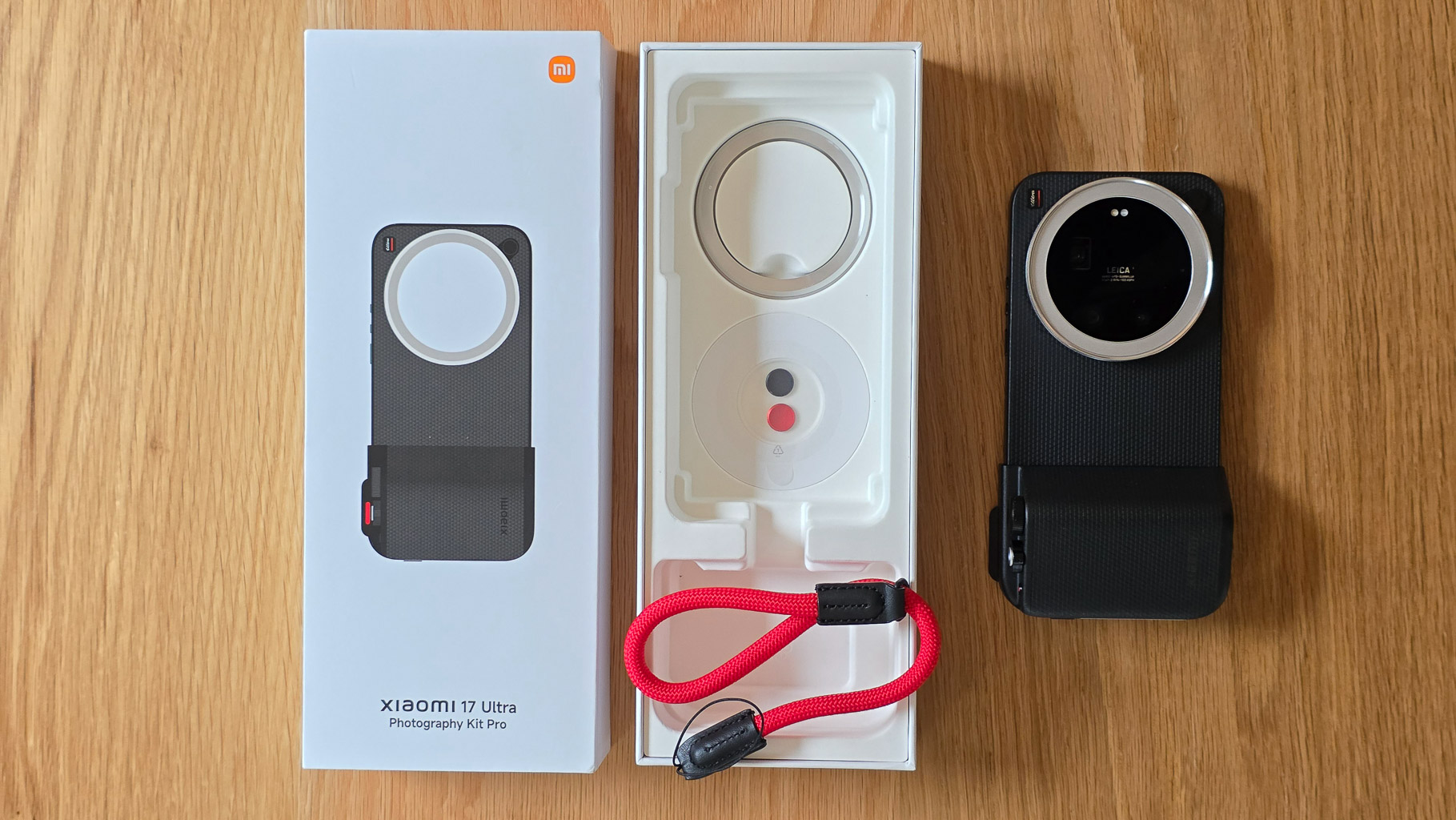
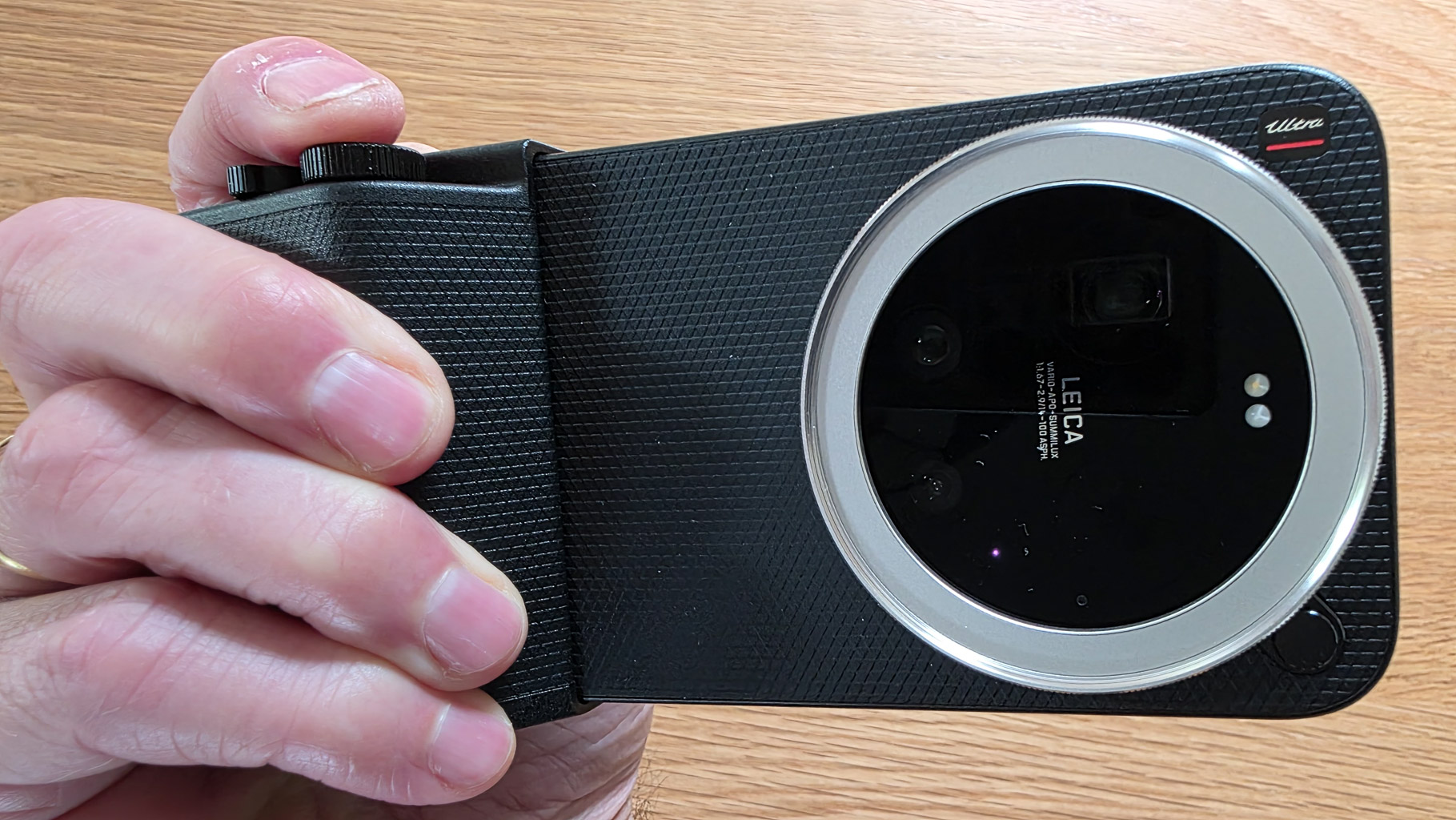
- A proper, physical, two-stage shutter release (which can be pressed and held to instantly wake the phone directly into your camera mode of choice (“Pro” obviously).
- A tactile zoom rocker.
- A customizable control dial, which I immediately assigned to exposure compensation.
- An additional, 2000mA battery that can also power the phone.
- The swappable lens ring that yields a standard 67mm filter thread — a massive plus for landscape shooters wishing to use physical ND filters.
Sadly, the rotatable lens ring on the case is similarly loose and rattly with no proper detents. It rotates too easily and isn’t accurate enough to use to control the camera’s settings.
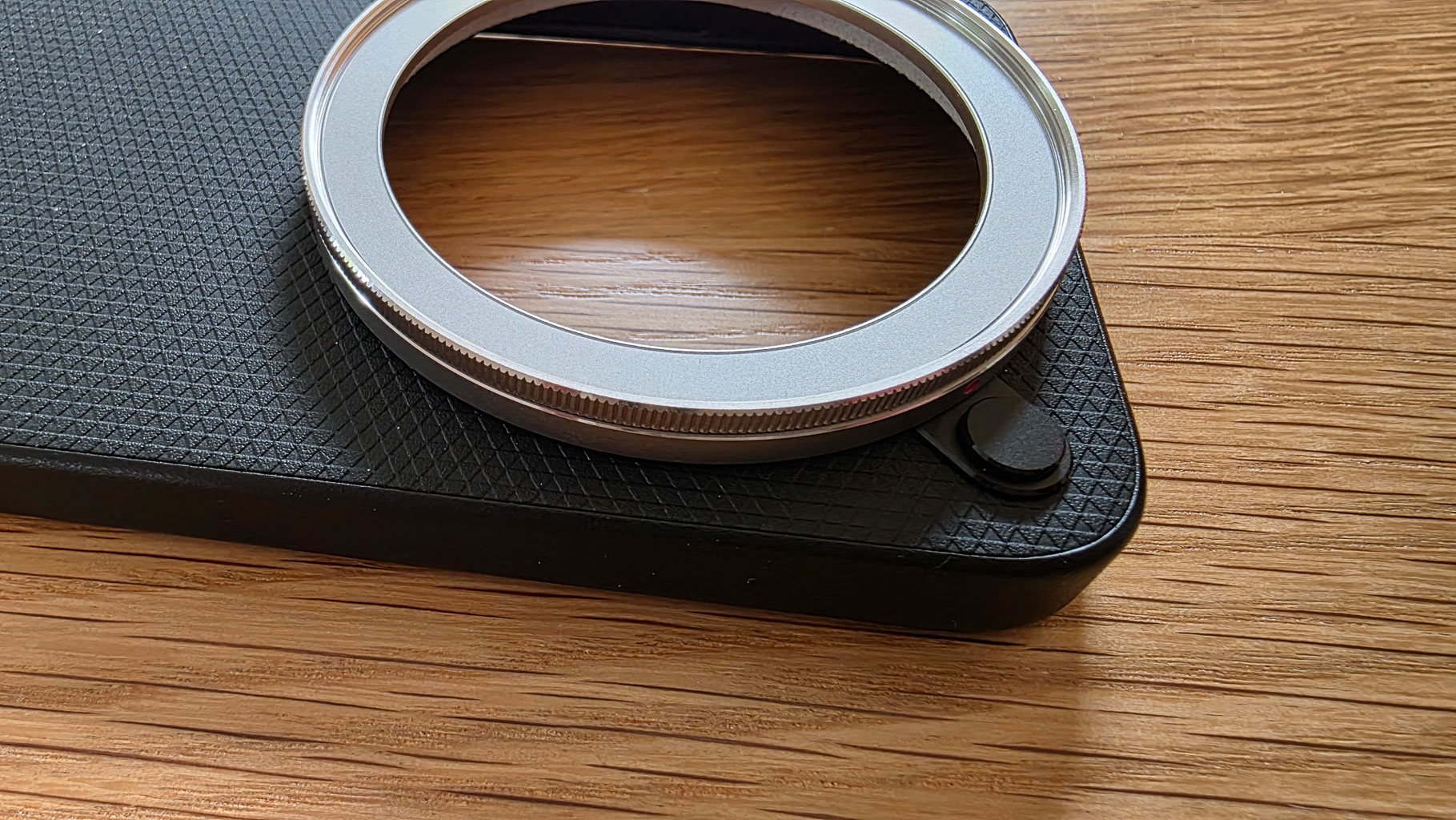
As for the ring on the phone itself, I turned it off as it was annoying me too much. It would also be useful to have a tripod mount screw thread on the bottom of the grip. Furthermore, sadly, the red Leica dot is now missing as it isn’t on the Xiaomi Photography Kit Pro case.
Despite these issues, I’d say the Photography Kit Pro is an absolute must-have. Without it, the Leitzphone is just another clumsy smartphone; with it, it finally starts to feel like an actual camera, albeit a slightly bulky one.
Other inbuilt functions
Like Samsung and Apple phones, the Leitzphone has Xiaomi’s other camera functions that I found accidentally, which include:
- Time-lapse
- Long exposure
- Panorama
- Xiaomi Fastshot
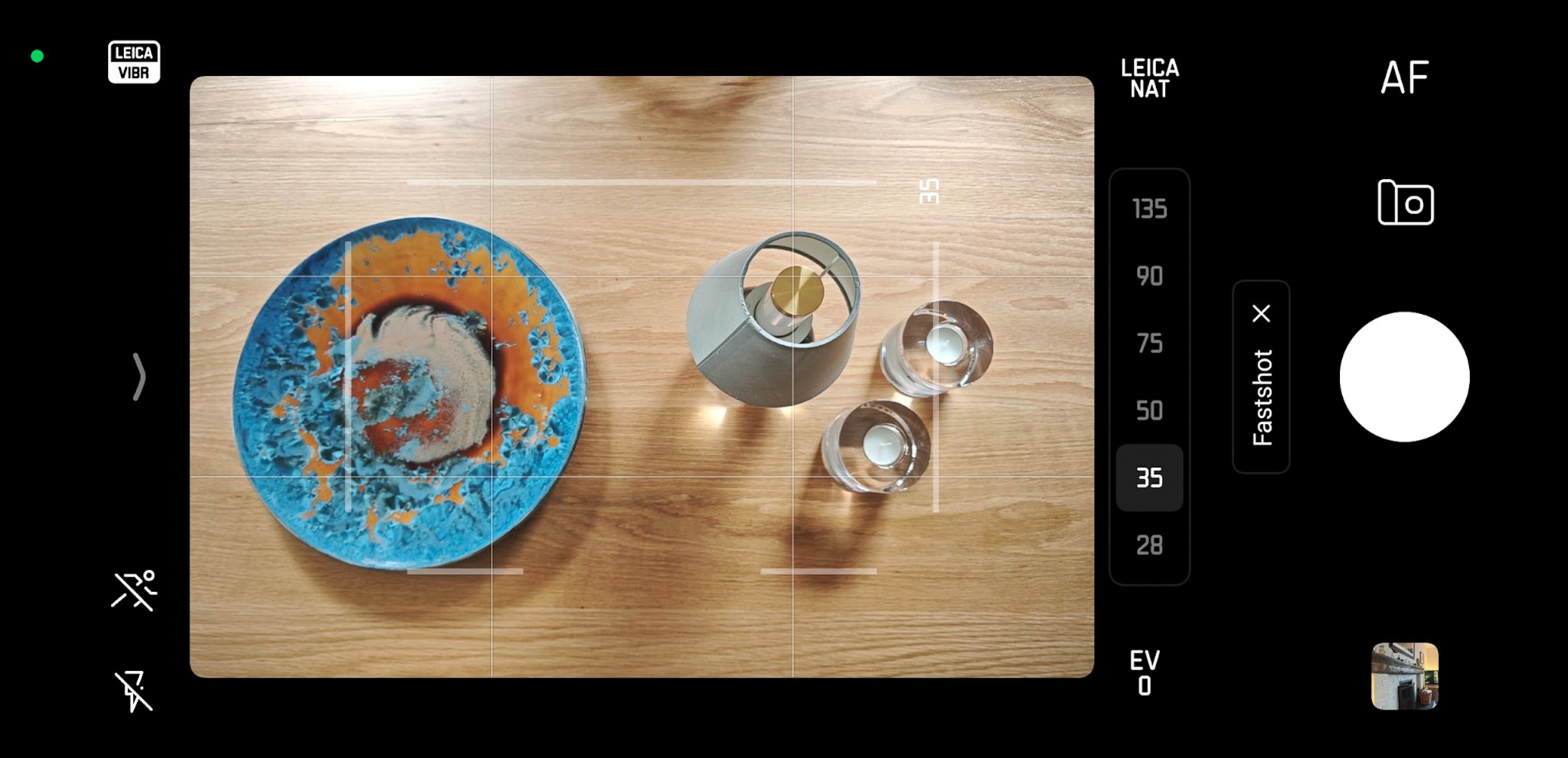
The latter is rather interesting. It is more like what I would have thought a Leica phone camera experience would be like. It is much simplified. Zoom is by common Leica M lens focal lengths at 28, 35, 50, 75, 90 and 135 (but no 24mm which is curious as the main native lens is 23mm equivalent). Some focal lengths have framelines which is great and very familiar.
The font is Leica style. There is a simple exposure compensation setting that can also be implemented by the dial on the Pro grip. What is missing is lens and aperture selection. Satisfyingly, things rotate with the phone orientation, except for the frame line text.
You can select Fastshot as the camera mode that opens when you long-press the Pro grip shutter release button. In fact, the more I used the phone, the more I enjoyed the simplicity of this mode. It is much more Leica-like than any other. Such a shame the lens selections aren’t in it. Imagine if this was instead called “Leicashot” and had lens and “virtual” aperture selection included. Wouldn’t that be good?
Usability verdict
For a casual (and wealthy) user looking for a fun smartphone wrapper with some neat Leica branding, the Leitzphone is an interesting and very expensive device. I can definitely see the marketing ploy of using it as a gateway drug to the world of high-end Leica Q, M and SL hardware, but I fear the user interface will put people off making the jump to the “proper” camera gear if they think the real cameras are similarly unsatisfying to use. Leica may have shot themselves in the foot here.
Unfortunately, for anyone used to the uncompromising, intuitive, tactile purity of a “proper” Leica camera like the Q3, or even just someone used to a basic and sensible user interface, the out-of-the-box camera software feels bloated, inconsistent and hugely confusing. After a lot of use during this road-test, I started learning where all the functions were, but it remained clumsy and unintuitive.
It is a huge let-down for me. There is so much potential that has been wasted. The basic components are there, but strung together haphazardly and illogically in a most un-Leica fashion. Someone has badly dropped the ball here. It takes the addition of the physical Pro Grip to unlock some of its photographic potential and bridge the gap between a phone and a camera. But I fear that is not enough.
b) Image quality and comparisons
Well, well, well. This got very interesting quickly. The Leitzphone is VERY good when shooting with the main 50MP 23mm camera. Detail and sharpness is impressive. As a reminder, the Leitzphone’s three cameras are:
- Ultrawide 14mm 12mp f/2.2
- Main camera 23mm 50mp f/1.7 (f4.5 in full frame equivalent)
- Telephoto 75-100mm optical zoom 200mp (just 12.5mp in RAW format) f/2.39-2.96
I have thoroughly enjoyed exploring the capabilities of this phone/camera. The more I used it and got used to the interface nightmare, the more I appreciated the result. In many ways, RAW or JPEG or 50mp or 12mp doesn’t really matter in the majority of circumstances.
A gallery of images from Skye
To whet your appetite, here is a gallery of images from around Skye to start you off before we get into the comparisons with my Q3. Some are quickly taken, some I have picked particular settings and lens simulations. They use the variety of main and telephoto camera.
All were quickly edited in-phone or had Leica look presets applied when the photo was taken. Some were taken using Pro mode, some in Portrait mode, some in Fastshot mode (a good example of the disaster of a user interface!).
Click on any one for a full-sized image:
The last mooring




Bottom Left: Leica Chrome look. Bottom Right: Summilux f/1.4 Chrome look.
All © Andrew Tobin
Textures




Bottom Left: Summicron f/4.5 High Contrast. Bottom Right:A little macro for you — Summilux f/2.8 All © Andrew Tobin
The monochrome wildness of Skye

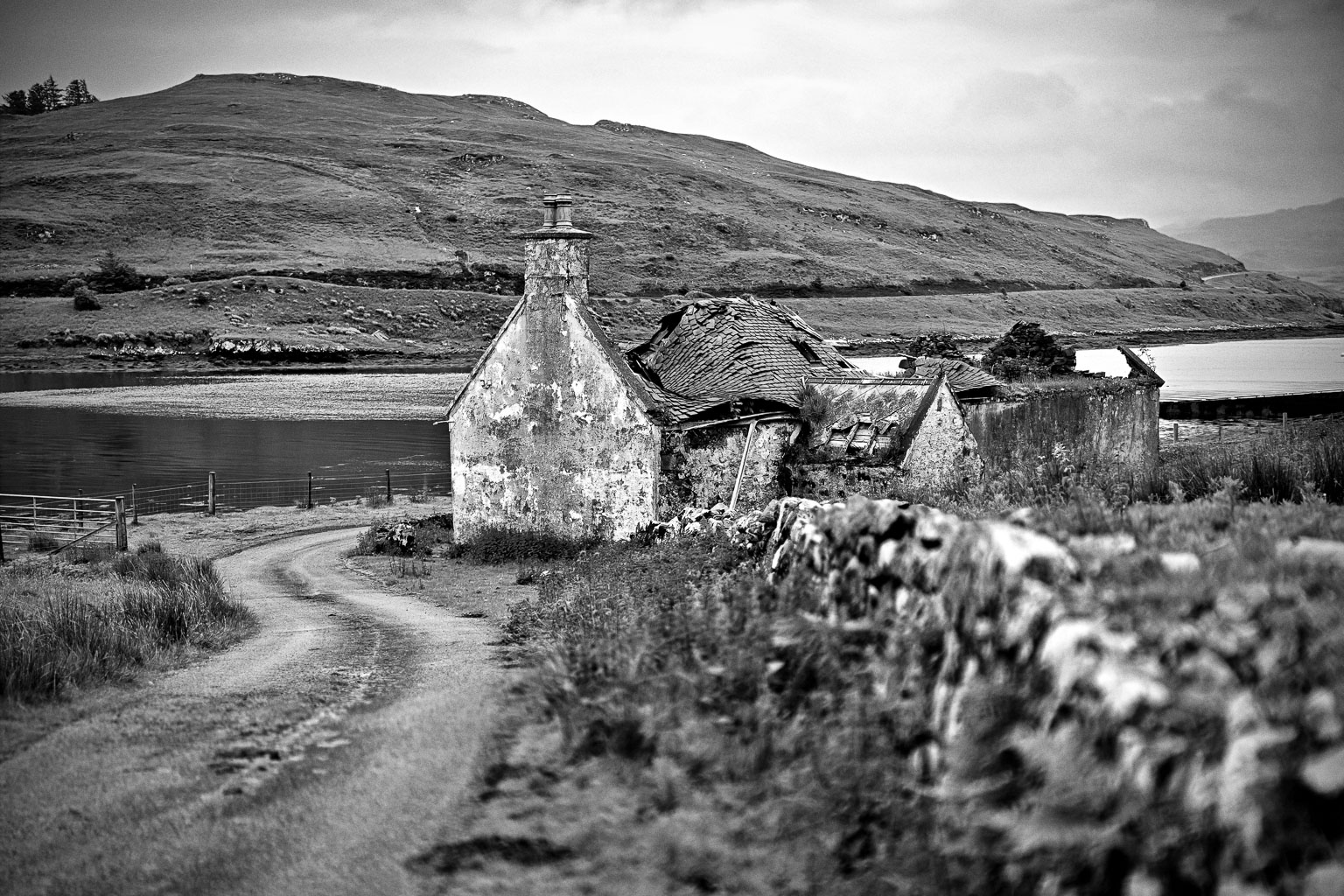

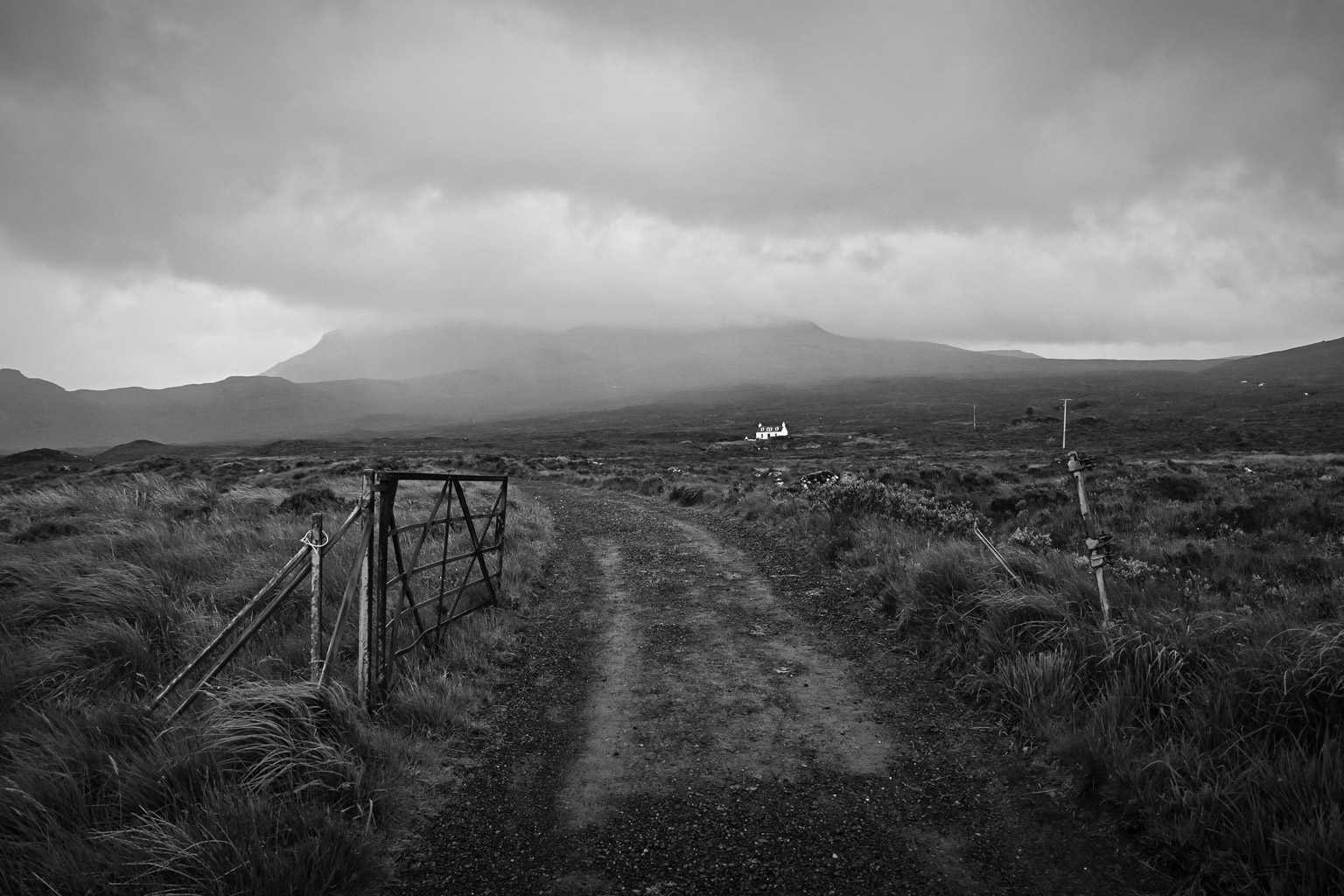
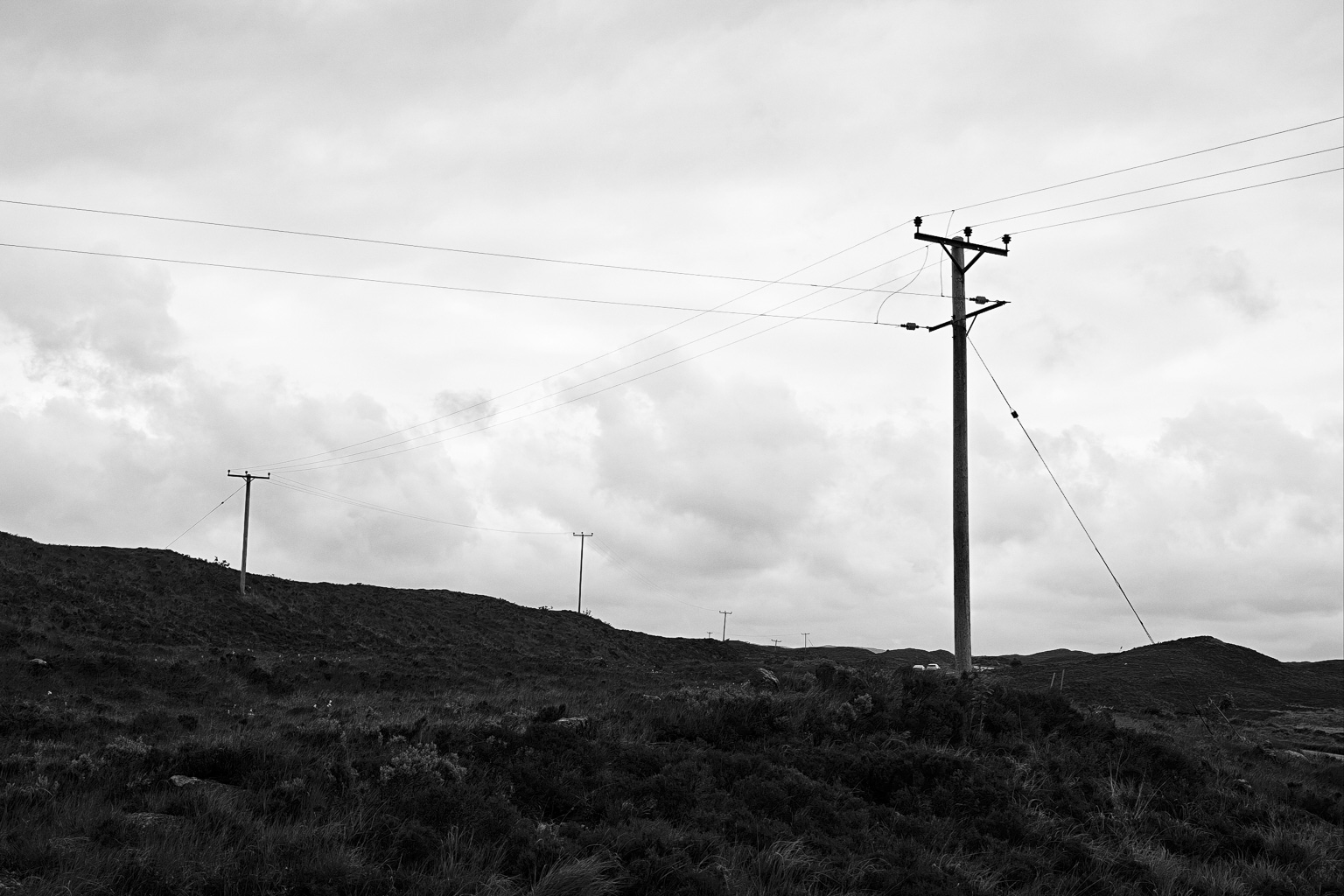
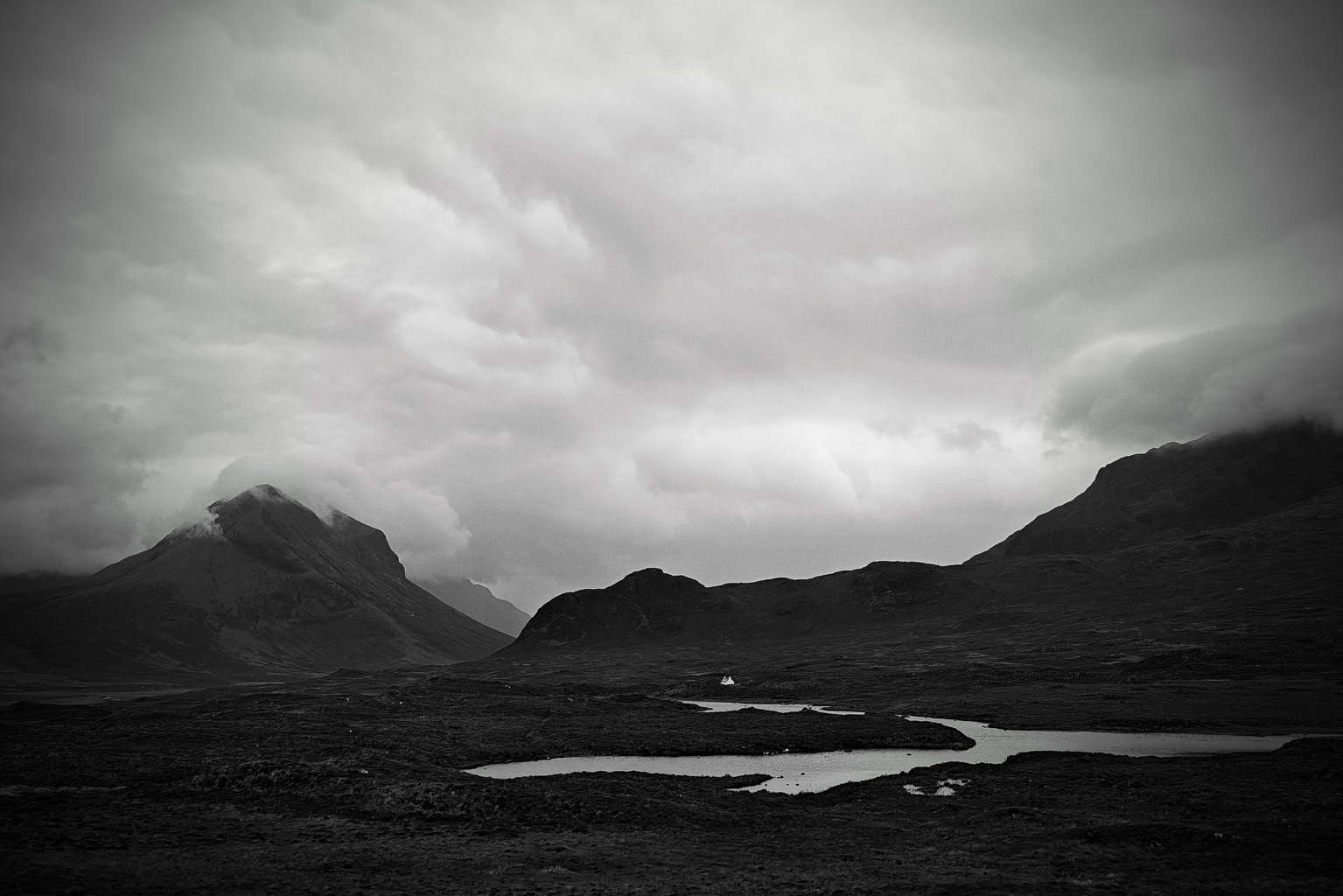
Middle Left: 08 sec with ND1000 filter. Middle Right: Fast shot mode 35mm Leica High Contrast.
Bottom Left: Fast shot mode 35mm Leica High Contrast. Bottom Right: Fast shot mode, in-camera mono conversion, and vignette.
All © Andrew Tobin
Skye in colour — just
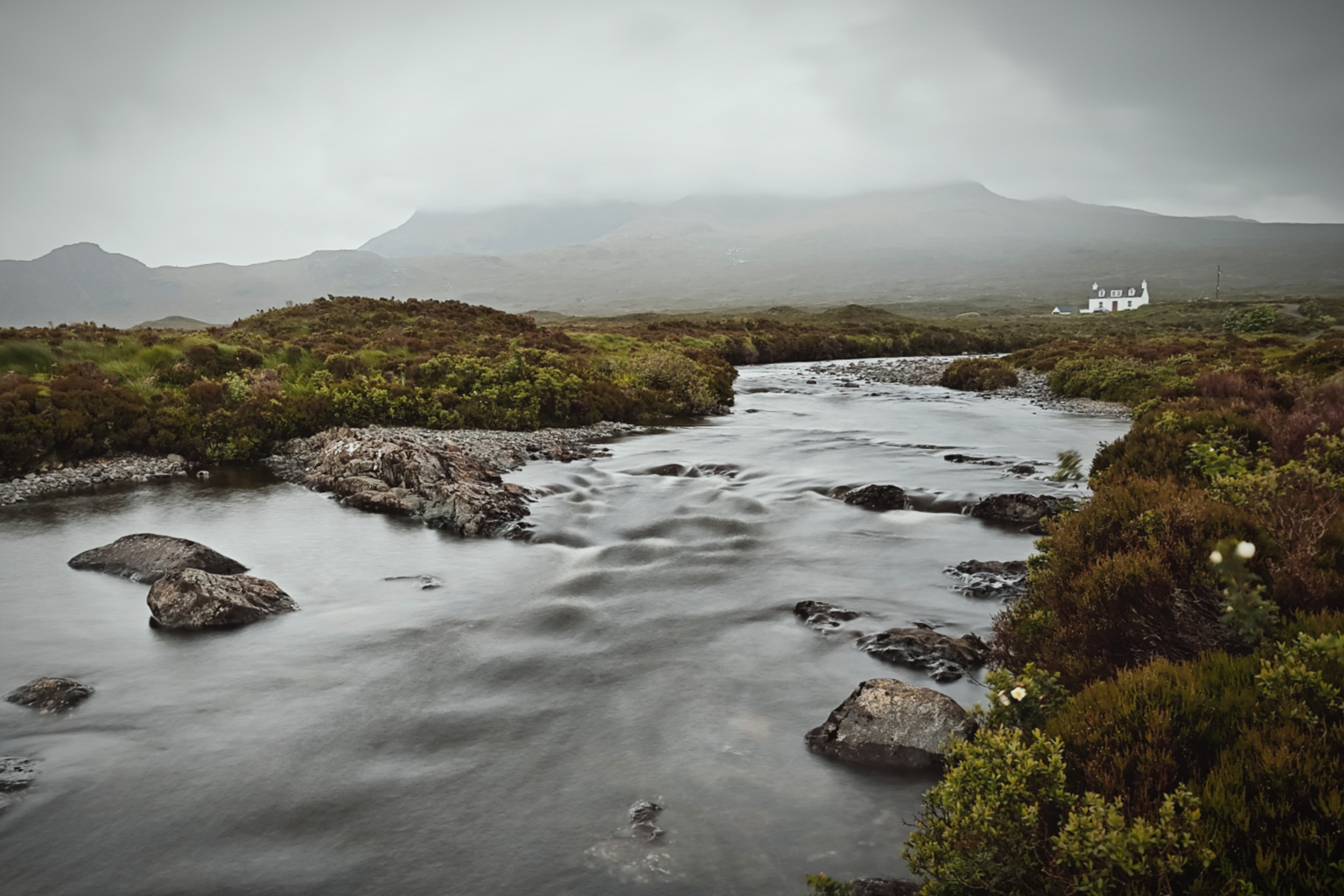



Bottom Left: 100mm optical zoom Leica Eternal look. Bottom Right: Point n’ shoot. All © Andrew Tobin
Side-by-side comparison versus Q3
My Q3 comparison testing method was fairly simple. Take a shot with the Q3 and the same shot with the Leitzphone. Initially, I wanted to use minimal computational photography on the Leitzphone, and then ramp up the AI tech later.
To compare the Leitzphone with the Q3 (60mp 28mm f/1.7 lens), I used the phone’s main camera (50mp 23mm) and RAW mode (except when the phone went to JPEGs without me noticing). First, I set the aperture on the Q3 to f/4.5 to match the full frame depth-of-field equivalent of the phone’s main camera lens and sensor combination. I then framed the shot as closely as possible to match compositions.
The goal was to try a variety of compositions and settings to pull out the differences between the two cameras. I just used the “Leica Standard” look/filter, as I knew I’d be editing the RAW files later. I imported the images into Lightroom and processed them in the way I would usually do. This would mean I’d convert some shots to black and white and leave some as colour, as determined by the subject matter and my own subjective choice.
The Leitzphone would shoot in 3×4 aspect ratio (it would drop to 12mp if I changed it to 3×2) and the Q3 in 3×2, so for comparison purposes I cropped the Leitzphone to images 3×2 in some cases. Due to website storage considerations, I exported JPEGs as 4000px long edge at 85% and 300dpi rather than full resolution, but enough for you to get a good idea of the quality level.
My intention was to use the phone like I’d use my Q3, real-world, rather than trying for an overly scientific pixel-by-pixel comparison. Ready?
Scene 1: Abandoned chapel
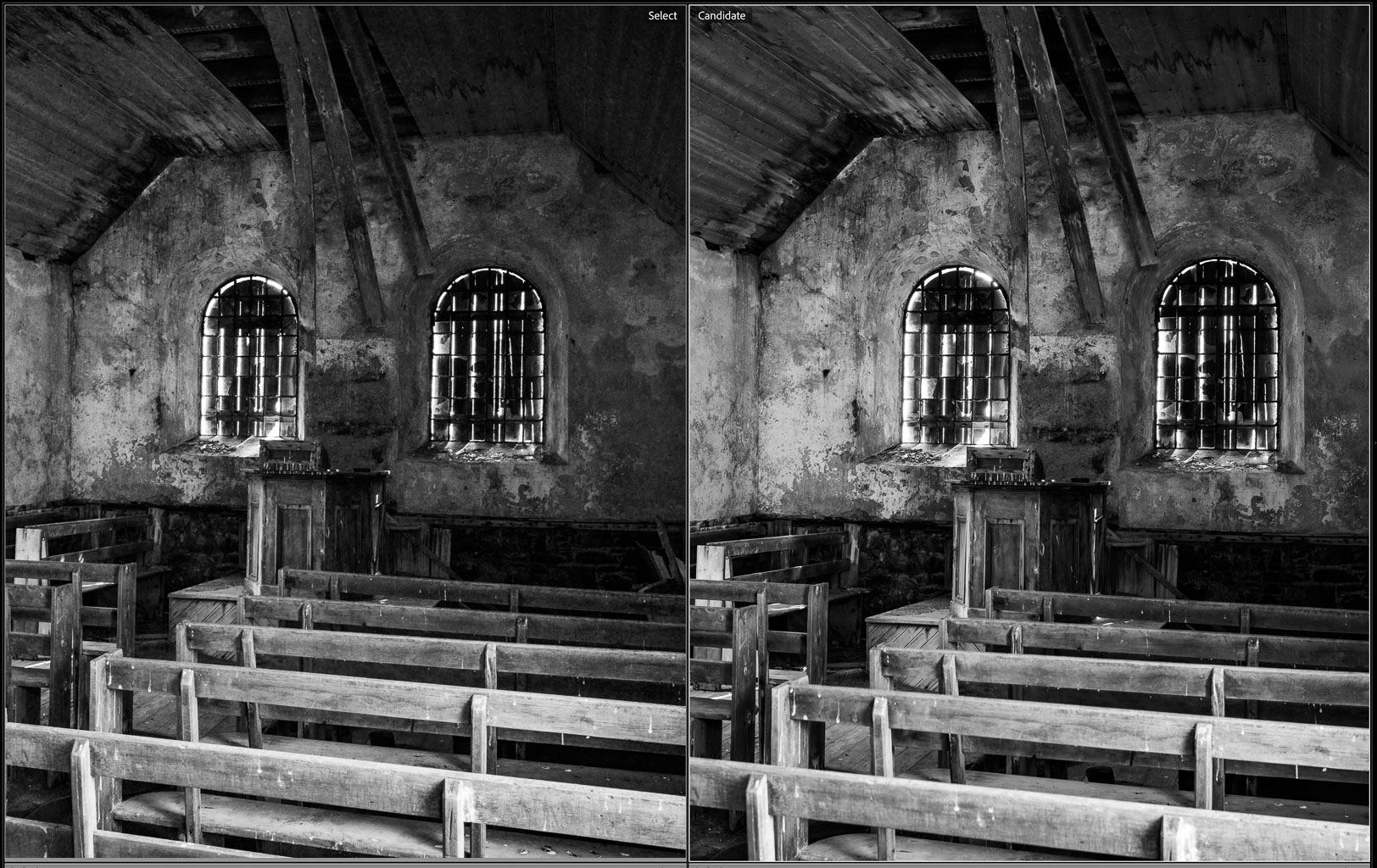
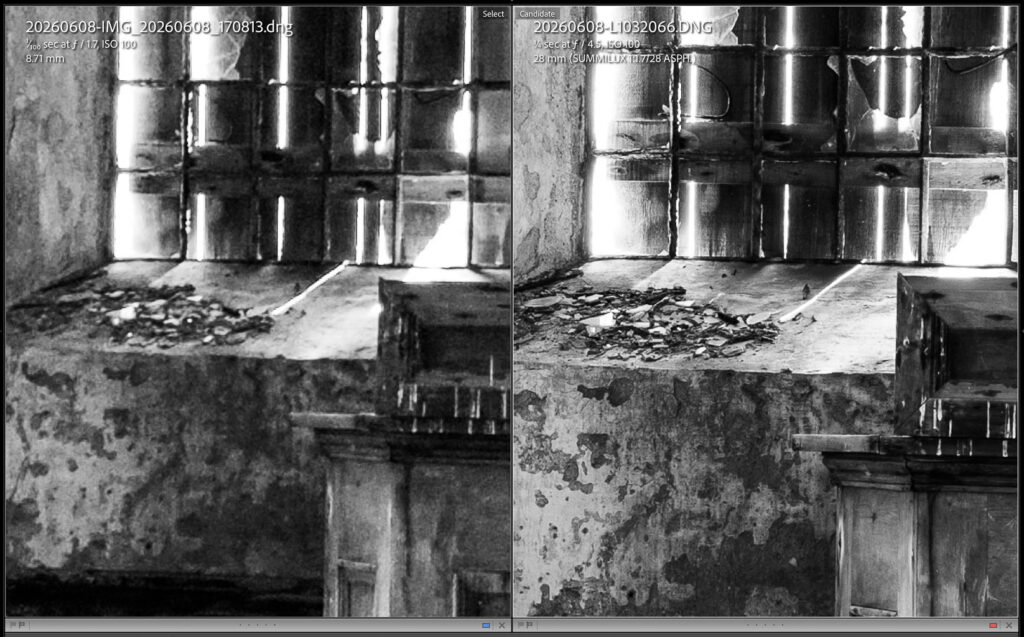
A very tricky scene for any camera. Dark, high contrast, loads of detail. Both cameras were mounted on a tripod. And wow, the Leitzphone really nailed this one. That’s impressive. It has captured the wonderful textures on the walls, and every bit of detail in the roof and pews.
Ideally, I’d have used a much smaller aperture to get the “sun stars” at the small holes in the windows, but you can’t adjust the physical aperture of the Leitzphone annoyingly. This is an important thing to understand about the Leitzphone. Creative effects with aperture are not possible except with computerised effects. And the computed aperture simulation in Portrait mode doesn’t really do small aperture simulation very well.
However, once converted to black and white in Lightroom, you’d be hard-pressed to figure out which camera took which image unless you zoomed right in (see side-by-side lower down). At normal viewing, the Leitzphone hits it out of the park. At high zoom levels, you can see where your £5,650 goes, as the sharpness and detail from the Q3 is definitively superior to the Leitzphone. But you’d expect that. I would have been happy to use this Leitzphone shot in my book “Glas”.


Scene 2: A woolly fence
Could the Leitzphone give me a similar (simulated) depth of field effect as the real optics of my Q3? Time to find out with a wire fence that the local sheep like to rub themselves on.
I have again converted these to black and white, as that’s what I would do with this image anyway. For me, and for this review, the key thing is whether I can get an image from the phone, in the look I want, once processing is complete. I ran these through a Lightroom preset I frequently use for mono shots, and equalled out the exposures which were slightly different between the two cameras.
When controls change their mode of operation
The difference with the previous Chapel shot is that here I used the Portrait mode Leica lens simulation on the Leitzphone to set it to as close to my Q3’s 28 Summilux as possible, so zoom to 1.2x (aaagghhh just tell me the focal length in mm, so I don’t have to google the equivalent every time please), and the lens set to a Summilux at f/1.6 (it wouldn’t allow me to set it to f/1.7 regardless of what the EXIF says).
The result from the Leitzphone is a 4096×2732 (12mp ish) JPEG that you can adjust the focus blur after the shot if you like. The Q3 shot is a RAW 60mp image. Both images are resized in Lightroom to 4000px long edge for my own website storage constraints.


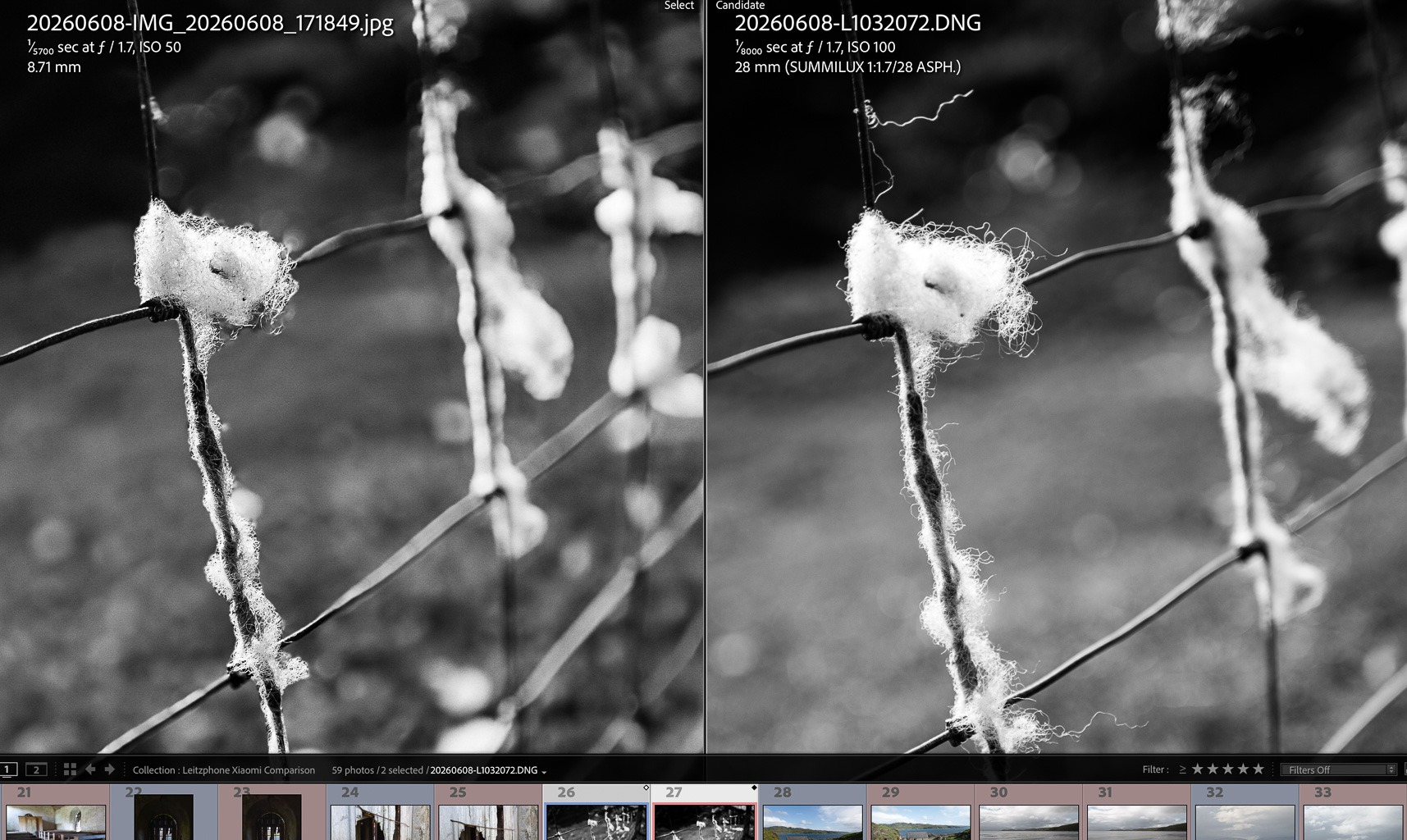
The side by side comparison above shows some of the flaws in the Leitzphone, such as the way the bokeh algorithm has missed the thread above the main clump of fleece.
However, it is remarkable, isn’t it? The lens characteristics have more of a “bubble bokeh” which is probably OK if we are thinking of an older Summilux (the phone doesn’t give you the option to pick versions or age of the lens when you select it). If you didn’t have the Q3 image to look at, and weren’t focused on the minutiae of tiny bokeh irregularities, you’d be very happy with the Leitzphone’s output. Sure, 12mp is a lot less than 60mp, but I doubt you’d have any problems printing this at A3 size.
Scene 3: Landscape

Time for a bit of colour. Here is a view of the outside of the ruined chapel, and what a lovely location it is. While not the most incredible composition you’ll ever see, it is useful to bring out the differences between the two cameras. The Leitzphone is in Pro mode at 1x zoom with the Leica VIBR “style” and the Leica STD “look”/preset to give me this 50mp RAW (actually a DNG) image.

I’m not sure how the Leitzphone can be in RAW mode and still have an image style/look preset applied to the resulting file. Also, how can I have a style AND a look at the same time? I really am baffled by this. Anyhow, the phone gives you a JPEG and a RAW, but both have the look/preset applied. I can’t get the colour back from a RAW file if I used a black and white look. Eh? Kind of defeats the purpose of RAW files. The Q3 is set to f/4.5 to mimic the equivalent depth of field of the Leitzphone.
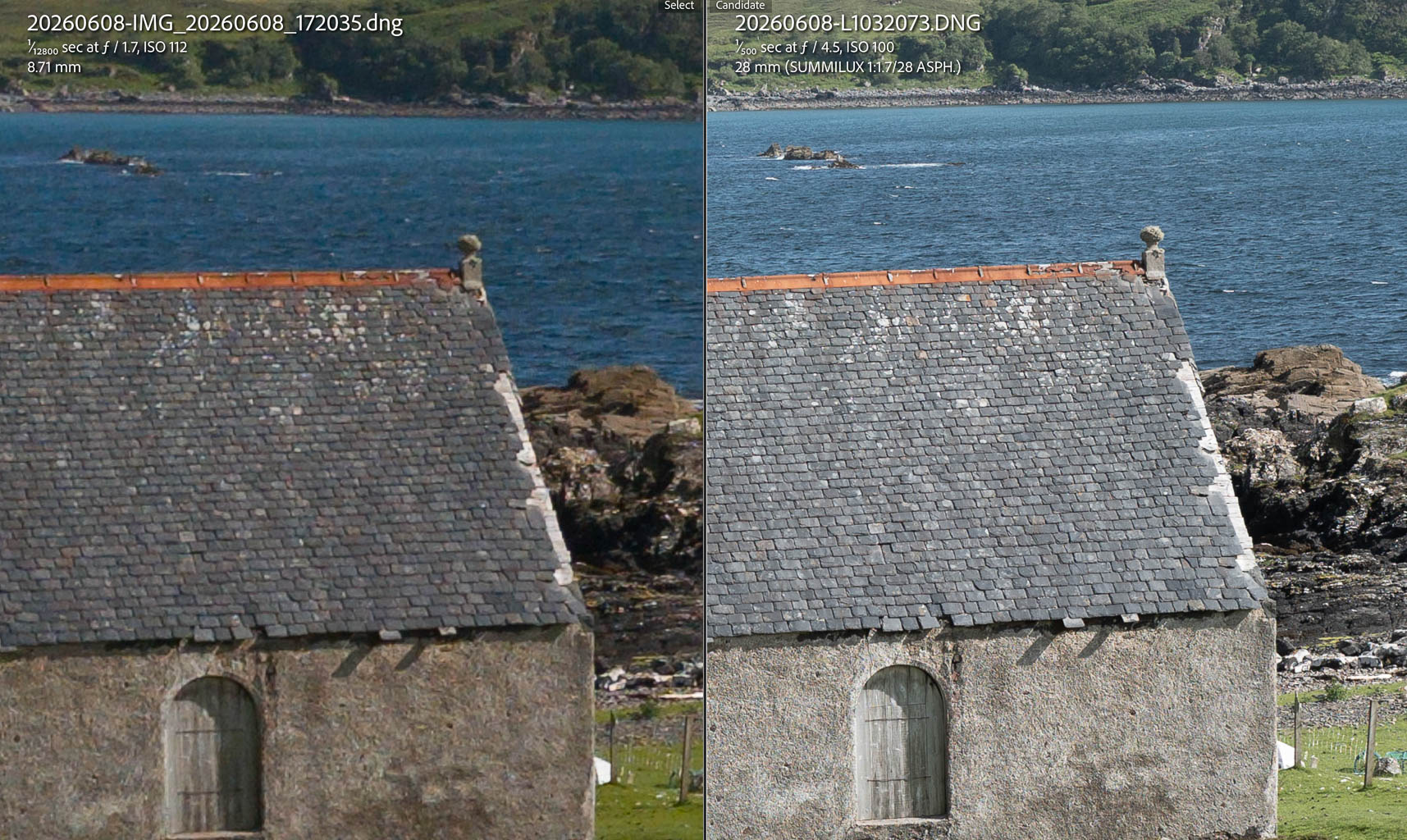
The Leitzphone shot is more contrasty and saturated than the Q3 image. Both are unprocessed. I suspect the unavoidable Leica style/look/preset that is applied to the RAW file is to blame. The Q3 image is a bit more exposed than the Leitzphone though both were on auto-shutter speed. The Q3 image is a better representation of reality.
When the quality of the Q3 still rules
As we saw on the interior shot of the chapel, the Q3 aces it from a sharpness perspective. The Leitzphone can’t compete at critical image sharpness, which is probably a good thing for the sale of Q3s!
As a side note, it was incredibly annoying to have to check the Leitzphone was in RAW mode for every shot. It seems that changing a setting like zoom or changing mode sets the camera back to JPEG, and when you find your way back to Pro and 1x zoom, it stays in JPEG so you need to manually change to RAW again. The user presets don’t remember the RAW setting either, which is insane.
Leica lens simulations
We have established that the Leitzphone Xiaomi 17 Ultra is pretty impressive in Pro mode, though not as good as the Q3 from an outright image quality perspective. We also know that the user experience is terribly confusing.
So let’s have a closer look at the lens simulations, as this is one of the most interesting capabilities of this flagship device.
To access the lens simulations, you need to go into “Portrait” mode, and click a tiny red “f/2.8” icon at the bottom left of the screen. This opens up the lens selection menu (which of course does not rotate with the screen).
Once you are there, you can select between five lens types, Summicron, Summilux, Noctilux, Thambar and something called “Anamorphic”. There are no focal lengths listed for these lenses — you can just freely zoom using the poorly designed magnification feature. Wouldn’t it be great for those who may move into real Leica M ownership to be able to choose and experience realistic lenses — for example, a 35 Summicron or a 28 Summilux?
Let me pick the actual lens and focal length based on real-world products. Perhaps a toggle for “Realistic” or “Flexible” would work? Or just make it like the “Leica Lux” iPhone app that lets you select specific lenses and focal lengths like a normal person.
Anyhow, I have conducted a number of experiments next to a glittering blue sea with some lobster pots, which always make nice subjects. The sparkling waves provide an excellent way to investigate bokeh characteristics. The netting makes for a very complex challenge for the depth calculation algorithm.
Leica lenses at “real” widest apertures
To start off, let’s look at these lens simulations with a realistic widest aperture for each lens type. I haven’t used the anamorphic lens here in this test as I’ve no idea what this is, but there is an example later. All were shot in the native 23mm equivalent focal length of the main camera, and they are all 12mp JPEGs (no RAW here in Portrait mode).
As you can see (click for larger), a lot of effort has been put into creating simulations that are noticeably different from each other. The Summicron is quite contrasty with smoothly round bokehballs. The Summilux is gentler and less contrasty, and the bokehballs change from round in the centre to cats-eye towards the edges, which is interesting. There’s a slight edge to the bokehballs. I feel this is an older Summilux as the newer ones are rather more contrasty.
How do bokehballs differ?
The Noctilux looks different again, with more pronounced edges to the balls, and a more pronounced cats-eye effect. The bokehballs are larger, as you’d expect with a native widest aperture of f/0.95.
The Thambar is a wholly different pot of lobsters, with very pronounced ring bokeh throughout, which is very characterful and could be useful to make images stand out from the crowd.
I should note that the accuracy of the cutouts at the edges of the in-focus to out-of-focus areas, such as the edges of the rope next to the distant water surface, is extremely good. Better than anything I’ve seen from Samsung or Apple. There are the odd mistakes here and there, especially in some of the netting nearer to the camera, but in general use nobody will notice. Quite extraordinary, and it’s only going to get better!




Row Two: Left Noctilux at f/0.95. Right Thambar at f/2.2 All © Andrew Tobin
Bokehgasmic! Noctiluxes everywhere
One of the weird features (bugs?) of the Leitzphone is that you can set any of the lenses at any focal length/zoom level, to be an f/0.95 aperture! This is surely the best way ever devised to save money on Leica gear. A 50mm Noctilux-M costs £10,580 at the time of writing.
Now you can have one as a little feature in your phone. Or a 28 Noctilux. Or a 90 Noctilux. Anything you like. So I decided to use f/0.95 for everything. And I included the Q3 and the Leitzphone’s Anamorphic lens as well, just for comparison purposes. Nice.







Row Two: LeftLeitzphone Summicron f/0.95. Right Leitzphone Summilux f/0.95.
Row Three: LeftLeitzphone Noctilux f/0.95. Right Leitzphone Thambar f/0.95.
Row Four: Leitzphone “Anamorphic” f/0.95 All © Andrew Tobin
Testing “front bokeh”
Can the computational photography algorithms handle blur ahead of the focal point as well as behind it? I took up a different viewpoint to look along the length of the stack of lobster pots to make sure there was plenty of foreground, and set focus to be on the pot on top of the stack by tapping the screen.
I am quite impressed by how the phone handled this. It has indeed figured out that the foreground needs to be blurred as well as the background, and has done a good job with it. The blurring reduces as you move through the shot to the focal point.
Notably, the foreground bokeh also reflects the characteristics set for the lens, and you can see differences in the “busy-ness”, texture and contrast of these areas. The bokeh-donuts of the Thambar are really pronounced here.
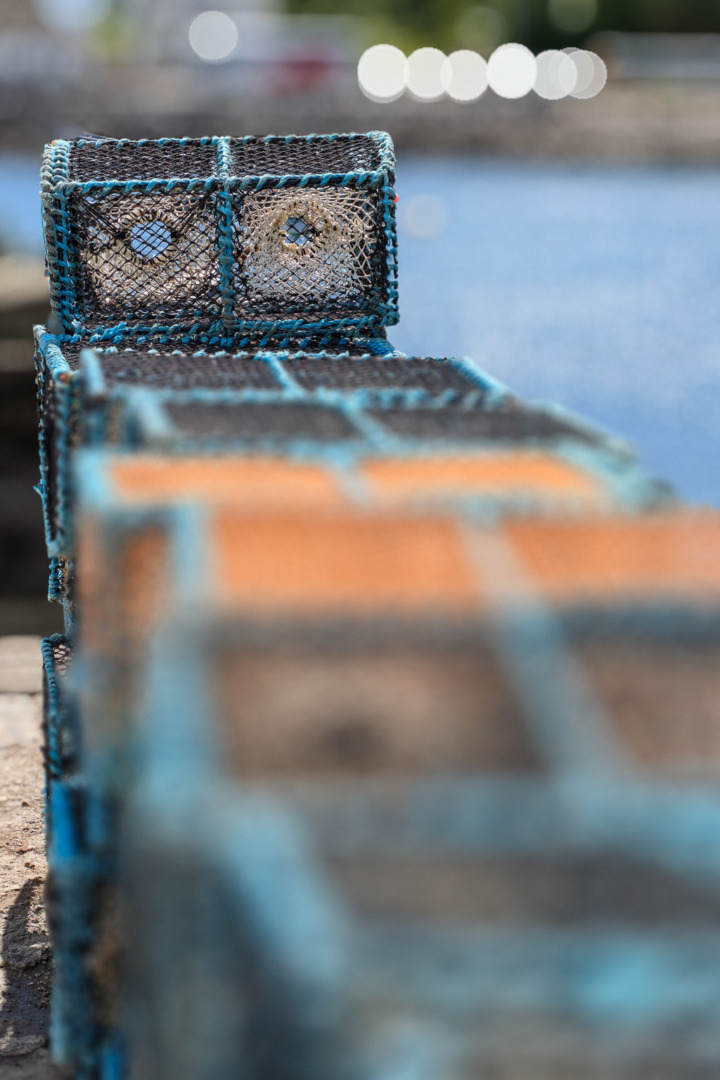
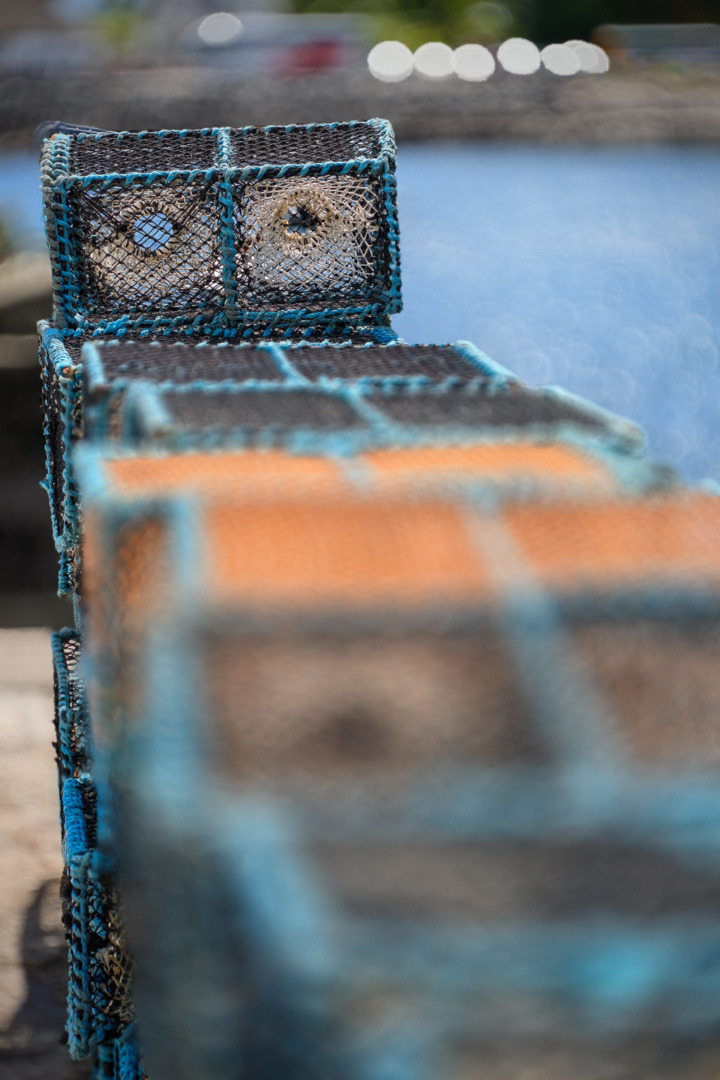
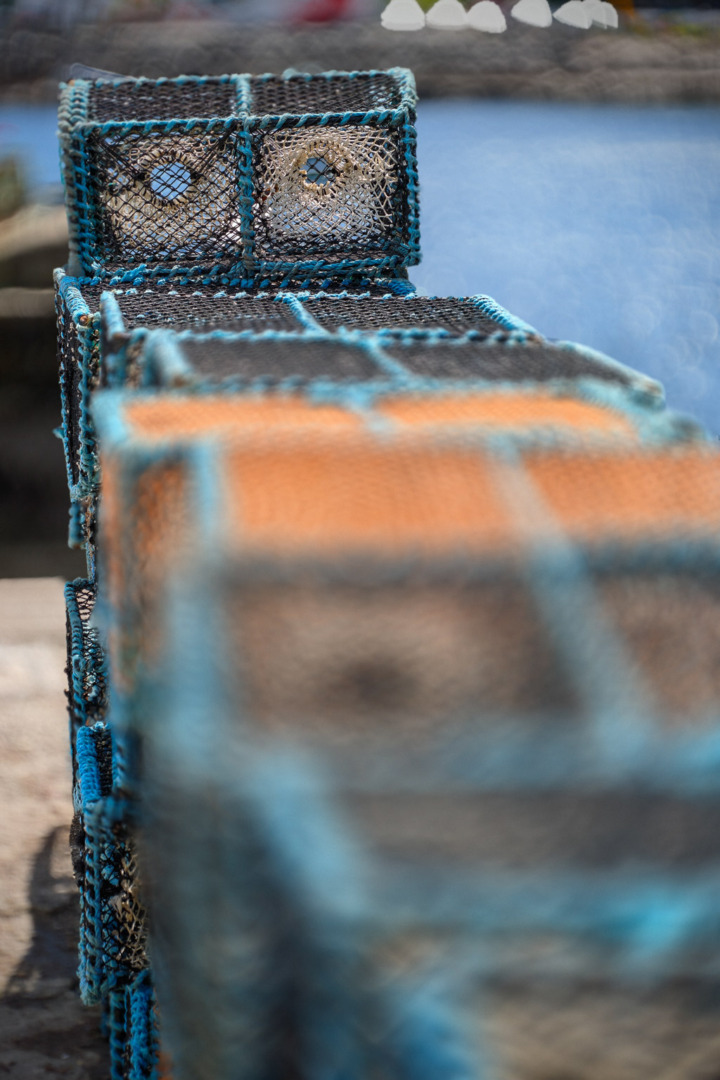
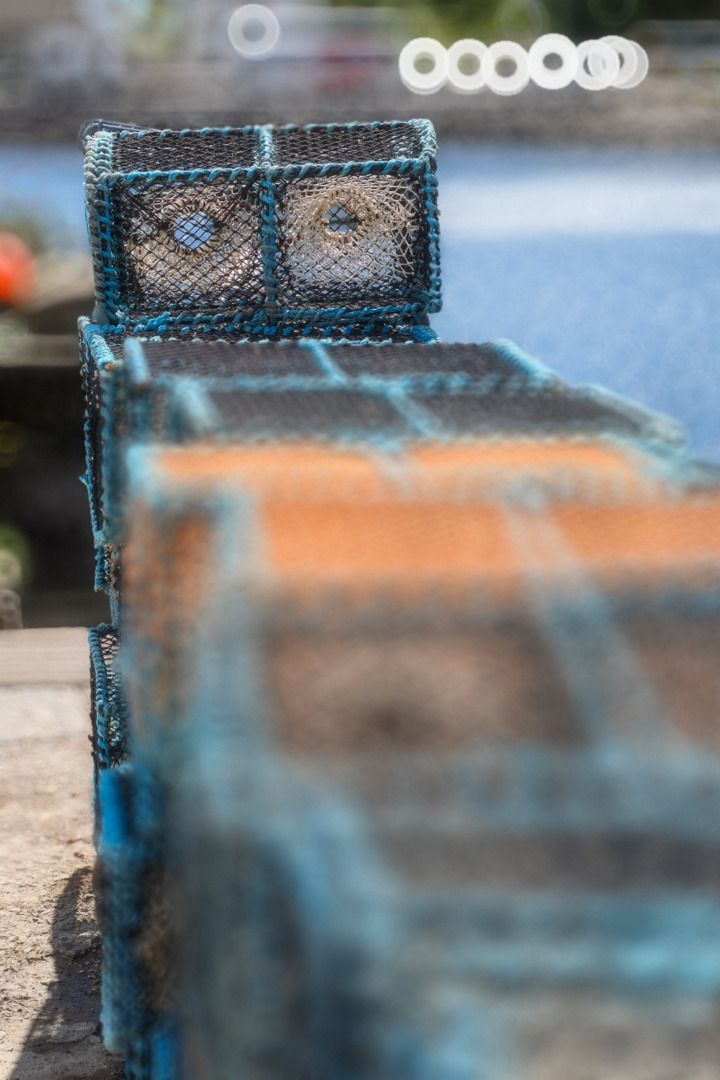
Row Two: Left Noctilux at f/0.95. Right Thambar at f/0.95 All © Andrew Tobin
All fascinating. How does it do this? Magic is the only explanation. Aside from the usability frustrations, I can see someone being delighted with these lens simulations.
I did test closing the virtual aperture down to f/16 in as I took a photo as well as afterwards, to see if I’d get an image sharp from front-to-back with “sun stars” at the highlights, but the results just looked like a normal un-adulterated shot. Same for the earlier images inside the chapel. So if you are looking for the ability to creatively use small apertures to make sun stars, you’re out of luck.
Leica Lux and brand integration
Are they any better than just getting a Leica Lux app? Well, you can’t get the Leica Lux app for Android phones. Why am I not surprised? Seeing as all Leica-branded phones are Android, I don’t see Leica cannibalising their profit share of their phone market by making their Leica Lux app available on Android (even at the same “Pro” price of £70/year). There would be no real reason to buy this phone if they did. I’d just install the Leica Lux app on my Samsung S25 Ultra instead.
I don’t have an iPhone Pro to hand, but such a comparison would be a bit irrelevant as it would involve an entire ecosystem switch for any Apple user, which, as we know, Apple makes notoriously hard to do. They do love sucking people in and not letting them out. If you are considering a switch from Apple to the Leitzphone, maybe try the Leica Lux app first and compare the results to what you see and read here.
However, here’s the Samsung S25 Ultra in portrait mode with maximum blur, versus the Leitzphone in portrait mode set as a Summilux at f/1.4. You can see that the Leitzphone did a way better job here.



Verdict on image quality
I’m really very impressed. RAW images with the main camera are great, though unsurprisingly not as sharp as the Q3. Ignoring the glaring user interface debacles, the lens simulations are incredibly interesting. They are really rather good, aren’t they. Not perfect, but for general use and social media stuff, they are impressive. And this is the worst they will ever be. This computational photography tech is only going to get better and better.
The obvious differences between virtual lenses was great to see. It makes the whole phone camera experience so much more enjoyable (aside from the mess of the camera app). While things like bokeh cutouts aren’t perfect yet, they are leagues above what was available just twelve months ago. The whole thing is quite astonishing. With such a solid set of camera and lens tech, software improvements are bound to make things a lot better.
I don’t think it will be long before smartphone computational image quality is mostly indistinguishable from the “real thing”.
I’d say bravo to Xiaomi for its computational photography tech and for packing so much capability into a phone. Personally, I’d be delighted with a whole host of images I shot for this review. Yes, I can see flaws, but wow, it’s really impressive stuff these days.
I don’t think it will be long before smartphone computational image quality is mostly indistinguishable from the “real thing”. It will never replace the physical feel of a gorgeous M with a luscious lens on, nor the experience of focusing and looking through an actual viewfinder. But….it’s coming.
Conclusions
My original question going into this review was: Has smartphone tech and “computational photography” risen to such a level that it can replace “proper camera” hardware, glass, and sensors? Could I ditch my Leica Q3 and just use a phone? Not quite, but it’s not far off. We are getting a good look at what is coming down the line in the next three years.
Is my Q3 for sale? No. Definitively not. Neither is my current phone, the Samsung S25 Ultra. I had thought of trading it for the Leitzphone before getting a hands-on, but now I’m glad I didn’t. The user interface and usability issues of the Leitzphone’s camera app make switching inconceivable for me.
I despise lazy design and lacklustre implementation in any product. In one that costs £1,699 plus another £179 for the grip, in a flagship top-of-the-range luxury phone, it is unforgivable.
When UI takes a back seat
I can almost see the UI designer weeping as the product manager said, “look, just put the lens selector in that corner, but don’t call it a lens selector, and don’t bother with rotating those icons and text as we have to launch in a week”.
I see it as a massive opportunity that has been missed. I’m sure that a bunch of these will be sold, but I foresee them languishing in a bedside drawer or at secondhand store CEX in twelve months for a fraction of their original price.
This is a real shame as the hardware and technology in the phone is incredible. The Leica version feels great with its ridged metal surround. It looks spectacular. The Pro grip and case are significant additions. The physical camera and lens setup is really brilliant.
Computational photography is getting really good now. Better than my flagship Samsung, for sure. The ability to replicate the character and characteristics of Leica lenses is quite extraordinary, even given the issues I have mentioned.
However, when I just had my “daily” S25 Ultra with me, I found myself missing the Leica lens simulations. The S25U cameras feel a bit boring by comparison. Maybe the Leitzphone is growing on me, warts and all.
Alternatives
It is always good to consider alternatives to a £1,878 bill (Leitzphone+Grip). You could get a new Leica DLux8 with £400+ cash to spare. A lovely Fujifilm X100VI could be yours with £278 spare for an air ticket somewhere nice.
A used Ricoh GR3 and GR3x would be in your hands with a smidgen of money left. An iPhone Pro Max 17 1TB is £1,599 which leaves a bit of cash for a Leica Lux app subscription. A used Leica TL2 is a mere £678 — add a lens of your choice. You can’t make a call or doomscroll TikTok with any of these, though.
The Leitzphone obviously won’t have the staying power of the Q3. Phone iterations and product life cycles are so short these days compared to Leica cameras that the Leitzphone will soon be obsoleted by the next version. But I think you already knew that.
Summing up
Being positive, most of the issues are software related and could be fixed with a new version of the camera app. Go on Leica: make something like the “Leica Lux” app for the Leitzphone. Or improve the “Fastshot” mode to have camera and lens simulations. Give me a virtual “camera bag” of virtual Leica bodies and lenses.
Leica could make it Android-exclusive to the Leitzphone. It would be way better than the iPhone version due to the better camera setup from Xiaomi. Combined with the lovely materials and design of the Leitzphone version over the base Xiaomi 17 Ultra, I’d pay the big ticket price AND the £200 premium if it meant not having to pay £70/year for the Leica Lux subscription on an iPhone. In three years I’d be ahead on the deal, and with an epic phone as well. Or just make “Fastshot” mode better.
End of term report
I am disappointed, as you can tell. Because I love Leica, I really wanted this phone to be outstanding. Sigh. Sorry Leica, I’ll send it back to you now. Please try harder.
To finish, here are the Pros and Cons for you.
| Pros | Cons |
| Image quality excellent on main camera. DNGs very good indeed. Decent latitude for editing. | Extremely poorly thought out software user interface. I expected much more. Looks rushed. Hard to use. Confusing. Could be so much better. |
| Pro grip makes a huge difference to hardware usability and feels good. | Maybe OK for marketing Leica to non-Leica users, but won’t fool a Leicaphile. |
| Variable bokeh is interesting with lots of potential, but needs better implementation. | Lack of variable aperture in Pro mode restrictive in some situations, removing an important area of photographer control. |
| Bokeh simulation images do have a certain something to them and look cool at a distance (or on the internet). | Hardware (rattly and poor lens ring and no dedicated shutter button on the handset itself) is disappointing for something bearing the Leica red dot. |
| You get a 23mm f/0.95 Summicron and a 100mm f/0.95 Thambar! And everything in-between! f/0.95 for everyone and everything! | Somewhat overprocessed JPEGs but OK for casual use. |
| Ridged metal frame — very nice. | JPEG images lack the subtlety of a “proper” camera, in terms of being over-sharpened, odd focus falloff, over saturated, but obviously depends on which preset you select. |
| Camera setup is first-rate. | Pricey. |
| Build quality really good except the lens ring. | |
Last words
“Hey Leica, how about putting the amazing Leica TL interface onto this thing?” Recommendation to Leicaphiles: Wait for the either a software update with a sensible camera app, or wait for the next flagship version.
And a word on prices: UK £1,700 including taxes | EU €1,999 including taxes | USA $2,300 without taxes. Not officially imported into USA.
Make a donation to help with our running costs
Did you know that Macfilos is run by five photography enthusiasts based in the UK, USA and Europe? We cover all the substantial costs of running the site, and we do not carry advertising because it spoils readers’ enjoyment. Any amount, however small, will be appreciated, and we will write to acknowledge your generosity.
Comments: Please add a comment to this article. Our comments section is a thriving community and everyone is treated with respect. In addition, please identify yourself (and add an email address, which will not be published, if you would like to see answers to your posting). Our system will automatically delete any “anonymous” posts on the basis that they are likely to be spam.
Many thanks for this interesting and entertaining article!
However, I didn’t actually need to read it to answer the question posed in the headline (I understand the intent, though I personally see the Leitz Phone as closer to the D-Lux than the Q): I wouldn’t trade any of my three Q3s for a mobile phone, and I don’t need a detailed comparison of the image results to know that.
The electronic viewfinder is superior to a phone display in challenging lighting conditions, and the “camera feel” is unbeatable anyway.
For me, it’s not a question of “either/or”; each piece of hardware has its own place.
Andy, don’t forget my offer to let you use my iPhone and Leica grip for an hour or two next time you’re in this part if the world. It would make an interesting comparison.
Ah yes thanks Paul. Later in the year. Hopefully I will get to GPS.
Well written Andrew. Some general points. I’ve just come off chairing an LSI Zoom on post-processing monochrome images where we were shown very simple 2 or 3 step processes for producing great images from RAWs. Any LSI member who missed it, missed a treat, but it will be on our website soon. Not being critical, Andrew, but an unprocessed RAW from the Q is irrelevant for comparison with the phone. The only reason for shooting RAW is to enable post processing, so this is only a beginning and not a final product. These days you would need to have a very mangled RAW before you could not get a decent image out of it. The phone DNGs above look to be already processed to my eye. Most pros and amateurs do not use RAWS for final images and are happy with JPEG conversion or TIFFs for some professional work.
Some people have expensive cameras and only use them to take JPEGs, which is their prerogative. You can, of course, apply looks or presets or filters to RAWs while they are being processed, so ‘chacun a son gout’ applies.
Almost everyone has a smartphone these days for various reasons and using them to take photos is not wrong per se. The old adage about the best camera being the one you have with you will always be true. I would often have with me a smartphone, a Leica I Model A from the 1920s and a Leica Q3 43 and I would use all 3 of them to capture images in the course of the same afternoon. As for whether the haptics are better on so-called ‘real cameras’, that is a moot point as the market has moved with its feet. I’m not particularly good at handling smartphones, but when I watch the youth of today I am in awe of their dexterity in using such devices. Maybe we are not the ‘target market’ for the Leitzphone.
As for whether the Leitz phone is any good, I would leave the judgment on that to you. I see nothing here that tells me that I need one to replace my iPhone which performs a range of functions, many just as important as taking photos.
William
Thanks for your comments William. I think a lot of people will be sticking with their current phone rather than changing to the Leitzphone while the camera user interface remains so poor.
I’m confused about your statement that “an unprocessed RAW from the Q is irrelevant for comparison with the phone”.
The review contains several processed RAW images from the Q3 and the phone. I make the point that I edited images from both phone and Q3 as I would for normally – “I imported the images into Lightroom and processed them in the way I would usually do”. For example, the abandoned chapel shot – “once converted to black and white in Lightroom…” and the wooly fence – “converted these to black and white…”.
I do make the point very strongly that the phone seems to process the RAW images “the phone gives you a JPEG and a RAW but both have the look/preset applied”. The computational photography (bokeh simulation) comparison shots are to show the effects of the phone’s computing power rather than any of my own editing prowess, and in any event the phone’s bokeh shots are all JPEG anyway.
Anyhow, like you I’m not replacing my phone either.
William
I have recently started using DxO9 and I have gone back to basics to try and understand how the software processes RAW data in its journey to producing a final image which is to our liking. However, what helped me in my understanding of RAW processing were the explanations I found:
“When you view a RAW file on your monitor, you are usually looking at a JPEG preview embedded inside the RAW file, rather than the RAW data itself. True RAW files are ‘digital negatives’ that the human eye cannot interpret without conversion.”
“A DNG (Digital Negative) file is a universal, lossless RAW image format developed by Adobe. It captures uncompressed, high-quality data directly from a camera’s sensor. Being an open-source standard, DNG files can be opened and edited by nearly all image editing software.”
Sony and others have propriety RAW files and do not produce DNG files. Leica and others can produce DNG RAW.
So is my interpretation correct in that when we view a RAW file on our monitor, it is actually a JPEG representation?
Chris
The RAW file (or DNG if your camera produces them) should be a direct readout of the pixels on the sensor. This doesn’t seem to be the case with the Leitzphone which applies styles to the DNGs it produces which, in my view, it should not.
If you have shot JPEG and RAW, your processing software may apply the “style” used for the JPEG onto the RAW file, so while you are viewing the RAW it may have that style or preset applied but you should be able to reverse that and just see the “raw” RAW file.
If you just import the RAW (or DNG), it may have the style used in-camera embedded in it which the image processing may then replicate, so again you are seeing the RAW with the style applied by the software.
It is possible to set up your computer processing software to not apply any camera-selected styles, in which case you should see the “raw” RAW file which will look rather dull.
Usually, a RAW image will come with an embedded “sidecar” preview jpeg (what you see on your camera screen), but software like Lightroom will usually display the RAW file. The preview will be used when you use “thumbnails” in Finder on a Mac or File Explorer on a PC.
Lightroom in particular has roughly one million parameters for this sort of thing on image import that it is worth taking a look through, including automatically applying presets to RAW files on import for example, or converting RAW files to DNGs on import.
Andrew
Thank you for your helpful comments. My learning on DxO9 continues. My Sony cameras produce proprietary ARW files and my initial conversions from RAW were with Sony’s “Imaging Edge Desktop”. DxO9 should open a whole new world to me with the much promoted noise reduction and AI masking.
Chris
The idea of replacing something like the Leica Q3 with a device like the LeitzPhone feels almost unthinkable at first, but your reflections make it a genuinely interesting debate.
Yes indeed, I was very surprised by the capabilities, which will only get better.
I admire your patience in reviewing the Leitzphone, even as one disappointment after another cropped up. How is it possible that this device is now coming onto the market – when it has been available in Japan for some time?
Writing such a detailed review must have been a real slog; I would have chucked the thing into a corner ages ago.
I did it so you don’t have to 🙂
Taking one for the Macfilos collective.
You deserve a medal, really!
Andrew, a really interesting, detailed – and for me timely – review. I read a review in LFI recently and was considering a Leitzphone to go alongside my Leicas and to replace my Samsung, which comes up for renewal in a couple of months.
Then I discovered that my network supplier couldn’t/wouldn’t supply it and wasn’t sure that they would be able to/want to (I couldn’t make out which in either case) support it even if I bought it through a third party and put one of their eSIMs in.
Your review put an end to all that. As someone who has been involved one way and another with UI design over the years, it just sounds very sloppy and nowhere near what I would want out of a top-end Leica-backed phone. Things like rings that rattle, displays that don’t give consistent info and file formats that change without warning etc is just not on. I am one of those who finds Digital M and Q interfaces un-necessarily complex, but this seems to take things to another level.
The seeming need to spend more money on the grip to make it behave a bit more like a camera seems crazy to me.
All that being said the photos that you show are intriguing. The idea of a Nocti equivalent, or Thambar ditto, on a phone really is intriguing.
A recent chat with someone at Leica seemed to me to indicate a lack of clarity in their vision of how they view the usage models (as opposed to the UIs) of phone cameras (eg the Leitzphone and its successors) and mainstream cameras (Qs, Ms, SLs) with regard to the convergence and integration of the technologies going forward. For one thing the Leica ethos has always been about a certain “purity” and straightforward excellence in design. The rapid evolution of phone technology somewhat militates against that, in turn suggesting that in future a specific and different vision for phones maybe required. As a “first step” I admire the Leitzphone, but it has too many issues for me at present.
Three conclusions then:
(i) Leica please make sure that network suppliers will supply it. And by extension that networks and their partners when the user is travelling – will support it.
(ii) Good try Leica, but please fix the issues that are identified in the article.
(iii) And finally, but very importantly clarify your vision of how camera technologies and phone technologies will evolve in the future.
If these were sorted I expect that this would be an expensive “no-brainer” for a Leicaphile. But not for me, not this time round.
Peter
Excellent points Peter, well made. I think it is a matter of “not yet” for me as well. Glad I could save you £1900 or so (for now).
So near, yet so far!
An interesting read Mr. Tobin, I agree, I am not sure that computational photography is still photography, rather it is like being a passive bystander.
Which is not to dismiss the digital camera completely, a straight digital camera, like a Q2/Q3 etc., still gets out of the way to let the snapper express him/herself.
Surely the point is that one develops the skills required to see a picture and then record it to film. A digital sensor that tries to gainsay your intention and yield what it thinks you want and gives you an image that comes straight from the computer programmer’s head, rather than from your own head.
As you say, the Leitz phone makes credible images, but they are not yours. You might as well go onto the internet and download an image of a place that you have just been to and put it into your own library as a trophy.
Looking is not the same as seeing.
I think there is the potential for quite a close connection with a computational photography phone type device. I do agree it will never replicate the physical binding you get with a beautiful M for example. It will be an interesting space to watch.
Thanks Andrew:
I think that I have just made myself a victim of an element of my previous comment to your excellent article and subsequent replies to commenters.
Yes, I went and bought a Xiaomi Leitzphone, I have had it for one day and I am already suspicious that it will end up languishing somewhere once the shine has worn off and I return to my ancient, and very handy iPhone 13 mini.
For me, one of the most irritating parts is that I have always used iPhone, and I am well used to IOS. I have used Apple Mac, both desktop and laptop for many years and I am used to macOS.
As an aside, I spent most of my working years working with (what became) ES, AS and PS IBM kit. Namely the IBM370 computer, three of them, which occupied around half an acre of floor space, and shared 3MB (mega bytes) between them, each one had 32kb of memory. I moved on and ended my career using AS400 computers.
These were giants of the banking world, and at the time, apart from the Cray Twins (weather forecasting computers), the biggest in the UK.
I feel that Android is trying to be all things to everyman, which is probably superior in concept, but in practise… Meh!
I wish Apple would release a new iteration of the mini, all the omens are suggesting that the company won’t though.
We shall just have to wait and see.
Sorry Andrew, that was wrong… my memory?
Those three IBM 370 mainframe computers had 1MB of memory each, which was later upgraded by engineers who flew to London from Rochester, Minnesota to hard-wire an extra 512KB of core storage, which made them 1.5MB each.
I lost a toenail manoeuvring the equipment into place, in preparation for those engineers to install it.
New Mac Mini is here, with multiple configurations on offer.
To me, this was an incredible article. The level of professionalism in the review — the short way to say it is that Leica would have been well advised to hire you before releasing the camera/phone.
The article also brought up an interesting point about computational photography/AI. It seems to me that those techniques change how a photo actually looks into how the AI feels the photo should look. A kind of dishonesty, akin to what Soviet propagandists did.
But this feels different: it seems as though the point here is to make an underperforming “Leica” into a better performing Leica. This seems to me to be a very different kind of thing, and in some ways, a more honest one.
A thoughtful article throughout.
Thanks Kathy! I’ll await a call from Leica.
Completely agree.
Yes, well said Kathy. If only Leica had truly applied their UI excellence and simplification to this phone. And, of course, some of the mechanical “feel” of Leica engineering. Really, one of the best new product reviews I can recall. Let’s hope people at Leica are reading. Bravo.
There is only one reason why someone should sell a Leica Q camera: A model of the Q series.
Or keep it and have the 28 and the 43. One Q is never enough.
I could not agree more ! I have all three actual models and enjoy using them all.
“Could I ditch my Leica Q3 and just use a phone?”
Could you? Yes.
Should you? No.
Succinctly put!