

Before I buy a lens I read about it for weeks. That used to mean a dozen browser tabs, a forum thread from 2012, two blog reviews, a dealer listing that never says what the thing weighs, and a spec sheet somewhere with the numbers I actually wanted. By the time I’d found everything, I’d forgotten where half of it was. So I decided to do something about it, and the outcome was my particular labour of love — Leica Lens List.
Leica Lens List started as my own notes on that problem. It’s now a reference site for Leica M and LTM lenses, and it does four things: it catalogues them, it helps you work out which one you want, it tracks what they cost on the used market, and it gives people somewhere to talk about all of it. It isn’t a shop. Every price on it belongs to someone else’s shop, and the links go straight there.
The catalogue
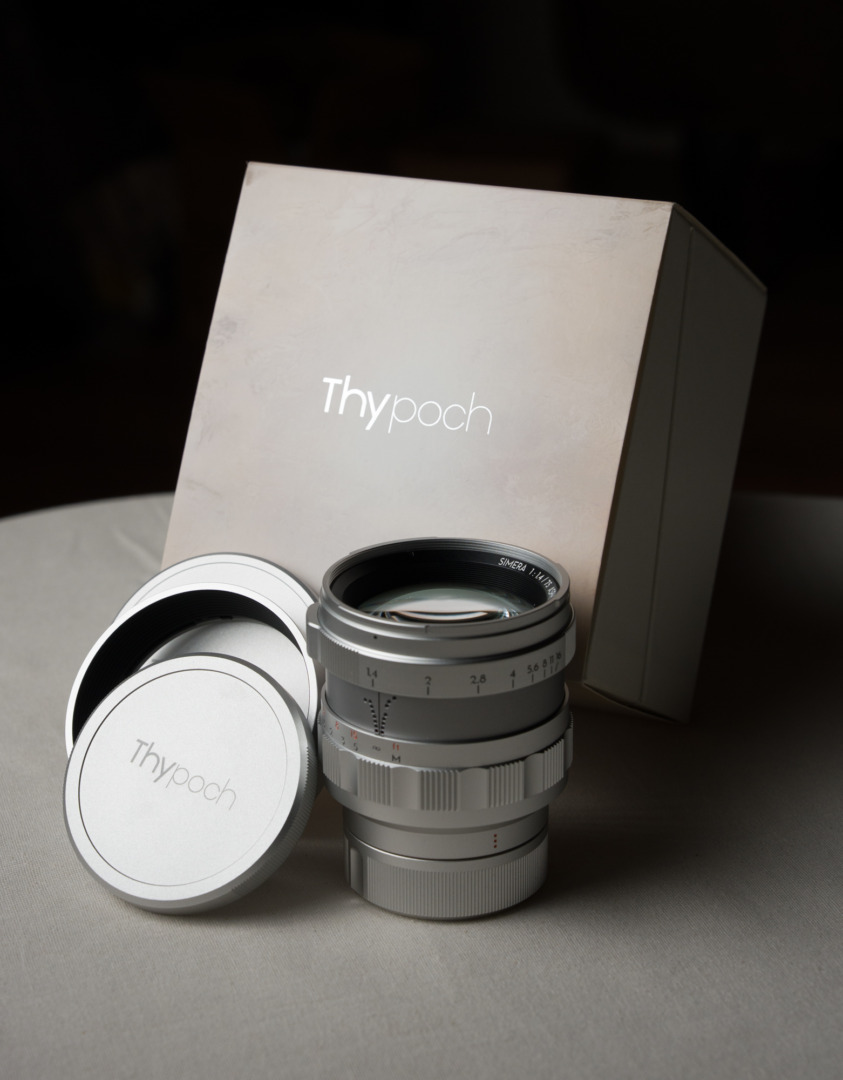
There are more than 500 lenses and over 130 cameras on the site, and I add to it most weeks. Leica is the bulk of it, but Zeiss and Voigtländer are in there, along with the newer makers: Light Lens Lab, Thypoch, Mr Ding, Artra Lab, Funleader, DK Optic. The range runs from the collapsible screw-mount Elmars of the 1930s to lenses announced this month.
Every lens has a page with the full specification. Focal length, maximum aperture, elements and groups, minimum focus, filter thread, diameter, length, weight, release year, and the Leica model numbers where they exist.
I include sample photos where I have them. There’s also a chart showing where that lens sits against every other lens of the same focal length on weight and aperture, which is the comparison I kept wanting and never finding anywhere else. I list related lenses at the bottom, plus any articles I’ve written about it.
Versions took the longest to get right. There are eight different 35mm Summicrons in there, four pre-aspherical versions starting with the 1958 eight-element, three aspherical ones after that, and the APO.
They are not the same lens in any way that matters. They focus differently, they draw differently, and as I write this the dearest of them is going for close to six times the cheapest. A listing that says only “Summicron 35mm” could be any of the eight, and working out which one it is turned out to be most of the work behind the price tracking.
Working out which one you want
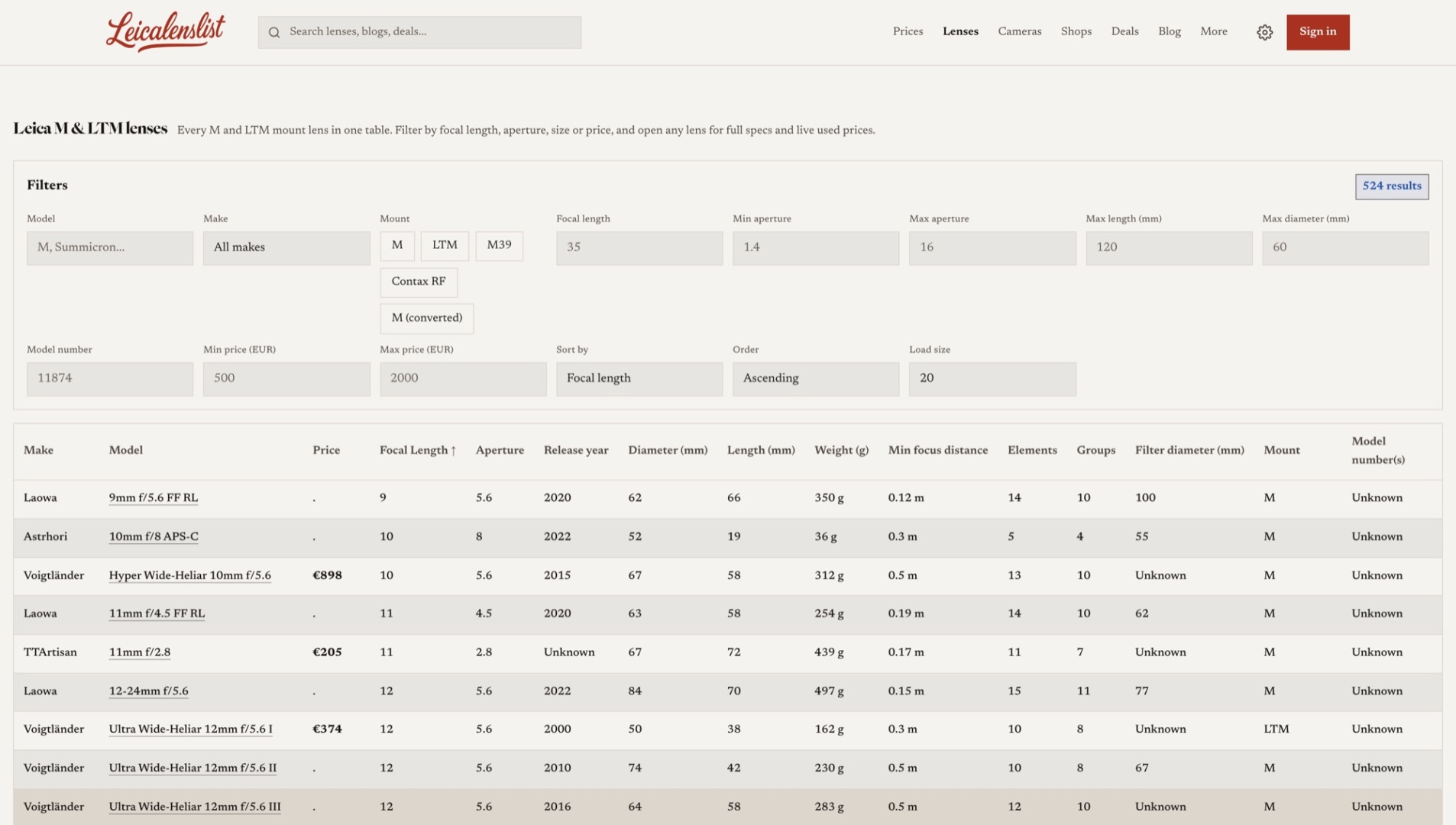
The lens list filters by focal length, aperture, physical size or price. There are also collections for each focal length, from 21mm to 135mm.
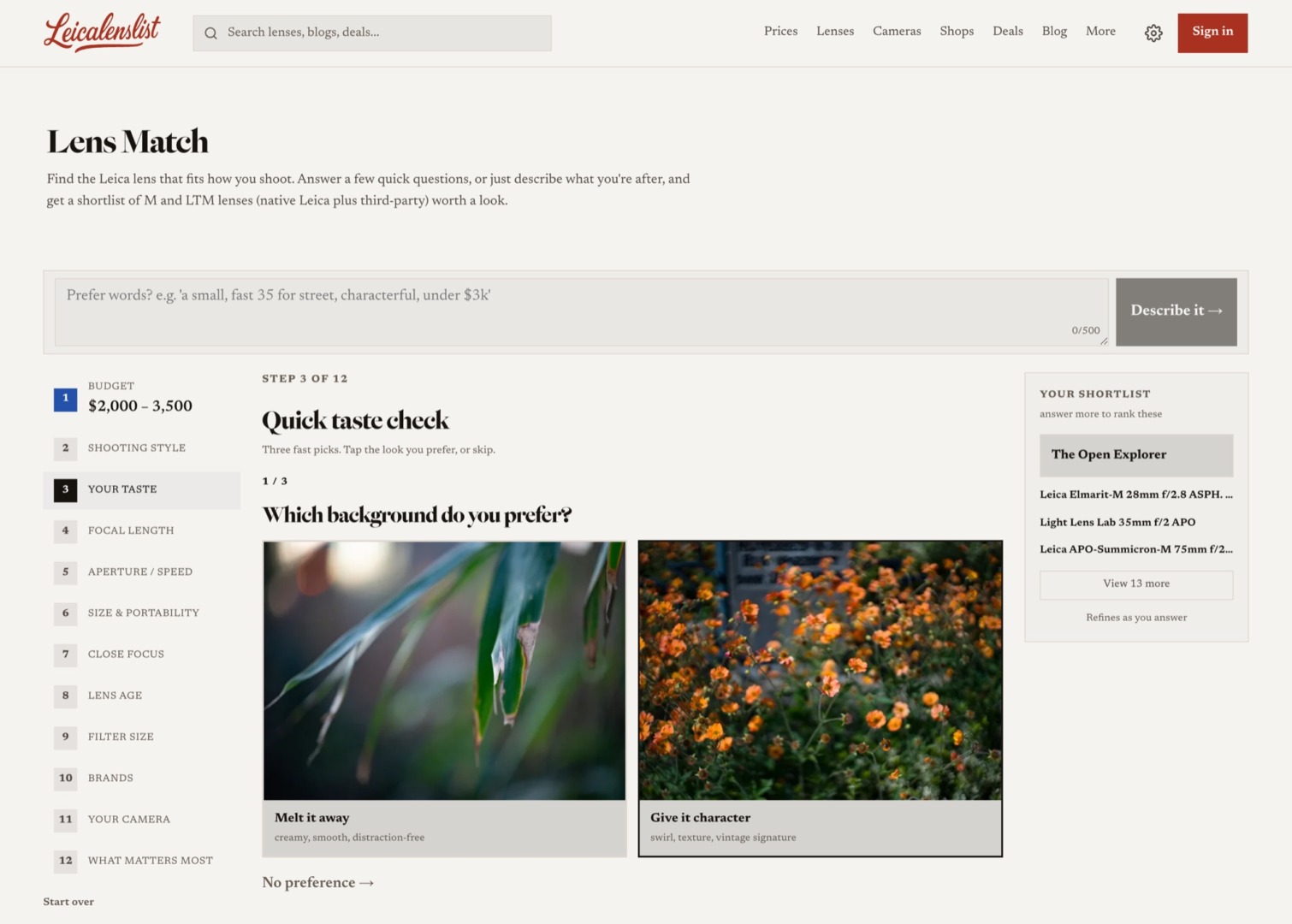
If you know less than that, there’s a lens finder. It asks up to twelve short questions. Budget, focal length, how much weight you’re willing to carry, how close you need to focus, whether you prefer modern correction or older rendering, filter size, which body you’re putting it on. You don’t have to answer all of them. The shortlist narrows as you go, so you can stop when it stops changing. And if you’d rather just describe what you’re after in a sentence, you can do that instead.
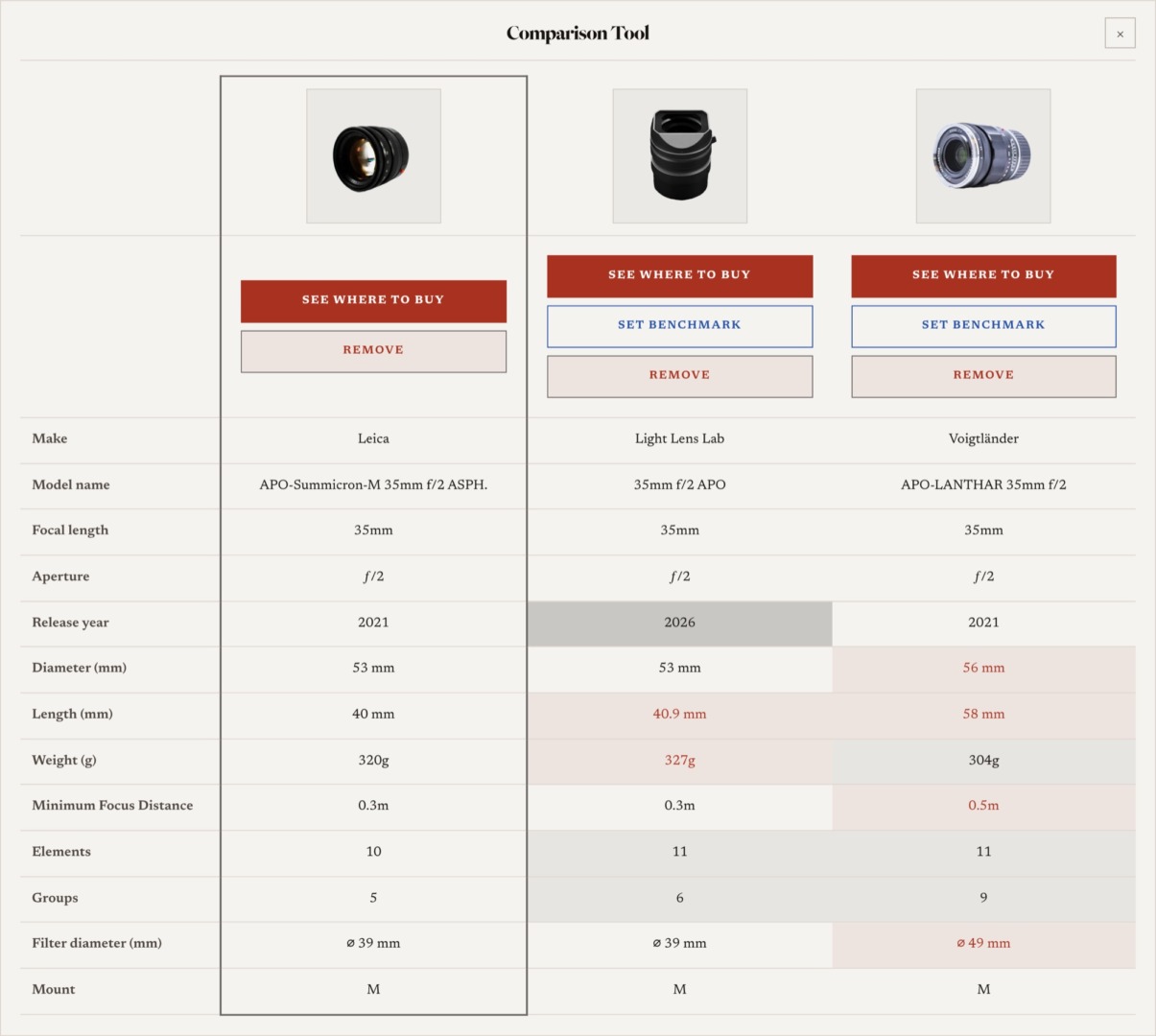
For the last step, when it’s down to two, there are side-by-side comparison guides that put both lenses next to each other with sample photos and the full specs.

What the lenses actually cost
This is the part I use most.
Every night, the site pulls listings from the shops and marketplaces it tracks and matches each one to a lens in the catalogue. None of that arrives as a tidy feed. Some shops run on Shopify or WooCommerce and hand over clean data. Others are hand-built and have to be read off the page, and each one needs its own reader. Then every listing has to be put against the right catalogue entry and graded for condition from whatever the seller happened to write.

When the description says nothing useful, the condition stays Unknown. I would rather leave a gap than guess at one. Around 330 lenses currently have live pricing. For each of those you get the lowest price today, the median over the last thirty days (we will add a 1-year and a 5-year view once we’ve been getting data for a longer time), how many listings are out there and how many are actually in stock. It’s sortable, and there’s a version for camera bodies too.
There are usually more than 2,000 listings live at any moment, and over 6,500 have passed through since I started. There are already users that got their Leica M6 or M10 at a discount by using the price tracker’s signals. It can tell you whether it is a good time to buy or wait a bit. This is also the case for rare lenses that don’t come across too often, and it’s nice to have a price of an item that hasn’t been listed in ages.
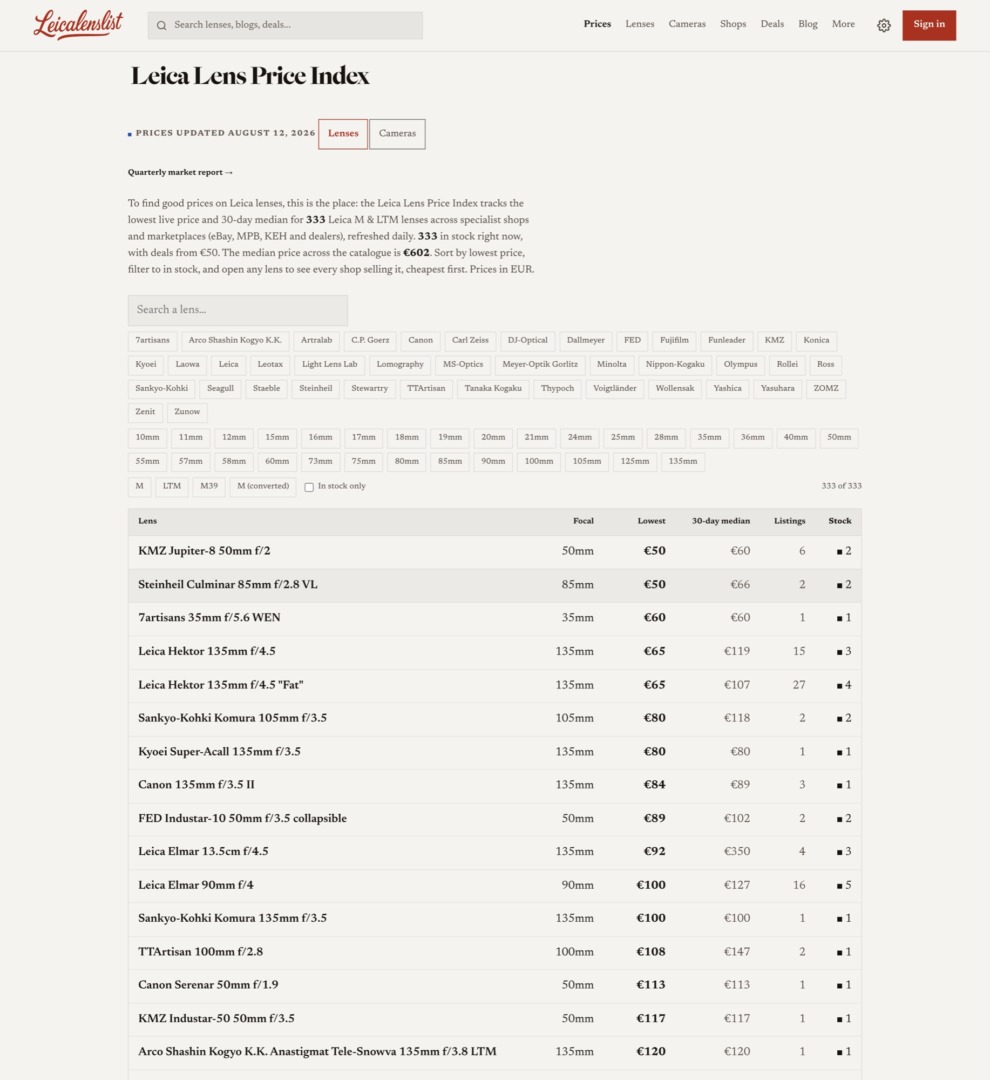

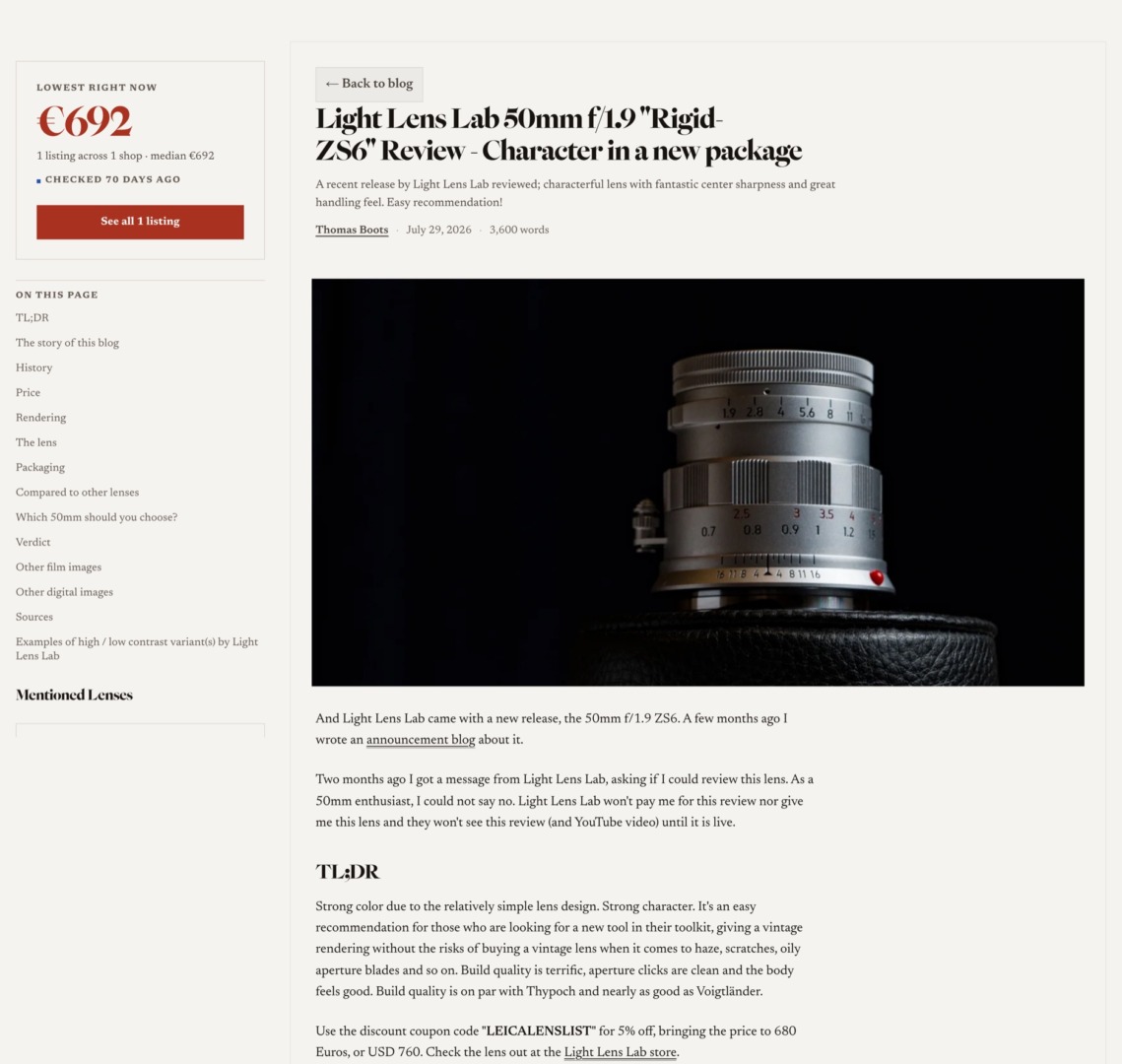
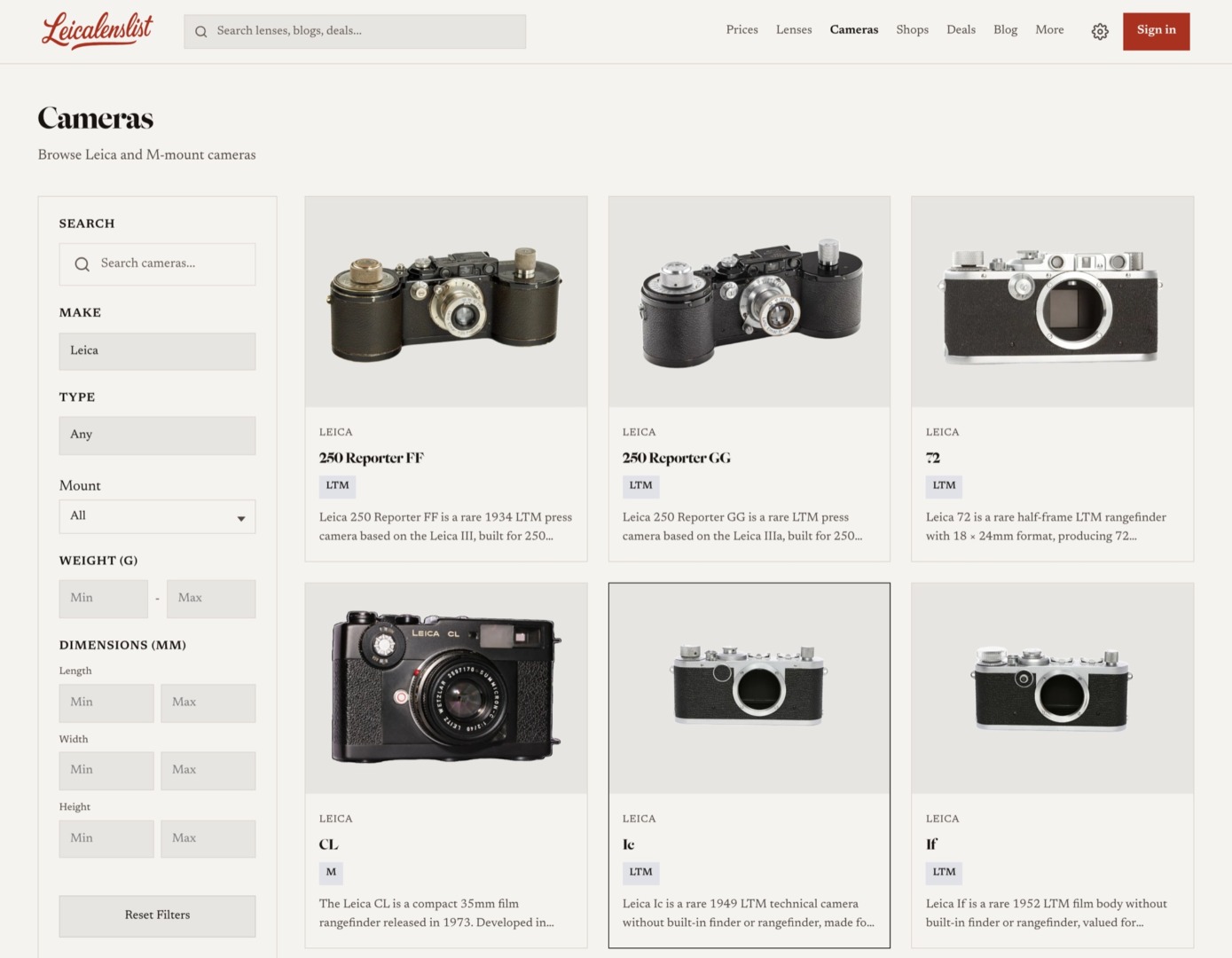
You can set a watch on a lens and get an email when it hits a new low. Every quarter, I also publish a market report on what has moved. There might be interesting insights from October 1!
Behind all of it is a shops page with more than 30 dealers worldwide, on a map, filtered by country and by what they do. Used gear, repairs, and so on. They sit across fifteen countries, and there are more in Japan than anywhere else. A few of them I found only because their listings turned up in the tracker.

The rest of it
Every lens page has a discussion thread under it. Someone who has owned a lens for twenty years knows things that never make it onto a spec sheet, and I’ve been corrected in those threads more than once.
There’s also the Lounge, a general forum for gear photos, photos taken with your gear and questions, and a stolen gear registry for checking a serial number before you hand over money for something at a train station.
The Journal is reviews, new release write-ups, restock notes, and whatever else I’m looking at.
I spent a long time thinking about how all of this should sit together. The redesign is what came out of that, and it’s all live now!
I still use it myself, usually to check a price before I commit to something, and the dozen tabs are mostly gone. Leica Lens List got a lot bigger than I first thought it would, since it started out as nothing more than a lens comparison tool. Its purpose is to guide you, the Leica M shooter, towards the kit that suits you.


If you go and look and something’s wrong, or a lens is missing, or a spec is off by two grams, tell me. You can contact me on the contact page. Most of the catalogue is accurate, also thanks to the ones with sharp eyes who have corrected me.
The same goes if there’s something you expected the site to do and it doesn’t. And if you know someone who’d get good use out of this resource, send them the link!
One thing I am thinking about building: a way to add your collection to your profile, cameras and lenses, kept private or made public, with the current market value of everything in it worked out from the price data. Public profiles could then be browsed and commented on. I would like to know whether that is something you would use. If it is, say so in the comments below.
Who pays?
There is a deliberate lack of advertising on the site. There are already some excellent websites covering Leica M and LTM equipment, and they include huge amounts of useful information. With Leica Lens List, I wanted to take a slightly different approach. I aim to keep the site clean, fast and enjoyable to browse, without filling the pages with advertising. We do use referral links where appropriate, and the small amount of income they generate helps pay for hosting, promoting the site, and buying lenses and other equipment to review.
So yes, the site does need to make money; I just wanted to be transparent about how we do it. The most we would want to do, which is something we still have to try out, is to use small advertisements from Leica stores and lens stores sprinkled around the website. But absolutely no intrusive Google Ads.
I write all the content and manage the site. My longer-term ambition for Leica Lens List is that it becomes a really useful home for Leica M and LTM users: a place to discover lenses, understand what they are worth, read about them, review them, and find reputable stores when they want to buy.
In the future, I’d also like to offer additional market insights to dealers, for example, helping them understand which items people are interested in and how particular lenses are being priced across the market. That could become another source of income for the site and, importantly, help us keep the experience for readers as clean and useful as possible.


Special thanks to Macfilos for being so generous as to let me post this article on the website. Find the Leica List here.
Further reading
While covering also M-Mount lenses, the Macfilos series, the M Files, follows a different approach. If focuses on M-Mount products which are not part of Leica’s M system and ofter offer a more affordable alternative. You can find in-depth reviews of 40+ lenses from Voigtländer, Zeiss, Konica, Minolta and others and of 10+ cameras from the film-loading Leica CL to the Pixii digital rangefinder camera. The easiest way to access all articles is the M Files Navigator, which covers the complete programme, sorted by cameras, lenses, accessories and the single episodes, which have just reached number 30.
| Macfilos Articles | Other Links |
|---|---|
| The extraordinary Leica Summilux M-Mount range of lenses – Mike’s tour through Leica’s flagship M lens family | Best Leica M lenses in 2026: every current Leica M rangefinder lens – Digital Camera World’s current roundup of the full M range |
| The M Files Jubilee: Creating the largest knowledge base for M-Mount photographic gear – Milestone marking Macfilos’s own M-mount knowledge base | m-mount-lens-database – Open-source GitHub listing of every M-mount lens ever made |
| The M Files (18): Everything but Leica M – here is our Navigator for all articles in the series – The series’ own index, linking every M Files instalment | LEICA M-Lens Compendium – A rival compendium cataloguing the full Leica M lens range |
| M Files (26): Third-party lenses for Leica on steroids with 6-bit-coding and EXIF tweaking – How to get native-like metadata from third-party glass | Every Leica M Lens in 2026: Native & Third-Party – A parallel native-versus-third-party lens rundown |
| Getting the best deal when buying and selling Leica equipment – Mike’s practical advice on Leica values, old and new | Leica M & LTM Lens Prices — Live Price Index – A live tracker of current M-mount lens prices |
| Leica Lens Names explained: A user’s guide – Decodes Leica’s lens naming and designation system | Leica Lens Codes – Reference list of Leica’s 6-bit lens coding values |
Make a donation to help with our running costs
Did you know that Macfilos is run by five photography enthusiasts based in the UK, USA and Europe? We cover all the substantial costs of running the site, and we do not carry advertising because it spoils readers’ enjoyment. Any amount, however small, will be appreciated, and we will write to acknowledge your generosity.
Comments: Please add a comment to this article. Our comments section is a thriving community and everyone is treated with respect. In addition, please identify yourself (and add an email address, which will not be published, if you would like to see answers to your posting). Our system will automatically delete any “anonymous” posts on the basis that they are likely to be spam.
Dear William and Bill,
Thank you for the responses. Appreciate this!
We are on the lookout for more US sources, please send me any if you found some through the contact page. Some do block data pulling, so I’m working on communication to fix this issue for specific sources, as I’m forwarding potential buyers to them.
I’m on holiday, so @William: I’ll be responding to you next week through e-mail. Appreciate your input! We’ll certainly add your source to our sources list as well. The 300mm Dallmeyer sounds special, never even heard of it!
@Bill We’ll be looking to add this piece of information to the leica lens finder so it shouldn’t affect the outcome if there’s a digital M selected as your body that supports live view or an EVF. Good suggestion!
Kind regards,
Thomas
I do agree with William, below.
Seems like a very useful source of lens information! I plan to consult this often! For someone just getting into the Leica M world, it would be a great place to start the decision process.
Current pricing is useful but could use more US sources. Also, for M lenses which are wider than 28mm, it is worthy of mention that the live view on CMOS digital Leica M cameras is a very good alternative to the external viewfinder. I have found that to be a very practical solution, even for street shooting.
Great work, Thomas. The current situation as regards the choice of M lenses is probably bewildering to a lot of users with a constant flow of new models and your guide will be of great assistance to them. I will share a link to this most useful tool with our over 2,000 members at Leica Society International where I am currently the President.
I am interested myself in the historical side of things and you are correct with your advice on the earliest models which are not interchangeable, having a 33mm fixed mount rather than an interchangeable LTM M39 mount. I’m glad to see that you have included the early Dallmeyer lenses for Leica made in Britain. I have a few of these myself including one in the 33mm fixed mount. Some of them are the earliest interchangeable lenses for Leicas with conversion work done in Britain by the likes of Sinclair even before the folks in Wetzlar got around to doing this. I also have some very rare items like the 12 inch (300mm) Dallmeyer lens from the 1930s which has an actual LTM mount. I have done some articles and a YouTube video on those items and I will send them to you through Mike.
Keep up the great work.
William