
The headlines this week have not been kind to Getty Images. “Collapse” is the word doing the rounds, and it conjures up visions of liquidators boxing up the Hulton Archive. The reality is less dramatic. On 21 October, Getty filed for Chapter 11 protection in Delaware, but this is a prepackaged restructuring designed to take the company private, not to wind it up. Even so, something has ended. The world’s best-known picture agency is leaving the stock market after barely four years. And the reasons why say a great deal about photography in 2026 . . .
Buying the past
Getty Images began in London in 1995, the creation of Mark Getty, grandson of the oil billionaire J Paul Getty, and Jonathan Klein, a former colleague at Hambros Bank. They started by buying Tony Stone Images and, a year later, Hulton Deutsch, the vast archive built on the old Picture Post collection. PhotoDisc, Kodak’s Image Bank, Allsport (the sports agency where our old friend Don Morley made his name) and iStockphoto followed. Mark once described intellectual property as the oil of the 21st century, and he went prospecting with all the appetite of his grandfather.
The idea was simple and, in its day, brilliant. Getty bought scattered archives, digitised them and sold access to anyone with a credit card and a deadline. After passing through the hands of two private equity firms, the company floated in New York in July 2022 through a SPAC merger.
Who stopped buying
Getty’s customers fall into three camps. Advertising agencies and large corporations license creative stock for campaigns and websites. Newspapers, broadcasters, and websites buy editorial pictures of news, sport, and celebrities. And a long tail of small businesses and bloggers buy cheap images through iStock.
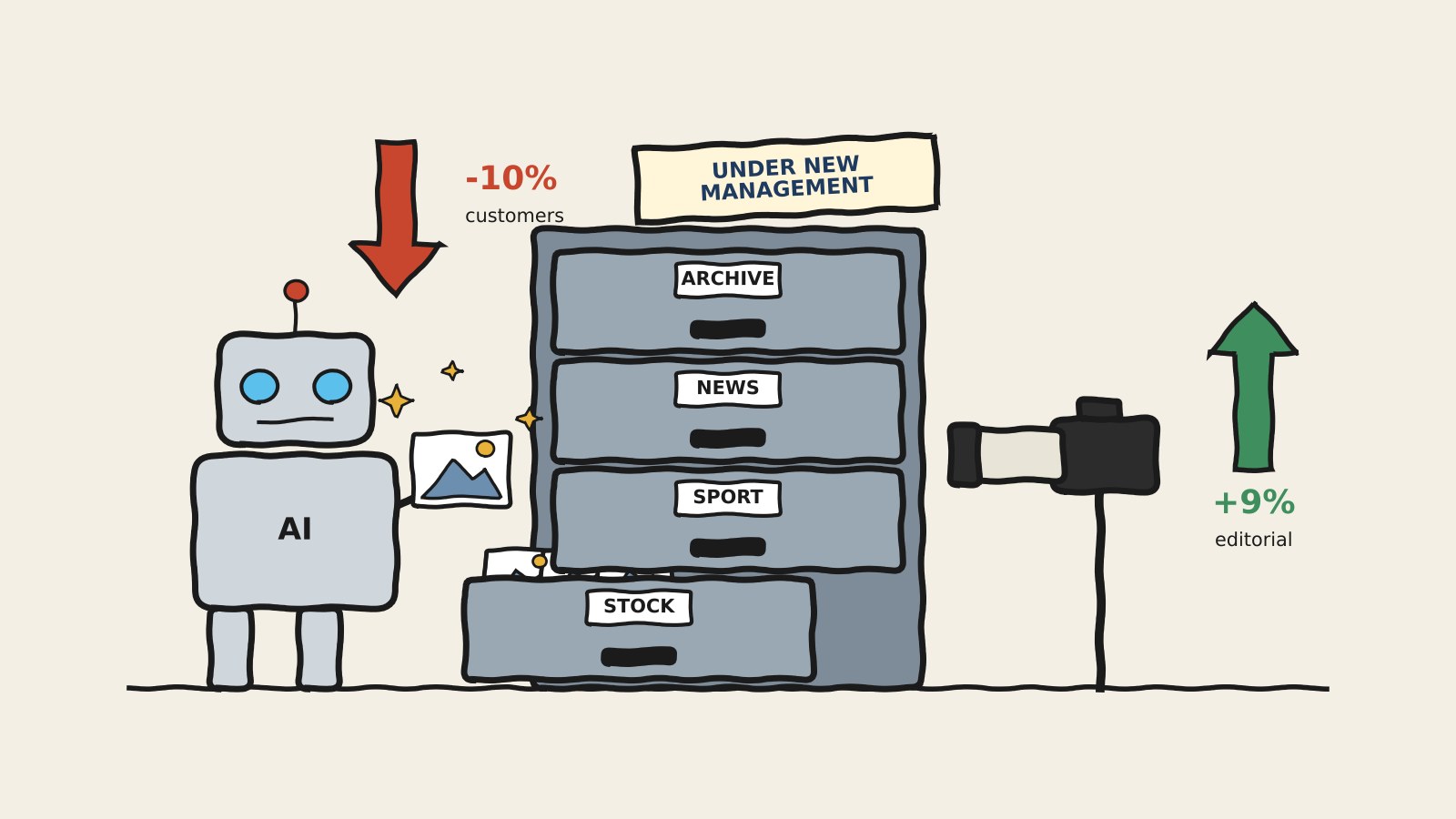
It is the first and last of these that are drifting away. Agency revenue fell 13% in the second quarter of 2026 as agencies brought production in-house, increasingly with AI tools. At iStock, search engines now answer queries with AI summaries, so fewer people click through, and price-sensitive buyers can simply generate a picture for nothing. Over the year to June, paying customers fell 10% to 636,000.
Editorial, by contrast, grew 9% on the back of the World Cup. A machine can conjure a passable smiling office worker in seconds, but it cannot photograph last night’s Champions League final.

Where the money went
The SPAC listing came back to bite. Former warrant holders sued, claiming Getty had stopped them exercising their warrants, and they won. According to its own SEC filing, Getty paid $110.9 million in April, with a further $67.8 million judgment against it in July.
Then there was Shutterstock. A $3.7 billion merger agreed in January 2025 foundered when the Competition and Markets Authority insisted that Shutterstock’s editorial business be sold. Getty refused and walked away in July, roughly $105 million poorer.
By the end of June, Getty had $51.6 million in the bank against $2.1 billion of debt. Under the rescue plan, the Getty family and Koch Equity Development will invest up to $533 million and own the whole company.
Not universally loved
Photographers have long had mixed feelings about Getty. It became notorious for demand letters to small websites over unlicensed pictures. In 2016 Carol Highsmith found Getty and Alamy selling thousands of licences for the photographs she had donated to the Library of Congress for public use. A licence-enforcement agency even asked her to pay $120 for showing one on her own website. More recently, its High Court case accusing Stability AI of training Stable Diffusion on millions of Getty pictures largely failed.


What happens next
Getty insists nothing changes for contributors and customers, and expects the restructuring to be complete by the end of the year. So this is not an obituary, more a change of address from Wall Street to the family office.
Yet, I find it hard not to feel a touch of melancholy. Getty did more than anyone to turn the world’s photographic heritage into a searchable commodity, for better and for worse. Getty will survive. Whether the business of licensing photographs survives in the form we have known it is another matter entirely.
Further reading
| Macfilos Articles | Other Links |
|---|---|
| The camera industry isn’t dying, it’s just recalibrating – A similar case of decline that isn’t quite what it seems | Getty Images second-quarter 2026 results – The company’s own figures on falling customers and rising editorial sales |
| The story of Don Morley: Shaping press photography over the decades – Don’s career, including his Allsport years | Nelson Atkins Art Museum, by Carol M. Highsmith – The public-domain photograph at the heart of the $120 demand |
Make a donation to help with our running costs
Did you know that Macfilos is run by six photography enthusiasts based in the UK, USA and Europe? We cover all the substantial costs of running the site, and we do not carry advertising because it spoils readers’ enjoyment. Any amount, however small, will be appreciated, and we will write to acknowledge your generosity.
As I recall Getty bought All-Sports first then Tony Stone’s. Not not that who came first matters much other that to those many like myself who back in those days entrusted much of our own copyright work to both. My point here being neither Tony Stone or Getty Images bought any of those images, rather we (And in this instance I do mean a vast number of individual photographers and smaller agencies etc) simply licenced some of our work out to them.
In short a very large percentage of the original negatives, colour transparencies, and or digitally scanned versions of them are actually not owned by Getty Images at all, and what’s more never have been but still are owned by we who originally took them, and that in turn raises another interesting question. I.E. What happens to them now. And could we get them back, assuming that is Getty Images have good enough records? Or Staff? Or could be bothered to find them?
This does bother me, not so much for myself, but I do often wonder how much of Getty Images content has sort become theirs by default? For instance very especially the older and more historical content given many if not most of the photographers who took such have since passed away? Maybe I should pull out my own digit and try and see if I can my work back as it certainly is still mine, and I will be 90 myself sooner than I like to think about.
I would appear that the company has attempted to create a cartel.
Unfortunately the Press Association (PA) is too powerful to for that to yield ripe fruit.