

It’s hard to imagine how a company could bring something truly fresh to the already extensive line up of full-frame, L-Mount lenses. But that’s just what Viltrox have done with their latest introduction: the Viltrox Chip lens. It’s tiny, it’s sharp, it’s autofocus, and it’s cheap! Let’s take a closer look.
Regular readers will know that we are big fans of lightweight lenses, even if this requires compromises in other aspects of performance, such as speed. We therefore enthusiastically welcomed the launch of the Viltrox Chip lens.
What exactly is the Chip?
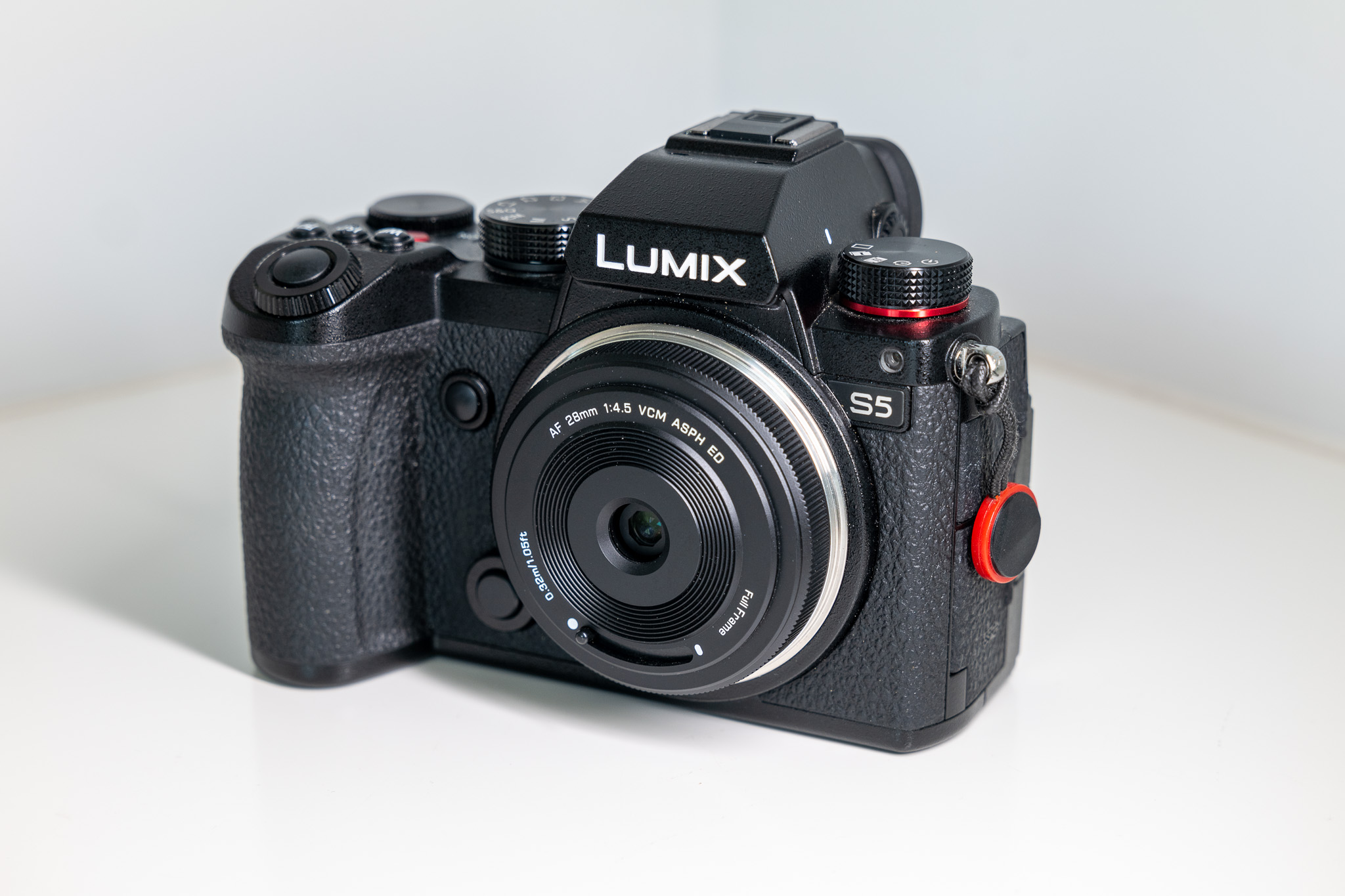
As described in a recent launch announcement, it’s a pancake lens which weighs just 60g and when mounted, protrudes around 1.5 cm from the camera’s front face. Remarkably, Viltrox incorporated an autofocus capability into this extremely narrow barrel.

The company made several crucial decisions in designing an autofocus lens this small and inexpensive, which I will discuss below.
I think its 28mm focal length — popular for street, travel, and walk-about photography — is a great choice. A favourite for fixed-focal-length camera owners, 28mm provides a moderate wide-angle option for many situations. And on cameras with high-resolution sensors, 28mm images can easily be cropped to at least an effective 50mm focal length.
Why launch on L-Mount now?
Viltrox joined the L-Mount Alliance back in September 2025. The Chip is one of its first releases for the system, alongside the excellent 16mm f/1.8, which I reviewed here on Macfilos back in March. Within the L-Mount ecosystem are several small, lightweight cameras – the Panasonic Lumix S9 and the Sigma BF.
Both are potentially pocketable, if equipped with a complementary pancake lens. The Chip represents a great choice in both these cases, given its diminutive form factor.

Clever compromises or cynical corner-cutting?
However, its fixed f/4.5 aperture, lack of filter thread, lens cap, and manual focus option will surely give some potential purchasers pause. Even at a price of $99.
But, are these actually significant drawbacks? Let’s look at each in turn.
The fixed aperture
In my view, if the aperture had to be fixed in order to keep the lens small, then f/4.5 is a great choice. A brighter maximum aperture would inevitably increase the size of the lens. A slower aperture would have limited low-light performance. In daylight, most users will be shooting at smaller apertures anyway. And if it’s a bokeh-monster you are after, you will need to look elsewhere, and spend much more money.

No filter thread
With regard to lack of filter thread, I suspect not many people use circular-polarising, or neutral-density filters on their walk-around cameras. So, the lack of a filter thread is a non-issue in most situations. Once again, if you really want that filter thread, there are many 28mm lens options available, but not at this size and price.
No conventional lens cap
Finally, as an alternative to an external lens cap, Viltrox incorporated an integrated lens cover, operated by a lever at the front of the lens. This is an ingenious solution, which works well — and, there is no chance of losing the lens cap! Most people use UV filters to protect the lens, primarily because they can’t be bothered with those easily lost lens caps.
No manual focus
Some photographers will probably want a focus ring as a matter of principle, even on a pancake lens like this. I did not see this as an issue, especially since the autofocus works so well. Furthermore as I’ll cover below, the autofocus mechanism Viltrox chose means that manual focusing is just not an option on this lens.
Build quality

The Viltrox Chip features an ultra-compact optical design, comprising six elements in six groups, of which two are extra-low dispersion (ED) and two are aspherical.
The lens body is hard plastic or resin. Its surface is textured, providing sufficient grip to twist it onto the camera’s bayonet mount. The rear of the lens is metal, incorporating contacts for connection to the camera’s electronics, as well as a USB-C port for updating the lens’s firmware.
The front of the lens features that lever to close the integrated lens cover. Since the fixed f/4.5 aperture is not small enough to generate sunstars, Viltrox has employed a hexagonal lens opening to offer the possibility of faux stars when pointing at a bright light source.
My real-world experience
I have used it on both a Leica SL2 and Lumix S5. I think it would be perfect for the even smaller Lumix S9.
Mounted on my S5, I have a compact, easy-carry kit which is only slightly heavier than a Q-series camera. Clearly my S5-Chip kit does not possess the stellar f/1.7 lens, or 60 megapixel sensor of a Q3. But, when I travel with the S5 as a backup to an SL2, it is so easy to pop on the Chip and use it as my compact walk-around kit. No need for a third, Q-series, camera.
I did not do much street photography with my S5/Chip set up, but in many ways its ideal for this genre, given how small and discreet the kit is.
Sharpness
Both I, and many on-line reviewers have found the optical performance of the Chip lens to defy its tiny size and sub-$100 price. Its centre sharpness is its standout strength, with softness inevitably creeping in at the edges. However, even at the edges of the frame, because of its f/4.5 aperture, it stands comparison with many faster prime lenses, which can also struggle in this regard.
I was able to capture the texture of a subject’s face when shooting close up, or after cropping. The lens also captures considerable detail when photographing more distant objects, such as landscapes. To be clear, I would not use this lens to take photographs I intended to display as large prints. But, for everyday shots of local scenes and vacation destinations, it’s just the ticket.

I captured genuine skin texture shooting close-up portraits. Landscape shots held plenty of fine detail as well, even after cropping in post-production.
Would I use it for a print sale? No. Would I use it for a travel journal, a blog, or a social feed? Absolutely, without hesitation.
Vignetting
Its most significant weakness is vignetting, which is especially pronounced in low light. However, I was always able to correct this in post. Since I was using the lens while experimenting with a 1:3 panoramic aspect ratio, shooting in this mode avoided the vignetting problem entirely.

Chromatic aberration and flare
I encountered no significant issues with chromatic aberration, unlike my experience with another incredibly cheap lens, in that case from TTArtisan, I wrote about recently. However, I did not use the Chip lens in exactly the same, heavily back-lit situation.
Similarly, I did not exhaustively explore the lens’s flair characteristics. However, the few shots I took with the sun at the edge of the frame (not shown) were not problematic.
Autofocus: the real surprise
Surely, the most remarkable attribute of the Chip lens, given its miniscule size (15.3mm deep and 60g) is its autofocus. Mounted on a Lumix S5, it was both fast and accurate.
I found myself wondering how it was possible to incorporate an autofocus motor into such a short lens body. Here is where the engineers at Viltrox pulled off another nifty design trick, using technology borrowed from an unrelated field.

Autofocus via a voice coil motor
Viltrox used a VCM: a voice coil motor. It’s a direct-drive linear actuator, the same basic principle used in loudspeaker drivers.
In brief, here is how it works.
The system employs a permanent strong, fixed magnetic field (usually using neodymium magnets) within the lens housing. A lightweight copper coil within the magnetic field is attached to the moving lens element(s). Guidance shafts ensure the coil remains centred, moving in a straight line, without touching the magnets.
The camera sends an electric current to the copper coil, which moves it back and forth, depending on the direction of the current. The amount of current applied determines the extent and speed of movement of the coil.

Why this matters in practice
There are no gears, screws, or belts in this system. That means zero mechanical play, and near-instant repositioning when the camera asks for it. The motor also runs almost silently, which matters for video work. Turn the camera off, though, and the lens elements float freely — you’ll sometimes hear them rattle gently.
Paired with phase-detection autofocus on a modern body, a VCM delivers an elegant, compact autofocus mechanism. I suspect it only really works with small, lightweight lens-element groups, which explains why Viltrox chose this approach for the Chip specifically. It also explains the missing manual focus ring.

How it compares
Here’s how the Viltrox Chip 28mm f/4.5 stacks up against the rest of the L-Mount field, as things stand today.
Panasonic Lumix S 26mm f/8
Panasonic’s S-R26 pancake is the Chip’s closest rival, and its only true “pancake” competitor on L-Mount. It costs $199.99 / £219.99 / €239.99 — roughly double the Chip’s price. It’s tiny too: 18.1mm long, 67.1mm across, and 58g. Panasonic built it specifically to partner the compact Lumix S9.
But it’s manual focus only, with no filter thread and, oddly, no distance scale. Turning the focus ring doesn’t even trigger magnified focus assist. The Chip beats it on price, aperture speed, and everyday convenience. It adds autofocus into the bargain, and it’s smaller still.

Panasonic Lumix S 40mm f/2
This one isn’t really a pancake at all. Panasonic itself has called it “more of a muffin lens than a pancake”, which is a fair description. At 40.9mm long and 144g, with a bright f/2 aperture, it aims at buyers chasing low-light performance and background blur rather than ultimate size.
It costs $399.99 — about four times the Chip’s price, for a genuinely different kind of lens.

The rumoured Viltrox 26mm f/2.8
Viltrox has not officially announced a compact 26mm f/2.8 for L-Mount, but it is widely expected. It’s currently available for Sony FE.
If and when it arrives, it should offer a faster aperture in a small body, although probably not quite as small as the Chip. I’ll be keeping an eye on it, and I’ll report back for Macfilos readers if I get my hands on one.
Compatibility with other mounts
The Viltrox Chip is available in four mount versions. Three are full-frame mounts: L-mount (the version I have reviewed), Sony E-mount (FE), and Nikon Z-mount — though the latter two are shared mounts, meaning they also fit those brands’ APS-C bodies (Sony’s crop-sensor E-mount cameras and Nikon’s DX Z-series) rather than being full-frame-exclusive.
The fourth version is for Fujifilm’s X-mount, which is APS-C only by definition, since Fujifilm has no full-frame X-mount body; on that crop sensor, the 28mm focal length behaves more like a 42mm standard lens than a wide-angle
Who is the Chip for?
If you own a Lumix S9 or a Sigma BF, and you want the smallest possible everyday lens, this is the one to buy. It’s an easy recommendation.
If you already carry a larger L-Mount kit and want an ultra-light lens purely as a spare, or a body-cap replacement, it’s also a sensible, low-risk purchase at this price.
If you need speed, weather-sealing, or a manual focus ring on principle, you should look at alternative L-Mount options. The Chip was not designed for photographers who prioritize those features.

Verdict
The Chip is both genuinely fun to use and eminently practical. It takes up almost no room in a kit bag, and adds almost no weight to a shoulder or a jacket pocket. Pop it onto the camera, though, and you instantly have a proper lightweight, walk-about kit.
Its capabilities, at this price point, seem nigh on miraculous. Viltrox’s design team chose which corners to cut very skillfully. The result punches well above its weight, and well above its modest price tag.
I enjoyed my time with this lens, kindly supplied by Viltrox for testing. I hope the images through this article show what it can do, shot both close to home and on a recent trip away.


At $99, you really can’t go far wrong. Christmas is still a few months off, but if there’s a full-frame L-Mount shooter in your life, I can’t think of a better stocking-filler.
Further reading
| Macfilos Articles | Other Links |
|---|---|
| Viltrox becomes the tenth member of the expanding L-Mount Alliance – How Viltrox arrived in the L-Mount fold in the first place | Viltrox AF 28mm F4.5 Chip L – Viltrox Store – Full specs and the official $99 listing |
| Hands-on with the Viltrox 16mm f/1.8 for L-Mount: A walk on the wide side – A faster, larger Viltrox lens for comparison | Panasonic introduces the LUMIX S 26mm f/8 (S-R26) – Official launch of the Chip’s closest rival pancake |
| This is Outrageous: The TTArtisan 35mm f/1.4 lens for L-Mount – The cut-price TTArtisan lens referenced for its chromatic aberration | Panasonic introduces the LUMIX S 40mm f/2 – Official launch of the brighter, pricier alternative |
| Panasonic announces the Lumix S9: A new, compact, full-frame, L-Mount camera – The compact body the author expects would suit the Chip best | Viltrox 26mm f/2.8 FE AF announced – First details of the upcoming faster pancake, still awaiting an L-Mount version |
| Panasonic’s Lumix S5 kit: The lightweight L-Mount alternative – The camera the author actually paired with the Chip | L-Mount: the universal lens bayonet – The alliance’s own site, for the full roster of compatible bodies and lenses |
| Leica Q2 review: Better at every level – The Q2 the author measures the S5-Chip kit against | How to use a VCM (voice coil motor) in cameras – A plain explainer of the autofocus technology behind the Chip |
Make a donation to help with our running costs
Did you know that Macfilos is run by five photography enthusiasts based in the UK, USA and Europe? We cover all the substantial costs of running the site, and we do not carry advertising because it spoils readers’ enjoyment. Any amount, however small, will be appreciated, and we will write to acknowledge your generosity.
Comments: Please add a comment to this article. Our comments section is a thriving community and everyone is treated with respect. In addition, please identify yourself (and add an email address, which will not be published, if you would like to see answers to your posting). Our system will automatically delete any “anonymous” posts on the basis that they are likely to be spam.
Keith – a very good review, and I am amazed that such a compact, relatively simple lens renders details very well and has great autofocus, to boot. A very good set of sample photos to showcase the lens, thank you. That’s $99 gone from the retirement fund now…..
Ed
Hi Keith:
A nice review you wrote, that actually made me buy one for my Fujifilm X-T5 at 77 Euros last week. An amazingly great lens at that price and so far the best pancake lens I had so far. I had a few pancake lenses in the past, but not one of them was satisfying for my needs, so I was suspicious at first. But the sharpness turned out to be great. I also use it for macro shots with a short extension tube.
Cheers,
Frank
I use this lens on my Fp with a small grip for general strolling around. It nearly disappears in my hand and is quite good enough for my purposes. With AF and a fixed aperture I really don’t have to think about anything but framing. For the money I love it. If I’m using another lens I slip it into my pocket and don’t even know it’s there. Great fun.
Hi Mark, thanks for your comment. I too found that having both focal length and aperture fixed was a refreshing experience — an opportunity to channel one’s efforts into framing the composition. While trying it out, I mostly shot in reasonable light, choosing shutter priority with a shutter speed of around 1/400s. So, the only variable controlled by the camera was AUTO ISO, which remained low as long as conditions were bright. I suppose it’s like shooting with an iPhone, but with better optics and sensor. All the best, Keith
Nice review of an interesting lens – thanks. Did you try it on a TL2 or CL? Soft edges would be less of a problem and it would be even more pocketable.
Hi Keith, thanks for mentioning this. I meant to include a comment on this point. Despite possessing an L-Mount, the lens is not compatible with L-Mount Leica APS-C cameras. I tried it on my TL2 and the camera was unable to detect the lens. Too bad, because as you say, you would have resulted in a handy focal length without any vignetting issues. All the best, Keith
I think it’s very nice on a Lumix S9, very pocketable.
I hope Viltrox will realease the slightly biggen 26 mm 2.8 lens EVO for L-mount.
Just slightly biggen than the cookie-lens, but manual focus also possible.
Hi Erica, sounds like you have first-hand experience of mounting the Chip on an S9. Although I have no direct experience, it looks like a perfect match to me. All the best, Keith
Hi Keith, unfortunatly I couldn’t get hold of one for my S9, it was already sold out before I went on holiday. But I did see one live on an S9 a few weeks ago. I hope Viltrox will make the 26mm EVO 2.8 for L-mount though. Just a little bit bigger, but the possibility of doing manual focus is a bonus (and the f2.8 too).
Not sure whether I would buy into the S9 right now. The S9 II is rumored to have an EVF and true hot shoe. Obviously to be confirmed.
That’s an interesting observation. The lack of an EVF is the main reason I haven’t bought one, and I am sure there are many similar potential customers out there.
I will be tempted as well. That being said, the S9 is currently only $1,197.99 in the US which is a bit of a steal. I don’t believe it sold well initially, but then they started lowering the price and it became more popular. If it does get an EVF and a hot shoe I would expect the price to go up. Sigma should lower the price of the BF as well. At $2,199 it is just overpriced.
Agreee, but the BF has other problems of its own. I think a new s9 would be popular, though
“Pancake” lenses are very popular these days, for good reason. I have used one (45mm GN-Nikkor) since 1974. I now also have the 45mm f2.8 P Nikkor. Both of these are manual focus, 4-element Tessars. It is quite remarkable that Viltrox has managed to squeeze 6 elements and autofocus into such a tiny package!
Hi Martin, couldn’t agree more that the engineers at Viltrox pulled off quite a feat incorporating an autofocus motor into this little fellow. I look forward to seeing more by way of L-Mount lens innovation from them. Cheers, Keith
The lens is really, really tiny. I use it on my SL2, it is nearly as large as a lenscap. On the SL you don’t notice it.
For me it’s mayor flaw is that is very prone to flaring: a bright sky, even against a clouded sky you have to be careful. It is a bit like an old R lens from the seventies, when the coating was not as advanced as the current coatings. The contrast is rapidly diminishing. But knowing that it as Keith said: you cannot go far wrong for the price.
Hi Donald, it’s helpful to hear that you have noticed the lens’s limitations in handling flare. I rarely shoot directly towards the sun, so it’s not something that would put me off, but anyone who does probably needs to consider other options. Cheers, Keith