

In June this year, Leica announced the APO-Macro-Elmarit-SL 100mm f/2.8. It’s a modern full-metal, £2,110 L-Mount macro lens which revives a famous R-Mount design from 1987. Appropriately, then, this brief overview looks at a well-regarded competitor which came to the market almost two and a half years earlier than the Leica. The Lumix S 100mm f/2.8 Macro is a genuine alternative, with some provisos, at under half the price of the price. Is the saving worthwhile?
This lens is distinctive in many ways. It is the lightest, smallest, and cheapest 100mm L-Mount Macro, but it is also a superb all-round lens for general photography. Furthermore, it belongs to Panasonic’s family of identical primes, sharing weight and filter size with other lenses in the range. I am reviewing it here for its general all-round capabilities, specifically as an excellent portrait lens. I didn’t buy it specifically for macro work, which I seldom use; so if you are looking for a macro review, this isn’t the place.
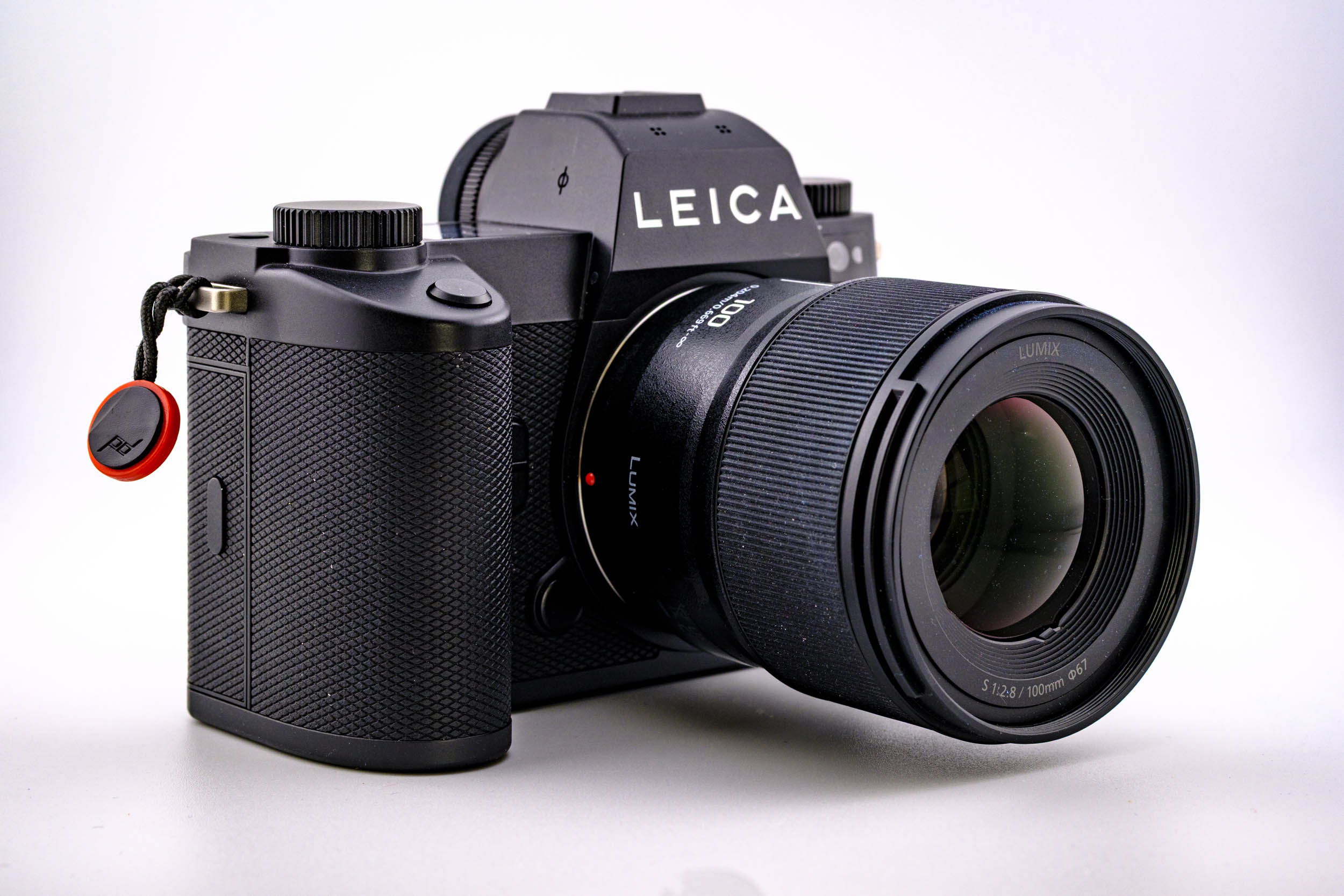
One of these lenses, the Lumix 50 f/1.8 is very similar optically and in specification to Leica’s “budget” 50mm f/2 Summicron. If we assume Panasonic had a finger in this pie, which I suspect, it demonstrates that Leica has a high regard for the Lumix S range. I have owned the Lumix S 100mm f/2.8 Macro since it was launched in 2024 and here I am reviewing my copy, rather than a Panasonic loan model.
Let’s look at the specification in more detail.
Full specification
| Spec | Value |
|---|---|
| Focal length | 100mm |
| Maximum aperture | f/2.8 |
| Minimum aperture | f/22 |
| Optical construction | 13 elements in 11 groups (3 aspherical, 2 UED/Ultra-Extra-low Dispersion, 1 ED elements) |
| Aperture blades | 9, rounded diaphragm |
| Autofocus motor | Newly developed “Dual Phase Linear Motor” |
| Minimum focus distance | 0.2m / 8in (from sensor) |
| Working distance at 1:1 | ~10–11cm (lens tip to subject) |
| Maximum magnification | 1.0x (life-size) |
| Image stabilisation | None (relies on in-body IBIS) |
| Filter thread | 67mm (shared with other Lumix S primes, from 18mm to 85mm |
| Weight | 298g (10.5 oz) |
| Length | 82mm (3.2 in) |
| Diameter | 73.6–74mm (2.9 in) |
| Weather sealing | Dust/splash-resistant, freeze-resistant to −10°C |
| Angle of view | 24° |
| Aperture ring | None |
| Focus ring | Switchable linear/non-linear response |
| Focus limiter | 3-position switch: 20–50cm / 50cm–∞ / full range |
| Extras | AF-Scope-compatible macro focusing aid, focus-breathing suppression, micro-step aperture control for smooth video exposure changes |
| Included accessories | Lens hood, front/rear caps |

Design and build
As a member of the Lumix S Prime range, this 100mm Macro is dramatically smaller than the other two contenders. At 298g and 82mm long, it is roughly half the weight of the Sigma 105mm Art (709-715g) and just over a third of the weight of the new Leica APO-Macro-Elmarit-SL (801g). It matches the weight and dimensions of its five siblings, which range in focal length from a super-wide 18mm to a portrait-friendly 85mm.

Panasonic’s Lumix S fast primes form a rare thing: a genuinely matched lens family. Every one shares the same 82mm barrel, 67mm filter thread and a tight 295–355g weight band, making them uncommonly easy to live with as a set. Build quality is solid rather than premium, with weather-sealing but no stabilisation or aperture rings. Reviewers consistently score them 4–4.5 out of 5, and value is exceptional: each undercuts Panasonic’s own S Pro line several-fold. The 100mm Macro stands out as the lightest full-frame 1:1 macro on the market, making this range one of L-mount’s strongest selling points.
Synergy
This is a similar approach to that adopted by the Viltrox EVO mid-range APS-C series (we tested the AF 90 EVO here). Maintaining dimensions in this way is helpful to gimbal users, but it is also a prime selling point for still photographers.

Filters can be shared, and all the lenses are genuinely light: you can build up a collection of three favourite prime focal lengths, and not have more than 1000g in your bag. However, while the hood fixing mechanism is common, there are significant differences in design for the various focal lengths, so it isn’t possible to share a hood in the interests of weight saving.
The family

| Lens | Weight | Length | Filter | Price |
|---|---|---|---|---|
| S 18mm f/1.8 | 340 g | 82.0 mm | 67 mm | £800 | €900 | $1,100 |
| S 24mm f/1.8 | 310 g | 82.0 mm | 67 mm | £800 | €900 | $1,000 |
| S 35mm f/1.8 | 295 g | 82.0 mm | 67 mm | £580 | €680 | $750 |
| S 50mm f/1.8 | 300 g | 82.0 mm | 67 mm | £430 | €470 | $500 |
| S 85mm f/1.8 | 355 g | 82.0 mm | 67 mm | £600 | €650 | $650 |
| S 100mm f/2.8 Macro | 298 g | 82.0 mm | 67 mm | £950 | €1,100 | $1,098 |
In common with the other lenses in the range, the 100mm f/2.8 Macro is weather-sealed (dust/splash resistant) and rated down to -10ºC. The high-quality engineered plastic body can be considered “less premium” than the metal build of the Leica, for instance, but many photographers (myself included) see this as an advantage. I appreciate the light weight and small size, and I am not fixated on the supposed benefits of an all-metal body.

There is no aperture ring, which can be a problem for some users who value manual control, and this is especially the case with video shooters.
Nevertheless, the lens does have two physical controls that are extremely useful: AF/MF and a three-position focus limiter switch for speeding AF acquisition. It can be set to 20-50cm, 50cm-infinity, and full range.

Autofocus performance
The Lumix S 100mm f/2.8 Macro incorporates a new dual-phase linear motor which offers speed, precision and near-silent operation. It’s a genuine differentiator, since many macro lenses use slower motors, such as STM, optimised for precision rather than speed.
I find the AF to be extremely fast and has been reliable and accurate on the three bodies, I’ve used this lens on the Lumix S5 II, the Leica SL3 and, now, the SL3-P. In fact, with the much better AF ability of the -P compared with the SL3, the lens really comes into its own.


I am not an experienced macro photographer, but I did find occasional focus hunting during close-up AF, although making use of the focus limiter does help a lot. Similarly, there is a small degree of hunting when focusing normally in low light environments.
The silent operation and strong focus-breathing suppression puts this in a separate league for video use; most manufacturers do not prioritise this feature.

Image quality
Having spent time going back through a large batch of images from this lens, I can say sharpness is a genuine strength. Centre performance is excellent even wide open, and corner sharpness holds up far better than I’d expect from such a compact 100mm design.
There is a touch of softening in the extreme corners at f/2.8, but it clears by f/4, and the lens is at its best across the f/4-f/7 range, much as you’d expect from any well-corrected prime.


Chromatic aberration and fringing are well controlled throughout, even on the high-contrast edges that usually give a lens away. I’ve seen no meaningful pin-cushion distortion in my shooting, whatever other reviewers have reported, and vignetting simply isn’t an issue worth worrying about.
Bokeh is where this lens really shines. It is smooth, creamy, and free of the nervous double-edging or cat’s-eye stretching that spoils background blur in lesser lenses. Panasonic calls it “stunning”. I wouldn’t go quite that far, but it in my view it is attractive rendering, and more than enough to make this a satisfying portrait lens as well as a competent macro performer.

Carry round lens?
Although this is a macro lens, I didn’t buy it for that reason. Instead, I wanted it as a small, light portrait/short telephoto prime, and at this, it excels. My experience with the APS-C Viltrox AF 90 EVO (which equates to a 135mm full-frame focal length) tempted me to spend more time with the Lumix 100mm. I have recently found myself using the Lumix more as a carry around lens on the SL3-P, even for casual street photography.

Everyone says that a wide-angle lens is the best for this type of work, but there are advantages in using such a small, unobtrusive long prime. A zoom lens covering this focal length would be provocative and certainly not unobtrusive, but this lens is no bigger than the 35mm Lumix S and is decidedly more stealthy than a normal long prime or zoom.


Macro-specific performance
As I said earlier, I am no macro photographer and I am therefore not qualified to report objectively on the macro capabilities. Strange, of course, but I see the lens primarily as a long prime for general purposes and, in this aspect, it performs brilliantly.
The Lumix 100mm f/2.8 Macro has a true 1:1 life-size magnification at a minimum focus distance of 20.4 cm from the sensor, which I calculate as roughly 10-11 cm working stance from the front of the lens to the subject.

This is noticeably tighter than some 100-105mm rivals, with a near-14 cm distance, and I am told that it can be a practical drawback. There is more risk of the lens casting a shadow on the subject or disturbing insects, for instance.
A lack of optical stabilisation can be considered a disadvantage, although all the cameras I have used have had excellent in-body stabilisation. Furthermore, neither of the two L-Mount competitors, from Leica and Sigma, have OIS. So this is not a competitive disadvantage within the L-Mount system.

Some reviewers note that automatic in-camera focus bracketing/stacking (if available on the camera) works well at 1:1, since depth of field at true macro distances remains extremely shallow even at narrow apertures such as f/8. It’s a caveat rather than a flaw in the lens itself.
The competition
As an L-Mount user, your choice is down to three macro-enabled lenses in this focal length. Here are the comparative specifications to help you choose.
| Lens | Weight | Length/w.hood | Max mag. | Stabilised | Filter | Constr. | Blades | Price |
|---|---|---|---|---|---|---|---|---|
| Panasonic Lumix S 100mm f/2.8 Macro | 298-350g | 82/120mm | 1.0x | No | 67mm | 13/11 | 9 | £950 | €1,100 | $1,100 |
| Sigma 105mm f/2.8 DG DN Macro Art | 709-715g | 134/198mm | 1.0x | No | 62mm | 12/7 | 9 | £700 | €830 | $880 |
| Leica APO-Macro-Elmarit-SL 100mm f/2.8 | 801-862g | 137/187mm | 1.0x | No | 67mm | 17/12 | 9 | £2,100 | €2,450 | $2,700 |

Within the L-Mount system, Panasonic is undoubtedly the portability/value champion. Roughly a third of the weight of the Leica and well under half the weight of the Sigma, the Lumix S 100mm f/2.8 Macro is also well under the Leica’s price. The Sigma sits in the middle: heavier and larger than the Panasonic but far cheaper than the Leica and, significantly, cheaper than even the Lumix. Furthermore, it is optically superb.

The Leica 100mm: Untested
The new Leica is the outlier on build and price, but not on core capability. It has the same native 1:1 magnification and also lacks stabilisation. As a result, on paper it has the same target market as the lighter Lumix, while burdened with 2.7x the weight and 2x the price. The Leica will trade on its all-metal build, apochromatic correction, tele-converter compatibility (1.4x/2.0x Leica Extender L) and heritage.

So far, however, we have not seen any reviews of the Leica APO-Macro-Elmarit-SL 100mm f/2.8, and the results will be interesting. It has already been compared favourable with the much-loved R 100mm f/2.8 from 1987 — considered one of the best macro lenses ever made for 35mm film — and which still commands high used prices today.

Moreover, the Panasonic v. Leica comparison is arguably the sharpest differentiator in this trio, with the Sigma as the value-minded middle ground. We are looking at portability/value versus mid-market versus prestige-and-build, all within the one L-Mount system.

Verdict
This lens is quite outstanding in sharpness and AF speed. It is also the smallest, lightest option if you want a high-performance 100mm portrait or tele prime. You can afford to forget the macro bit if you wish, and buy this lens for its generally excellent performance. I see macro capability as a bonus on an otherwise superb lens.


For under £1,000, the Lumix S 100mm f/2.8 Macro remains the best choice for most users. As a lens that is unlikely to be in constant use, and one that will spend much of its time in the camera bag, it’s an easy choice. It’s the lens that you will add to your bag without a thought, and it’s the one you will have with you when you need it.


Make a donation to help with our running costs
Did you know that Macfilos is run by five photography enthusiasts based in the UK, USA and Europe? We cover all the substantial costs of running the site, and we do not carry advertising because it spoils readers’ enjoyment. Any amount, however small, will be appreciated, and we will write to acknowledge your generosity.
Comments: Please add a comment to this article. Our comments section is a thriving community and everyone is treated with respect. In addition, please identify yourself (and add an email address, which will not be published, if you would like to see answers to your posting). Our system will automatically delete any “anonymous” posts on the basis that they are likely to be spam.
Nice article Mike, many thanks.
One thing that I do not understand though is the ‘bokeh’ concept. Is the purpose of using an f2 or brighter lens wide open specifically to achieve excellent bokeh, which is a lens quirk (failing), or rather to be able to shoot in lower light? I do not like flash, it disturbs the subject, if living, so for me a brighter lens is a boon in this regard.
After all, we only have one pair of eyes and if they are not in some way compromised, focus very quickly… In the blink of an eye, so to speak.
To my perhaps uncultured mind, the out of focus (bokeh) concept might just be something that detracts rather than enhances the primary purpose of photography (along with tonality), which is surely composition.
This article and the act of writing my comment has reminded me of the f2.5 Summarit series and their untimely demise.
I wonder why Leica discontinued them and did not replace them with a similar idea, when they could have continuously improved their accuracy and quality?
Is this similar to the old Leica CL and the Leica M5, where the former outsold the latter by the bucket load, and Leica was suspected to have discontinued them because they perceived a loss of income?
Or was it perhaps, merely pursuit of the dirty lucre, encouraged by the idea of public listing?
In the world of motoring, there are a few manufacturers that specialise in constancy, whilst constantly improving build quality. I am thinking here of the British company’s Alvis and Morgan, with perhaps a special mention for Bristol, which closed its doors when founder Tony Crook passed away.
Germany has Mercedes, the oldest motor manufacturer in the world, who used to update their cars by almost imperceptible degrees, and still do, more or less with the exception of new concepts like the SUV idea. Was Karl Benz a genius, or just mean?
Oh and I forgot, there are companies like Kobalux/Avenon from Japan, who still make very high quality screw fit lenses for Leica cameras, and all that is required is a cheap L39-M adapter to fit any Leica camera from the 1930’s through to today.
Useful, thanks, and something I didn’t know. I will reply to your other comment when I’m at my desk!
I think the fall-off effect when using fast lenses is the main attraction these days; it isn’t primarily about light gathering any more. However, as you know, a longer lens such as this 100mm Lumix, even at f/2.8, creates a desirable fall-off effect and blurred background which is particularly attractive in portraits. It’s interesting, incidentally, that Leica’s latest f/2 APO lenses, such as the 35mm Summicron, exhibit a subject separation and fall-off that is more like that of, say, an f/1.4 than a traditional f/2. It’s one of the reasons I decided some time ago to standardise on f/2 rather than anything faster. For the rangefinder, too, they are a bit easier to focus — Mike
Thanks Mike, you make good points, particularly regarding newer designs and finer manufacturing accuracy.
I suppose that what I am seeking, is something that I will possibly never get, a one size fits all camera, the OCOL(One Life) concept if you will. 🙂 The nearest I have come so far is the Leica Q2, which I really like.
Last night, I developed a roll of Kosmo Direktor, which is the latest re-spool from Stephen Dowling of the afore mentioned blog/company. On looking at the negatives, which I have yet to print, I have no scanner or enlarger, they look a bit dense, I will see when I get to a public scanner.
I think that I might get a bit closer to OCOLOL if I ditch film completely. This would be a shame for me as I reckon that film, ie. a new sensor with every new roll, has a lot to be said for it.
However, this is not the back end of the 1990’s and digital cameras are way better now, and nostalgia isn’t what it used to be. Many film photographers do not do their own development, but I think that I might miss getting my hands dirty.
In the end, and looking at several reviews like that from Andrew Tobin of this manor (20 July 2026), I might be heading for the Leitzphone 3, I have been to Mayfair, and the only thing that slightly detracted me, was the sheer size of it, having standardised on an iPhone 13 mini. The problem with that mini, is that Apple have seemingly ditched the mini format and my example is getting a little old now. So the big camera-phone makers are all concentrating on giant phones.
We will see what Apple comes up with on 9th September, but as things stand, the Leitzphone 3 looks to be my favourite.
I will be interested to hear of your experiments. Mike
I’m hoping that others will reoply at length concerning “bokeh” — I think I could learn a great deal from that. However, ‘d like to add my own comment, and I’ll start with what those in my profession call a reductio: what if the human eye could focus not just on what’s 10 feet ahead of us, but everything: everything for a hundred or a thousand feet ahead of us? I believe it would be very difficult to find what’s salient in that mass of information.
And of course, a camera can do just that … not a hundred feet, but quite far. For landscapes, that might be quite valuable. But … you spoke of composition. I’ve been hauled in front of the Court of Proper Composition before: I’d included too much in my photos — what was it I want the viewer to see? Bokeh is one method of focusing attention. Cropping another, color, and if I were more experienced, I might be able to add a few more.
I hope this does address your point, and equally hope some of our very experienced people here can address this!
What strikes me always when shooting with this lens, is how flat the field remains. Lines stay straight and free from distortion. It is a specialist tool nonetheless, get’s way too little use in my bag, but I still am more than happy to one around. Your shots from the Zoo were a bit of an inspiration. Thank you.
Many thanks, Maukka the zoo shots were what I would call “recovery position”. We should have had a telephoto lens for many of these shots. Although the massive crops work, they would have been so much better with optical zoom. That said, I would rather not carry a heavy lens around, and the 100mm is light and a good all-round compromise. I was very pleased with the results, as I have been with the output from this lens in general.