
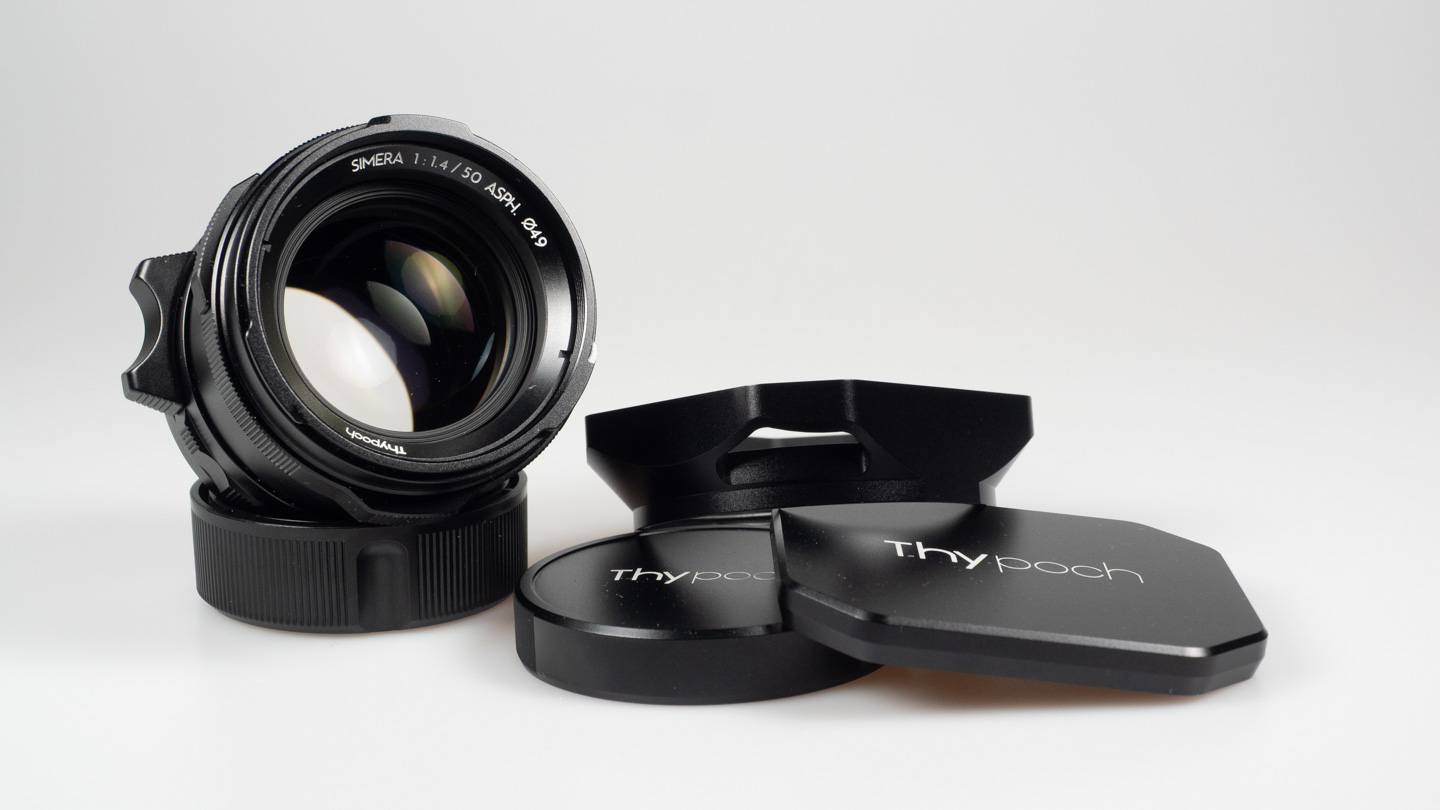
Thy . . . what? And Simera, wasn’t that this Japanese compact car back then? No, it wasn’t. But, right, the name Thypoch might not immediately ring a bell for you. It’s one of the newer lens brands from China, but it has created a pretty impressive line-up of M-Mount lenses. So, it’s about time to include them in the M Files. The Thypoch Simera 50/1.4 makes a start, and an article about the 28/1.4 will follow.
A fast 50mm lens is still, in my opinion, a must-have for the rangefinder photographer, and here, the Thypoch Simera 50/1.4 offers an interesting option. The focal length, combined with the f/1.4 maximum aperture, promises great versatility. You can use such a lens for portraits, but also for landscape and architecture if you want to focus on detail.
Why the 50 still has its place
It is no surprise that 50mm was a standard lens for general photography until we got more and more used to wider angles — not least because of smartphone photography, where a 28mm equivalent dominates. And for the rangefinder camera, in particular, 50mm is a focal length that is still easy to handle, unlike 75mm or 90mm.

Thypoch was, according to its website, founded “from a deep admiration for the timeless designs of the past”, and it claims a high level of mechanical craftsmanship. That’s “because we believe that a tool with soul and character holds more meaning than mere technical perfection.” So, is this all marketing prose, or is there something special about these products? This review tries to find out.
Thypoch Simera 50/1.4: A lens of today
Firstly, some etymology. “Thypoch” is, according to the company, a merger of “thy” and “epoch” — make of it what you want, but the company translates it as “your era” or “your time”. More interesting is “Simera”, the Greek word for today. So, the Simera product line is supposed to be contemporary, in the sense of modern design. It consists of fast f/1.4 lenses in the classic rangefinder focal lengths: 21mm, 28mm, 35mm, 50mm, and 75mm.
The modern approach clearly sets the Simera lenses apart from the same manufacturer’s Ksana (according to Thypoch, from an old Sanskrit word for “the fleeting moment”) range. This consists, at the time of writing, of two slower lens designs, a 21/3.5 and a 35/2, both with aspherical elements. Thypoch’s two Eureka lenses (28/2.8 and collapsible 50/2) are labelled as replicas of famous earlier designs.
But now, let’s finally look at the lens under review in this episode 31 of the M Files: the Thypoch Simera 50/1.4.
Technical data, scope of delivery, price, and availability
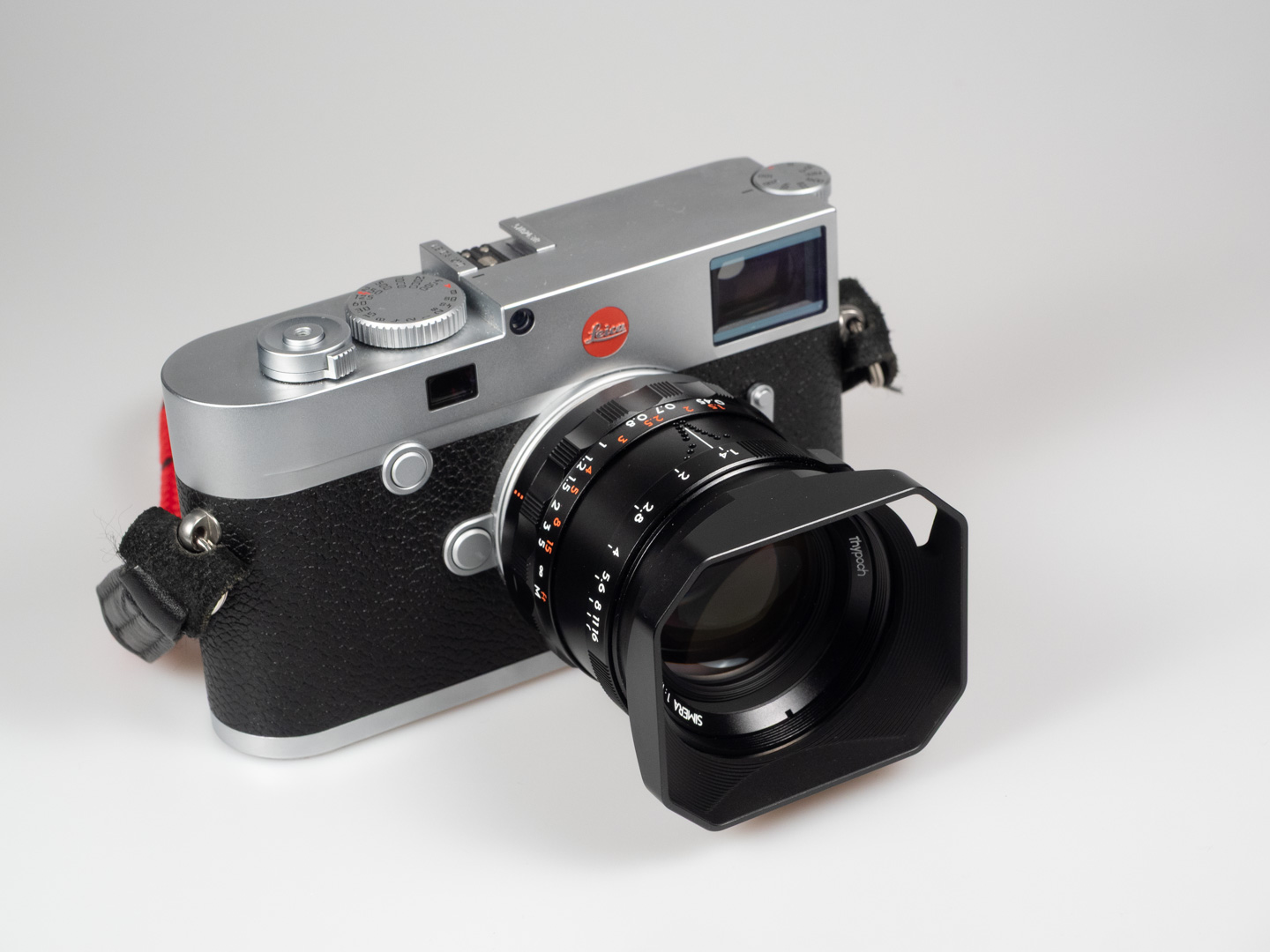
The Simera 50/1.4 is Thypoch’s signature product for the most famous focal length in the company’s fastest class of full-frame M-Mount primes. It is a rather complex design (see below), and you can guess that there was is quite some engineering involved. The lens first came out in August 2024 and has remained unchanged since, see here on leicalenslist.com. It is rather compact, at 53mm long (69mm with the supplied metal hood) and 59mm in diameter. Weight is 268g for the lens alone and 321g as-in-my-bag (with hood and both caps). The 49mm filter thread is shared across most of the Simera range, so one set of filters covers several lenses — a small thing, but I appreciate it.
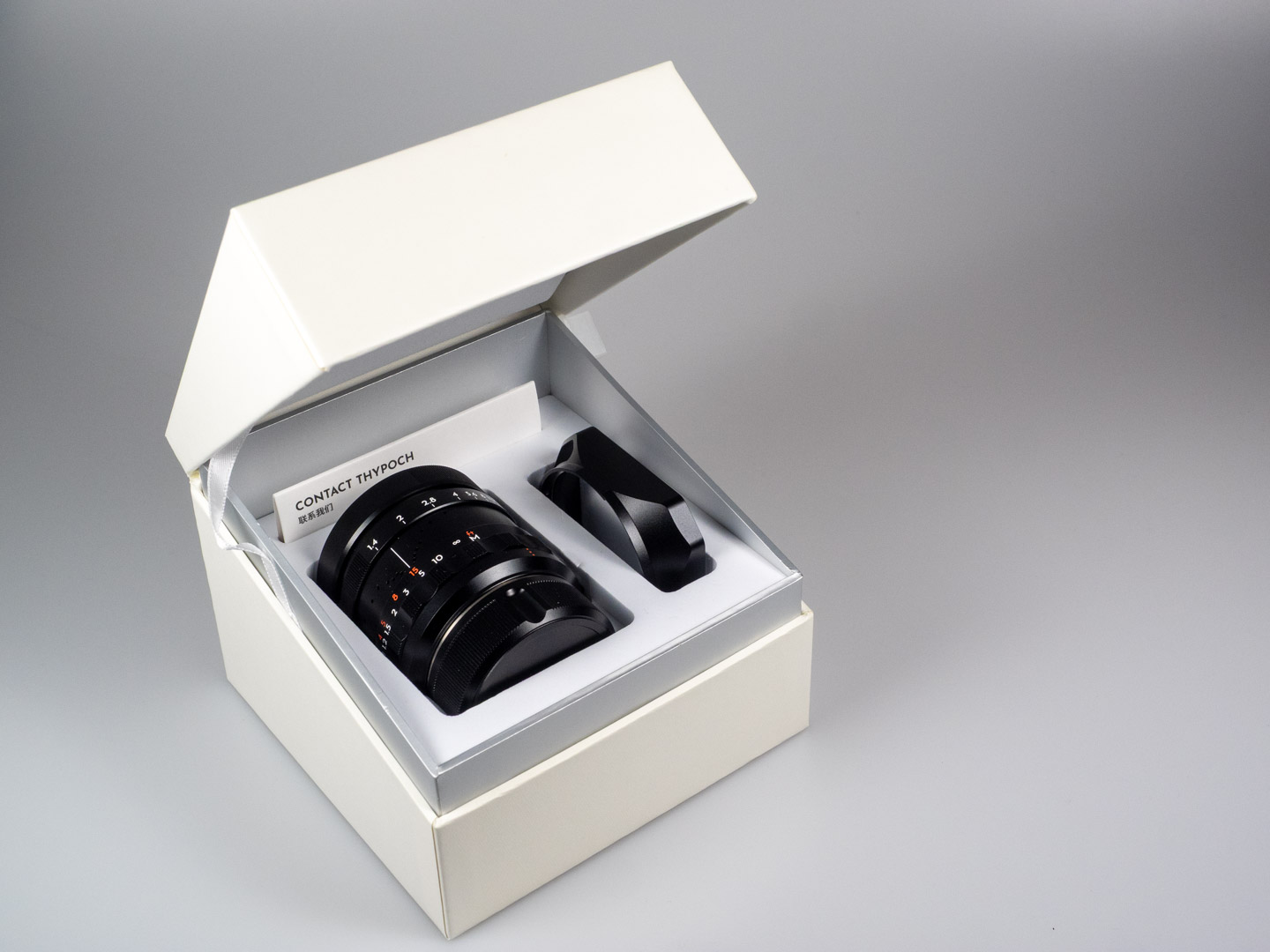
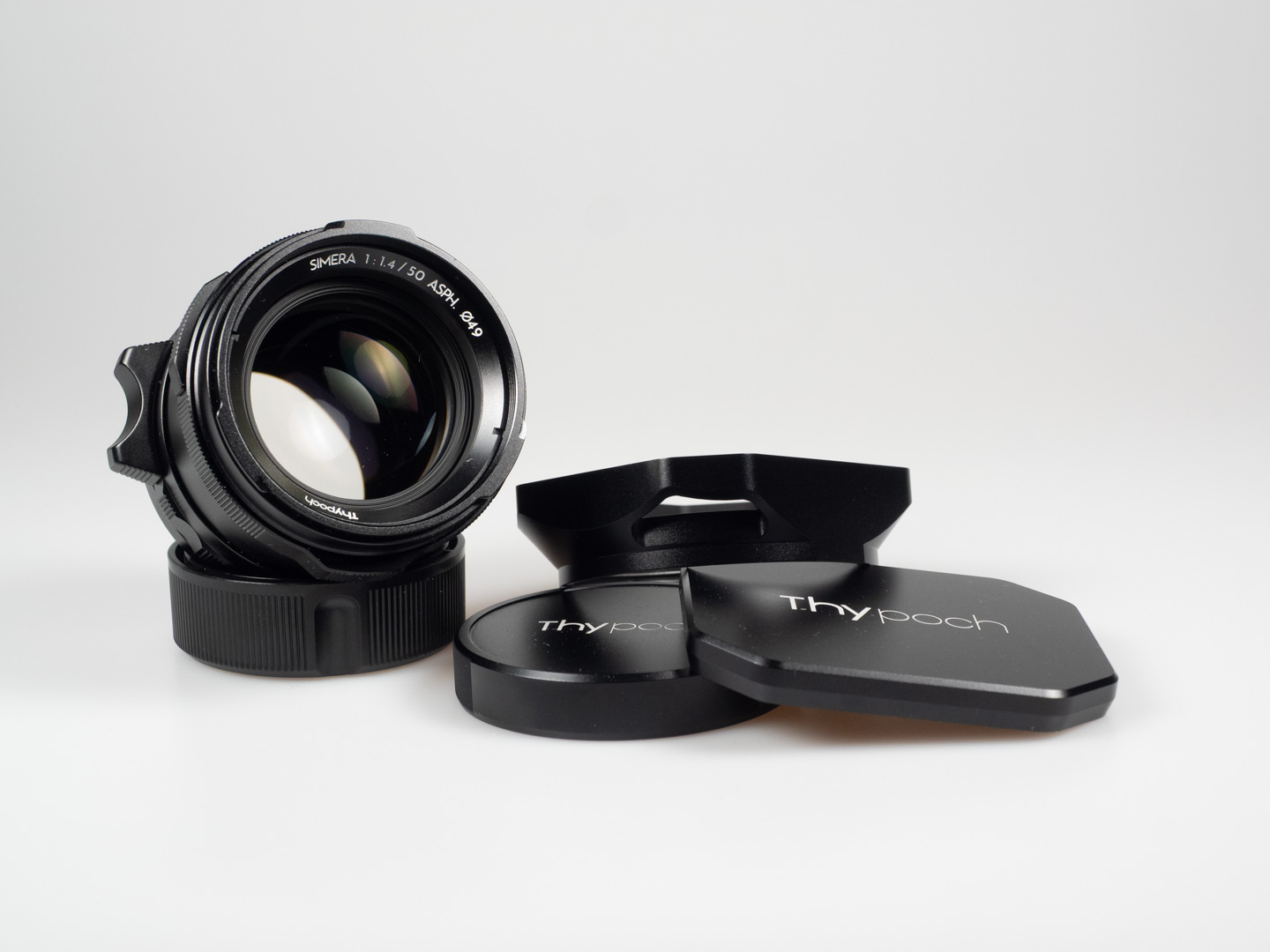
Scope of delivery is comprehensive: the lens, a round front cap, a rear cap, the metal hood — very much Leica-styled, but bayonet-mounted — and a second, square front cap with angled corners for use with the hood attached. Nothing extravagant, nothing missing, but it comes in a well-made box which tries to make the lens look somewhat luxurious. It strikes me as rather kitsch, but I guess some prospective customers will like it.
Price can vary, and at the time of writing the black version lists at £619 | $749 | €709, as supplied by Thypoch. Street prices may be lower, so comparing is worthwhile. The lens is available in both matte black and silver.
Optics and rendering
Lens design
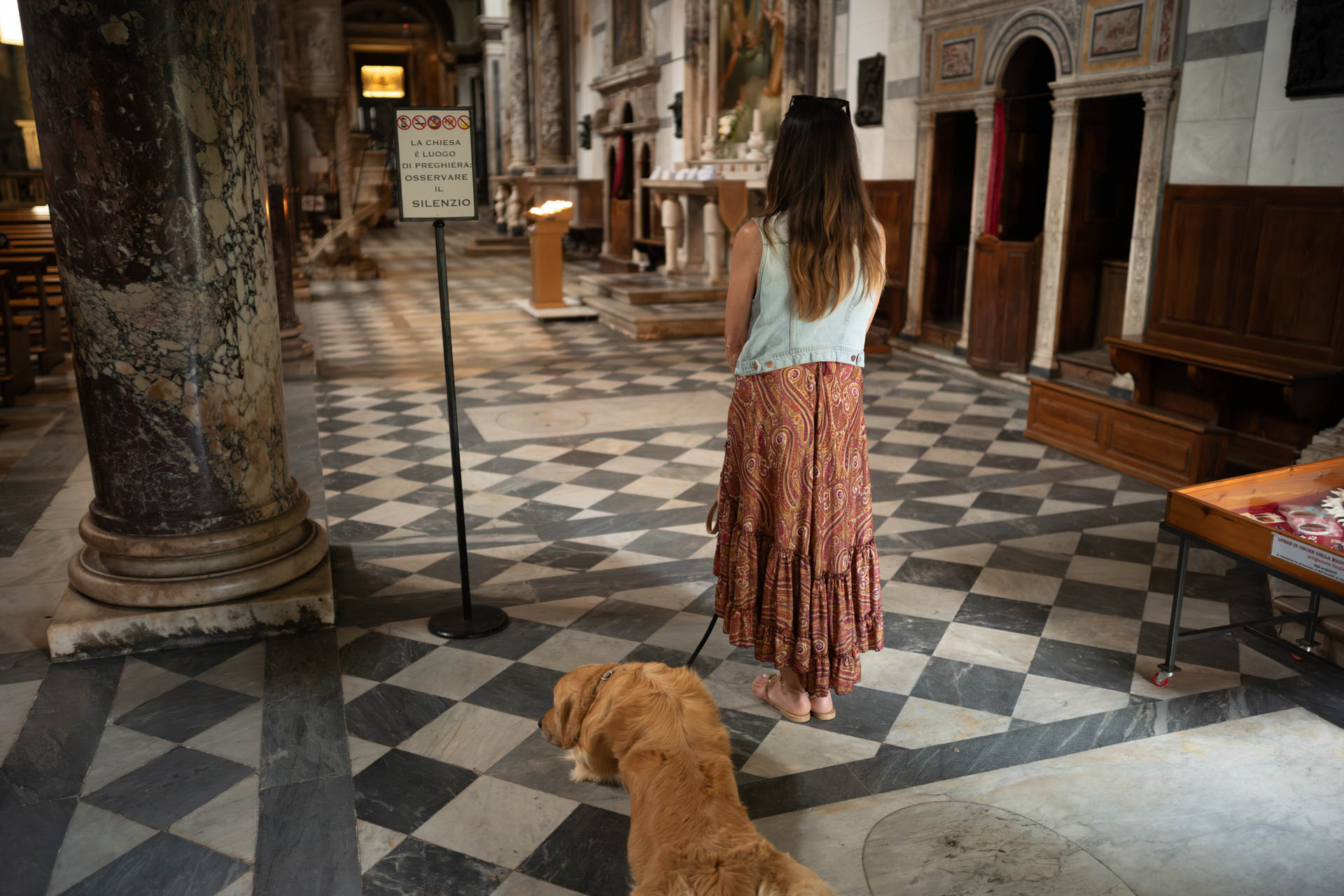
Built from eight elements in six groups — one aspherical, one ED, three high-refractive-index elements — the Thypoch Simera 50/1.4 is anything but a simple design. You could call it a thoroughly modern lens, and it echoes an interesting feature of newer Leica lenses. It focuses down to 45cm, with a noticeable click at the 70cm rangefinder limit. The presence of a floating element is further proof that Thypoch really pulled out all the stops for this lens design.
Colour drift and vignetting
Colour drift mainly appears with lenses that send light rays to the sensor at a very flat angle towards the margins. Often, this is visible as a green and magenta colour cast at the left and right edges of the image. A 50mm lens is, by principle, not particularly prone to this imaging error, and so it goes for the Thypoch Simera 50/1.4. Vignetting is as you would expect in a fast 50mm lens: wide open, there is a light fall-off off-axis, but it’s not dramatic at all.

Chromatic aberration
From a lens with such an optical design, you would expect low chromatic aberration. And in fact, I could find hardly any. Even the most notorious objects — a power line against a bright sky, say — are rendered with none or very, very little colour cast. This proves that lateral chromatic aberration is extremely well controlled. Indeed, I have not seen many better M-Mount lenses in this respect over the years. Purple or green fringing of out-of-focus elements (longitudinal CA) does occur, but not prominently. All in all, commendable marks for CA correction.
Sharpness
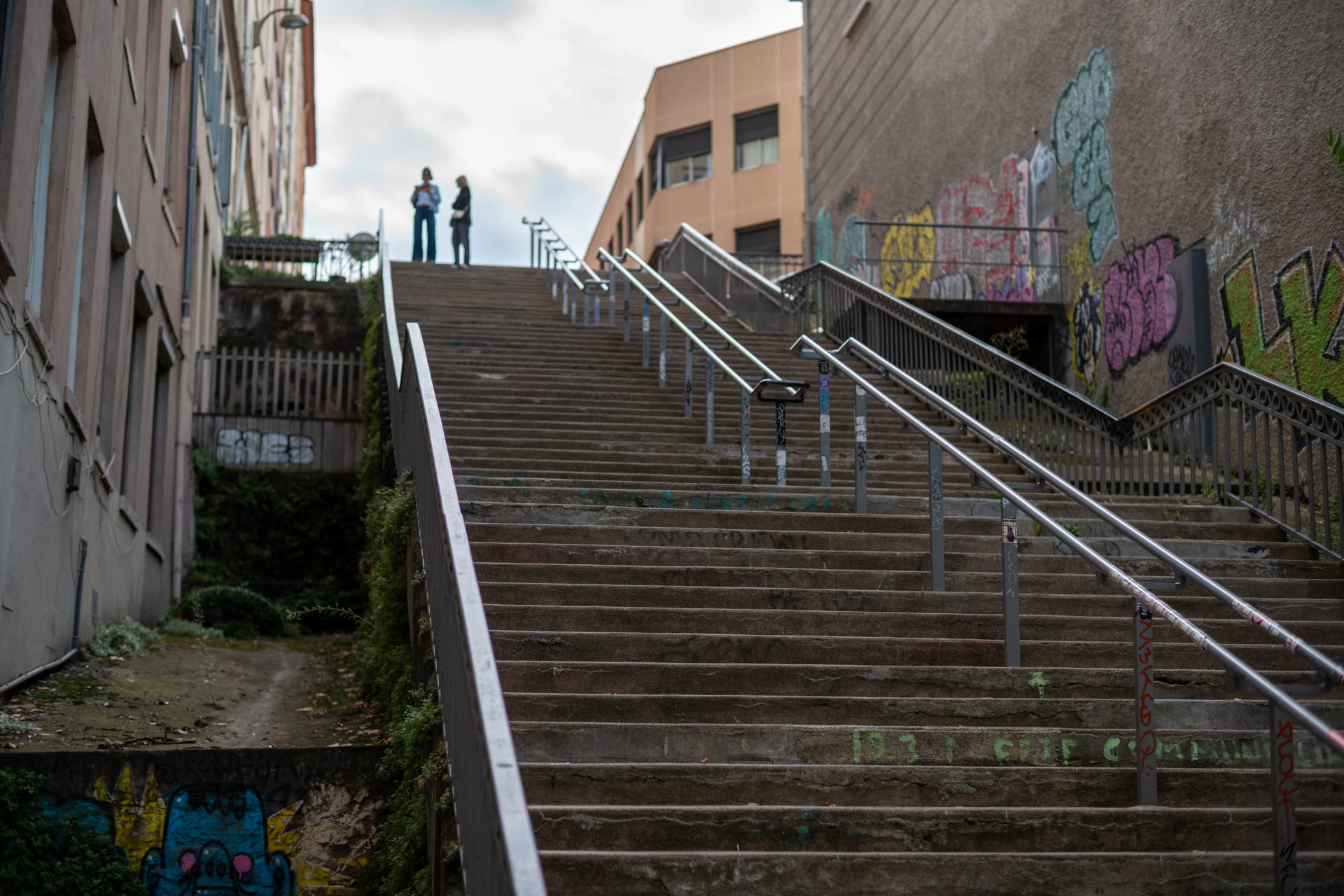
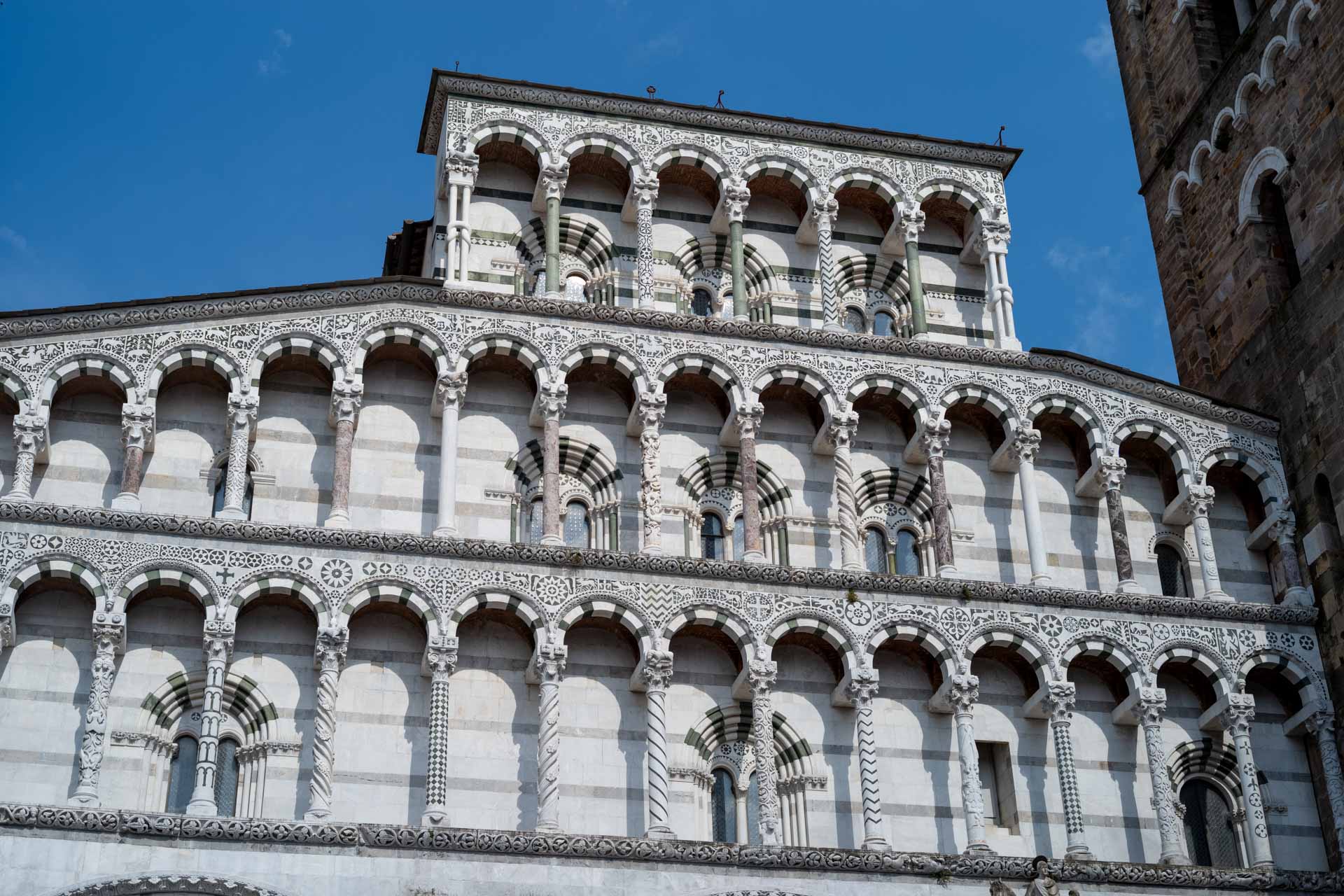
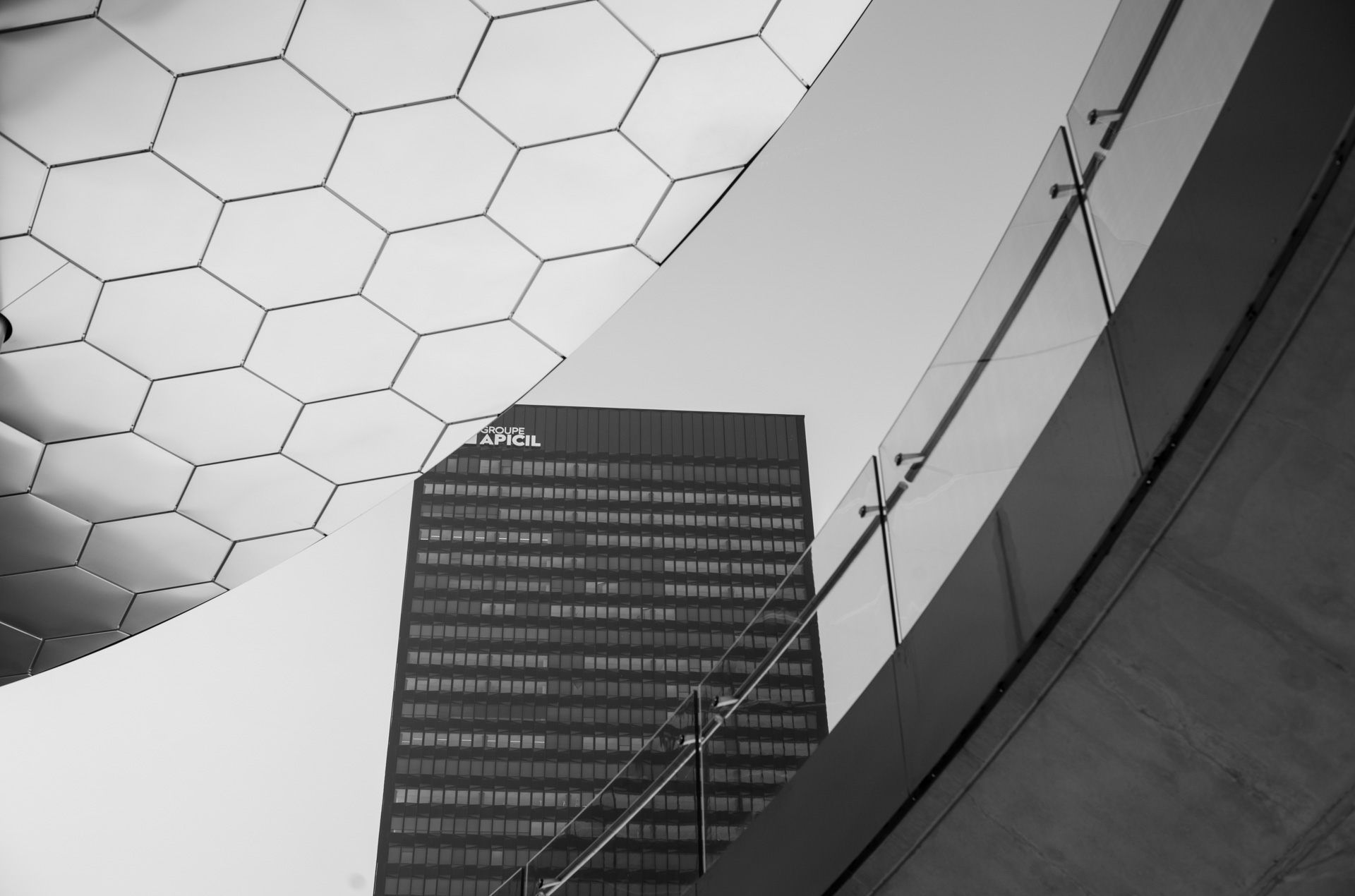
The Thypoch Simera 50/1.4 is sharp, period. It is extraordinarily sharp at close distance from f/1.4 until stopped down — somewhere around f/11 — visible diffraction sets in. It is very sharp at medium distances and at infinity too. Excellent resolution and good microcontrast play together very well here, creating an image full of nicely separated detail. This is pretty consistent from the centre to the corners, but for the very best off-axis performance, you might want to stop down to f/4 or so. However, there is no reason not to use this lens for landscape or architecture photography wide open if poor light makes that necessary.


Bokeh and flare
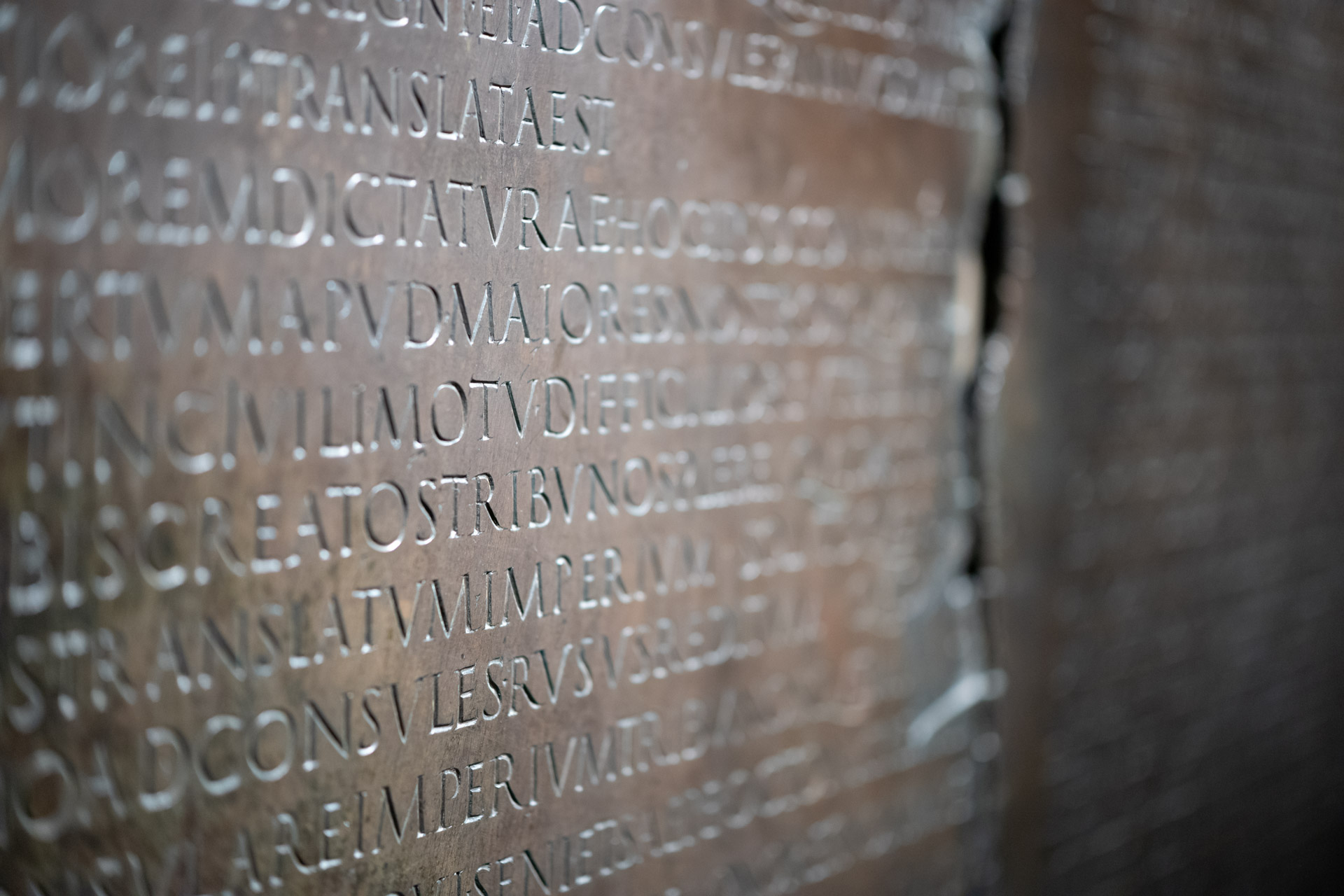
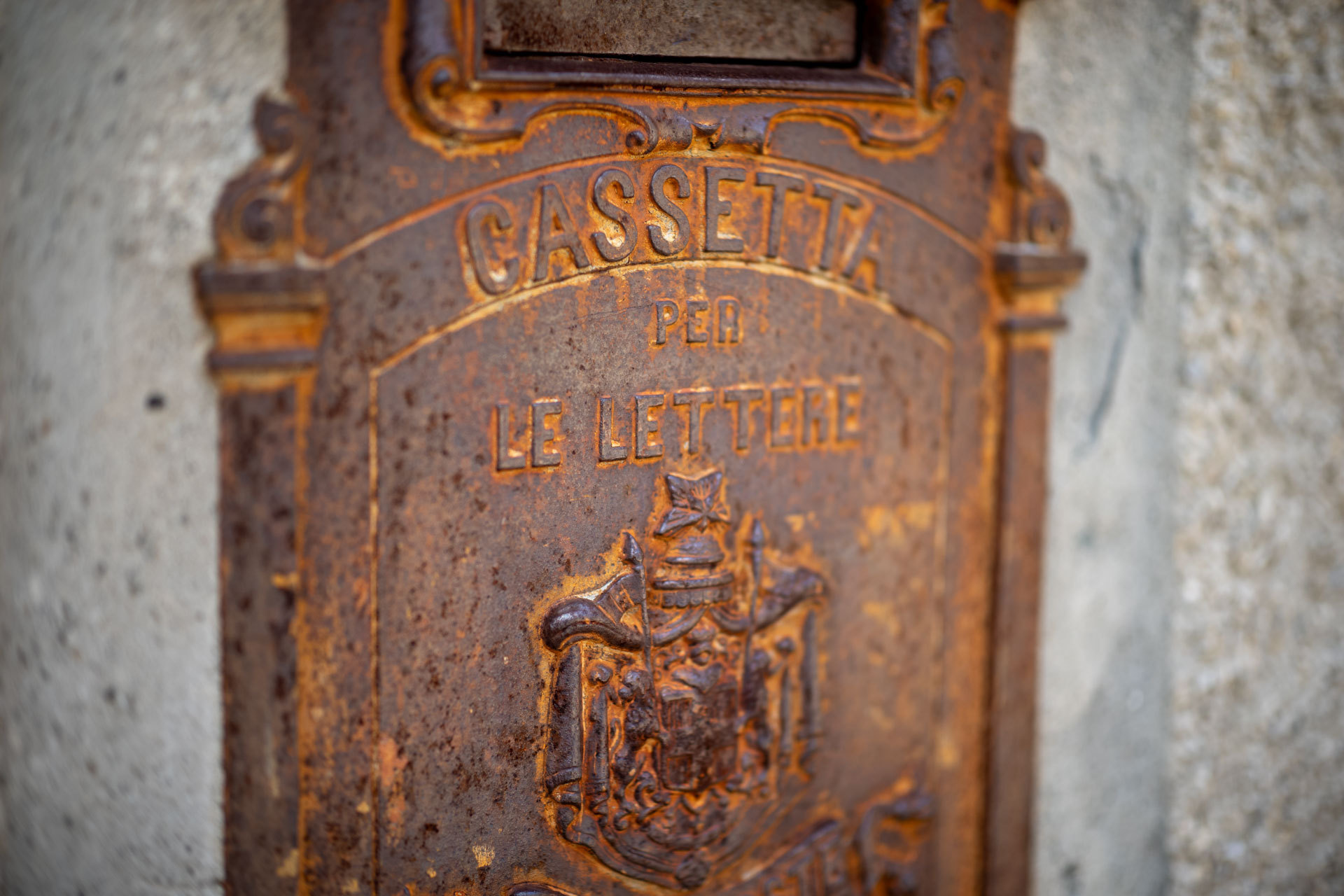
The play with depth of field is certainly the most important reason to buy an f/1.4 lens nowadays. Low-light performance of modern cameras is so impressive that a smaller and cheaper f/2 lens will do in almost all cases. And here, there is good news. The Thypoch Simera 50/1.4 handles the separation of sharp and out-of-focus areas very well, and unsharp fore and background are rendered beautifully. Some might call it creamy, others soft yet well-structured. For me, writing about bokeh is always a bit like writing about wine: the vocabulary is often weird and can’t convey the real impression. So just look for yourself and see if you agree with me in liking the bokeh.




Flare control is excellent — even trying hard, I could hardly induce any veiling or ghosting. This speaks for Thypoch’s lens coatings and deserves more than an honourable mention.
My verdict, optics
In my opinion, the Thypoch Simera 50/1.4 is optically an impressive lens, albeit a tad short of being excellent. While not entirely free of chromatic aberration, it scores for sharpness, especially at short distance and from wide open. This is quite something, also given the price point. Furthermore, the Simera’s resolution is certainly good enough for sensors far above the 24MP of the Leica M10 — proven by the images captured with the much higher resolution sensor of the Leica M10 Monochrom (40MP, and no Bayer filter to boot).
Mechanics and handling
Overall appearance
The Thypoch Simera 50/1.4 is neither particularly small and nor particularly large. The lens sports a knurled distance ring as well as a focus tab, so you will feel comfortable with either way of setting distance, according to your preference. With design elements from the 1950s (the focusing ring) and the 2010s (the lens hood), the product design seems a bit eclectic.
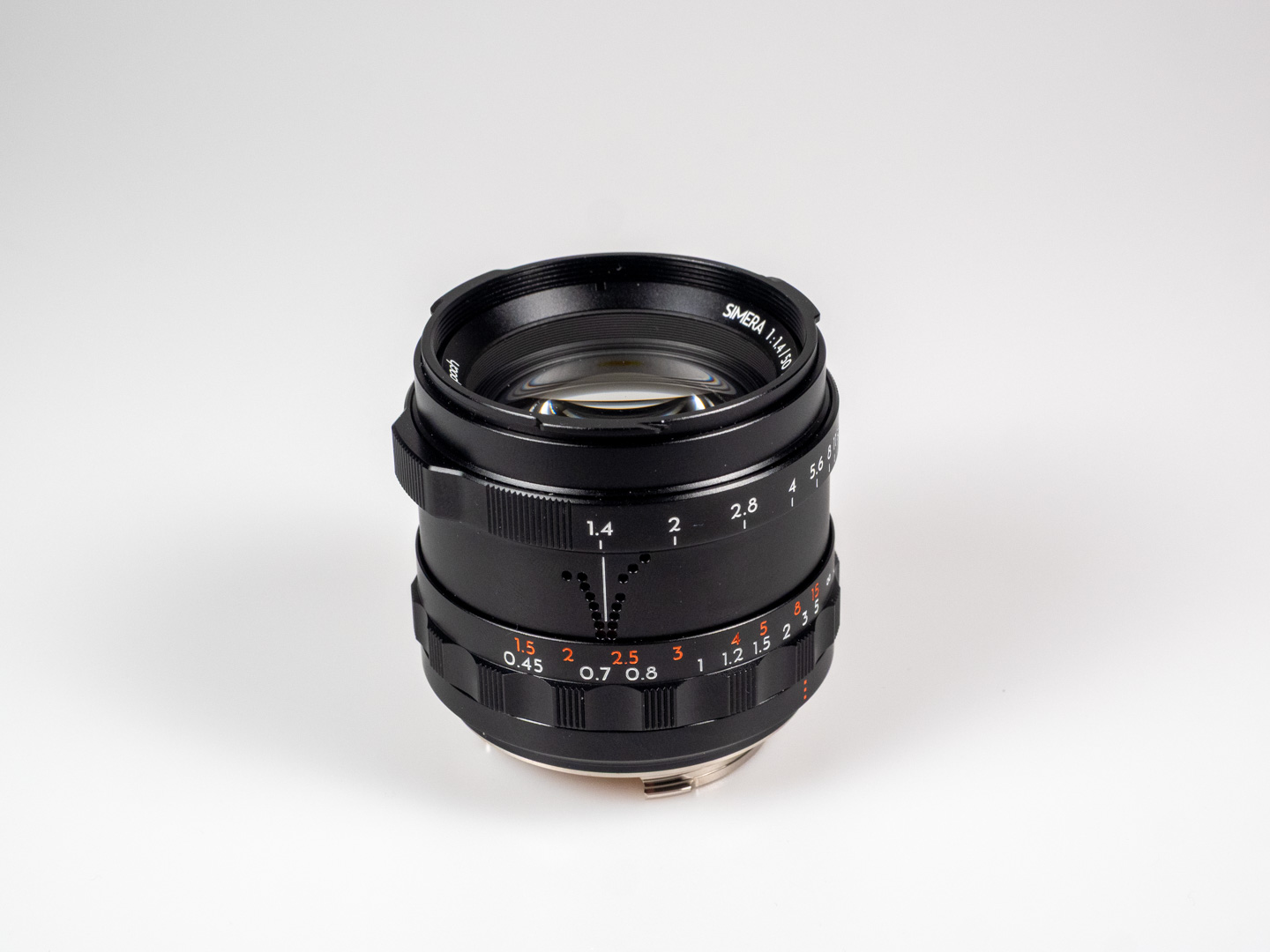
Lettering is beautifully engraved in white (feet scale in red). What’s missing, though, is the focal length number somewhere on the barrel. If you own several Simeras, you always have to take the front cap off to see whether it is the 28, the 35, or the 50 — so similar are they.

What stands out is the inconsistency in the aperture ring. The distance between the full stops gets smaller from wide open to closed. Furthermore, there are one-third stops from f/1.4 to f/5.6, a half-stop between f/5.6 and f/8, and no intermediate steps at all to the minimum aperture of f/16.
The Thypoch Simera’s most unusual feature, however, is its depth-of-field indicator. Where almost all other lenses use a simple engraving, our candidate makes red dots appear, depending on the selected aperture. This echoes the 1950s Visifocus design by the Swiss manufacturer Kern. The trade-off is a rather shallow focus ring. I don’t mind, but I can’t see a big advantage in the extravagant feature either. The red dots do not really stand out against the matte black barrel, this might work better on the silver version of the lens.
Build quality
The lens certainly makes a very solid impression, made of metal and glass only. Both caps — a round one for use without the hood, and a square one for use with it — are made of solid metal. The same is true for the lens hood itself. All in all, the lens is an impressive piece of kit to handle and compares well with M-Mount lenses from other, more expensive manufacturers. The people at Thypoch have done their homework.
Focusing
As mentioned, the lens sports a knurled ring and a focus tab. The six o’clock position corresponds to a distance setting of about 1m, as in many rangefinder lenses. The ring rotates very smoothly, well damped but not too sticky. The focus throw of just under 90 degrees from 70cm to infinity allows you to adjust it accurately enough. But … the lens focuses down to 45cm, with floating elements in action — closer than most native Leica 50mm options manage. But then the throw between 45cm and the rangefinder-coupled 70cm is very short, so focusing is not that easy. On the positive side, there is a very helpful click at the rangefinder limit.



Viewfinder
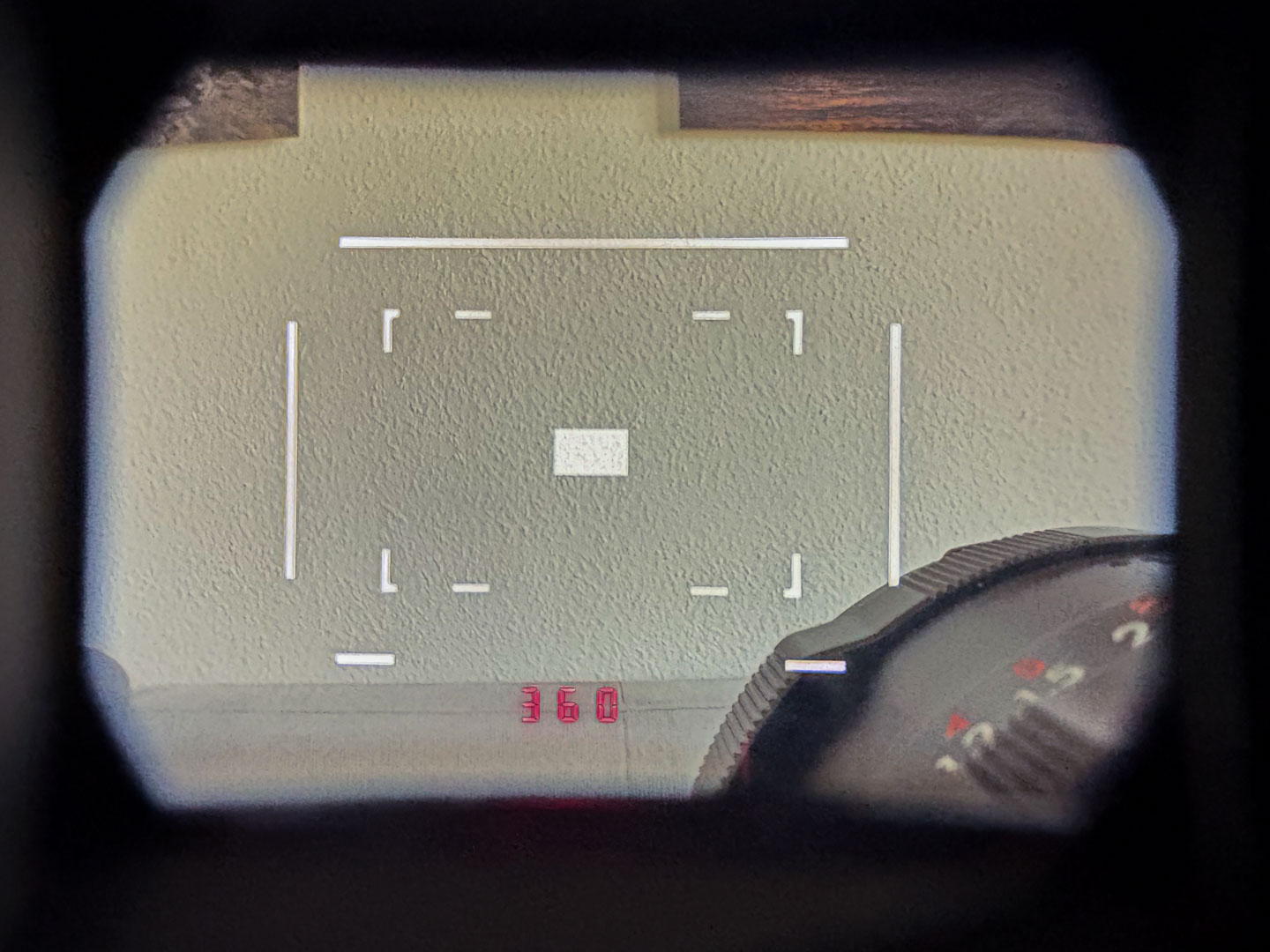
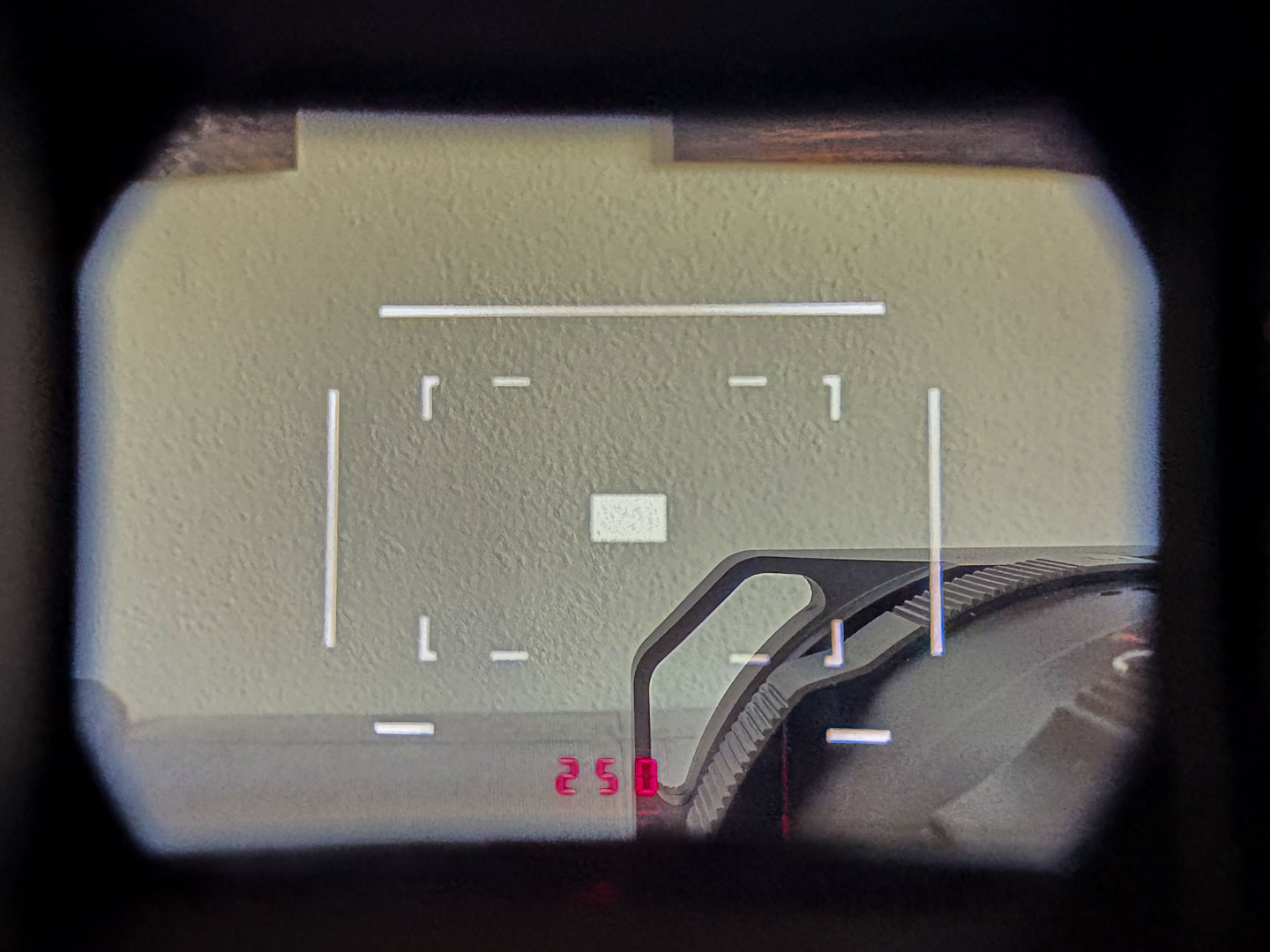
There is some rangefinder obstruction, despite the 50mm frame lines in a typical rangefinder camera leaving lots of space. The amount of “invisible” space is minimal without the lens hood and at infinity, but amounts to about 15 per cent with the hood attached at 0.7m. The cut-out in the hood’s top-left corner helps a lot here. That’s well-designed.
My verdict, handling
While really well-built and coming at a reasonable size and weight, the Thypoch Simera 50/1.4 has its weaknesses more on the handling side than in optical performance. The depth-of-field indicator is certainly a nice idea, but I can’t see it as a real improvement over the standard solution. Furthermore, the unevenly graduated aperture ring is no masterpiece in terms of ergonomics. But you can certainly work with this lens, not least because focusing is easy both with the knurled ring and the provided tab.
Alternatives to Thypoch Simera 50/1.4
As we all know, fast 50mm M-Mount lenses are legion. The Thypoch Simera stands out for featuring a floating element and a 0.45m close focusing distance at a reasonable price. What are the alternatives?
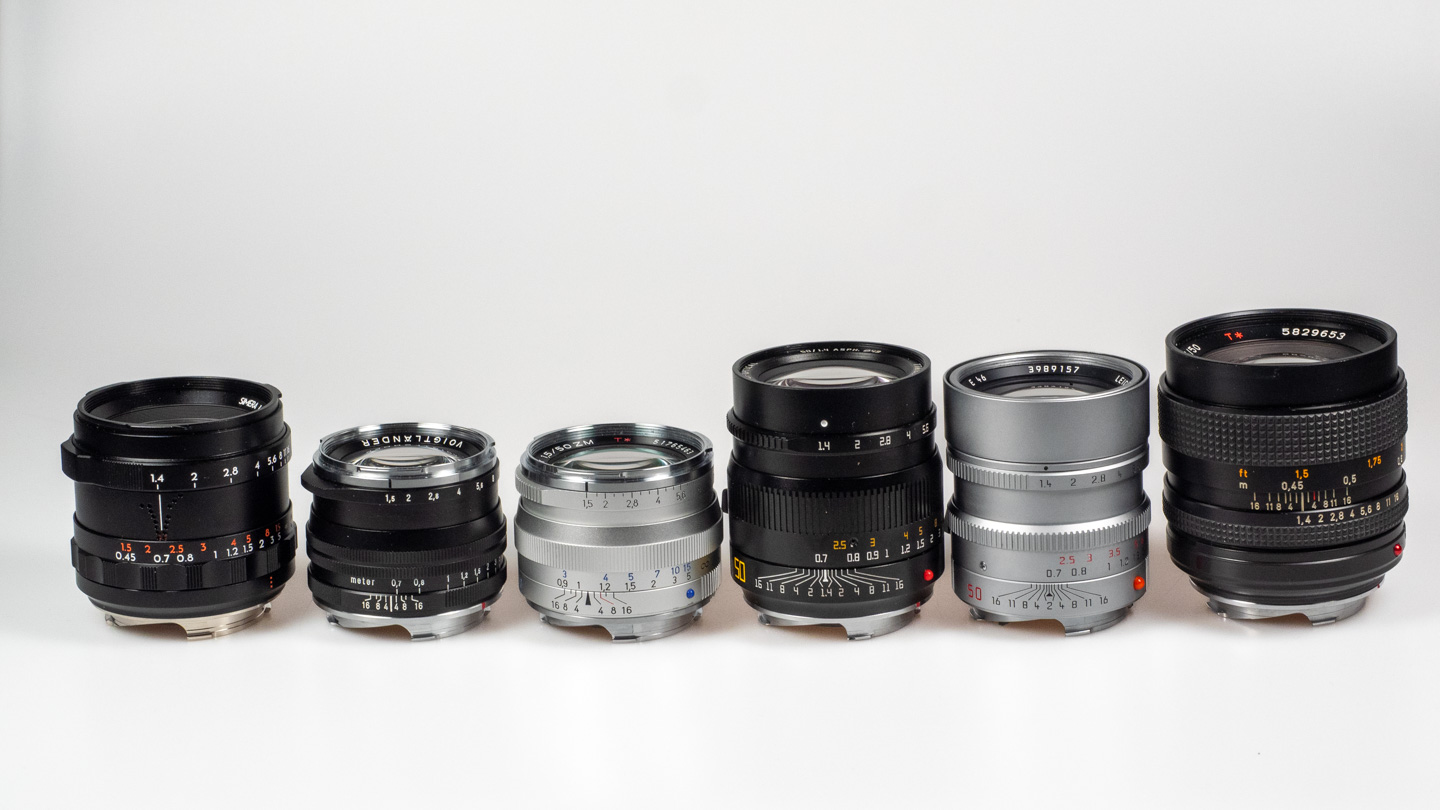
Leica’s Summiluxes come to mind first. There are several generations of the classic 50/1.4, and the ASPH. design from 2004 has a particularly good reputation. It now comes in a newer iteration with a 0.45m close focus distance. These lenses show, as even Leica’s legendary lens designer Peter Karbe has pointed out, excellent rendering and close to APO performance. However, this comes at a price — the current 50mm Summilux retails at €4,850. That is almost seven times the price of the Thypoch. But then you get a smaller and overall better lens with tremendous value retention.
Don’t forget Voigtländer and Zeiss
Other fast fifties include the current Voigtländer Nokton 50/1.5 VM. This is an extremely versatile, small and quite affordable (€899) lens — see episode 27 of the M Files for a full review. Another fast 50 for M-Mount still available new is the Zeiss Sonnar 50/1.5 ZM (€899). This is certainly a controversial lens: it can show excellent results while also having quite some issues. Read more in episode 29 of the M Files.
And there are even more options
More for the sake of completeness, I also want to mention the excellent Zeiss Planar 50/1.4 from the Contax/Yashica SLR system, in a marvellously made conversion by Skyllaney in Scotland (see M Files episode 15 for details). Another 50/1.4 comes from TTArtisan, a very affordable option at €399. I can’t say anything about it, however, since I have not tested it so far.
The bottom line: My verdict of the Thypoch Simera 50/1.4
Is the Thypoch Simera 50/1.4 the one fast 50 to go for, then? It is a versatile lens with very good performance, for sure. Its wide-open rendering belongs to the best in class, and flare control is excellent too. However, the Simera does have some handling issues, especially with its pretty useless depth-of-field indicator. All in all, I would personally prefer the compact and yet competent Voigtländer Nokton. But it is a closer shave than you might think.
If a fast 50 is, maybe, your only rangefinder lens, or if you are looking for your one and only 50, investing in an original Leica lens is certainly also worth a thought. It could well be an investment for life. But you can’t go wrong with the Thypoch Simera 50/1.4 either. It is an all-rounder. Whether it is the all-rounder is up to you to decide.

The M Files: Get in-depth knowledge of M-Mount lenses, cameras, and compatible accessories
The M Files is an ongoing project on Macfilos that focuses on photographic equipment with or for Leica M-Mount, made by companies apart from Leica or which are otherwise not part of Leica’s M system. It follows a more or less encyclopaedic approach without being scientific. The focus is always on the real-life use and usability of cameras, lenses and other items. Products covered by The M Files include cameras, lenses, viewfinders, light meters and more. Brands on the growing list include Contax, Konica, Minolta, Rollei, Voigtländer and Zeiss.
Click here for the M Files Navigator, which gives you easy access to all articles and reviews by product type and brand.
Die M-Files: M-Mount-Objektive, -Kameras und passendes Zubehör jenseits von Leica M
Die M-Files sind ein Langzeit-Projekt, das sich auf Foto-Ausrüstungsteile mit oder für Leica M-Bajonett konzentriert, die von anderen Firmen als Leica hergestellt wurden oder die nicht zum M-System von Leica gehören. Es verfolgt einen mehr oder weniger enzyklopädischen Ansatz, ohne wissenschaftlich zu sein. Der Schwerpunkt liegt immer auf der praktischen Nutzung von Kameras, Objektiven und anderen Produkten. Zu den in den M-Files besprochenen Produkten gehören Kameras, Objektive, Sucher, Belichtungsmesser und mehr. Einige der Marken auf der wachsenden Liste sind Contax, Konica, Minolta, Rollei, Voigtländer und Zeiss. In deutscher Sprache erscheinen die Inhalte auf www.messsucherwelt.com.
Hier geht es zum deutschsprachigen M-Files Navigator, der einen einfachen Zugang zu allen Artikeln und Reviews nach Produkttyp und Marke ermöglicht.
Make a donation to help with our running costs
Did you know that Macfilos is run by six photography enthusiasts based in the UK, USA and Europe? We cover all the substantial costs of running the site, and we do not carry advertising because it spoils readers’ enjoyment. Any amount, however small, will be appreciated, and we will write to acknowledge your generosity.
Many thanks and kudos for the detailed report on the latest Asian alternative to the lenses from Wetzlar.
I cannot judge the performance specifications. What does surprise me, however, is that—with the exception of Voigtländer—none of the Asian manufacturers offer focal lengths that differ from the Leica lineup. I am thinking of 16mm, 18mm, 24mm, 100mm (or 105mm), or 135mm. To me, this feels like the tenth alternative offering the 28mm, 35mm, and 50mm focal lengths; consequently, I don’t feel particularly curious about taking a look at any of these lenses.
The Laowa 15mm f/2 is one of my favorite lenses to shoot with. It’s only one millimeter off from 16!
Dear Arthur, thank you for your comment. To be honest, I was not even aware of the fact that this lens is existing, so I appreciate this very valueable information.
Dear Olaf,
this is an interesting question because it touches the topic of innovation and courage. I think, you can’t judge the “Asian alternatives” just by the focal lengths they offer. Some use well-known designs, some are trying new things. In M-Mount, the limitations of the rangefinder rule the focal lengths in my opinion. If your camera only supports 28, 35, 50, 75, 90, 135 the niche for something in between might just be too narrows (and there are no existing designs to study, adapt, copy). The number of M-Mount users who are willing to work with an additional electronic viewfinder, or the display of a camera at arm’s length – might be pretty limited.
But it’s still an exciting thought. We see so many interesting focal lengths for the big mirrorless systems, such as 20-60 or 50-130 zooms or 35 macros. Interesting times.
All the best, Jörg-Peter
Dear Jörg-Peter,
Thank you for your message. I agree with you that there are focal lengths specific to rangefinders. On the other hand, there is now the M-EVF, and the Visoflex has been around for a long time; in my—admittedly non-representative—view, it sees frequent use, making those “unconventional focal lengths” quite practical to use.
Leica has just recently introduced a “non-standard focal length” with the new 66mm lens (admittedly, likely more of a collector’s item), and the prices for used lenses like the 24mm f/1.4, 16-18-21mm, and 21mm f/1.4 suggest to me that there is a market for them.
Regarding 40mm: Voigtländer sells this focal length very successfully for various mounts. And while the Q3 43 isn’t strictly a 40mm lens, it serves as proof that such a concept can work.
Of course, every photographer has their own preferences—preferences that often aren’t enough to justify commercially viable production. I can therefore understand why it seems easier to stick to traditional rangefinder focal lengths. At the same time, I wonder who is supposed to buy all these lenses; rangefinder cameras aren’t exactly mainstream products, and it’s not as if owners of these cameras were simply waiting for alternative lenses to appear. In any case, it’s an irresolvable philosophical debate, but certainly a genuine challenge for a manufacturer like Leica.
Another wonderful review, the sample shots really show what the gear can do in real conditions. Love the depth of these write ups. Thank you!
Thanks, Hazel, glad you enjoyed it! Jörg-Peter
Excellent in-depth write up, the attention to detail here is remarkable. This is exactly the kind of thorough coverage that keeps me coming back. Thank you!
And it seems you are exactly the kind of reader we love to see coming back, Rosa! We are doing all this in our spare time, and it’s great to see that people find it useful, entertaining, sometimes even thought-provoking. Do recommend Macfilos if you know fellow photographers who might be interested. Tanks! Jörg-Peter
I will not purchase a lens made in China. China is well known to copy designs from other countries. I once worked at a high tech company that China stole from the company and then put a cheaper product on the market and killed the Canadian company. This is common practice with China.
Hi Brian,
While you are entitled to your views, here isn’t the place to air them. As you know, we don’t allow political comment and the only reason I didn’t delete your comment was because you are a long-standing reader. We have more tests of Thypoch, Viltrox, TT and LLL lenses and we look at them on their technical and commercial merits. We’ll leave political aspects to other forums.
Mike
Of course you can remove my comment.
I did not perceive it as political.
That’s ok Brian.