
Macfilos authors and readers love the Leica Q3 43, especially its 43mm focal length. It’s an impressive piece of kit, but will cost you almost $8,000. The recently launched Viltrox Air 40mm f/2.5 offers an inexpensive way to add a comparable focal length to your L-Mount kit. But does it run the risk of being neither fish nor fowl?
Viltrox Air 40mm f/2.5
For the last several weeks, I have been shooting with a Viltrox Air 40mm f/2.5 lens. It is part of a suite of lenses Viltrox introduced recently. We posted an article about the series launch, and Mike Evans has published a detailed review of another member of the series, the Viltrox Air 50mm f/2.
Mike and I each had the chance to pick a lens from the series for testing. Mike, the traditionalist, who likes to play it straight down the middle, chose the 50mm. I grabbed the opportunity to try out a quirkier focal length and chose the 40mm.
My rationale? It has a similar focal length to the lens on the Leica Q3 43.
As the owner of a Leica Q2, who enjoys shooting with a 28mm lens, I have been surprised by the enthusiasm surrounding the Q3 43, and its odd focal length. It has always seemed rather gimmicky. A marketing ploy. Neither fish (35mm) nor fowl (50mm). A camera for the infuriating undecided voter who has $8,000 burning a hole in their pocket.
I thought shooting with this new Viltrox lens might help me understand the attraction of this in-between focal length.
Almost but not quite
The Viltrox 40mm has an angle of view of approximately 58 degrees. That is a bit wider than the Q3 43, but in my view close enough to draw some conclusions about shooting at this focal length.

I took a few shots with the lens mounted on a Leica SL2. But I thought this compact, lightweight lens was better suited to a smaller camera body. So, I shot mainly with the Viltrox on my six-year-old Lumix S5.
Here is a quick comparison of the S5/Viltrox kit and the Q3 43.
| Lumix S5 + Viltrox Air 40mm f/2.5 | Leica Q3 43 | |
|---|---|---|
| Price | About $1,600 | $7,950 (B&H, September 2026) |
| Sensor | 24MP full frame | 60MP full frame |
| Lens | 40mm f/2.5, 10 elements in 6 groups | 43mm f/2 APO-Summicron, 11 elements in 8 groups (7 aspherical) |
| Close focus | 0.34m | 0.6m (0.27m in macro mode) |
| Crop modes | Crop in post only | 60mm, 75mm, 90mm, 120mm, 150mm |
| Card slots | Two | One |
| Rear screen | Fully articulating | Tilting |
| Weather sealing | Splash-resistant body; coated front element only | IP52 |
| Weight (with hood and battery) | 890g | 795g |
| Interchangeable lens | Yes | No |
I was able to fit each of these kits into my small Billingham 72 camera bag.
Design and build
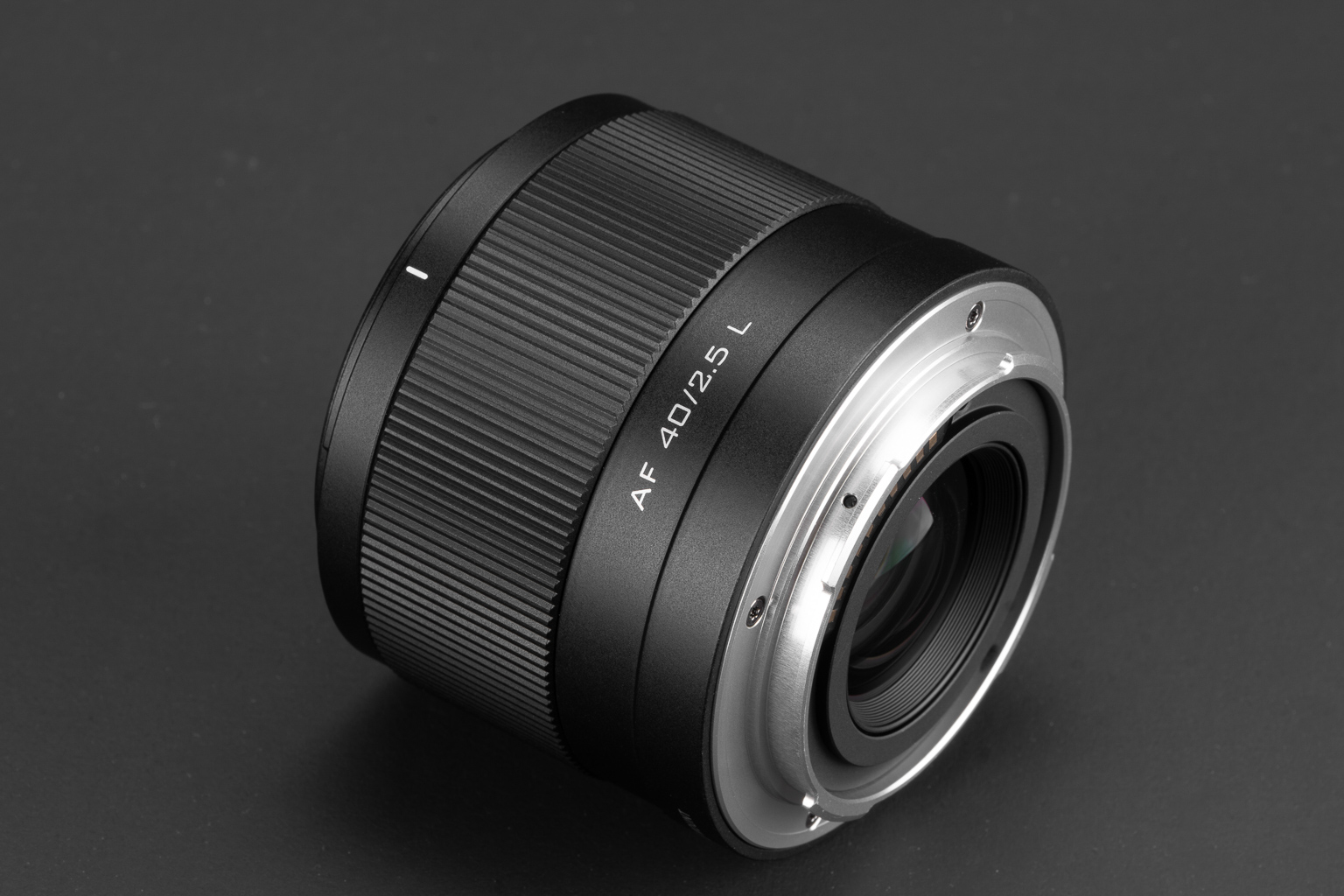
The lens barrel of the Viltrox Air 40mm f/2.5 is a polycarbonate composite on a metal mount. It has only a focus ring, with no manual/autofocus switch or function button. Viltrox supplies the lens with a twist-on petal hood. The lens weighs just 169g. At 64mm in diameter and 52.5mm long, it barely clears the S5’s grip.
The focus ring works by wire, with no hard stops at either end, so zone focusing by feel is out. That’s common for budget lenses. Viltrox has, however, built a USB-C port into the mount for firmware updates: a surprising feature on a $168 lens, but consistent with other Viltrox lenses I have tested.

Weather protection amounts to a water- and dust-repellent coating on the front element. The S5 body is splash-resistant, but I wouldn’t trust the lens in a real downpour.
Official spec sheet
Here is what Viltrox publishes for the L-mount version:
| Specification | Viltrox Air 40mm f/2.5 (L-mount) |
|---|---|
| Focal length | 40mm |
| Aperture range | f/2.5 to f/16 |
| Aperture blades | 7 |
| Optical construction | 10 elements in 6 groups (1 ED, 3 high-refractive, 1 aspherical) |
| Angle of view | 57.8° |
| Minimum focus distance | 0.34m |
| Maximum magnification | 0.14x |
| Autofocus motor | STM stepping motor with lead screw |
| Filter thread | 52mm |
| Dimensions | 64mm × 52.5mm (diameter × length) |
| Weight | 169g |
| Weather resistance | Water- and dust-repellent coating on the front element |
| Price | $168 (Viltrox store) |
Handling
The small size and light weight of the lens make it a comfortable everyday-carry option when paired with a similarly compact, lightweight camera body.
On the S5, the pairing balances neatly. The lens adds so little weight that the camera does almost all the work.
With no switch on the barrel, you set the focus mode on the camera. The S5 has a dedicated switch on the rear, toggling between AFS, AFC and MF. All three modes engaged correctly. In MF mode, turning the focus ring automatically opens a magnified view in the EVF or on the rear screen as a focusing aid.
On the SL2, the lens looks small, but handles perfectly well. It’s an inexpensive way to give the big Leica a light, discreet standard lens.
Autofocus
The autofocus is fast and silent, and I had no difficulty locking on to subjects with either the Lumix S5 or the Leica SL2.
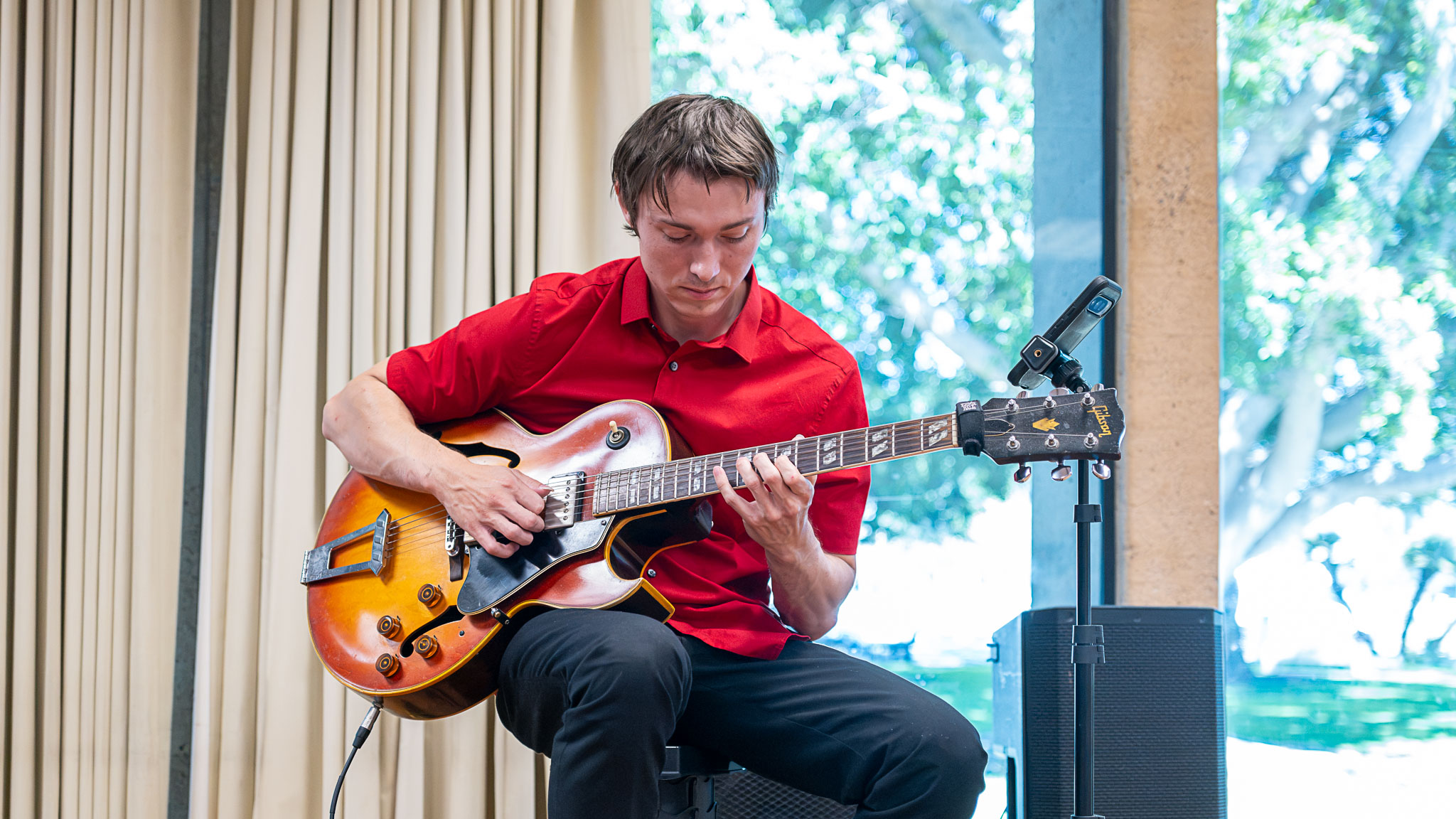
The lens uses a stepping motor driving a lead screw, which explains the near-silence. More useful is the hit rate. With the lens mounted on the SL2 at f/2.5, I photographed a group of road cyclists riding towards me. The lead rider’s face and helmet came out crisply focused. Indoors, at a gallery opening, a harp performance and an acoustic guitar set, at ISO 800 to ISO 5000, it locked on without fuss.

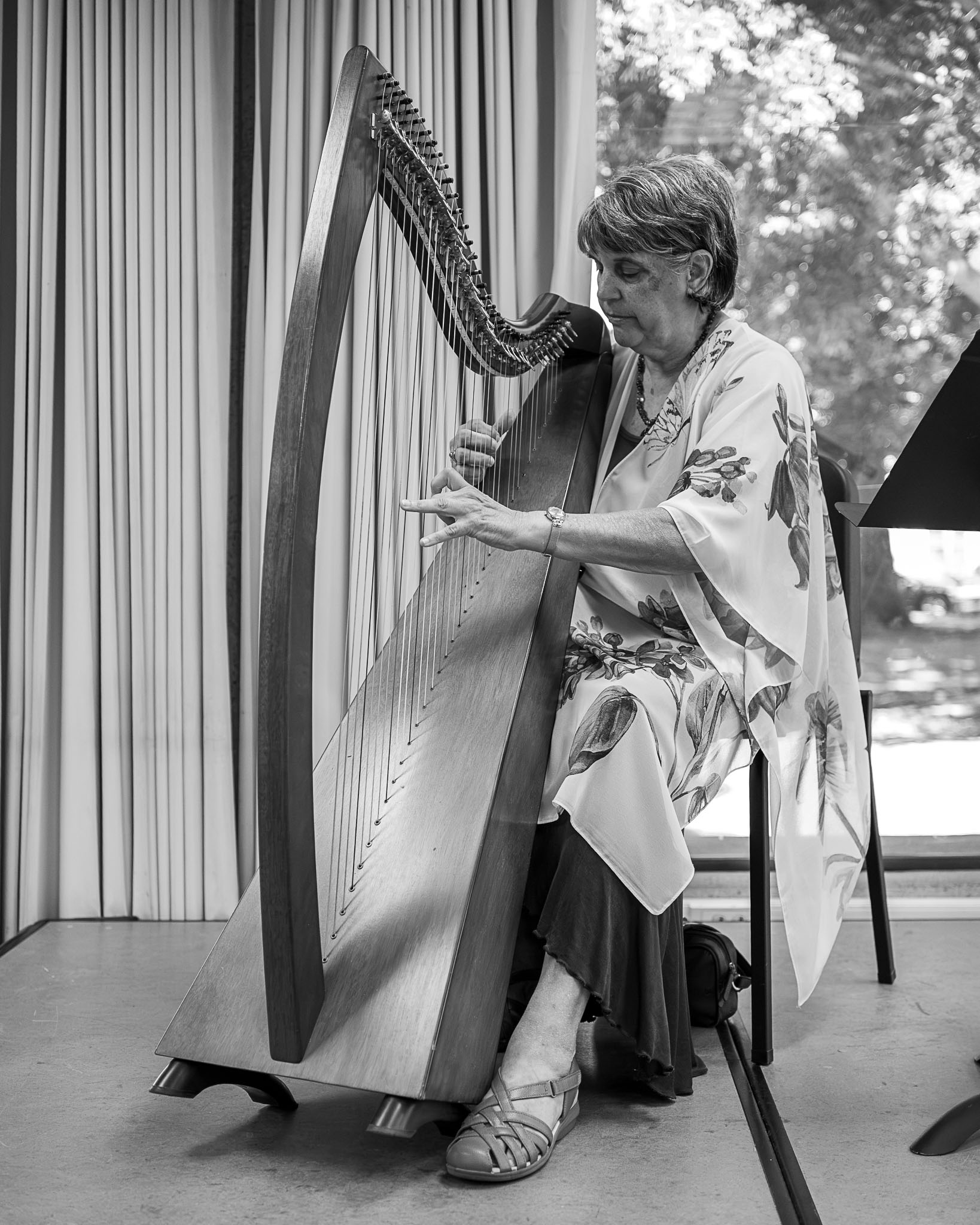
Only two of the example frames missed, and then only narrowly. The harpist’s face is a touch softer than the harp neck just in front of her. In the cycling shot, the second rider sits just behind the plane of focus. To my eye, both look like the camera’s wide-area AF choosing the nearest high-contrast target, and so not a fault in the lens.
Image quality
I judged the lens on around a dozen frames from real outings (street scenes, a harbour ferry, live music and gallery openings) mostly with the 24MP S5 and occasionally the 47MP SL2. I shot most of them wide open because photographers typically want to know how a lens performs at its widest aperture.
Two things can be dealt with quickly. Distortion is so low that a long shop shelf running across the full width of the frame stays dead straight, with no correction. Vignetting is moderate at f/2.5, visible in the corners of a street shot of a cow statue and down a gallery corridor, and easy to correct, or to leave where it helps pull the eye inwards.
Sharpness

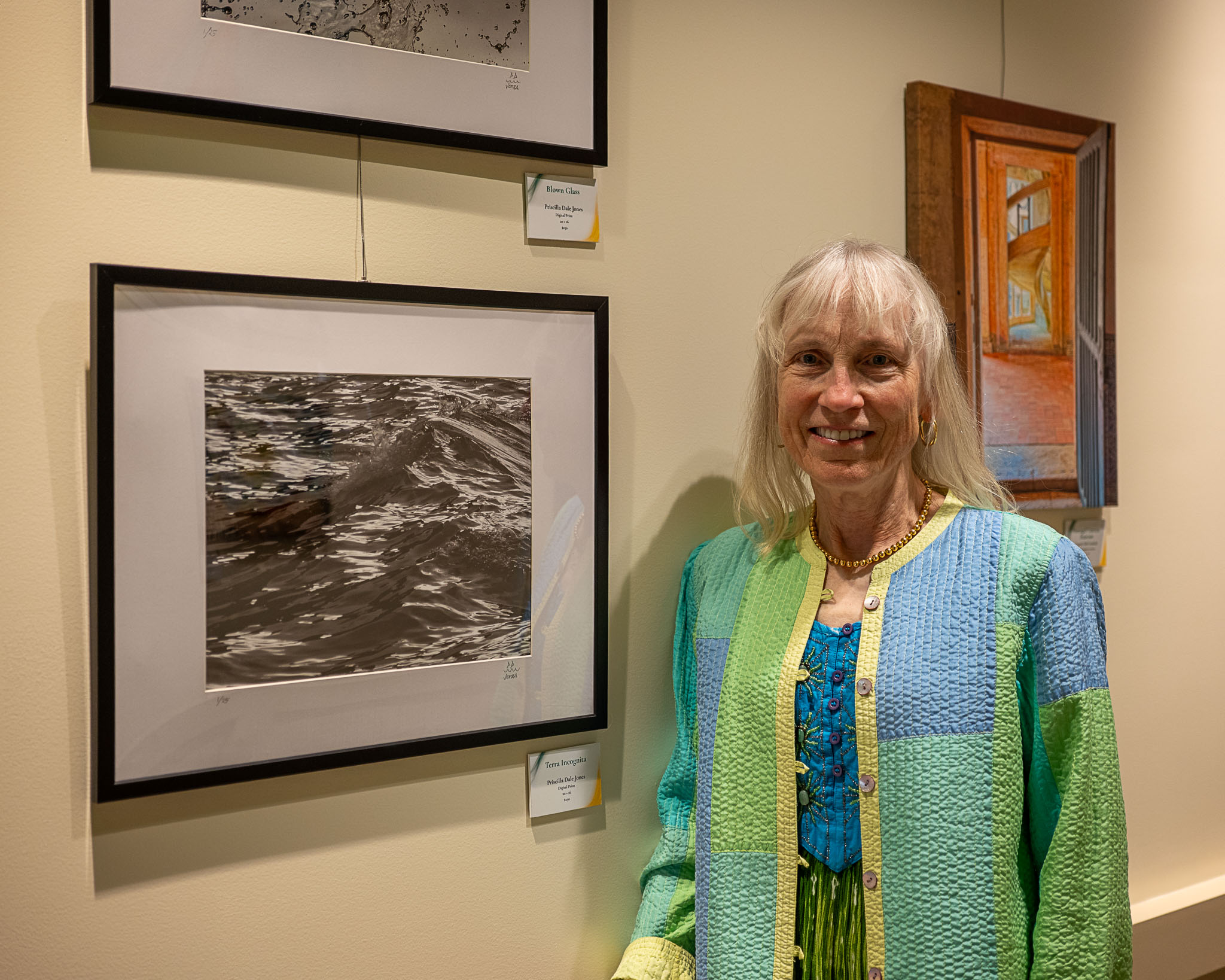
Centre sharpness at f/2.5 is excellent. The beard of a laughing guitarist on a bar patio and the eyes of an artist behind her cat-eye glasses are both critically sharp, wide open (see below).
More telling is how evenly that sharpness holds across the frame. In the image of the pasta-sauce jars above at f/2.5, every label is readable from the left edge to the right. Stopped down to f/10, a pile of pumpkins is crisp corner to corner. On the 47MP SL2 — a demanding test for a $168 lens — a harbour ferry shot at f/6.3 holds detail from the dock cleats to the distant bridge.

Cropping
I cropped a portrait of a bass player from a full-length shot. My Effective Focal Length Calculator app put the crop at 77mm effective focal length, a linear enlargement of 1.93x, producing a roughly 6.5MP image. That’s ample for my 2,048-pixel web images. The same crop from the SL2 would leave around 12.8MP.


So the S5 gives you a comfortable crop out to around 80mm.
Chromatic aberration
I looked hard at the high-contrast edges in the Viltrox files: white ferry funnels against a blue sky, a guitarist’s hair and glasses against a bright window, a harp silhouetted against daylight.
I couldn’t find purple or green fringing in any of them, even zoomed in on my exports. Online reviewers did find some lateral chromatic aberration towards the edges of the frame, so it is not entirely absent.

Bokeh and flare
Here the physics of a 40mm f/2.5 catch up with it. At head-and-shoulders distances the background softens but doesn’t melt away. Behind the smiling guitarist below, the drinkers on the patio remain recognisable. Background control comes down to where you stand rather than the aperture setting.

Where the background is further away, the rendering is smooth and neutral. The bottles on the back shelves behind those pasta sauces dissolve into an even wash with no hard outlines, and the fall-off in front of and behind the plane of focus in the gallery corridor is gentle. Backlit foliage at f/4 turned a little busy, and with seven aperture blades, out-of-focus highlights become polygonal as soon as you stop down.
As for flare, I didn’t point the lens into the sun. Against bright windows (the harpist, and a guitarist backlit by trees contrast held up well. Online reviewers report veiling flare in direct light, so the supplied hood earns its place in the bag.
Colour and texture
Colour rendering is neutral, and the lens adds no obvious cast of its own. The colour problems I found in my files were of my own making: warm white balance under gallery spotlights; and a pile of pumpkins, brightly lit by afternoon sun, so saturated that the red channel clipped.

Texture is where the lens punches above its price. The ribs and stalks of those pumpkins, the quilting on an artist’s jacket below, the strings and tuning pins of a harp all come through with real clarity. To my eye, the look is crisp and modern rather than soft and vintage.
It also converts well to monochrome. My black-and-white frame of the harpist holds a full tonal range, from the dark harp column to a bright window, without blocking up or blowing out.
Alternative options*
Several manufacturers offer alternatives to the Viltrox Air 40mm f/2.5. I have listed them below for comparison. Ed Lara has posted a review of the TTArtisan f/2 version, so you will be able to see how it performs against the Viltrox lens I tested.
| Lens | Fastest aperture | Diameter × length | Weight | Filter | US price | Status |
|---|---|---|---|---|---|---|
| Panasonic Lumix S 40mm f/2 (S-S40) | f/2 | 69.4 × 40.9mm | 144g | 62mm | $398 | Current (Launched April 2026) |
| TTArtisan AF 40mm f/2 L | f/2 | 61 × 44mm | 166–176g | 52mm | $168 | Current (L-mount since September 2025) |
| Viltrox AF 40mm f/2.5 Air (L) | f/2.5 | 64 × 52.5mm | 169g | 52mm | $168 | Current (L-mount since 22 September 2026) |
| 7Artisans AF 40mm f/2.5 LITE (L) | f/2.5 | 63 × 40mm | 90g | 46mm | $159 | Current (L-mount since August 2026) |
*Prices are manufacturers’ US list prices as of late September 2026; street prices vary.
Final thoughts
Shooting with a 40mm full-frame lens was more enjoyable than I expected. For everyday shooting, I found the wider field of view preferable to a 50mm lens, since I could include more context in the scene, and did not have to back up so often to frame the shot. On the other hand, I could frame subjects more tightly than with my collection of 28mm lenses.


The difference in field of view between a 40mm and a more conventional 35mm lens is fairly marginal, though: 58 degrees versus 63 degrees. And it doesn’t take much cropping to tighten a 35mm shot into a 40mm one.
Perhaps the 43mm focal length of the Q3 43, with its 53-degree angle of view, is more clearly differentiated from 35mm, and that may be part of the reason Leica chose it over 40mm.
Having spent a few weeks with it, I think the Viltrox Air 40mm f/2.5 is a versatile option, offering a distinctive perspective from both 50mm and 28mm lenses. If you already own a 35mm L-Mount lens (which I do not), it is harder to argue that you also need this one. But if you are in the market for a budget 40mm L-Mount prime, I can heartily recommend this sharp, lightweight, compact performer.
Further reading
Make a donation to help with our running costs
Did you know that Macfilos is run by six photography enthusiasts based in the UK, USA and Europe? We cover all the substantial costs of running the site, and we do not carry advertising because it spoils readers’ enjoyment. Any amount, however small, will be appreciated, and we will write to acknowledge your generosity.