
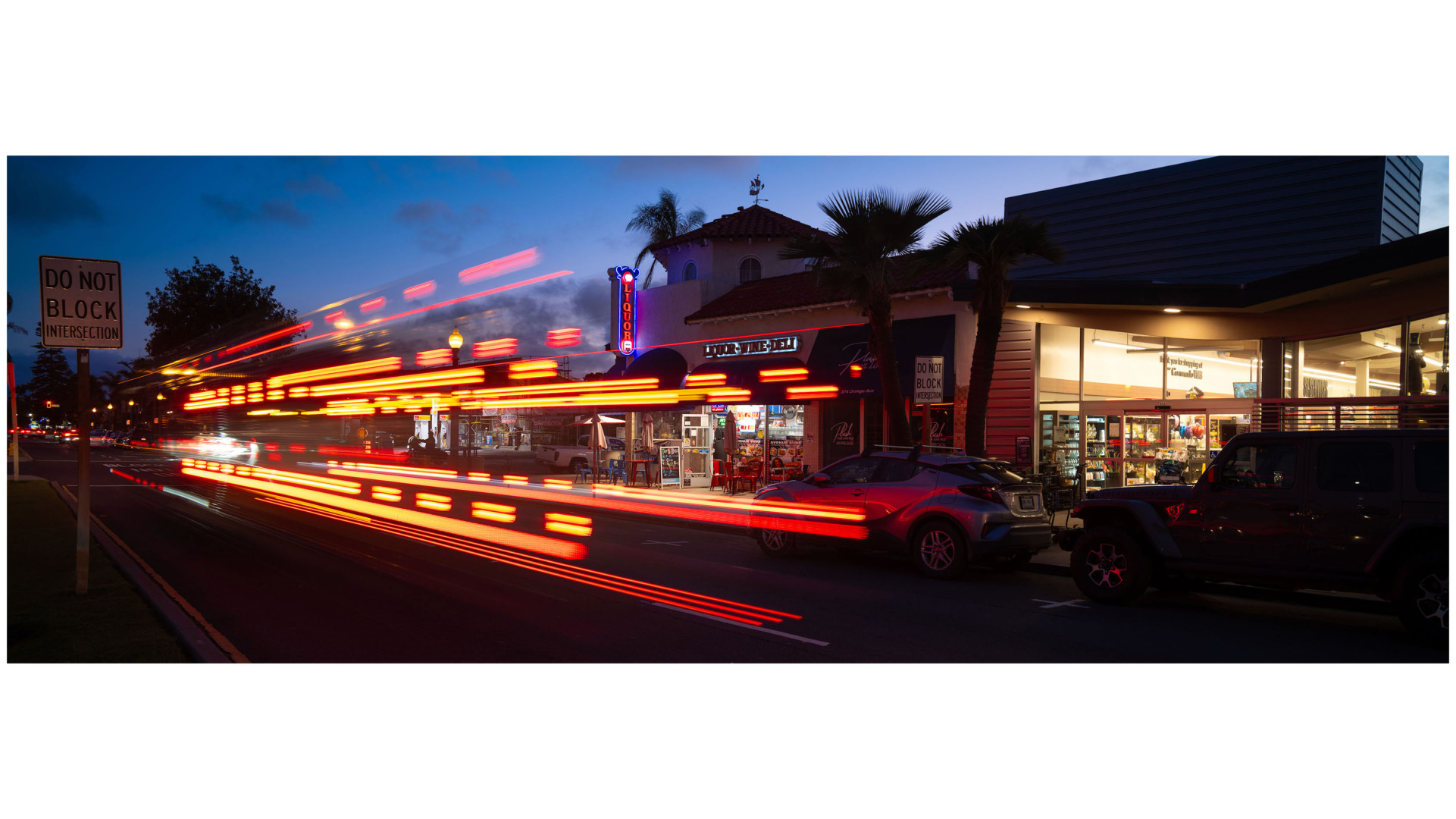
The sun has just set in Coronado, California. Ambient light is fading, artificial lights are glowing, and car headlights are blazing. It’s time to reach for my Sirui Saturn anamorphic lens, grab my tripod, and start shooting dusk panoramas.
I have thoroughly enjoyed shooting with a used Sirui 1.33-squeeze Super-35 anamorphic lens I bought last year. Mounted on my Leica TL2, it has opened up a new world of ultra-wide-angle picture-taking.
If you are not familiar with the concept of anamorphic lenses and squeeze-factors, you can find more information about these in recent articles. I have included a full set of links in the table at the end of this article.
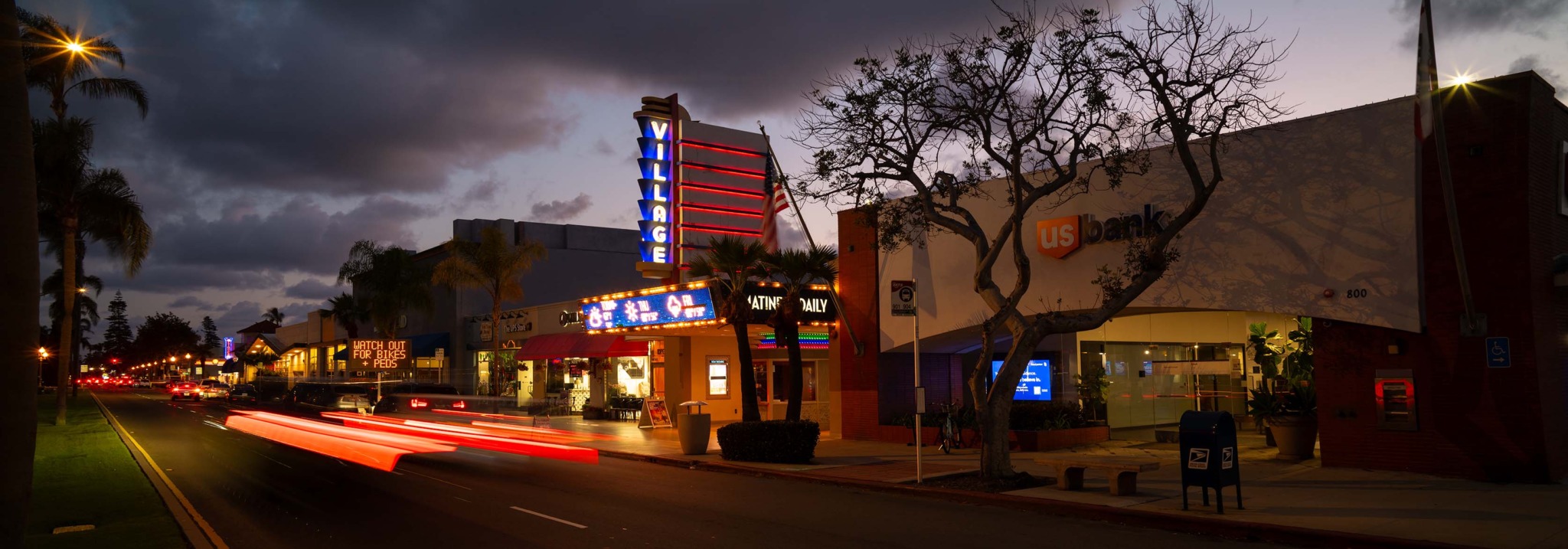
It seemed a natural next step to buy a full-frame 35mm anamorphic lens I could use with my Leica SL2. I therefore began hunting used versions of Sirui’s Saturn series of anamorphic lenses. As well as being full-frame, these are relatively small, lightweight lenses featuring a fibreglass barrel. They also offer an even more dramatic, 1.6-squeeze.
Sirui Saturn anamorphic lens
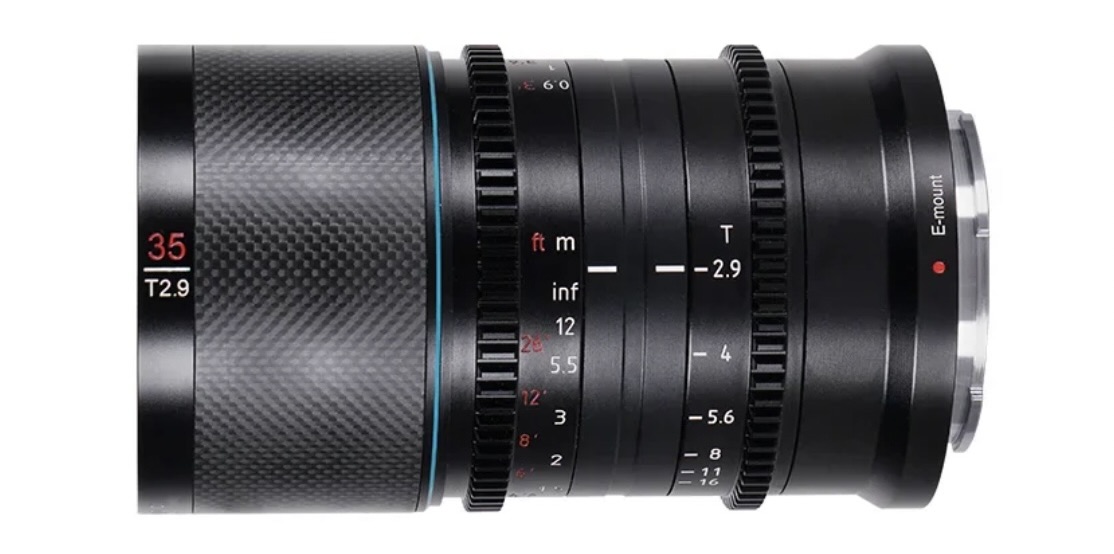
Because Sirui’s Saturn series is a relatively recent introduction, used versions are difficult to find. They are also not that heavily discounted. However, I spotted a 35mm T2.9 Saturn on the MPB site. It had been mislabelled as an older, larger model, and therefore priced very well. So, I jumped on it.
It is in perfect condition, very well-built, and weighs 408g. That’s much less than my Sirui 35mm Super-35, which comes in at 728g. The Saturn is primarily geared to videographers. It is manual focus and has prominent teeth on both focus and aperture rings, the latter being non-clicked. However, once you are alert to the risk of inadvertently nudging the aperture ring, which covers T/2.9-T/16, it is straightforward to use for stills photography.
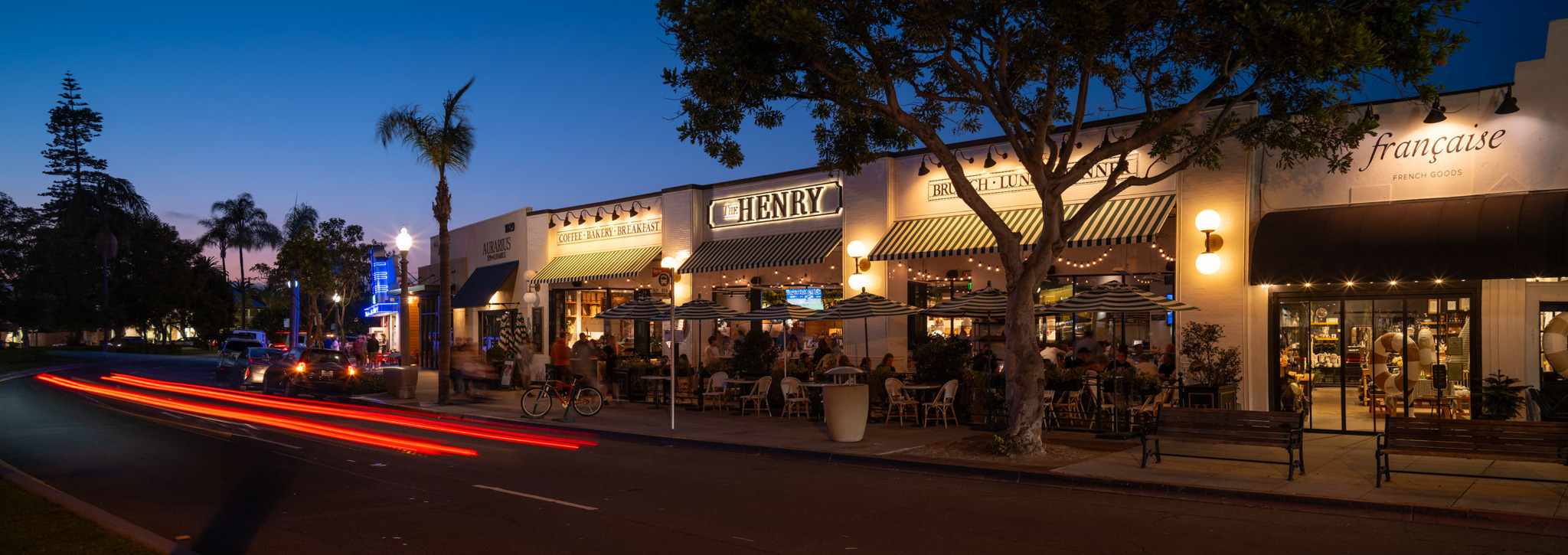
The focus ring is smooth, with just the right amount of dampening. Although the lens is manual, the intrinsically larger depth of field of a 35mm lens, together with the focus aids on my SL2, make focusing easy.
As I discussed in this article, anamorphic lenses represent a compelling way to take panoramic shots. Its 1.6x squeeze factor means my Sirui Saturn anamorphic lens has a 35mm vertical field of view, but an approximately 22mm horizontal field of view. When I shoot with the sensor set to a 16×9 aspect ratio, the de-squeezed image has an aspect ratio of almost 1:3 — truly panoramic.
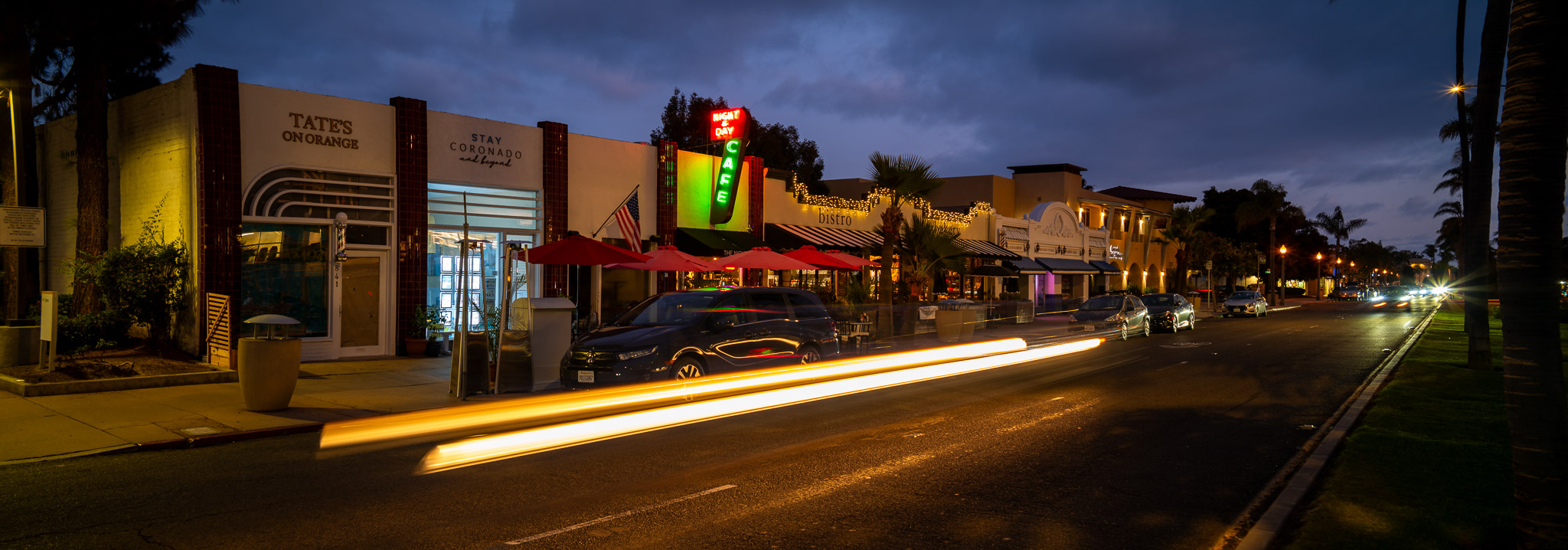
Anamorphic advantages
Shooting panoramic with an anamorphic lens has several advantages over other methods.
You do not need a dedicated panoramic camera; you just fit a different lens on your existing camera. Furthermore, because the image is captured in a single exposure, as opposed to stitching together multiple images in post, you can incorporate moving subjects. And, although the lens exhibits some distortion, scenes look normal, unlike the output of a swing-lens camera.
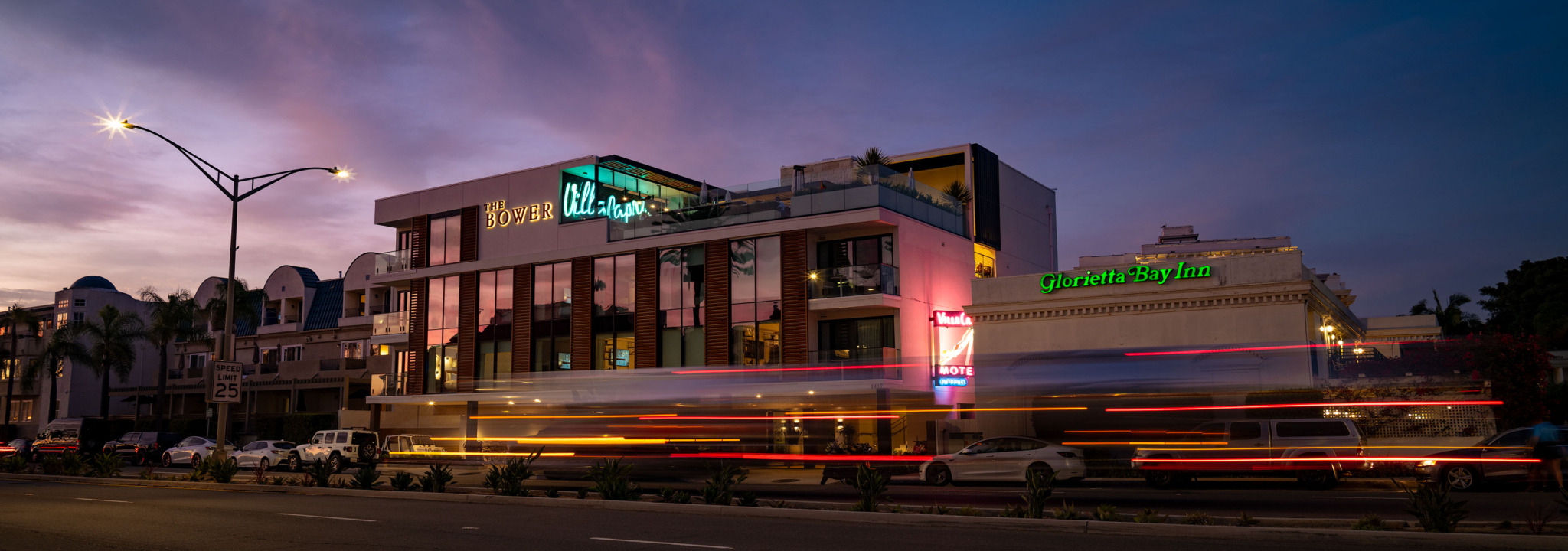
I have recently taken on a panoramic photography project in the small city in which I live — Coronado, California. I was inspired by the work of Nick Carver, a large format film photographer I wrote about here, who also lives in California.
Nick has been documenting many of the vintage buildings and storefronts in his local neighbourhood. He also exploits a balance of ambient versus artificial illumination in his images to impressive effect.
I therefore began to photograph a series of our local landmarks at dusk, also trying to balance the fading ambient light with colourful splashes of artificial light. To keep the scope of the project within bounds, I limited myself to views along a single street — Coronado’s main drag, Orange Avenue.
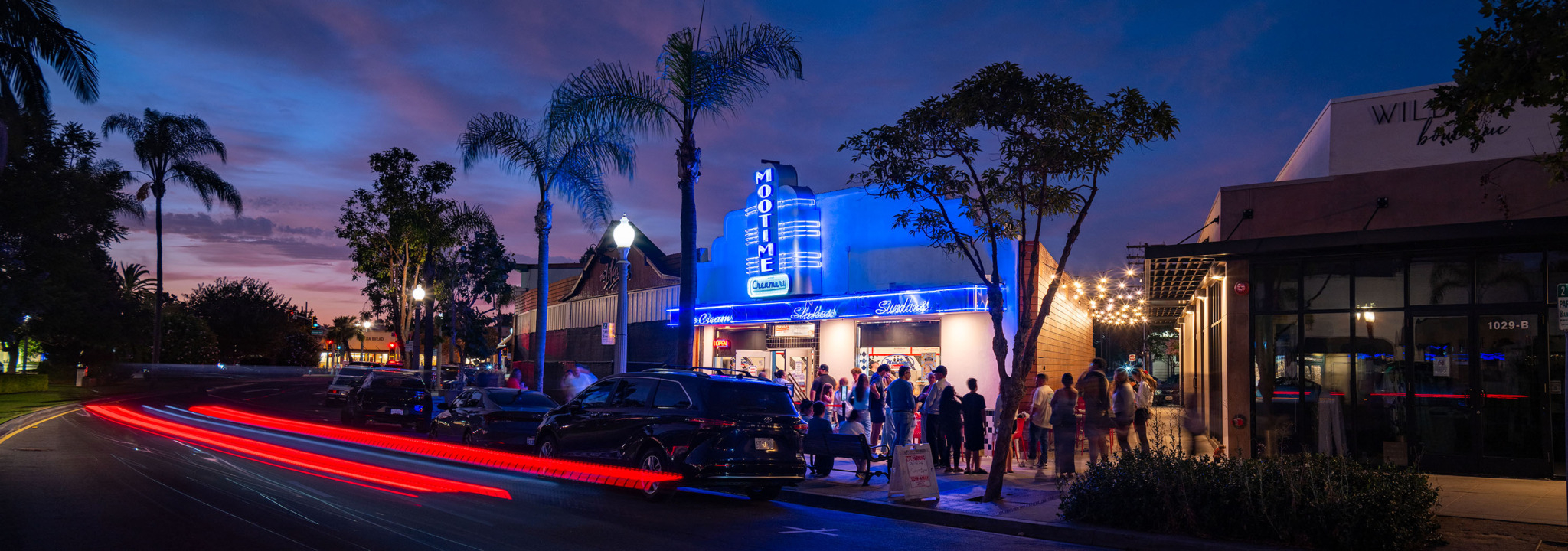
More context
Thanks to that wider horizontal field-of-view, one of the major benefits of taking panoramic photographs is the ability to capture more context than with a spherical lens. I have therefore embraced the inclusion of adjacent buildings and light trails from passing vehicles as both contextual and colourful elements in my compositions.
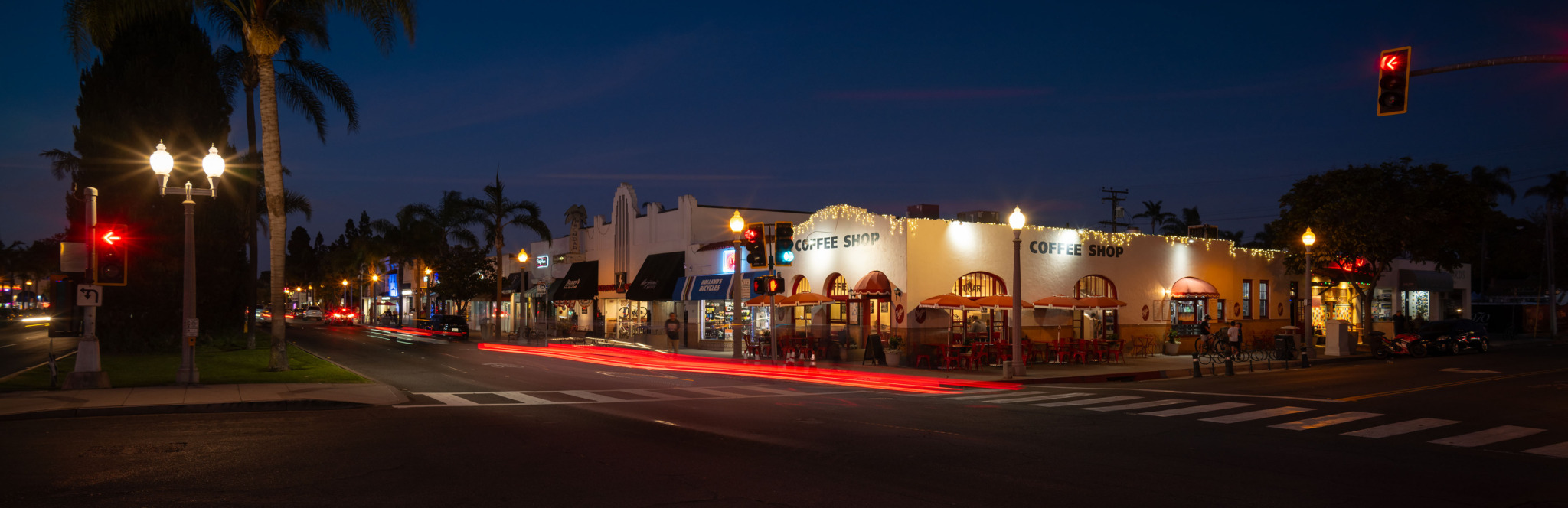
Since I was shooting at dusk, with an aperture of f/8, shutter speeds were slow. So, I mounted the SL2 on a tripod, also made by Sirui. It has telescopic carbon-fibre legs, screw tighteners, a ball head, and an Arca-Swiss mount. It was very reasonably priced, and I can recommend it.
Judging when to press the shutter release, as ambient light faded and cars flew by, took some practice. Since my eyes were adjusting to the dimming light, I relied more on the scene visible through the camera’s viewfinder.
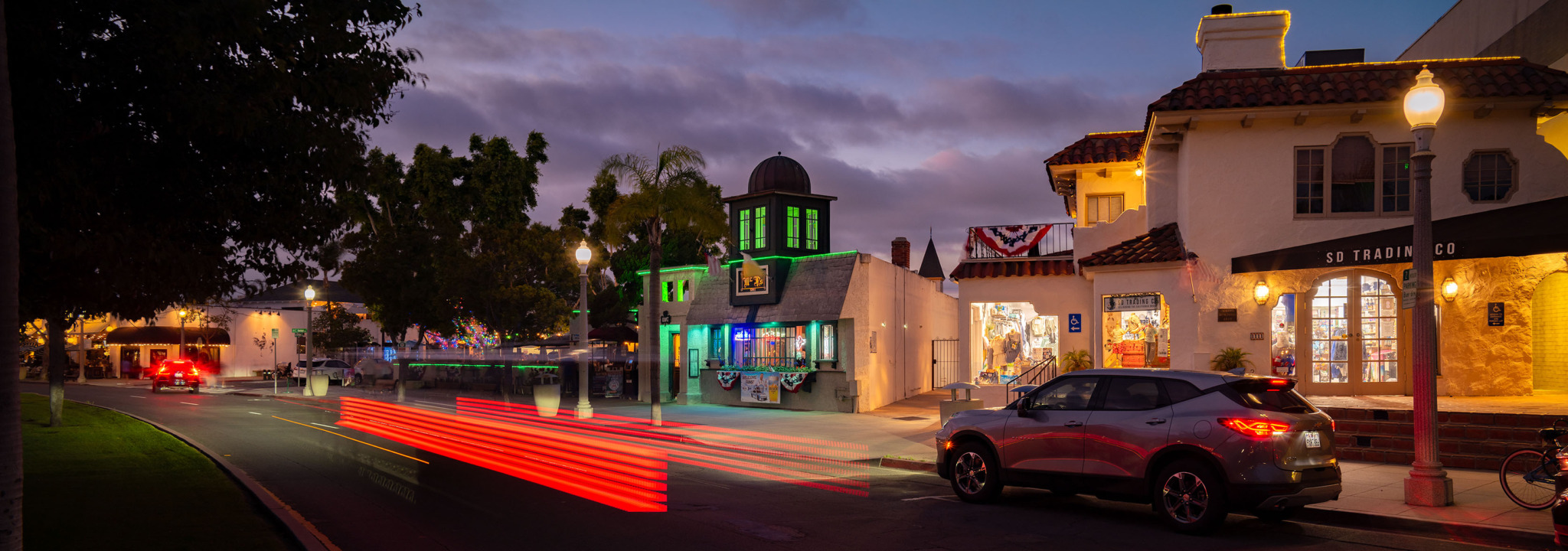
With ISO set to AUTO, shutter speed to 0.6s, and exposure compensation to -2eV, I waited for ISO to begin creeping upwards. Keeping ISO close to 100, I found there was a window with shutter speed ~1s, where the balance of light sources was just right.
Light trails
This slow shutter speed and low ambient light meant that passing cars left beautiful light trails, even though the vehicles themselves were practically invisible. For most shots, I positioned myself so vehicles were heading away from me, leaving bright red light trails. I tried to time the shutter release so that the entire trail, from start to finish, was in frame.
Some of the buildings I photographed were themselves colourfully illuminated, so the red tail lights contrasted particularly well with splashes of blue or green. The Sirui Saturn anamorphic lens is less prone to flaring than my Super-35 anamorphic lens, which throws off classic anamorphic blue, horizontal flares when shooting directly at a light source. This particular Saturn model exhibits neutral flares, reflecting the color of the originating light source
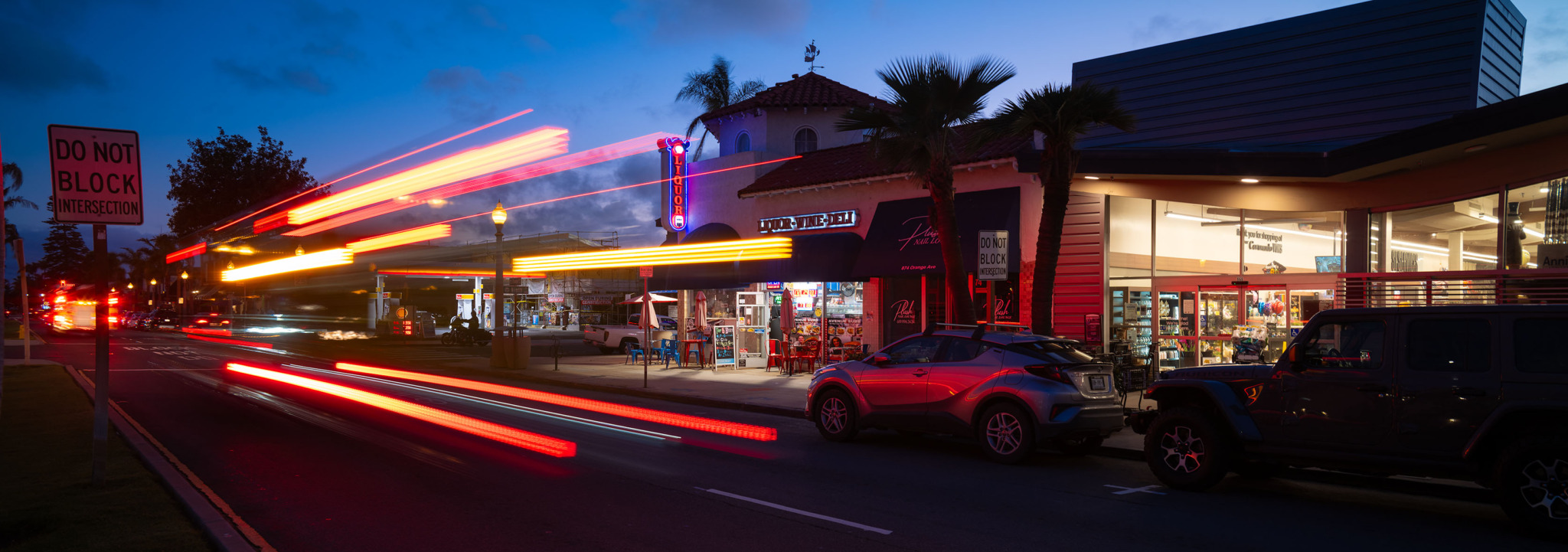
The Sirui Saturn turned out to be quite sharp at f/8; I can pick out a lot of detail in the resultant images. It does, however, exhibit obvious pincushion distortion at the edges of the frame. These can be corrected to some extent using Lightroom’s perspective controls. However, I embraced it as part of the charm of this lens type.
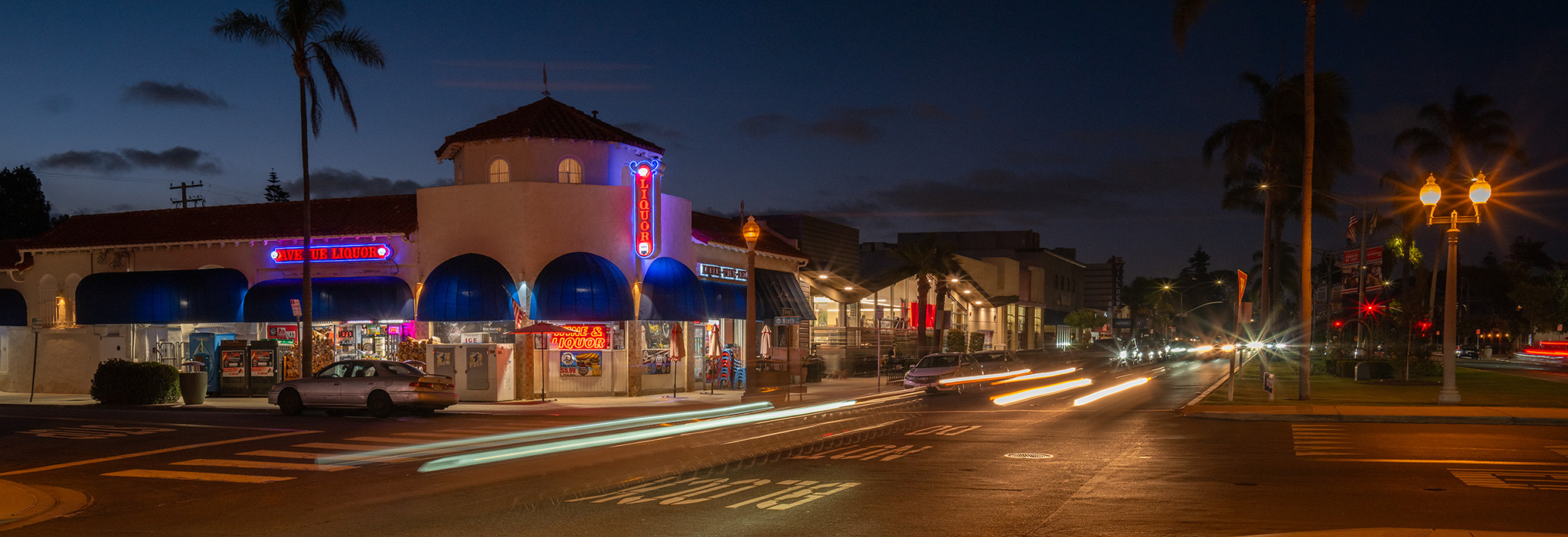
Sirui Saturn – fun but not for professionals
I doubt that commercial landscape photographers would employ a Sirui Saturn for their panoramic shots. I can handle that pincushion distortion, but I do not believe it would be acceptable in a commercial print. They are much more likely to turn to Hasselblad or Fujifilm medium-format cameras, with optically perfect lenses, and use an XPan crop.
However, their kit might well cost forty times more than the $300 I paid for my used lens! And, I did not have to migrate from my Leica camera system to take these pictures.
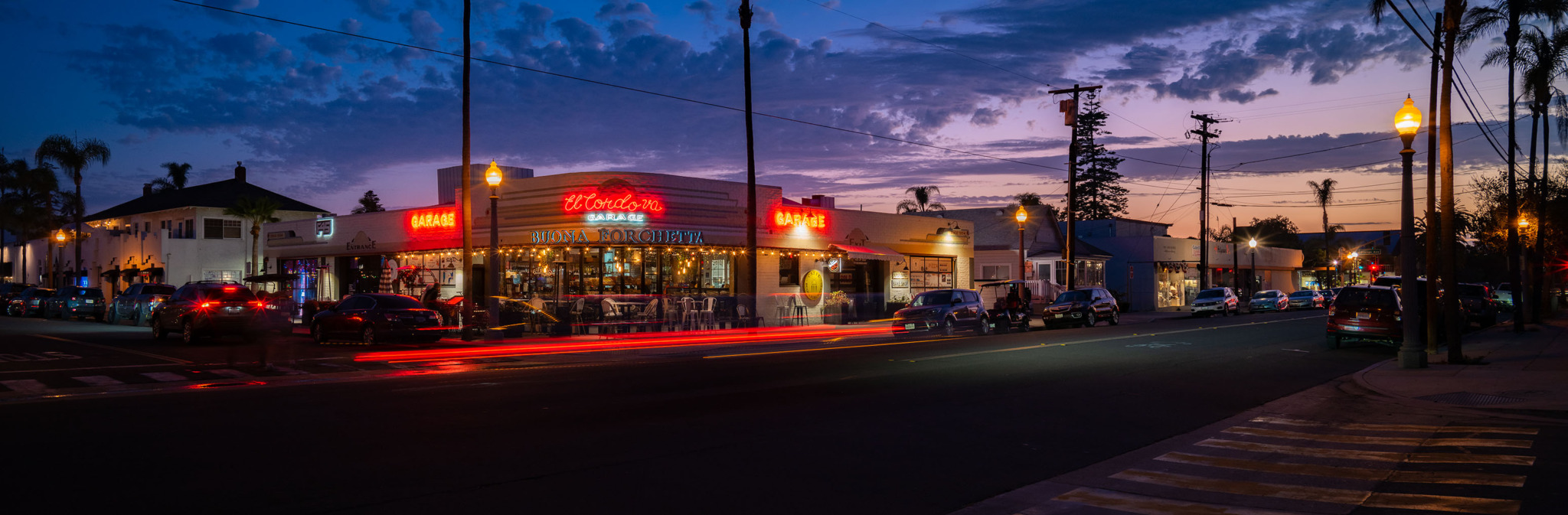
I view this small collection of photos as a visual documentation of the place where I live. It might also eventually be the basis of a zine I can give to friends and neighbours. I had previously viewed the 1.33-squeeze as about right for stills photography. But, I have grown to enjoy the sweeping panoramic scenes you can capture with a 1.6-squeeze lens.
De-squeezing
As documented previously, the workflow associated with RAW files generated using an anamorphic lens is a bit more involved. Having made my preliminary edits in Lightroom, I export the file to Photoshop, where I de-squeeze it. This is very straightforward. I can then save and export the final image.
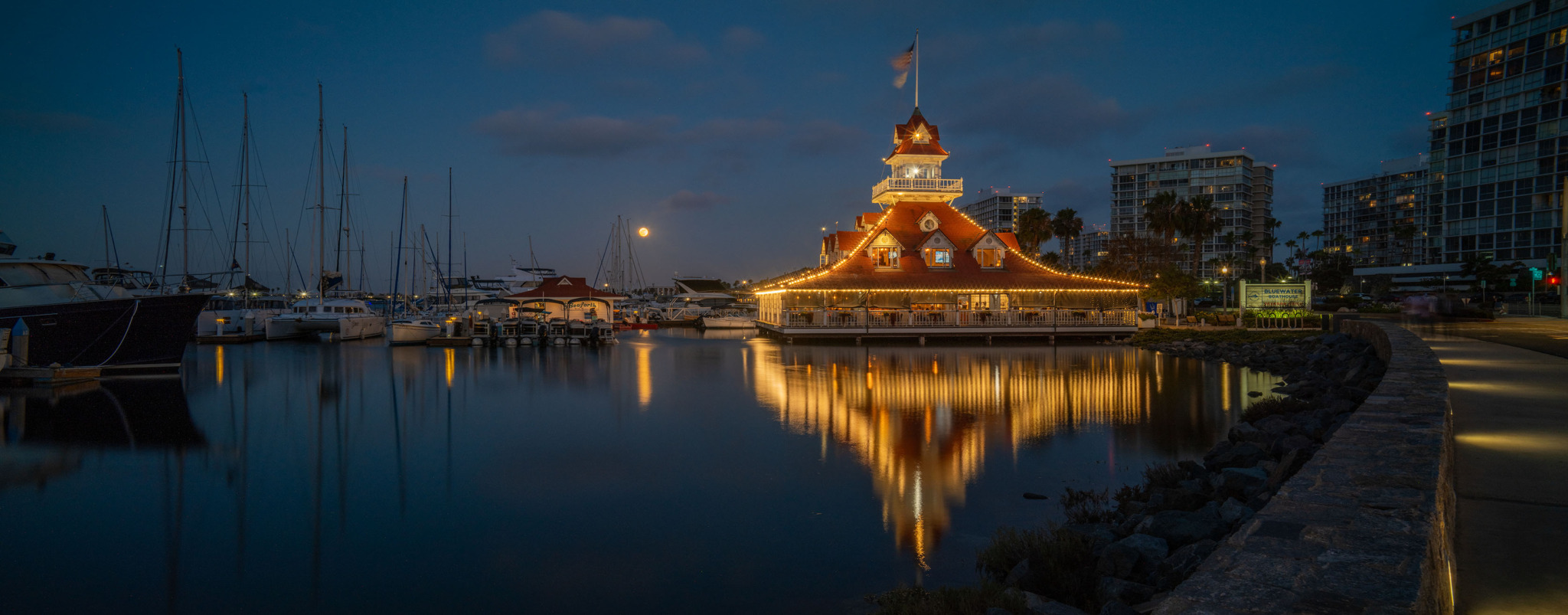

If you have not tried anamorphic photography, but are tempted to give it a whirl, I can highly recommend a Sirui Saturn anamorphic lens. You might even be able to find a used one in good nick. They are a lot of fun, and are capable of producing intriguing, dare I say, “cinematic” pictures.
| Sirui, an innovator in anamorphic lenses | Shooting anamorphic on the Leica TL2 |
| Comparing anamorphic and spherical lenses | Panoramic photography with anamorphic lenses |
Make a donation to help with our running costs
Did you know that Macfilos is run by six photography enthusiasts based in the UK, USA and Europe? We cover all the substantial costs of running the site, and we do not carry advertising because it spoils readers’ enjoyment. Any amount, however small, will be appreciated, and we will write to acknowledge your generosity.
Keith – thanks for another great article on anamorphic lenses. As I mentioned to you, I ended up buying a Sirui 35mm T1.8 for my Leica CL after reading your articles on the lens and using it on your TL. I have since sold the CL, but still have the Sirui, so I will give it a try on my SL3-S on APS-C mode. Not sure I will be using it enough to justify buying a full-frame version of the lens, but that may change if I use the APS-C lens more and more on the SL3-S. Thanks again!
Ed
Hi Ed, many thanks! I have taken some photographs with my 35mm Super-35mm anamorphic lens on my SL2. As you’d expect, the smaller image circle projected onto the full-frame sensor mean heavy vignetting. However, cropping, especially to a 16:9 squeezed aspect ratio results in a de-squeezed image free of this problem. I would be very interested to hear how you get on with the SL3. In my experience, the lens is sharp and de-squeezed image quality is good. All the best, Keith
I will try again. since we are discussing panoramic photography.
Great article Keith, many thanks.
I was recently on the mailing list created by Jeff Bridges along with his wife and a couple of investor friends as they spent a fortune remaking the Widelux camera, their version is called “Wideluxx”. It does some impressive tricks, and for a while I was tempted.
Bridges, in what is an impressive feat, successfully brought the camera to the market place where so many such ventures fail. Here I am thinking of Neil Young and his ‘Pono Player’.
As an actor, one of the little tricks that inspired him was to ask his subject to adopt two different expressions, for example a smile and a grimace, then move the camera as the exposure is being made to produce a single image with both expressions in a single image… demonstrated here: https://wideluxx.com/the-29th-annual-infinity-awards/
This is a bit like your aside about school photos, where an enterprising pupil runs along the back of the assembled pupils in order to appear twice in the resulting snap. For what is really a novelty, the $4.400 asking price, which will probably be the same, only with a pound sign in front of it, should it ever be available in the UK, will be a bit rich for my blood.
As a mildly brain damaged pensioner, I made a good decision not to proceed with a purchase, although I suspect that those who have will have made a sound investment.
Who said that the camera doesn’t lie?
Hi Stephen, thanks once again for sharing the link to the work of Jeff Bridges. It’s a very interesting short video. All the best, Keith
Keith, I am quite impressed by these photos. The panoramic nature is one thing, but the dynamic range for the time of day, lighting conditions, impressed me even more.
I recently stumbled onto another way of creating panoramas. For most of my photographic life (spans a lot of years!), I have had no interest in fisheye lenses. Yet for some unknown reason, I recently purchased a Fisheye-Nikkor 16mm f3.5 lens, a full-frame type of fisheye, to experiment. This lens dates from the mid-1970s, and is pre-AI, for those familiar with Nikkor lenses. Nikon made later f2.8 versions, AIS and AF, but the older f3.5 manual focus lens is anecdotally sharper. I use it on a Nikon Df camera, which accepts every F-mount lens ever made.
It creates a full-frame 24x36mm image that exhibits the usual extreme distortion of a fisheye lens. But loaded into a program called PTLens, the image can be de-fished. The de-fished image has an hour-glass shape; upon rectangular cropping one is left with a panorama with approximate 2.5:1 ratio. And I am quite impressed with how sharp the image is.
I suppose in a way, this process is similar to the one you are describing with anamorphic lenses.
Hi Martin. Fascinating! It’s remarkable how many strategies there are in fact for creating panoramic images. I had never come across the approach you describe. I recently tried some panoramic shots of the scenes included in this article, with a 16mm super-wide-angle lens – cropping them to approach a 1:3 aspect ratio. I preferred the versions taken with my 35mm 1.6-squeeze anamorphic, which has an effective 22mm horizontal field of view. The 35mm vertical field of view brings you closer to the subject, which, to me, results in a more pleasing image while still panoramic. All the best, Keith